Jev for Python engineers
Supporting native Rust in Workers with the new Emscripten target for wasm-bindgen
With the new experimental support for the Emscripten target in Rust Workers, many previously unsupported Rust libraries and applications can now be built and deployed directly to Cloudflare’s global Workers platform, including upcoming support for Tokio async.
How Delphi ships 100 times a day with its Python backend on Vercel

Investing in the Python ecosystem
Vercel welcomes the Gel Data team and deepens support for the Python ecosystem through PSF sponsorships, community funding, and improved Python developer tools.

Start Anywhere, a magazine by Figma
New tools and materials make it easier to build anything and start anywhere. The question now is, where do you want to go?

Making Rust Workers reliable: panic and abort recovery in wasm‑bindgen
Panics in Rust Workers were historically fatal, poisoning the entire instance. By collaborating upstream on the wasm‑bindgen project, Rust Workers now support resilient critical error recovery, including panic unwinding using WebAssembly Exception Handling.

watgo - a WebAssembly Toolkit for Go
Concurrent Servers: Part 7 - Rust - Eli Bendersky's website
Concurrent Servers: Part 8 - Go - Eli Bendersky's website
2025 Recap: so many projects
I’ve been working on so many projects in 2025, I thought it was important for me to make a recap, if only just to clear my head. There are many, many, many things to go through and we don’t have a sponsor today, so I’m gonna start right away with facet! facet facet is a project that I started working on in March of this year — that’s right, it’s only been ten months, yet it feels like an eternity.


Introducing arborium, a tree-sitter distribution
About two weeks ago I entered a discussion with the docs.rs team about, basically, why we have to look at this: When we could be looking at this: And of course, as always, there are reasons why things are the way they are. In an effort to understand those reasons, I opened a GitHub issue which resulted in a short but productive discussion. I walked away discouraged, and then decided to, reasons be
What Else Could Container Queries... Query?
How far can we really go with container queries? There are dozens of media queries now, so what if there were dozens of container queries as well? What could we use them for?

Accessible UX Research, eBook Now Available For Download — Smashing Magazine
We’ve got exciting news! eBook versions of “Accessible UX Research,” a new Smashing Book by Michele A. Williams, are now available for download! Which means soon the book will go to the printer. (Update March 2026: Printed copies are shipping now!)


Does Dioxus spark joy?
Note: this article is adapted from a presentation I gave at a Rust Paris Meetup — that’s why it sounds a little different than usual. Enjoy! Good evening! Tonight, I will attempt to answer the question: Does Dioxus spark joy? Or at the very least, whimsy. What’s Dioxus, you ask? It is first and foremost a name that is quote: “legally not inspired by any Pokémon”. Even if the author concedes in a H

Issue no.13: All systems go
Figma’s editorial newsletter about how products take shape—and shape our world.

Engineering a Rust optimization quiz
There are several Rust quizzes online, including one that’s literally called the “Unfair Rust Quiz” at https://this.quiz.is.fckn.gay/ , but when I was given the opportunity to record an episode of the Self-Directed Research podcast live on the main stage of EuroRust 2025 , I thought I’d come up with something special. The unfair rust quiz really deserves its name. It is best passed with a knowledg

How we found a bug in Go's arm64 compiler
84 million requests a second means even rare bugs appear often. We'll reveal how we discovered a race condition in the Go arm64 compiler and got it fixed.


Making our own spectrogram
A couple months ago I made a loudness meter and went way too in-depth into how humans have measured loudness over time. Today we’re looking at a spectrogram visualization I made, which is a lot more entertaining! We’re going to talk about how to extract frequencies from sound waves, but also how my spectrogram app is assembled from different Rust crates, how it handles audio and graphics threads,

Explore your Cloudflare data with Python notebooks, powered by marimo
We’ve partnered with marimo to bring their best-in-class Python notebook experience to your Cloudflare data.

What they’re not teaching in design class—and what you can do about it
With so many design programs lacking in business fundamentals, these Figma Campus Leaders argue that students should go extracurricular.

Suppressions of Suppressions
I heard you like linting.


The virtue of unsynn
Addressing the rumors There have been rumors going around, in the Reddit thread for facet , my take on reflection in Rust, which happened a bit too early, but here we are, cat’s out of the bag, let’s talk about it! Rumors that I, podcaster/youtuber fasterthanlime, want to kill serde , serialization / deserialization framework loved by many and which contributed greatly to Rust’s success, and I jus

Our journey to type checking 4 million lines of Python

Why we built a custom Rust library for Capture

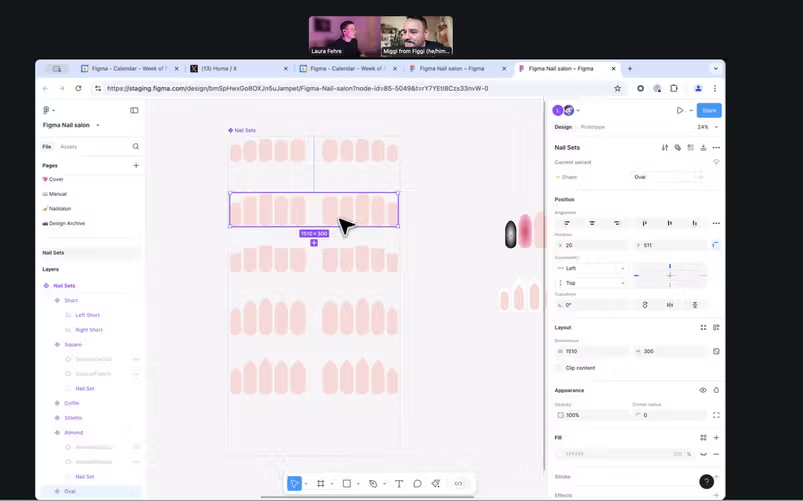
The power of play
When Designer Advocate Laura Fehre set out to design a digital nail salon, she had a vision in mind. Nailing it, however, meant letting go of perfection and letting herself play.

The promise of Rust
The part that makes Rust scary is the part that makes it unique. And it’s also what I miss in other programming languages — let me explain! Rust syntax starts simple. This function prints a number: fn show ( n : i64 ) { println! ( "n = {n}" ); } And this program calls that function — it looks like any C-family language so far, we got parentheses, we got curly brackets, we got, uhh…

Jeanne DeWitt Grosser joins Vercel as COO
Vercel welcomes Jeanne DeWitt Grosser as Chief Operating Officer. Jeanne helped take Stripe from $100M to billions, pioneered usage-based go-to-market strategies, and scaled influential developer platforms. Now, she brings that momentum to Vercel.

Solo Development: Learning To Let Go Of Perfection — Smashing Magazine
The best and worst thing about solo development is the “solo” part. There’s a lot of freedom in working alone, and that freedom can be inspiring, but it can also become a debilitating hindrance to productivity and progress. Victor Ayomipo shares his personal lessons on what it takes to navigate solo development and build the “right” app.


Revisiting "Let's Build a Compiler"

Implementing Forth in Go and C

Benchmarking utility for Python - Eli Bendersky's website

Decorator JITs - Python as a DSL - Eli Bendersky's website

Catching up with async Rust
In December 2023, a minor miracle happened: async fn in traits shipped. As of Rust 1.39, we already had free-standing async functions: pub async fn read_hosts () -> eyre :: Result < Vec < u8 >> { // etc. } …and async functions in impl blocks: impl HostReader { pub async fn read_hosts ( & self ) -> eyre :: Result < Vec < u8 >> { // etc. } } But we did not have async functions in traits:

Introducing Annotated Logger: A Python package to aid in adding metadata to logs
We’re open sourcing Annotated Logger, a Python package that helps make logs searchable with consistent metadata.


Break Stuff on Purpose
“A complex system can fail in an infinite number of ways.” -“Systemantics” by John Gall Incidents are stressful but inevitable. Even services designed for availability will eventually encounter a failure. Engineers naturally find it daunting to defend their systems against the “infinite number of ways” things can go wrong. Our team found ourselves in…

Designing For Gen Z: Expectations And UX Guidelines — Smashing Magazine
There are many myths revolving around Gen Z and how they use tech. Time to take a look at actual behavior patterns that go beyond heavy use of social media. Part of [Smart Interface Design Patterns](https://smart-interface-design-patterns.com) by yours truly.


What's new in Svelte 5
Svelte 5 brings runes for universal reactivity, snippets for reusable markup, and compiler improvements. Get started with Svelte 5 on Vercel today.
We’re All Just Looking for Connection
We’ve been working to bring components of Quip’s technology into Slack with the canvas feature, while also maintaining the stand-alone Quip product. Quip’s backend, which powers both Quip and canvas, is written in Python. This is the story of a tricky bug we encountered last July and the lessons we learned along the way about…

Interview With Björn Ottosson, Creator Of The Oklab Color Space — Smashing Magazine
Go behind the scenes with Björn Ottosson, the Swedish engineer who created Oklab color space, and discover how he developed a simple yet effective model with good hue uniformity while also handling lightness and saturation well — and is “okay” to use.


Some Go web dev notes
Some Go web dev notes

How To Manage Dangerous Actions In User Interfaces — Smashing Magazine
One of the main laws that applies to almost everything in our lives, including building digital products, is Murphy’s Law: “Anything that can go wrong will go wrong.” Our goal is to prevent things from going wrong and, if they do, mitigate the consequences. In this article, Victor Ponamarev explores different strategies for preventing users from making mistakes.


Go wild: Wildcard support in Rules and a new open-source wildcard crate
We’re excited to announce wildcard support across our Ruleset Engine-based products and our open-source wildcard crate in Rust. Configuring rules has never been easier, with powerful pattern matching enabling simple and flexible URL redirects and beyond for users on all plans.

Go structs are copied on assignment (and other things about Go I'd missed)
Go structs are copied on assignment (and other things about Go I'd missed)
Supercharged Developer Portals
Today, we announced Spotify’s latest products and services for companies adopting Backstage, the open source framework for building internal developer portals (IDPs). Whether your company needs a highly customized IDP built from scratch or an out-of-the-box solution that’s ready to go ASAP, we want to make it easy for anyone to maximize the value they get from their Backstage developer portal. You
The End Of My Gatsby Journey — Smashing Magazine
[“Gatsby headaches”](https://www.smashingmagazine.com/2023/06/gatsby-headaches-i18n-part-1/) are over. Juan Diego Rodríguez reflects on his decision to stop using Gatsby as his go-to framework. Through a detailed examination of its strengths and weaknesses, he provides valuable insights and alternative options for developers navigating their tooling choices.


Using Gemini models in Go with LangChainGo - Eli Bendersky's website

Reading Google Sheets from a Go program - Eli Bendersky's website

Tokens for LLMs: Byte Pair Encoding in Go - Eli Bendersky's website

Ranging over functions in Go 1.23 - Eli Bendersky's website

Locally patching dependencies in Go - Eli Bendersky's website

Sign in with Google in Go - Eli Bendersky's website
SentencePiece BPE Tokenizer in Go - Eli Bendersky's website

Building static binaries with Go on Linux - Eli Bendersky's website

git rebase: what can go wrong?
git rebase: what can go wrong?

Why Rust is the most admired language among developers
Rust continues to top the charts as the most admired and desired language by developers, and in this post, we dive a little deeper into how (and why) Rust is stealing the hearts of developers around the world.

Wasm core dumps and debugging Rust in Cloudflare Workers
Debugging Rust and Wasm with Cloudflare Workers involves a lot of the good old time-consuming and nerve-wracking printf'ing strategy. What if there’s a better way? This blog is about enabling and using Wasm core dumps and how you can easily debug Rust in Cloudflare Workers


The anatomy of launching a Figma open beta
A go-to-market strategy doesn’t just end on launch day. We’re putting our very own Dev Mode under the scalpel to dissect what’s at play in the critical two-week period after launch.

How Turborepo is porting from Go to Rust
Our strategy for making updates and maintaining stability while we migrate languages.