Zone setting changes used to rebuild entire DNS zones, even ones with tens of millions of records. Here is how we built a planner that picks the smallest safe build, cutting full builds by 40%, peak memory by 85%, and halving build delay.
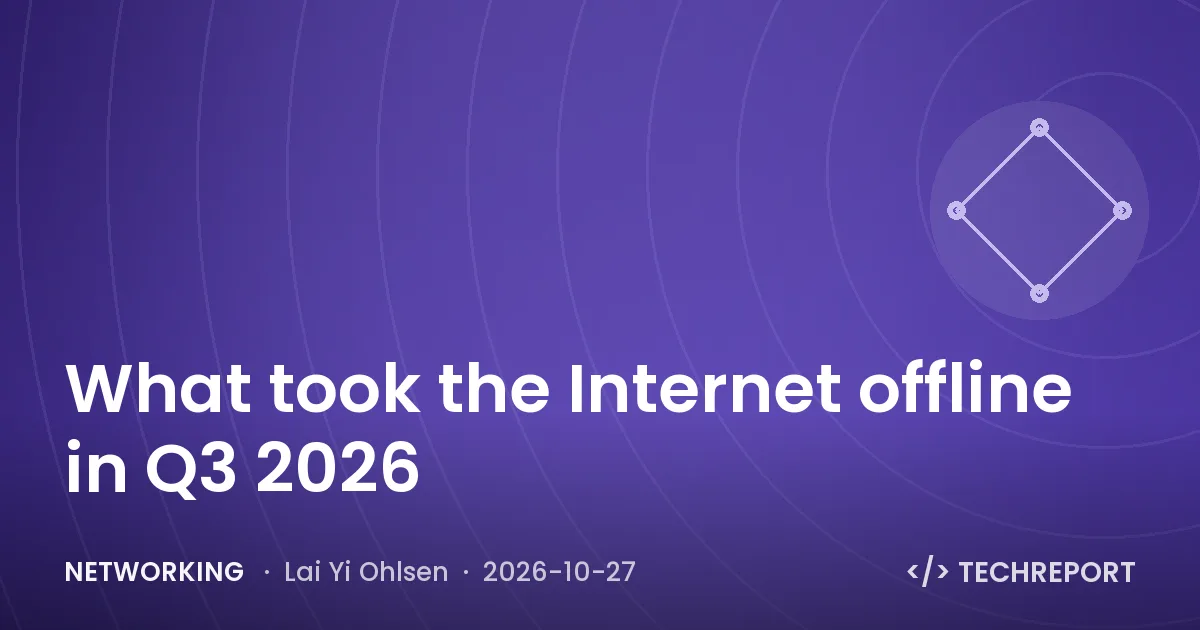
An examination of global Internet disruptions observed by Cloudflare Radar during the third quarter of 2026. This review analyzes how power failures, natural disasters, and government shutdowns impacted network connectivity and traffic.
Every four years, the World Cup becomes the largest planned stress test of our infrastructure. This year it also set an all-time record! There are a few moments throughout the year, like New Years Eve, that really let us see the collective impact of everything we’ve built — but none are bigger than the quadrennial [...] Read More... The post 2026 World Cup: Breaking Records, Spiky Charts and Relia
A deep dive into how D1 architected its control plane to scale and manage millions of databases, while keeping data plane query operations at the edge. We share guiding principles on how to build on the Developer Platform effectively.
On October 11, 2026, the DNS root switches to a new key-signing key (KSK-2024). Learn what this means for you, and how RFC 8509 trust anchor sentinels allow you to test whether your DNS resolver is ready for the rollover.
Meta’s public time service now speaks NTS (Network Time Security, RFC 8915) at nts.meta.com. Packets are authenticated, so a device can verify the time came from us and was not modified on the way. Our NTS servers hold no per-client state. Cookie keys are derived, not stored and not replicated. We’ve open sourced everything, including [...] Read More... The post NTS: Authenticated Time at Meta app
Cloudflare K2 is a serverless event streaming service built directly on top of R2 object storage for high-scale data movement and long-term retention. By decoupling producers and consumers at the edge, K2 enables durable, ordered log streams without the operational overhead of traditional broker clusters.
Vary support is now available in Cache Rules on every plan. You can normalize known negotiation headers, pass exact values through to the origin when those small differences matter, or bypass cache when the variation is too unpredictable.
Petal, the next step in Meta’s subsea innovation, will be the first subsea cable to deliver petabit capacity at transoceanic distances, connecting France and the United States over approximately 7,000 km (4,300 mi). Expected to enter service in 2029, it will be the first subsea cable system to deploy multi-core fiber technology at scale, doubling [...] Read More... The post Inside Petal: Building
Cloudflare's global network is immense but not limitless. As we look for small ways to trim our resource usage, we sometimes get lucky and we can cut significantly more. Here’s how we reduced one of our Pingora-based service's RAM usage with statistics.
This blog is a deep walkthrough about network policies in Kubernetes, read to know more.

Five Rust-level memory optimizations to the DNS cache layout of Big Pineapple cut per-entry memory by 56%, freeing approximately 100 TB of memory across Cloudflare's fleet.

Generated code in v0 sandboxes queries Snowflake, but the OAuth token never enters the sandbox. A protocol-aware proxy injects credentials at request time, and blind replacement was itself a leak.
RFC 9234 lets routers reject route leaks on their own, using BGP Roles and the Only to Customer attribute. We measured who has deployed it, and found two Tier 1 networks unexpectedly stripping OTC.

Running untrusted code safely requires more than separating it from the host. You also have to control what that code can reach.

Cloudflare Workers now support inbound TCP connections via Spectrum, allowing direct socket forwarding to Durable Objects and Containers. Developers can run full-duplex gRPC applications or leverage automatic gRPC-to-gRPC-web translation directly within Workers.
MW Mar Witek, Thomas Rubini·August 3, 2026Networking

Last year we made every Cloudflare server a Media over QUIC (MoQ) relay. Now the new provisioning API lets you create your own isolated relay and control who can publish and who can only watch.
JC Jacob Curtis, Manish Pandit·July 31, 2026Networking

pvcli is a curl-like tool designed to simplify the testing of complex privacy protocols like OHTTP.

By doing in-depth testing, we found nearly 70% of BGP paths experience ORIGIN attribute rewrites by transit providers seeking traffic advantages. We examine the global impact of this practice and argue for deprecating ORIGIN in route selection.

We analyzed global HTTP traffic to explore how kickoff times, streaming habits, and hydration breaks reshaped online activity worldwide. From late-night traffic surges to halftime browsing spikes, here is how the world connected during the global tournament.
SF Sabina, Francisco Content·July 21, 2026Networking

Cloudflare Internal DNS brings authoritative and recursive DNS for private networks to the same global network and control plane that runs Cloudflare's Zero Trust, networking, and public DNS.

When a failed DNSSEC key rollover took down the .AL TLD, we deployed a Negative Trust Anchor to restore resolution. This time, though, clients didn't have to take our word for it: 1.1.1.1 returned EDE 33, a new DNS error code that signals directly in the response that DNSSEC validation was bypassed.
Firefox 154 (Nightly) will ship text-box, text-box-trim, and text-box-edge, making them Baseline.

We are launching Workers Cache, a regionally tiered cache that sits directly in front of your Worker entrypoints. Infinitely composable, configured via standard HTTP headers
DL Dan Lapid, Connor Harwood·July 6, 2026Networking

Vercel Community uses Vercel as a CDN in front of monolithic servers like Discourse or Wordpress. Use microfrontends to incrementally migrate to a new app.

We partnered with Biome to push their noFloatingPromises lint rule to the limit, uncovering edge cases and showing how we solve hard problems together.

The Vercel CDN now supports request collapsing for ISR routes. For a given path, only one function invocation per region runs at once, no matter how many concurrent requests arrive.

By rearchitecting the Images binding, we accidentally uncovered a bug that existed in the open-source hyper library across multiple major versions.

About 3 weeks ago, Leo Laporte and I recorded the first episode of what will be a new monthly show on the TWiT network. Naming things is hard, and we almost voted on the name, like we did for Stack Overflow, but we quickly landed on Off By One with Jeff Atwood – which is funny for so many reasons, but mainly because of this programmer joke: No, I did not come up with this variation on the classic

BGP is vulnerable to routing hijacks and path leaks that negatively impact traffic on the Internet. RPKI helps solve some of these problems, but for some forged paths, we need to rely on a simpler mechanism: First AS enforcement in BGP.

Cloudflare Radar data confirms early indications of a partial Internet restoration in Iran, nearly three months after the shutdown began. Traffic spikes and DNS queries have risen, but network activity is currently just 40% of pre-shutdown levels.

We have completed a massive engineering effort to make our infrastructure more resilient. Through new tools like Snapstone and the Engineering Codex, we've implemented safer configuration changes and automated best practices to prevent future incidents.
We analyzed checkout activity across more than 20K businesses, surveyed shoppers and ecommerce leaders, and gathered insights from businesses on the Stripe network to understand what’s changing in online conversion.

The Problem: Legacy Tooling and Its Limitations Currently, Slack utilizes a hybrid approach to network measurement, incorporating both internal (such as traffic between AWS Availability Zones) and external (monitoring traffic from the public internet into Slack’s infrastructure) solutions. These tools comprise a combination of commercial SaaS offerings and custom-built network testing solutions de

Log Explorer customers can now identify and investigate multi-vector attacks. Log Explorer supports 14 additional Cloudflare datasets, enabling users to have a 360-degree view of their network.

Today we’re disclosing request smuggling vulnerabilities when our open source Pingora service is deployed as an ingress proxy and how we’ve fixed them in Pingora 0.8.0.

Stripe is now the first and only provider that supports both agentic network tokens and buy now, pay later tokens in agentic commerce through a single primitive.

ASPA is the cryptographic upgrade for BGP that helps prevent route leaks by verifying the path network traffic takes. New features in Cloudflare Radar make tracking its adoption easy.

Cloudflare suffered a service outage on February 20, 2026. A subset of customers who use Cloudflare’s Bring Your Own IP (BYOIP) service saw their routes to the Internet withdrawn via Border Gateway Protocol (BGP).
TD Tubes, Dzevad Trumic·February 21, 2026Networking
ecdysis is a Rust library enabling zero-downtime upgrades for network services. After five years protecting millions of connections at Cloudflare, it’s now open source.

As a proof of concept, we built a Matrix homeserver to Cloudflare Workers — delivering encrypted messaging at the edge with automatic post-quantum cryptography.
The last quarter of 2025 brought several notable disruptions to Internet connectivity. Cloudflare Radar data reveals the impact of cable cuts, power outages, extreme weather, technical problems, and more.

I love me some good web research reports. I'm a sucker for them. HTTP Archive's Web Almanac is one report I look forward to every year, and I know I'm not

A recent change to 1.1.1.1 accidentally altered the order of CNAME records in DNS responses, breaking resolution for some clients. This post explores the technical root cause, examines the source code of affected resolvers, and dives into the inherent ambiguities of the DNS RFCs.
There has been speculation about the cause of a BGP anomaly observed in Venezuela on January 2. We take a look at BGP route leaks, and dive into what the data suggests caused the anomaly in question.
Physical data center maintenance is risky on a global network. We built a maintenance scheduler on Workers to safely plan disruptive operations, while solving scaling challenges by viewing the state of our infrastructure through a graph interface on top of multiple data sources and metrics pipelines.
KD Kevin Deems, Michael Hoffmann·December 22, 2025Networking
Connecting Africa and the World We’re excited to share the completion of the core 2Africa infrastructure, the world’s longest open access subsea cable system. 2Africa is a landmark subsea cable system that sets a new standard for global connectivity. This project is the result of years of collaboration, innovation, and a shared vision to connect […]

We explore the fundamentals of Saltstack and how we use it at Cloudflare. We also explain how we built the infrastructure to reduce release delays due to Salt failures on the edge by over 5%.

Workers VPC Services enter open beta today. We look under the hood to see how Workers VPC connects your globally-deployed Workers to your regional private networks by using Cloudflare's global network, while abstracting cross-cloud networking complexity.

Cloudflare used historical data to investigate reports of potential new firewall tests in Turkmenistan. Shifts in TCP resets/timeouts across ASNs corroborate large-scale network control system changes.

A BGP “zombie” is essentially a route that has become stuck in the Default-Free Zone (DFZ) of the Internet, potentially due to a missed or lost prefix withdrawal. We’ll walk through some situations where BGP zombies are more likely to rise from the dead and wreak havoc.

HTTP/2 implementations often respond to suspected attacks by closing the connection with an ENHANCE_YOUR_CALM error code. Learn how a common pattern of using Go's HTTP/2 client can lead to unintended errors and the solution to avoiding them.

Researchers and practitioners have been studying connections almost as long as the Internet that supports them. Today, Cloudflare’s global network receives millions of connections per second. We explore various characteristics of TCP connections, including lifetimes, sizes, and more.

IPv4 scarcity drives widespread use of Carrier-Grade Network Address Translation, a practice in ISPs and mobile networks that places many users behind each IP address, along with their collected activity and volumes of traffic. We introduce the method we’ve developed to detect large-scale IP sharing globally and mitigate the issues that result.

While large cloud providers hold vast troves of passive network data, analyzing them is complicated. The scale, noise, and absence of definitive ground truth all create major hurdles. Yet by carefully quantifying these constraints and finding alternative forms of evidence, meaningful insights can still emerge.
We’re introducing Candle, a new submarine cable connecting countries across East Asia and Southeast Asia. We’re also announcing several updates to our subsea cables across the Asia-Pacific, including the completion of the Bifrost cable system. The Asia-Pacific (APAC) region is home to over 58% of the world’s internet users1 – many who rely on robust […]
AS-SETs, for better or worse, are critical data sources that help build BGP route filters across the Internet. Because these AS-SET objects are based solely on trust, they can be misused. We will cover some of the reasons why operators need to monitor the AS-SET memberships for their ASN, and now Cloudflare Radar can help.

Workers Launchpad program offers resources and mentorship for founders building on the Cloudflare network. Learn more about prior cohorts, where Launchpad alumni are today, and the participants of Workers Launchpad Cohort #6.
CR Christopher Rotas, Valentina Tejera Hernandez·September 22, 2025Networking