The Core 2Africa System Is Complete
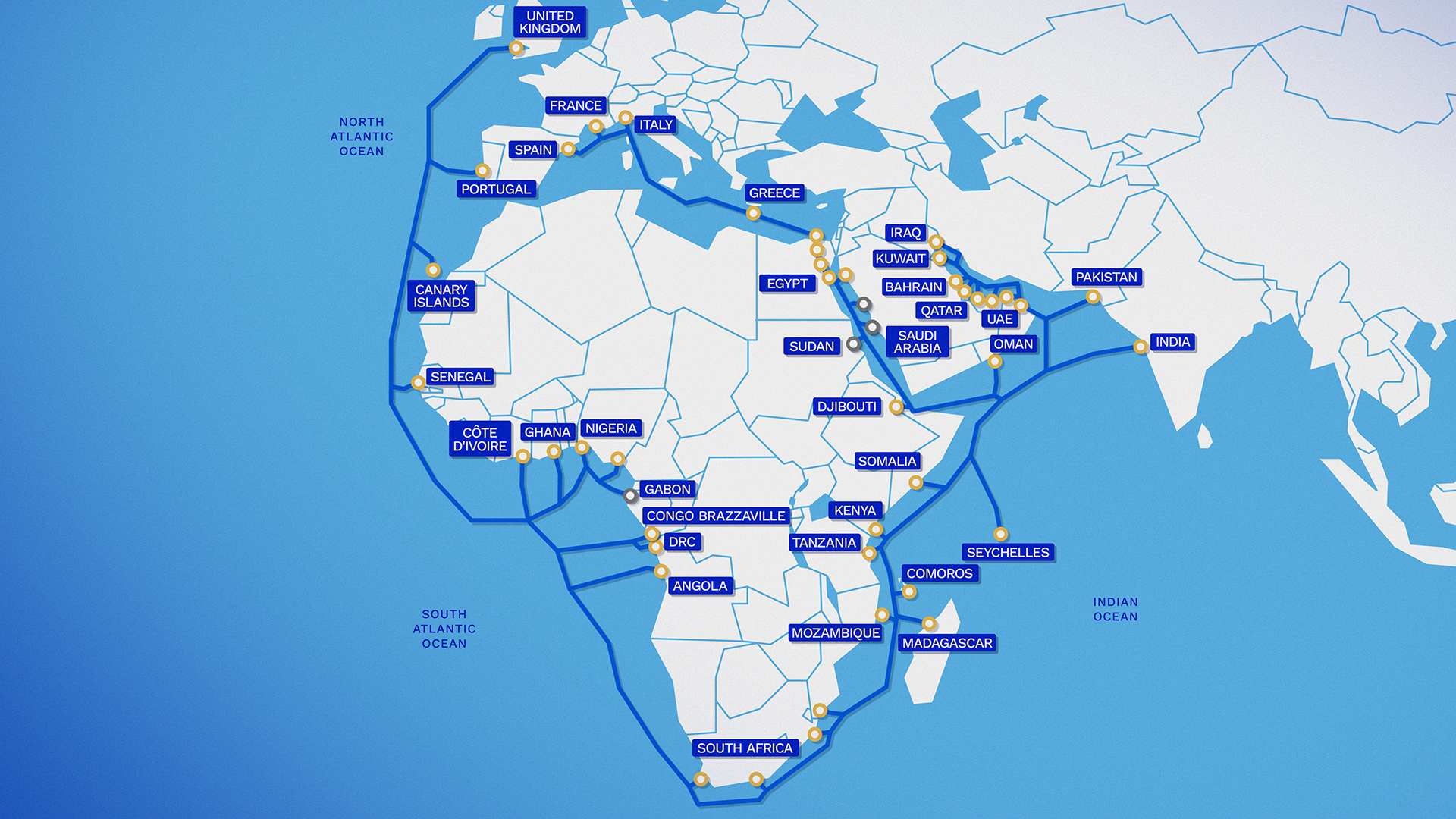
The consortium behind 2Africa has finished the core portion of what it calls the world’s longest open-access subsea cable system. The project connects communities across Africa, Europe, and Asia, with a reach that currently spans 33 countries and approximately 3 billion people—more than 30% of the global population. 2Africa is notable for being the first cable to link East and West Africa in a single continuous system, and for tying that route into the Middle East, South Asia, and Europe.
Consortium, Scale, and Open Access
The cable is being delivered through a consortium led by Meta, with partners including Bayobab (MTN Group), center3 (stc), CMI, Orange, Telecom Egypt, Vodafone Group, and WIOCC. The deployment has spanned 50 jurisdictions and close to six years, with regulation and local landing arrangements a significant part of the effort. A separately planned Pearls extension is set to go live in 2026, after which the full system will stretch 45,000 kilometers—longer than the Earth’s circumference.
The open-access model is central to the design. Multiple service providers can buy capacity on the same infrastructure, which the consortium expects to spur competition, speed up digital transformation, and support AI adoption. Additional partners such as Bharti Airtel and MainOne (an Equinix Company) have contributed to specific cable segments and data center integration.
Engineering Choices and Construction Constraints
2Africa uses spatial division multiplexing (SDM) technology to support up to 16 fiber pairs per cable—double the capacity of older systems—and is the first 16-fiber-pair cable to fully connect Africa. Undersea optical wavelength switching is built in, giving operators flexibility in managing bandwidth for AI, cloud, and other high-throughput workloads.
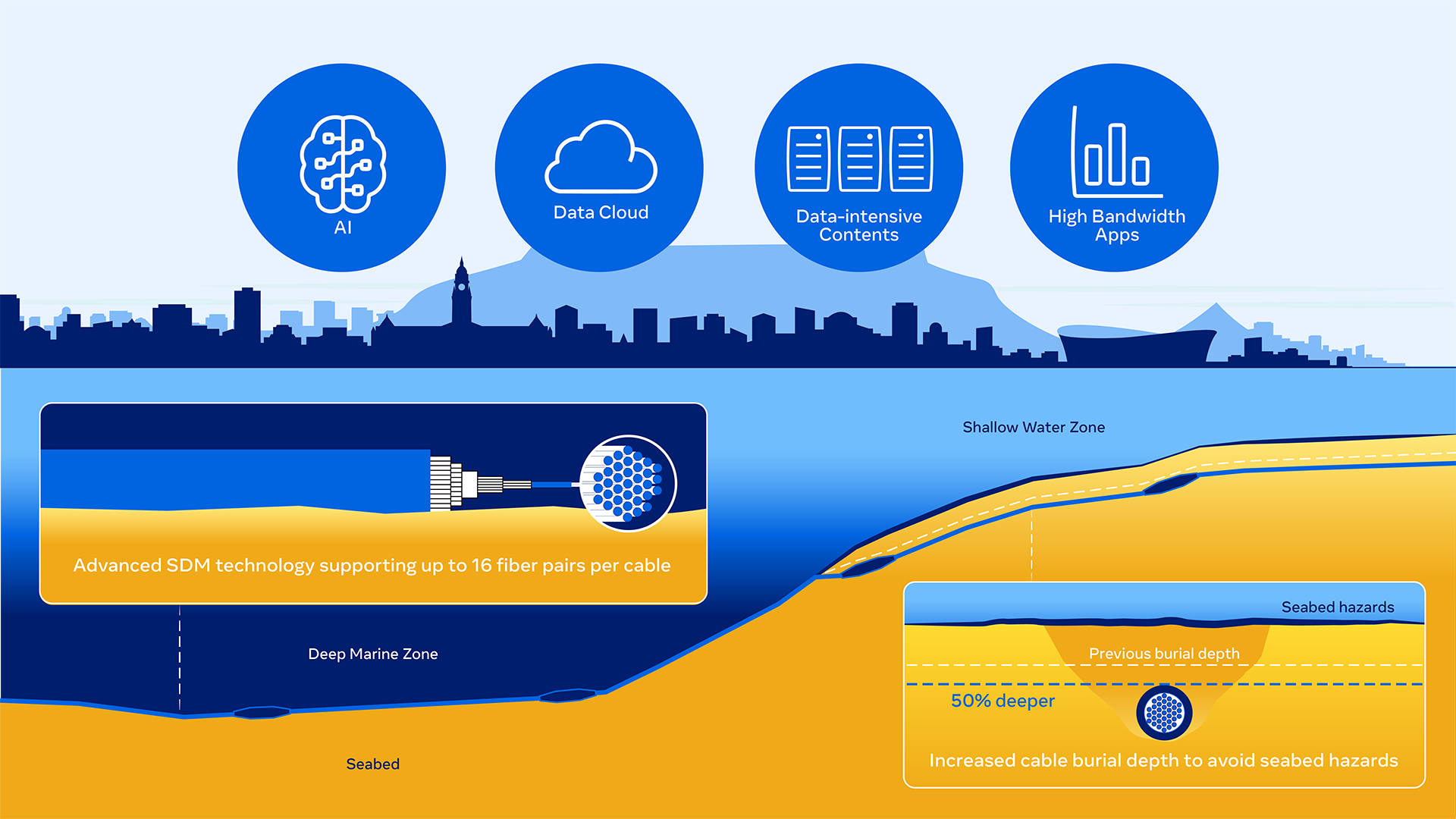
Several reliability hardening measures were applied during design and routing. Cable burial depth was increased by 50% compared to earlier systems, routes were chosen to avoid seabed hazards like hot brine pools, and two independent trunk powering architectures were deployed across the West, East, and Mediterranean segments to guard against electrical faults. Branching unit switching allows trunk routes to farther offshore lines where seabed hazards like Congo Canyon turbidity currents are a concern, while still serving landings in West African countries. Engineers also designed crossing solutions for over 60 oil and gas pipelines along the path.
Construction involved 35 offshore vessels, totaling close to 32 years of vessel operation. Local shore-end operations required additional inshore vessels for pulling, guarding, security, and dive support; in remote areas, specialist equipment such as decompression chambers and burial tooling had to be imported and fitted locally.
What the Bandwidth Delivers
The West segment, running from England to South Africa with landings in Senegal, Ghana, Cote d’Ivoire, Nigeria, Gabon, the Republic of Congo, DRC, and Angola, provides 21 Tbps per fiber pair across 8 trunk fiber pairs, for a total trunk capacity of up to 180 Tbps.

To size that differently:
- 180 Tbps can handle over 36 million simultaneous HD movie streams at 5 Mbps each.
- An individual could download 15,000 full-length Nollywood films (roughly 1.5 GB each) per second, or access a university’s entire remote library in a minute.
- In a city like Lagos, millions of users could video call, stream, and work at once without congestion.
The abundance of capacity is expected to push down wholesale bandwidth prices for ISPs and mobile operators, which in turn supports cloud, data center, and 5G growth. According to a study cited by the consortium, 2Africa could contribute up to $36.9 billion to Africa’s GDP within the first two to three years of operation. Prior cable landings have shown correlations between faster internet access, higher employment, increased productivity, and a shift toward higher-skilled jobs.
Completion of the core system marks a major step for Africa’s digital backbone. The infrastructure is designed to handle both conventional internet traffic and future AI-driven services, with further segments still to arrive via the Pearls extension in 2026.