Meta has announced Petal, a subsea cable that the company says will be the first transoceanic system to deliver petabit capacity and the first to deploy multi-core fiber at scale. The roughly 7,000 km (4,300 mi) link between France and the United States is expected to enter service in 2029 and will carry 1 Pbps — 1,000 Tbps — doubling what today's most advanced cables carry at that distance. Meta frames that figure as roughly the capacity needed for 75% of the world's population to stream music simultaneously.
The project is part of Meta's broader subsea investment program, which the company positions around capacity, resiliency and future-proof infrastructure for Europe as communications demand keeps rising. Petal is being built with NEC and Sumitomo Electric Industries, with Orange supporting the French landing.
Subsea cables carry approximately 99% of intercontinental data traffic, making them the least visible yet most critical layer of the internet.
Why capacity gains stalled
Capacity on subsea systems has advanced in waves. The erbium-doped fiber amplifier (EDFA) arrived in the 1980s, and in the 2010s coherent optical transmission and dispersion-uncompensated cable designs drove a decade of 10x-and-greater fiber capacity increases — until the Shannon Limit pushed back.
The industry's answer was spatial division multiplexing (SDM), which raises the fiber count inside a cable. Meta's own systems trace the trend: Marea at eight fiber pairs, Amitié at 16, and Anjana at 24 — the first 0.5 Pbps transatlantic system.
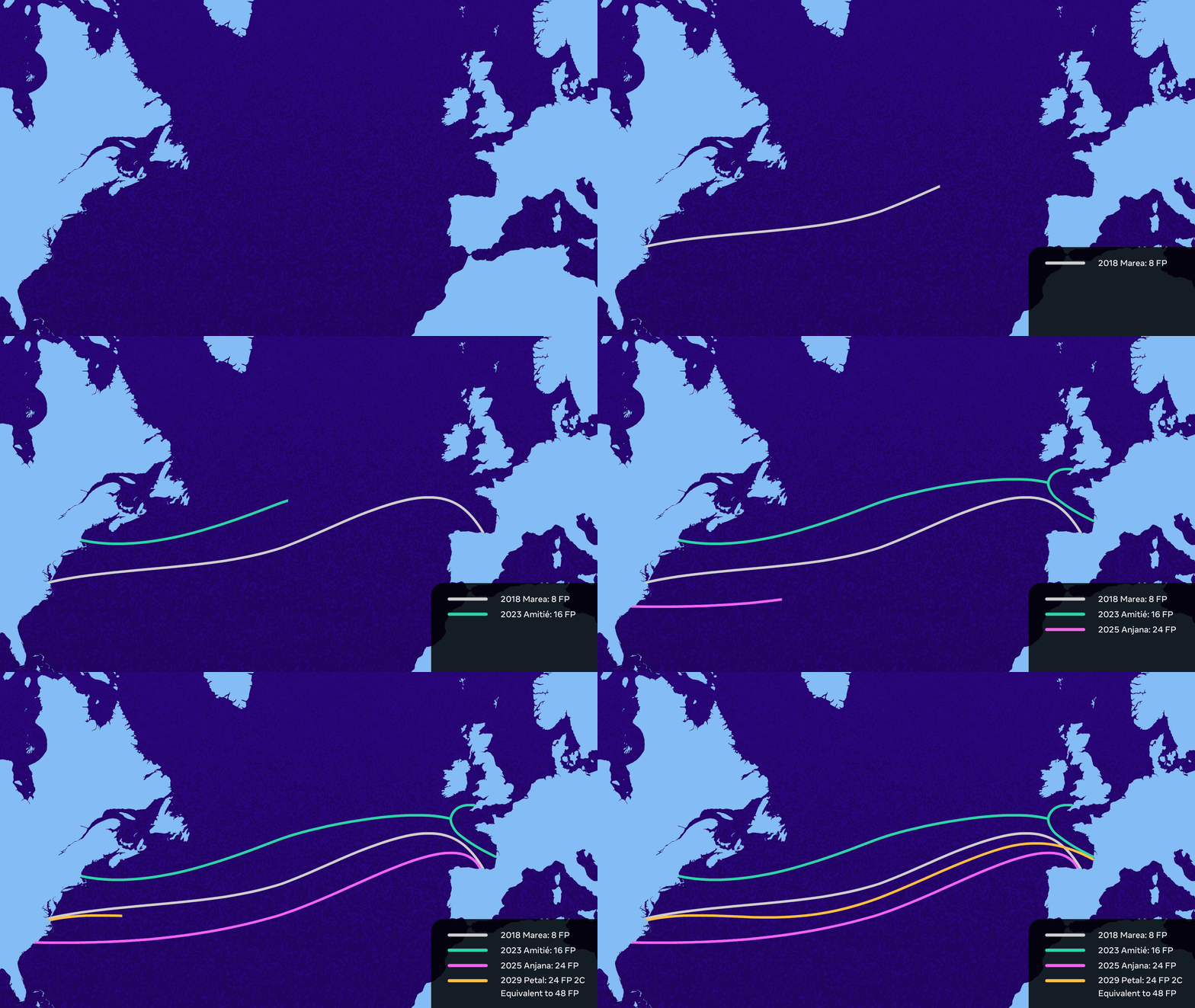
Broadly, three routes could double capacity again: increasing fiber count toward 48 pairs on the conventional path; widening the optical transmission band with the L-band, as Meta did on PLCN, for 24-fiber-pair C+L transmission; or adopting 2-core fiber.
Petal takes the third option, pairing 2-core fiber with a 24 fiber-pair design — the equivalent of 48 fiber pairs — to reach 1 Pbps at transatlantic distances. Meta describes it as double Anjana's capacity and the single largest generational increase in cable capacity of any repeatered subsea system.
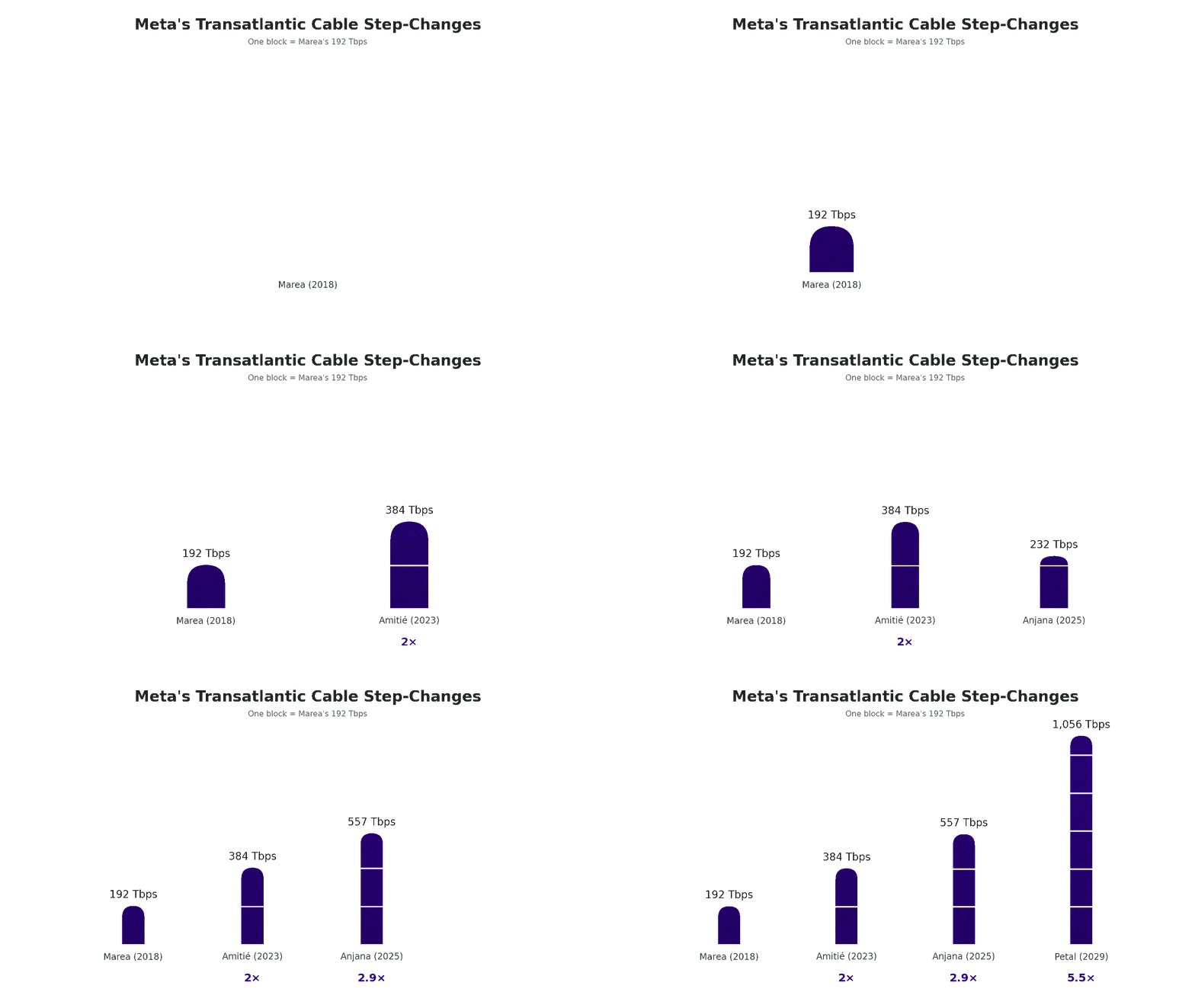
Pushing a petabit through one cable cuts materials, resources and carbon footprint relative to building two 0.5 Pbps systems. Multi-core fiber, however, changes the engineering requirements for both the fiber itself and the subsea repeaters.
Fiber design
Two problems dominate 2-core fiber. The first is holding attenuation low while keeping the outer fiber's physical dimensions — including its 125 μm width — unchanged. The second is minimizing crosstalk between cores so optical performance and capacity stay high.
Low loss comes from ultra-pure synthetic silica used in manufacturing the preform. Crosstalk is suppressed by carefully controlling high refractive indexes in the cores against lower indexes in the surrounding medium and by counter-propagating the optical signals, which Meta says yields nearly immeasurable crosstalk.

Repeater design
A 7,000 km subsea cable typically requires about a hundred repeaters. Petal uses a single-body 96 amp repeater with single-core fiber amplification, relying on a Fan-In/Fan-Out (FIFO) interface that converts 2-core fiber into two single-core fibers inside each repeater and back again after amplification. The approach preserves the efficiency and reliability of single-core amplification while using SDM pump sharing.
FIFO, efficient amplification and low-loss fiber together let Petal double capacity without a proportional rise in power demand. The system stays within existing power feeding equipment limits, rated up to 18 kV, avoiding the requalification of the subsea ecosystem that higher equipment voltages would trigger.
The build partners
NEC is the turnkey system supplier. It engineered and qualified the world's first petabit transoceanic system around the next-generation SDM foundation — 2-core fiber cable, repeaters, FIFO systems and system powering — and is responsible for manufacturing and installing the finished product. The company has invested heavily in manufacturing facilities for petabit-class SDM repeaters and multicore fiber cable.
“Achieving petabit-per-second capacity across a transoceanic submarine system represents a major technological milestone in the history of global telecommunications. This achievement reflects NEC's sustained investment in research and development, combined with decades of experience delivering some of the world's most advanced, reliable, and secure submarine networks that interconnect the globe,” – Eduardo Mateo, Chief Strategy Officer, Submarine Network Division, NEC Corporation
Sumitomo Electric Industries, NEC's fiber supplier, developed and manufactured the 2-core fiber, with ultra-low losses and practically immeasurable crosstalk for counterpropagating signals, giving optical performance nearly identical to single-core fiber.
“We are thrilled that Sumitomo Electric's innovative submarine multi-core fiber, “2C Z-PLUS ULL Fiber” will contribute to “Petal”, an epoch-making Pb-class transatlantic cable system. As a pioneer with nearly four decades of experience in ultra-low loss submarine fiber manufacturing, we are committed to supporting the global network expansion essential to realizing a highly digital future.” -Takehiko OKADA, General Manager of Optical Fiber & Cable Division, Sumitomo Electric Industries, Ltd.
Orange and Meta are working on plans to land Petal on France's Atlantic coast, including the terrestrial interconnection into the European network.
“Reaching one petabit on a transatlantic link, 25 years after the terabit milestone, represents a significant breakthrough to meet the exponential traffic growth while optimizing network capacity. This makes us very proud to welcome this new generation petabit subsea cable with dual-core fiber technology in our infrastructure, as the landing party in France. This new project reinforces our commitment with Meta and demonstrates our leading expertise in landing subsea systems, and extending connectivity to other European countries. It underlines our dedication to developing reliable infrastructure that guarantees the security and resilience of the terrestrial segment of those connections.” – Jean-Louis Le Roux, EVP, Orange International Networks
What Petal is meant to prove
Meta positions the project as a move from experimental to mainstream for multi-core fiber, making it a practical design for building subsea systems at scale — a shift it says the wider industry can benefit from. The stated aim is to set a new standard for undersea infrastructure and to invite the ecosystem to invest alongside it.
*Calculation based on a total capacity of 1 Pbps with an audio stream bitrate of ~0.16 Mbps (160 kbps) for ≈ 6.25 billion simultaneous streams.