Happiness at work resists easy definition, which makes it hard to measure and report. Yet as tooling and team structures keep shifting, understanding how product teams experience that change matters more than ever. Figma's State of the Designer 2025 survey put the question to 943 designers and developers, and the results were supplemented with commentary from design leaders at Spotify and Wise during a recent livestream.
The overall picture is encouraging.

With 41% of designers and developers reporting greater satisfaction than the year before, the survey isolates five contributors to happiness and the roles organizations, managers and individuals play in shaping them.
Design as a strategic partner
Whether an organization treats design as a strategic function or a service has a direct bearing on creative job satisfaction. Marianne Guillen, Senior Director, Editorial & Design Platform at Spotify, ties this to "a higher level of customer centricity," which in turn "allows designers to make the strategic impact [they're] looking for."
Josh Payton, Vice President of Design at Wise, points to habits designers can adopt to shift how cross-functional partners and leaders perceive the design org—chief among them knowing when exploration should give way to delivery. "A lot of times designers will get in trouble for discovery phases that never end," he says. Wise's guiding principle is "now, next, future": 70% of time on current deliverables, 20% on what's next and 10% on the future. That balance lets designers raise craft standards while acting as strategic partners to product and engineering.
Where work happens

Location policy is now a major factor in how people feel about their jobs. Ninety-seven percent of respondents work remotely at least some of the time, and more than half are fully or mostly remote—yet a single blanket policy may not serve everyone.
Josh describes hybrid as a potentially awkward middle ground, recalling a colleague's view that organizations should go either fully remote or fully in-house: otherwise "nobody comes into the office on Mondays and Fridays, and then on Wednesday a million people turn up and there's nowhere to sit or open conference rooms." Whatever the model, clear policies and expectations are what count.
Managerial support
Leaders see what happens on the ground and hold the authority to help teams do their best work—and to make sure that work is rewarded. The best managers read what kind of support each team needs. Josh's policy is blunt: "I don't care about the hours, and I don't care about where you do your work, as long as it's good."
Collaboration and shared language
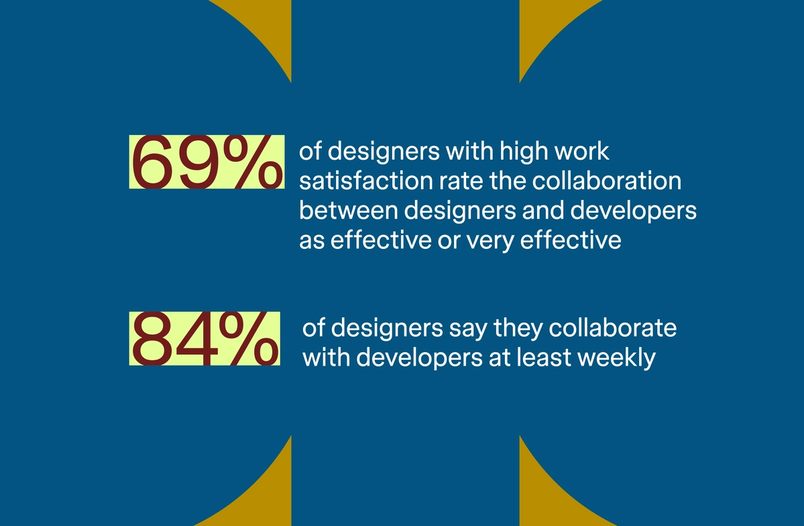
Satisfaction and collaboration track closely together. Among designers reporting high work satisfaction, 69% rate collaboration with developers as effective or very effective, and developers with higher satisfaction collaborate with designers more often. As product development has turned iterative and nonlinear, closer teamwork has become central to individual and team satisfaction.
Communication frequency reflects this: 84% of designers say they collaborate with developers at least weekly, with whiteboarding and collaborative design tools doing much of the work—happy respondents are far more likely to use them, plausibly because they enable multiplayer collaboration.
Still, 91% of developers and 92% of designers see room for process improvement. When misalignment occurs, 47% of developers attribute it to designers not understanding the engineering process. Marianne's advice is not for designers to become engineers but to "explore a little bit, to understand the code better or how modern development works"—enough to "speak a common language."
Self-empowerment and AI
Beyond org structure and leadership policy, individuals can shape their own experience. "It starts with really understanding your role as well as your own aspirations, skillset, and where you want to take your career," Marianne says; a good balance among these is "a really good foundation for how you operate successfully."

AI appears to be a net positive for morale: 56% of respondents say AI makes them more optimistic about the future of product design and development. Both groups cited its ability to cut manual work, freeing time for higher-value and strategic goals—a business benefit too, since teams with room to experiment can improve and accelerate workflows. "It's a learning process for all of us right now," Marianne notes. "The more we all experiment with it, the faster we can come to conclusions about where it's actually impactful and where it's not."



