AI-Assisted Scope 3 Accounting for Data Center Hardware
Meta’s path to net zero emissions by 2030 requires precise accounting for the embodied carbon in its data center hardware. While the company has already published a methodology for estimating emissions down to individual components, the accuracy of those estimates depends heavily on data quality. To improve its Scope 3 emissions tracking, Meta is now applying a combination of natural language processing (NLP) and large language models (LLMs) to its component database.
The approach tackles three specific problems: identifying components that can share product carbon footprints (PCFs), extracting structured data from inconsistent supplier records, and building a standardized taxonomy for IT hardware. Meta plans to open source this methodology through the OCP PCR workstream, with an introduction scheduled for the 2025 OCP Global Summit.
Why AI for Emissions Estimation?
Meta’s existing carbon estimation framework combines cost-based estimates, modeled estimates, and component-specific PCFs. PCFs, calculated per the GHG Protocol, are the gold standard for data quality, but they take months to produce and are typically tied to a single identifier. When a PCF arrives, it is critical to apply it to every matching component across the fleet—otherwise, similar parts retain lower-quality estimates.
The company has split its AI strategy across two model types. NLP techniques work well for bounded, specialized tasks on a relatively small dataset. LLMs, which are pre-trained on general language patterns, are better suited for handling variability in how information is formatted or described across heterogeneous sources. Meta uses Llama 3.1 for three specific functions: extracting data, understanding potential component groupings, and strictly classifying components based on text strings once categories are defined.
The Role of NLP in Component Matching
Inventory data frequently contains multiple identifiers for the same part—due to lifecycle stages, minor variations, or new iterations. When a PCF arrives for one specific board, there may be dozens of related subcomponents or variants that share the same emissions profile. If those similarities go undetected, those components stay at lower data quality scores.
The NLP solution operates on two passes. First, when a new PCF is received, the algorithm analyzes component descriptions in the same category and identifies those with high textual similarity—enabling the PCF to be applied as a proxy. Second, working in reverse, the algorithm takes low-data-quality components and searches for existing higher-quality references that can serve as proxies, provided the data quality score exceeds a defined threshold.
Each proposed proxy is reviewed by Meta’s Net Zero team before it is applied. This workflow improves consistency across the dataset and amplifies the value of each PCF that is completed.
Extracting Data With LLMs
Where hardware lacks a PCF, Meta prefers parameterized modeling over spend-based methods, since spend estimates are skewed by supply chain pricing fluctuations. But parameterized models need structured inputs, such as memory capacity or cable length. In practice, this information is scattered across inconsistent tables, formats, and units—sometimes missing entirely.
LLMs are used here to extract the required parameters from these heterogeneous sources. The model recognizes different representations of the same data, even when phrasing varies. This approach has been applied to memory modules and cables: the LLM pulls values like capacity or cable type and length, then feeds them into physics-based formulas to scale emissions calculations consistently across the component family.
A New Component Taxonomy
Analyzing emissions at the rack level requires first understanding what is in the rack—and suppliers do not describe the same components in the same terms. Meta is applying generative AI as a categorization algorithm to create a new, standardized taxonomy from the text strings present in its fleet data.
The LLM serves two purposes in this workflow: it suggests plausible groupings of related components, and it then acts as a strict classifier to assign each component to the agreed category based on its description. Since prompt engineering is faster than training a custom model, this approach reduces the time to a workable classification.
The resulting taxonomy gives Meta’s design teams a view of emission hotspots that speaks in their own engineering vocabulary. More importantly, the company intends to iterate on this taxonomy with the wider industry, with the goal of agreeing on a common standard that enables direct comparison of embodied carbon across hardware types and generations.
Drilling Down to the Component Level
Meta’s centralized component carbon footprint database does more than support emissions reporting; it is the engine behind targeted reduction efforts. By analyzing emissions at the individual component level, the company can identify which parts of a server rack carry the heaviest carbon burden and respond accordingly. This might mean substituting materials, altering manufacturing processes, or deciding to reuse and extend the life of high-impact components.
The foundation of this analysis is a bill of materials (BOM) that structures every component in a server rack as a tree, with child nodes nested under parent nodes. Unfortunately, BOM structures vary between vendors, meaning two functionally identical racks can be cataloged differently. That inconsistency, combined with differing calculation methods across suppliers, makes it difficult to compare emissions and determine where to act.
Using AI to Standardize Rack Taxonomy
To cut through that variability, Meta applies AI to classify rack descriptive data into two hierarchical levels:
- Domain-level: Major functional groupings such as compute, network, power, mechanical, and storage.
- Component-level: The primary emission-driving parts, including CPU, GPU, DRAM, and Flash.
This requires two separate classification models—one for domain mapping and one for component mapping—which differ only in their training data and example sets. Combined, they produce a mutually exclusive hierarchy tailored for emissions analysis.
Initial exploration let a GenAI model suggest categories on its own. After hardware experts reviewed and refined those groupings into a fixed list, the approach shifted to a strict classifier. The final process runs in two stages:
- For each rack, recursively identify the highest emission contributors, grouping smaller items together.
- Apply a GenAI mutually exclusive classifier to assign components into the established categories.
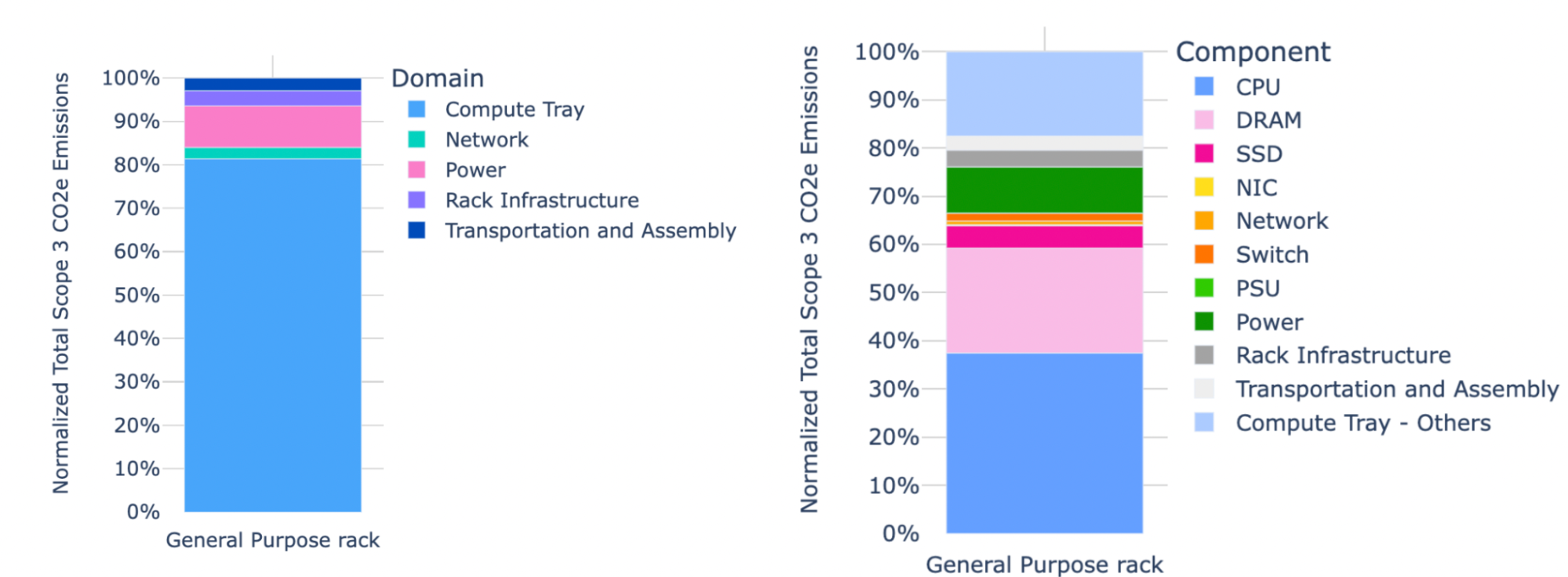
Meta presented this methodology at the 2025 OCP regional EMEA summit, with the aim of pushing the industry toward a common carbon accounting taxonomy and open sourcing its approach. While these groupings are built specifically for carbon footprint analysis—not cost analysis—the underlying method can be adapted to other use cases.
Open Sourcing the Approach
Component-level visibility is central to Meta’s goal of reaching net zero across its value chain by 2030. Combining product carbon footprints, spend-based estimates, and AI-assisted classification helps improve both data quality and coverage, making reduction efforts more effective.
Planned open-source releases include the taxonomy and methodology for server rack emissions accounting, the GenAI-based taxonomy builder, and the aggregation methodology aimed at improving facility-level reporting across the industry. Meta is also bringing this work into the OCP PCR group as a collaborative effort to evolve the standard further.