

A self-serve path to GitHub Enterprise Cloud
Moving an existing codebase to GitHub.com means bringing more than just source files along. Teams need the surrounding context — pull requests, reviews, comments — to preserve the history of why code changed, not just what changed. GitHub Enterprise Importer (GEI) is now generally available as a self-serve tool that migrates that full set of data to GitHub Enterprise Cloud or GitHub.com.
GEI has already been used by more than 2,000 customers to move over 400,000 repositories. The tool handles the collaboration metadata that typically gets lost in a migration: pull requests, reviews, and comments are all carried over alongside the code itself.
Migrating our code with GitHub Enterprise Importer was frictionless. We quickly moved 5,300+ repos from GitHub Enterprise Server to GitHub Enterprise Cloud.
What GEI supports and how it works
GEI supports migrations from GitHub Enterprise Server, Azure DevOps, Bitbucket Data Center, and Bitbucket Server. It can also be used by existing GitHub.com customers adopting Enterprise Managed Users (EMUs) for identity and access management.
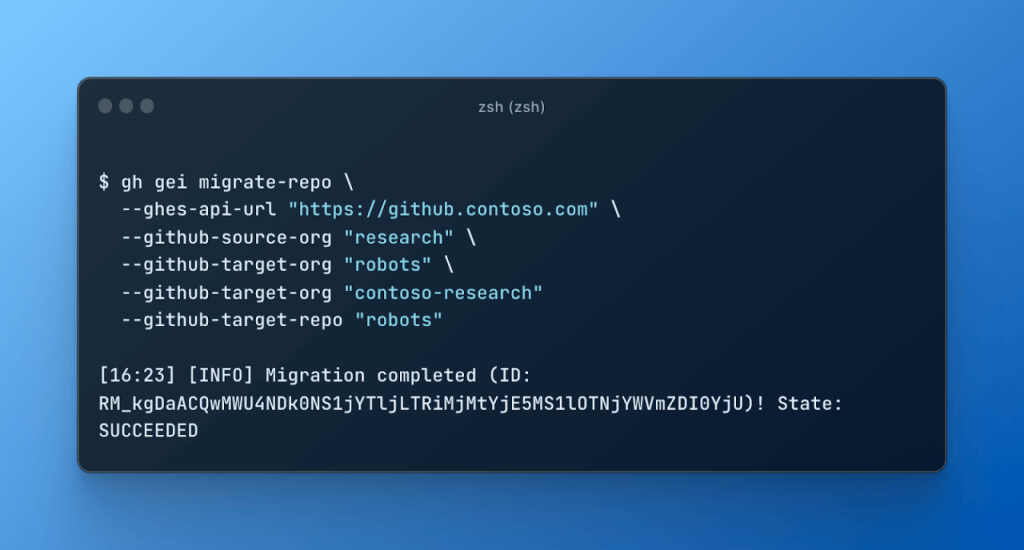
Migrations are run through the gh-gei command line interface. The average repository takes about 70 seconds to migrate, and the CLI includes tooling for bulk migrations of many repositories at once. When a migration finishes, the CLI reports its status, including warnings about any data that couldn't be moved.
For teams that want deeper automation, GEI also exposes a fully-featured GraphQL API alongside the CLI. Documentation on data migration support and usage instructions is available on GitHub Docs.
Planning before you run
GitHub has published a new planning guide covering how to prepare for a migration to GitHub, with step-by-step guidance that applies even to platforms not currently supported by GEI. For large or especially complex migrations, the GitHub Expert Services team provides hands-on assistance with planning and execution.
A case in point is Travelport, which consolidated its DevOps toolchain onto GitHub Enterprise Cloud. Instead of months of disruption, GEI let the team automate the move in days: more than 4,000 repositories, 200 teams, and 1,500 developers migrated from an on-premises GitHub Enterprise Server to the cloud version.
GitHub Enterprise Importer has been a godsend. It has given us a smooth path to migrating all our repositories. Without GEI, we wouldn't have been able to get our engineering teams to migrate, period. They would have put it off indefinitely so it wouldn’t disrupt their workflows. With GEI, we could move a large group of repositories very quickly so the teams only needed to plan for a few hours of downtime at most.
CI/CD pipeline migrations expand to Bamboo
Repository migration is only part of the picture. GitHub Actions Importer, which automates the migration of CI/CD pipelines to GitHub Actions, is used by thousands of teams coming from CircleCI, GitLab, Jenkins, Azure DevOps, and Travis CI.
GitHub has now announced a public beta that extends GitHub Actions Importer to Atlassian's Bamboo Server and Data Center products. The tool is free, and it lets teams plan, forecast, and automatically migrate Bamboo pipelines over to GitHub Actions. Getting started instructions are in the documentation, and feedback can be shared on the gh-actions-importer discussions board.
Getting started
Migrations from GitHub.com, GitHub Enterprise Server, or Azure DevOps can begin by following the instructions in the GEI documentation. Teams migrating from Bitbucket Server or Data Center can register for the beta program; Atlassian has announced it is ending support for Bitbucket Server in February 2024, making this a timely window for a move.