Why a Dedicated Performance Team Pays for Itself
Large US tech companies routinely hire performance engineers to keep infrastructure spend and service latency in check, and to guarantee reliability under peak load. The mandate is broader than just running profiling tools: these engineers work directly with development teams and vendors to build, test, debug, tune, and deploy new performance solutions. A fresh performance team at a company that has never had one can realistically find enough optimizations to halve infrastructure costs within the first couple of years, even if commercial observability tools are already in place. Those tools miss deep wins that proactive engineering uncovers.
Justification for hiring performance staff is straightforward for hardware vendors like Intel, where beating a competitor's benchmark is the top sales factor. This article focuses on non-vendor tech-heavy companies—banks, telecoms, defense, AI firms, and any organization spending more than $1M/year on back-end compute and AI—where the same logic applies.
Counting the Return
Performance engineering delivers four measurable forms of ROI: infrastructure cost savings, latency reductions, improved scalability and reliability, and faster engineering. Cost savings are the most tangible and can determine team size, but the others can matter more depending on the company's growth stage.
Cost Savings and Margin
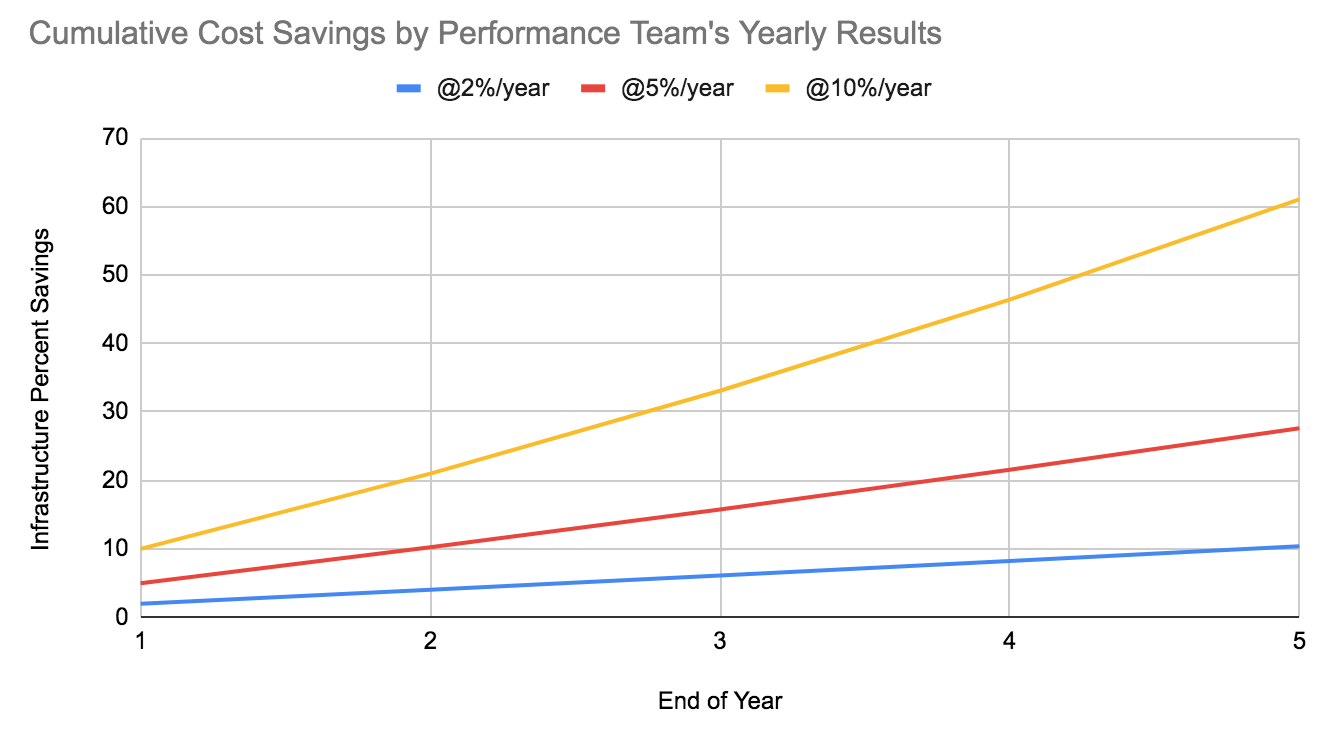
A properly sized performance team should target 5-10% infrastructure cost savings annually through tuning and product adoptions. For large companies, 5% is "good" and 10% is "great." These wins compound: 5% savings each year becomes 28% after five years, much like compound interest. Even a modest 2% per year accumulates significantly over time. The team must keep finding the next 5-10% each year to justify long-term retention.
Years of savings are not the only driver. Some companies invest for a competitive advantage, offering better cost/performance ratios than rivals with similar tech-based services that pass costs to customers. In companies that have never employed performance engineers, low-hanging fruit can yield a 50% infrastructure cost reduction in the first two years. The actual result depends on staff headcount and expertise, how much performance work senior developers and SREs already handle, the volume of custom code, and stack complexity.
Publicly sharing concrete dollar figures is rare since they reveal company growth, financial health, and confidential vendor discounts. A typical 8% annual win often decomposes as follows:
- 2%: direct optimizations. The team found an average 5% win on 40% of the infrastructure, nothing on the rest.
- 3%: developer/SRE enablement. Custom observability tools the team built and maintained helped developers find 15% wins across 20% of the infrastructure.
- 3%: vendor adoptions. The team supported a major project replacing 10% of the infrastructure for a 30% win.
Enablement and adoption wins are not found directly by the performance team but are a direct result of their work. At Netflix, for instance, the published flame-graph "self-service" application was used by developers daily to find their own wins, and the team supported multiple product adoptions yearly. That all counts toward the team’s ROI.
Latency Reductions
Latency work spans average response times, 99th percentile latency, outlier latency, SLA/SLO compliance, and behavior during peak load or perturbations. Cost optimizations often lower average latency but leave variance alone. A system task running every five minutes may have negligible CPU cost yet perturb the application and produce latency outliers. Debugging these requires monitoring, logs, distributed tracing, system-level tracing, packet logs, and purpose-built tools. High latency may also be an inherent property of certain request types or an expected effect of load (queueing theory, tail latency), or it may trace to complex interactions across software layers or network endpoints.
One notable anti-pattern: installing a monitoring agent to diagnose a performance problem, only to have that agent's periodic work create new latency outliers. Always consider turning monitoring agents off entirely to see whether the problem vanishes.
Scalability and Reliability
Systems under heavy load can exhibit exponential latency or cascade into outages. Performance engineers build custom load generators and benchmarks to test resource scalability, then analyze every system component to locate and fix bottlenecks. They should not simply report scalability limits—they must explain the limiting factors and prescribe how to push past them. A stable service under load also builds customer trust and may be a contractual requirement for enterprise SLA/SLOs.
A representative case from Sun Microsystems illustrates common pitfalls. To reach the industry's top storage throughput (over 1M IOPS), the expected bottleneck was rotational disks. Custom load generators and analysis tools revealed the real constraint was the CPU interconnect (AMD HyperTransport 1). AMD supplied a new board with HT3 and faster CPUs, but performance was unchanged—they had mistakenly sent an HT1 board. After receiving a true HT3 board, performance improved by up to 75%. CPU interconnects are just one of many components neither companies nor commercial tools typically check.
Engineering Velocity
For early-stage companies, the ability to ship faster may be the most important ROI. Performance teams offload non-codebase issues so developers stay focused, and they create headroom in cost and latency budgets. This plays out in several ways:
- Eliminate outside performance distractions. When developers hit a bottleneck in a library, kernel, hypervisor, or hardware, they must pause to learn new tools. Evaluating a new performance technology seen on Hacker News also takes time away from shipping. A perf team absorbs those tasks, much as SRE and DevOps teams offload OS, deployment, and reliability work.
- Bypass expensive project failures. Developers often propose ideas based on incorrect assumptions about stack internals. A one-hour meeting can save months of work when a perf team explains why option A fails and helps with option B. At one large tech company, an engineering proposal to adopt a new event-based coding framework was based on the belief it would improve performance by ten times. Analysis showed the real gain would have been under 10%, and the project—which would have involved rewriting all company code over roughly a year—was abandoned.
- Develop accelerator tools. Custom observability tools that find issues sooner speed up development. AI flame graphs are one example, since building them requires deep kernel and hardware knowledge.
- Faster feature adoption. Lowering costs and latency lets developers squeeze more processing per request or meet cost ceilings that previously blocked features. Companies can ship features ahead of competitors while maintaining a reliable service with a strong cost/performance ratio.
The Performance Team's Actual Work
For a non-vendor tech company, a performance engineering group typically owns a broad set of responsibilities that cut across products, infrastructure, and internal tooling.
Technology evaluation and adoption. The team tests, debugs, and tunes new software and hardware so the company can actually realize claimed benefits. This covers new cloud instance types, language runtimes, JVM versions and subsystems (new GCs or compilers like Graal vs. C2), system libraries (glibc vs. tcmalloc), kernels and kernel versions (Linux vs. BSD), compilers (gcc, llvm, icc), CPU features (AVX, QAT), and hardware accelerators. Getting a new technology to deliver its advertised performance can take months of debugging, patching, and integration work.
Custom performance tooling. Much of the necessary tooling is open-source, but someone has to integrate it with local systems, teach other teams to use it, and maintain it. This includes Prometheus/Grafana dashboards, one-click flame graphs, and analysis tools built on eBPF.
Deep-dive bottleneck analysis. When a workload underperforms, the team identifies the root cause using code profilers (CPU flame graphs), distributed tracers (OpenTelemetry), application logs, system counters (Linux sysstat), system tracers (eBPF, Ftrace, perf), and debuggers (gdb). They do hands-on debugging over SSH and may write custom mini load generators or observability helpers when existing ones don't fit the problem.
Configuration tuning. Beyond code changes, performance engineers tune system parameters: Linux sysctls, network socket options and qdiscs, device settings, JVM flags (-XX:*), library settings, and environment variables. This work requires SSH access and usually superuser privileges.
Early development consultation. The team reviews designs to catch non-scalable solutions before they're built. They also help developers who have a good optimization idea but can't get it working, and they may revive stale upstream performance patches—fixing conflicts, testing the result, and advocating for a merge.
Proof-of-concepts. Some performance techniques are too esoteric for developers to prototype on their own. Linux eBPF and io_uring, for example, can produce major hot-path wins, but someone needs to build a working demonstration that fits the company's actual use case.
Direct code contributions. When no one else has time to implement a fix in Linux, a runtime, or a database, a performance engineer may simply write the patch. They tend to be slower than full-time developers because they move between many languages, and as new committers they face extra scrutiny.
Capacity planning. The team models and characterizes workloads for hardware purchases, defines what metrics to monitor for alerts and autoscaling, forecasts bottlenecks, and helps the business side set practical SLA/SLOs.
Knowledge sharing and tool vetting. They teach engineers to write more efficient code and act as a conduit between teams so performance lessons aren't rediscovered in silos. Their expertise also matters when the company evaluates commercial observability and telemetry products. Without in-house knowledge, it's easy to buy an overpriced re-wrap of Prometheus and Grafana—or adopt a tool whose overhead (sometimes exceeding 10%) costs more than the insight it provides.
Testing new technology deserves special attention. A typical developer reads the README, configures the thing, runs a load test, and shares the number with management. A performance engineer runs analyzers during the test to find the limiter, then tunes the technology for an extra 5%, 50%, or more. They may even discover the test was accidentally hitting a caching layer rather than the intended target. Any performance test result should come with an explanation of what limited it. Asking a simple question—"why isn't the result double?"—quickly reveals whether a result was analyzed at all.
Also, "CPU bound" is not an explanation. It could mean the clockspeed cap, thread pool size, core count, memory bus (which kernels misleadingly count in %CPU), or power/thermal limits. Each leads to a different action: faster processors, more threads, more cores, faster memory or NUMA-aware techniques, or something else entirely. A performance engineer will also examine the code itself for inefficiencies, and sometimes the actual instructions.
Day-to-day work involves a surprising amount of fixing broken builds and configuring workloads—you're frequently the first person testing patches and bleeding-edge software versions. This description applies to tech consumers. Vendors that sell technology use performance engineering for design modeling, prototype analysis, competitive benchmarking, non-regression testing of releases, and pre- and post-sales support.
Sizing and Timing the Hire
Most companies already do scattered performance work across projects and individuals, but without a central team the attention is spotty—deep in some areas, absent in others. A dedicated group examines everything through the same lens and prioritizes based on potential return.
Rule of thumb: headcount vs. infrastructure spend
Hire the first performance engineer once annual infrastructure spend passes $1M. That individual finds low-hanging fruit quickly. Add another for every $10M to $20M of additional spend, maintaining a 3:1 junior-to-senior ratio. The exact numbers depend on engineer skill, environment complexity, and how aggressively you want to optimize.
The math shifts as you scale: at $20M annual spend, a 5% yearly improvement saves $1M per team member (before salary); at $10M spend you'd need to find 10% yearly wins for the same return. Larger sites do develop new performance problems as they grow, and smaller percentage wins become increasingly valuable at scale. Real-world performance teams have stopped growing around 150 people.
Rule of thumb: staff cost vs. observability cost
A useful benchmark is that performance engineering staff spend should at least match observability tool spend. If you're paying $1M/year for an observability product, allocate $1M/year to the performance team—roughly three to four senior engineers. Since monitoring costs typically scale with instance count, and these engineers are actively reducing server count, the monitoring savings alone will fund the team.
At the other extreme, if observability costs $50k/year, you can't justify a full-time engineer at that price—but a consultant or paid team training fills the gap.
Rule of thumb: when latency stalls growth
Small companies with tiny compute bills shouldn't waste developer hours chasing negligible cost reductions. But when new customers arrive and the system can't hold up—latency climbs or reliability falters—that's the signal to start investing. Losing customers to slowness is far more expensive than the infrastructure that would prevent it.
Caveats to the rules
- Some of your existing senior developers or SREs may already be doing performance work under different titles. Subtract their contribution from what you hire centrally.
- Be aware of backpressure. If a new team halves your infrastructure bill, you might be tempted to halve the team. These staff are generalists who can fill other gaps—they understand multiple operating systems, languages, and hardware. At Netflix, performance engineers have spent an 18-month stretch on core SRE rotation or done kernel crash dump analysis because they already had the debugging skills.
- Ideally, you have more performance engineers than major technologies so individuals can specialize. A stack of AWS, Intel, Linux, Ubuntu, containers, Lambda, gRPC, Java, Go, Python, Cassandra, and TensorFlow—that's 12 engineers, plus one for in-house code. Going multi-cloud means adding one per provider.
- Performance wins are cumulative. A novice team might only deliver 2% savings in each of their first three years while they learn both the discipline and your environment. That still compounds to 6% going forward, permanently.
Performance Engineering Across the Industry
Performance engineering is not confined to vendors. Many non-vendor companies have published detailed accounts of their work in this area. Notable examples include Netflix’s cloud performance root cause analysis, Meta’s Strobelight profiling service built on open-source technology, and Pinterest’s debugging of one-in-a-million failures during a Kubernetes migration. LinkedIn, eBay, and Twitter have also documented their efforts around 99th percentile latency, incremental speed improvements, and edge expansion. Salesforce, Uber, Twitch, and Airbnb have shared insights on enterprise-scale performance engineering, generative AI-assisted optimization in Go, low-latency garbage collection, and page performance scoring. Stripe, DoorDash, Roblox, and Capital One round out the list with work on ML-driven degradation detection, microservices caching standardization, data store redesigns, and cloud cost optimization.
Some major financial institutions—such as Bank of America, Wells Fargo, JPMorgan Chase, and Citigroup—employ many staff with the title “performance engineer,” but their work is rarely documented publicly. Similarly, a canonical list of central performance engineering teams is difficult to assemble because org charts are not always public, and practitioners do not always use the title “performance engineer.” Related job titles to search for include those involving insights, monitoring, observability, and sometimes “support engineer.” Hardware, software, and cloud vendors such as Intel, AMD, NVIDIA, Apple, Microsoft, Google, Amazon, and Red Hat also perform substantial performance engineering, as do performance solution companies, but the focus here is specifically on non-vendor organizations.
How Many Performance Engineers Are There?
Concrete global employment data for performance engineering is scarce. Estimates based on available information suggest:
- Fewer than 1,000 staff explicitly identify as performance engineers at non-vendor companies.
- More than 10,000 staff work as performance engineers at software and hardware vendors.
- More than 100,000 staff focus on performance engineering work under other titles, such as developer, SRE, or support.
- Most developers likely do some performance engineering work occasionally.
More precise figures might be obtainable through LinkedIn’s enterprise analytics tools.
Recommendations and Rationale for Hiring
There are compelling reasons to build a performance engineering team: infrastructure cost savings, reduced latency, improved scalability and reliability, and faster engineering cycles. Cost reduction alone can justify the headcount. A well-functioning team should aim for 5–10% cost reductions per year, which compounds to 28–61% savings over five years.
Suggested hiring guidelines based on experience: hire one performance engineer when infrastructure spend exceeds $1 million, then add another for every additional $10–20 million. Also, performance staff spending should be at least equal to observability and monitoring spend. It is worth noting that some senior developers or SREs are likely already handling performance work, which reduces the number of new hires needed.
Many engineers are interested in performance roles but their employers do not offer them, despite having significant infrastructure budgets. This is distinct from performance testing positions, which are not the same discipline. A dedicated performance team targeting multi-million-dollar infrastructure can deliver clear value.
Hiring for this specialization is challenging given the limited talent pool. Part 2 will cover how to hire or train such a team, including sample job descriptions, and what to do if hiring a full team is not feasible.