The End of the Big Reveal
Client-agency relationships have changed shape over the last two decades. Remote work scattered teams across time zones, boutique studios rose to challenge legacy giants, and the old idea of design as an opaque, behind-closed-doors process largely fell away. In its place is a more continuous partnership, where agencies and clients co-create a bespoke workflow for each project and where roles inside studios blur. “Now, more than ever, you need to be well-versed in everything,” says Judson Collier, Co-founder of Design Business Company. “Generalism is back.”
What that means in practice is open communication, room for diverse perspectives, and tools that keep pace with the work. A handful of studios and independent designers explain how they use Figma to spark ideas, build alignment, and hand off finished work without the outdated formality of the boardroom.
A Shared Canvas for Health-Tech Branding
Rachael Yaeger and Michael Ray founded the digital studio Human in 2013, when scaling a team up or down based on client needs was an outlier. Now it is closer to standard. Human fluctuates between 6 and 10 employees, a structure that keeps the team intimate with clients, emphasizes the craft of both designers and developers, and cuts the friction that occurs when in-house and agency teams stay siloed. “We sit in this beautiful sweet spot with the agility and expertise of a freelancer, but the cohesion, experience, and security of a large agency,” Rachael says.
Clients, for their part, want more intimacy too. “Traditional management layers are becoming less and less frequent,” says Rachael, who sees clients more comfortable embedding outside partners within their own teams. Clients today also arrive with higher design aptitude and fluency in design tools. “Figma speaks to the fluidity of the industry right now,” she says. “We’re not suits in a boardroom with printed PDFs anymore.” Remote work has made interactions less formal and more frequent: “We send a client a Figma link, and they drop some comments at the end of day, and we keep riffing. The dynamic is friendlier now. It’s less ‘agency is God and knows everything.’”
That fluidity was essential when Human built a new visual identity and website for Jimini Health, an AI company for mental health. While in sprint mode, both teams started with conversations about what the brand should embody. Human used Figma Slides, chosen because it is easy for non-designers to jump into, to organize ideas, research, and mood boards that Jimini could comment on directly. That produced a sign-off on brand direction in about two weeks. The identity leans on a wide color spectrum as a metaphor for the range of human emotional experience; the close partnership let the client be decisive, and the rest of the design work took around four more weeks, a schedule that only worked because of continuous communication and transparency.
Figma also eased the transfer of ownership as Jimini began applying the brand book to its app—feedback on whether UI elements followed brand guidelines came through comments. “Figma gives everyone access to each other in a really easy way,” Rachael says.
Flexible Systems for Streaming Surfaces
At 32-person PORTO ROCHA, adaptability is the differentiator in a competitive market. The agency’s strategy, design, motion, and interactive teams span the globe and serve tech, fashion, finance, and culture clients, from Kunsthalle Basel to Google. That breadth keeps the studio sharp. “It allows us to remain curious, shift our approach across these industries, and make decisions rooted in context,” says Gabriela Carnabuci, Associate Design Director at PORTO ROCHA.
The studio has worked Figma into every stage of its workflow for the past five years, from ideation and concepting to design and final handoff. “It’s a tool that feels alive,” Gabriela says, and beyond the design team—the strategy group runs remote workshops and consolidates research and data using FigJam files. Internally, PORTO ROCHA files allow free riffing, while external files keep the agency in conversation with the client without exposing the messier parts of the process.
That approach showed when PORTO ROCHA redesigned the brand and product for VEEPS, the official livestreaming platform for Live Nation and Ticketmaster events. The brief was to craft a recognizable identity strong enough to anchor millions of viewers’ experience of big-name shows—without stepping on the artists themselves. “Striking this balance meant building a cohesive, yet flexible, experience across desktop, mobile, TV, and social media,” says Marcos Rodrigues, Interactive Design Director at PORTO ROCHA. “It was about stress testing every possibility and format.” Figma helped ensure designs held up on every surface, especially regarding video, motion graphics, and live elements. To ease the transition post handoff, the designers built an extensive component library and relied on plugins such as Stark to keep the work within accessibility parameters.
“Our process explored creating an iconic, yet utilitarian system that balanced brand personality and functional needs,” Gabriela says. “Because the client needed a flexible system, our approach was to imbue each brand element—from the logo to the typography and color—with personality, allowing artists and their own brand expressions to take center stage.” Since the rollout, VEEPS engagement has more than tripled and its social following has grown 50%.
An Open-Source Approach to Client Work
Design Business Company was founded by Stewart Scott-Curran, Judson Collier, and Jordan Egstad to leave behind the one-size-fits-all agency model. Scott-Curran, who once worked in-house at Nike, Coca-Cola, and CNN, “always yearned for a relationship that felt like the agency understood us more, or had more curiosity about who we were.”
DBCo’s answer is to keep clients invested and hands-on from day one. Instead of onboarding, disappearing, and returning months later with a big reveal, DBCo shares its Figma files immediately, welcoming comments and sticky notes. That allows course correction much earlier and reduces formal presentations. “We can share ideas more quickly and collaborate more freely, which in turn makes the whole creative process feel less precious,” Jordan says.
That is a sharp reversal from industry norms only a few years back. “I remember peers saying, ‘I never want somebody looking over my shoulder while I’m designing. That freaks me out,’” Judson recalls. “Now, we’re on the other side of that.”
The approach proved out when reimagining the online shop for GitHub, a project spanning a new website, merchandise, packaging, and product photography, all designed in Figma. “What’s really nice about the tool is you can see in one location how the brand can stretch and apply to all these different surfaces at the same time,” Jordan says. To speak to developers, DBCo designed text animations mimicking lines of code and promotional codes that seem to unscramble themselves. Prototyping in Figma made it possible to realistically depict those interactions without heavy developer lift, including am Easter egg where the Konami code (↑↑↓↓←→←→BA) transforms photos into ASCII images.
Each project has its own workflow, but all start with Construct, an internal design system built on Figma variables. Construct’s four collections auto-populate files with the right values, cutting what used to be a day and a half of grunt work down to roughly 30 minutes. “We can expedite all of the grunt work,” Jordan says, “It has taken time to find the sweet spot between having enough system in place to be helpful and having too many constraints, but we’ve found a good balance.”
A modular identity for Eastern Margins
London-based studio ChaChaanTeng! has also shifted how it partners with clients since its founding four years ago. Founder Wei Prior says moving to Figma has replaced formal presentations with in-file guidance, which helps “gamify the working process” through interactive games, canvas backdrops, and drawings. With the entire small team able to see each other’s work in real time, the studio develops project narratives faster. “We work so collaboratively,” Wei says. “As a platform, Figma enables us to work across a large cohort of projects with ease and is foundational to our growth.”
Figma enables us to work across a large cohort of projects with ease and is foundational to our growth.“Figma enables us to work across a large cohort of projects with ease and is foundational to our growth.”
That efficiency has let ChaChaanTeng! take on more clients, including international ones like Eastern Margins, a UK record label championing alternative artists across Asia. The collaboration began two years ago with a new brand identity: a layered mix of neon colors, symbols, illustrations, and video exceeding 100 layers total. Wei describes the work as “a modular approach to madness,” a reference to the visual density of megacities like Hong Kong, Tokyo, and Manila, where the label’s artists are based.


When Wei first showed the concepts to Eastern Margins founder David Zhou, he built the visuals layer by layer in real time. Zhou was so engaged that the teams decided to make motion part of the identity to emphasize its dynamism. “We like things that are unexpected, when things get distorted, and when we produce mutations,” David says. “Because we work in Figma, those happy accidents or unexpected things pop up much more naturally.”
The music industry’s pace also shapes the workflow. ChaChaanTeng! often ships files that are roughly 95% complete, leaving room for Eastern Margins’ in-house designers to adjust the order and size of artist names on a poster. Those details can change hours before a show, so the label needs to make last-minute edits without waiting on an agency in another time zone. “Figma makes it easy for someone who’s not a graphic designer, but has a rudimentary understanding of design, to change the font size or order, and that’s saved us significant headaches,” David says.
Iterating on a parenting app with Good Inside
Kevin Twohy, Founder and Principal at Twohy Design Works, keeps his practice flexible by matching the model to the job. He sometimes embeds within a client team like an employee, and other times acts as a mini-studio, bringing in specialists as needed. “We’re in this era of the super individual,” Kevin says. “With new technology, there’s an ability for one person to creative direct a larger scope of work.” That approach also aligns with his preference for direct client relationships and staying close to the creative details.
For two years, Kevin has worked with Good Inside, an online parenting resource founded by clinical psychologist Dr. Becky Kennedy. Early research pointed to a clear need: parents wanted immediate help during stressful situations. That insight drove the design of a personalized coaching app to guide parents through tantrums, bedtime resistance, and other common challenges.
We’re in this era of the super individual.“We’re in this era of the super individual.”
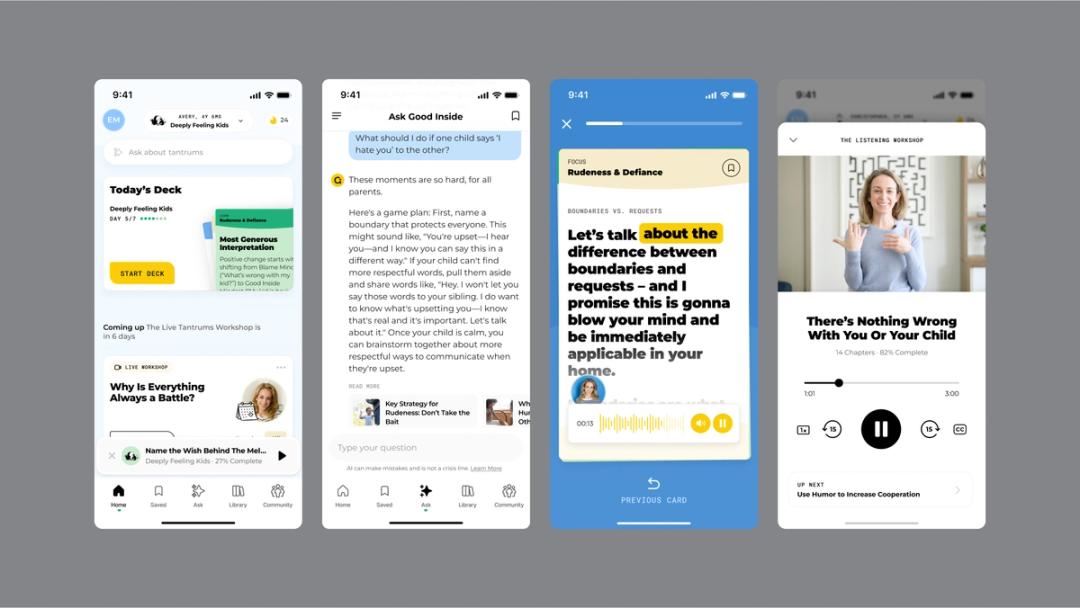
The real design problem was broader than the interface. “Not just designing the interface or content,” Kevin explains, “but the map that shows the arc of what a parent goes through, and the content plans associated with it.” The team used FigJam to map what parents needed to know, then organized that content into low-fidelity wireframes in Figma before building high-fidelity prototypes for user testing. Tight iteration loops let them quickly refine scripts, instructions, and the interface itself.
Getting the information architecture right was critical for building lasting relationships with subscribers. “You can’t just make something that works for a week or 30 days in a user test,” Kevin says. “It’s not enough to hear a user say, ‘Oh, it’s great. It makes me feel X.’ You have to test it for real.” The app went through beta testing lasting a month or more, with learnings fed back into multiple iterations. One change: a deliberately light onboarding flow that avoids burdening parents with irrelevant information during an emotional moment. The result is a 4.9-star rating on the App Store.
“The parents—the customers—they’re real people in the real world, and they need help with an issue,” Kevin says. “They didn’t wake up saying, ‘I want an app.’ It’s about having the right things there that truly help, and delivering them in the right way.”
Agencies and freelancers need tools that let them pull in the right collaborators quickly and work more intimately with clients. Smaller studios are tackling bigger scopes, designing across websites, apps, print, and physical products within a single engagement. In this landscape, Figma helps teams build trust, develop ideas, and keep communication close—ultimately producing better outcomes. Learn more about how teams are using Figma, or request a demo.