Why MLOps doesn't fit the DevOps mold
Git-based workflows have made software delivery more reliable and collaborative by treating Git as a single source of truth for everything from infrastructure as code to Kubernetes configurations. But machine learning applications don't translate directly to that model. ML models fail differently than traditional software: not from race conditions or buffer overflows, but from edge cases, poor data coverage, adversarial inputs, and overfitting. Those are data problems, not code problems.
That's why porting standard CI/CD practices to ML pipelines isn't enough. MLOps requires versioning datasets in lockstep with the code that consumes them, plus tooling for data lineage, model training, and production monitoring. The core differentiator is data itself.
Pachyderm and GitHub Actions, together
Pachyderm brings Git-like version control to binary data assets through a version-controlled file system, and its processing pipelines can be triggered by data changes. GitHub Actions provides event-driven automation that hooks into nearly any GitHub event—pull requests, releases, pushes—to run builds, CI steps, and deployments.
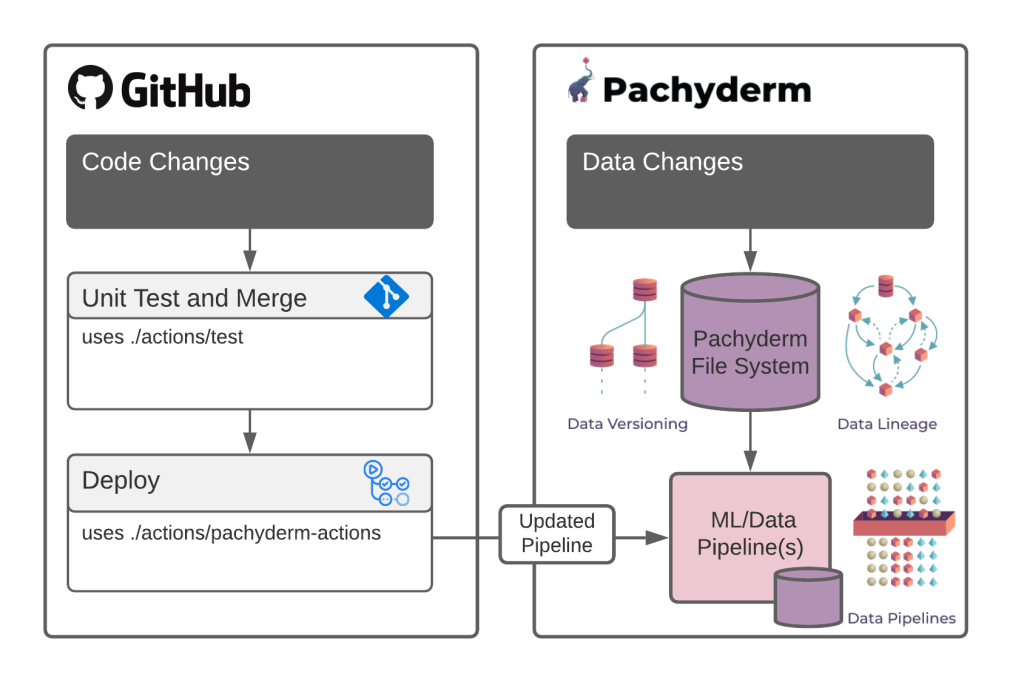
Wiring Pachyderm into an Actions workflow makes it possible to trigger ML pipeline updates from code pushes. When a GitHub event fires, the action pushes the repository code—your ML code—to a Pachyderm cluster for processing. The Pachyderm action performs these steps:
- Builds the repository's code into a Docker image.
- Tags the image with the
github commit. - Pushes the image to your Docker registry.
- Builds a GitHub runner image containing Pachyderm cluster credentials.
- Updates the pipeline specification with the new image tag.
- Submits the updated pipeline to the Pachyderm cluster.
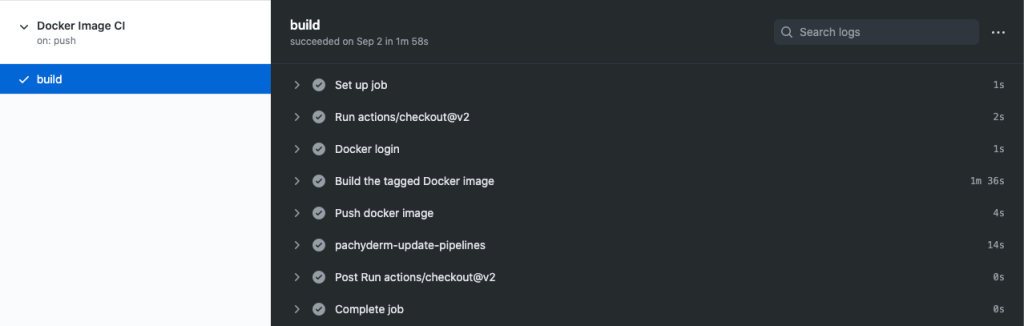
Automating pipeline updates
A tutorial built around Pachyderm's regression example shows the integration in practice. The workflow updates a running Pachyderm pipeline whenever code is pushed to the main branch. Two files control the behavior: push.yaml defines the workflow and its steps for the push event, while action.yaml implements the connector that updates the pipeline.
- uses: pachyderm/pachyderm-actions@master
  env:
    PACHYDERM_CLUSTER_URL: ${{ secrets.PACHYDERM_URL }}
    PACHYDERM_TOKEN: ${{ secrets.PACHYDERM_TOKEN }}
    DOCKER_IMAGE_NAME: ${{ secrets.DOCKER_IMAGE }}
    PACHYDERM_PIPELINE_FILES: <list pipeline JSON files to be updated>
Previously, keeping code and Pachyderm pipelines in sync required manual intervention—an engineer building, pushing, and updating the cluster by hand, or fragile watcher scripts. With Pachyderm and Actions, code changes automatically deploy to production-scale data workflows. Data scientists write their ML code and it flows through to live pipelines without a manual handoff.
Versioned code meets versioned data
Pairing Git-based CI/CD with Pachyderm's data versioning lets you keep code and data synchronized from commit through pipeline execution. The integration eliminates the guesswork around whether your model code and its training data are in sync, giving ML teams the same confidence that DevOps practices brought to traditional software delivery.