QLC Flash Finds a Home Between HDD and TLC
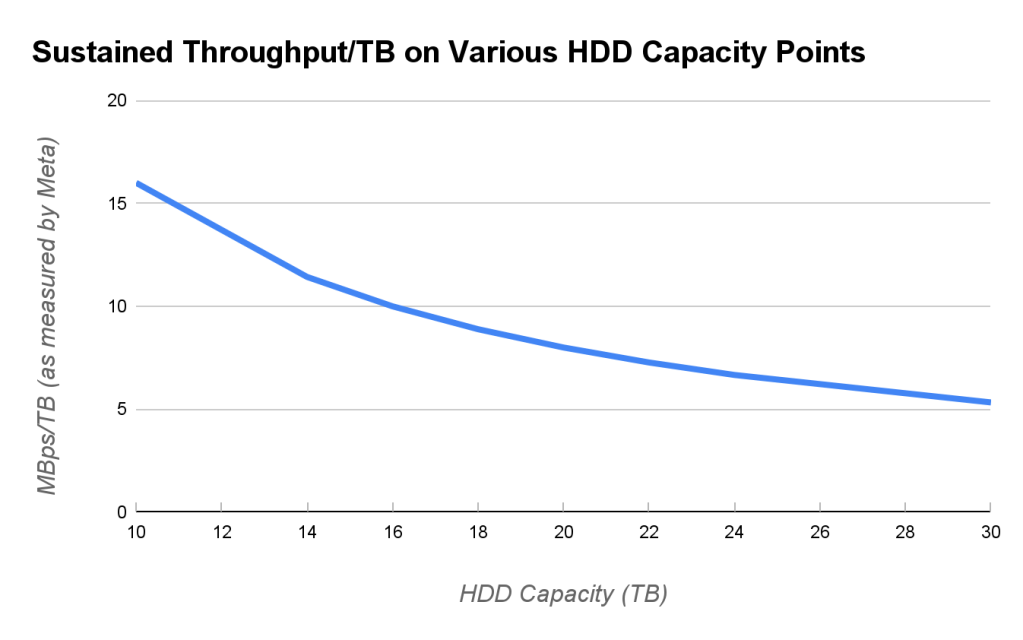
Data center storage has long been a trade-off between HDD capacity economics and TLC flash performance. HDDs have grown denser over the years, but their I/O throughput has not kept pace. The result is a steady decline in bandwidth per terabyte, pushing operators to either tier hot data onto expensive TLC flash or overprovision capacity to hit performance targets. QLC flash, meanwhile, has existed since 2009 but saw little data center adoption due to low drive capacities, high cost, and limited write endurance.
That calculus is shifting. With 2Tb QLC NAND dies and 32-die stacks becoming mainstream, QLC densities are scaling faster than TLC at both the package and drive level. That opens a practical middle tier: QLC SSDs can service workloads in the 10-20 MB/s/TB range — the same territory as 16-20TB HDDs and certain large-batch I/O workloads that currently run on TLC. These workloads are read-bandwidth-intensive with infrequent writes, which suits QLC's endurance profile. And because writes dominate NAND power consumption, read-heavy workloads on QLC should draw less power than equivalent TLC deployments. The density gains also translate to server and rack-level byte densification, lowering per-TB acquisition and power costs.
Deployment and Hardware Strategy
Meta's storage teams are evaluating two paths to bring QLC into production. One is a partnership with Pure Storage, using its DirectFlash Module (DFM) and DirectFlash software to run reliable QLC storage. The other is integrating standard NVMe QLC SSDs from other NAND vendors. While QLC is cheaper than TLC today, it is not yet price-competitive enough for broad deployment — but the power efficiency gains are already material for the target workloads.
Form factor choices matter for scaling density. Meta's existing E1.S form factor has worked well for TLC but limits the number of NAND packages per drive, making it unsuitable for QLC's density goals. The industry-standard U.2-15mm form factor is more attractive because it can scale to 512TB per drive. The E3 form factor offers no additional value over U.2 right now, and its market is fragmented across four variants. Pure Storage's DFM modules can reach up to 600TB with the same NAND package technology. Designing servers to accept DFMs while also supporting U.2 drives in the same slots creates flexibility in cost competition, scheduling, power efficiency, and vendor diversity.
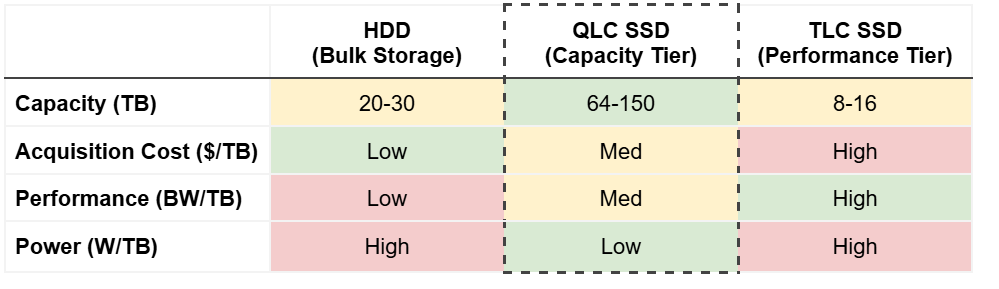
The primary payoff of QLC is byte density at the drive and server level. Meta's target for a QLC-based server is 6x the byte density of its densest current TLC server. Even though expected bandwidth per terabyte is lower than TLC, that density requires a more capable CPU, memory, and network subsystem to fully exploit the media's capabilities.
Software Adaptations for QLC
QLC's high density and higher performance than HDD mean throughput expectations exceed anything Meta has previously handled in a single server. Sustaining that throughput across CPU cores and sockets requires careful placement of data and compute, minimizing data touchpoints, and separating I/O by type.
Pure Storage's software stack uses Linux userspace block device driver (ublk) devices over io_uring to expose storage as a regular block device, enable zero-copy data elimination, and communicate with the userspace FTL (DirectFlash software). For other vendors, the stack uses io_uring to interact directly with the NVMe block device.
QLC also introduces a significant asymmetry between read and write throughput — read performance can be 4x or more than write. Since read workloads are typically latency-sensitive, I/O delivering large read bandwidth must not be serialized behind writes. This requires building and carefully tuning rate controllers and I/O schedulers.
Future Outlook
Meta sees QLC flash as a viable optimization opportunity for storage cost, performance, and power in data center workloads. As flash suppliers continue investing in advanced fab processes and package designs and increase QLC production output, cost improvements should make QLC progressively more attractive across a broader range of workloads.