
Five Years of Open-Source Data, Now With Video
The GitHub Innovation Graph, a public dataset designed to help developers, researchers, and policymakers track global open-source activity, now covers more than five years of data through March 2025. The quarterly update extends the platform's historical record and introduces new visualization features alongside continued growth in AI and data-science-related topics.
For researchers looking to ground analysis in real-world developer activity, the Innovation Graph provides a transparent and reliable window into collaboration patterns by region and over time. The latest additions make that data easier to consume and interpret at a glance.
New Bar Chart Race Videos
The global metrics pages for git pushes, repositories, developers, and organizations now include bar chart race videos. These animations make it easy to see how regional activity has shifted relative standing over the past several years, complementing the static charts and tabular data already available.
data-visualization Breaks Into the Top 50 Topics
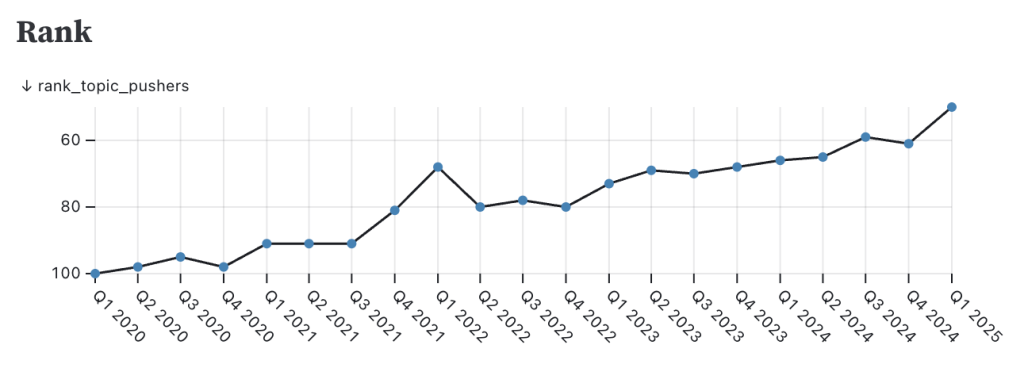
In Q1 2025, the data-visualization topic cracked the top 50 topics ranked by the number of unique pushers:

That placement represents a steady climb from rank 100 back in Q1 2020:
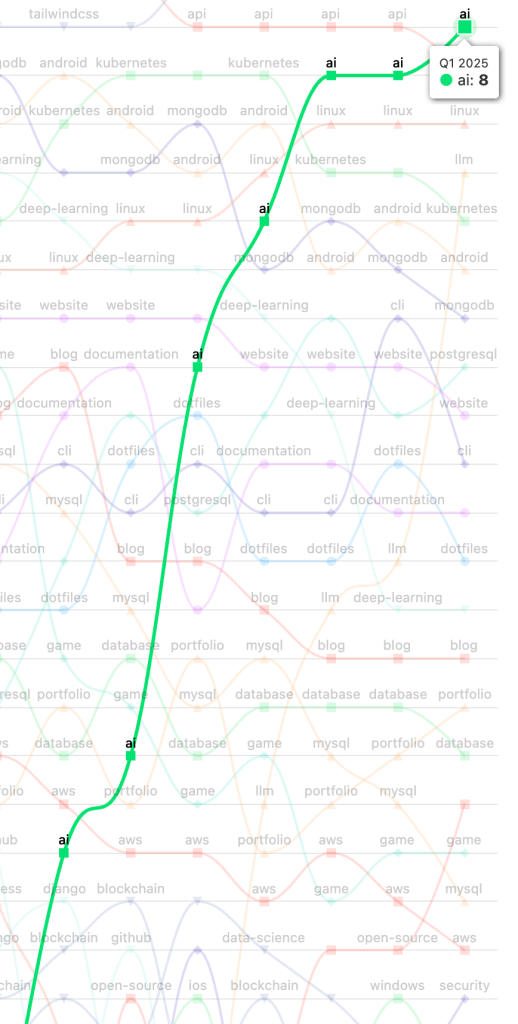
Not every topic follows the dramatic upward arc of ai:
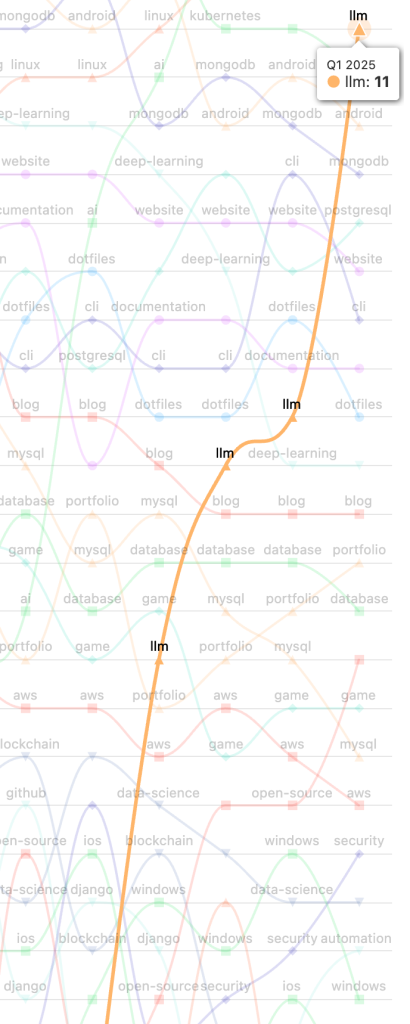
Or the meteoric rise of llm:
Notable Research Using Innovation Graph Data
Several recent papers and reports have drawn on Innovation Graph data—either as a primary source or as a validation tool—to explore topics ranging from AI adoption to startup outcomes and workforce dynamics.
Stanford's 2025 AI Index Report
The Stanford Institute for Human-Centered AI (HAI) published the AI Index Report, an annual synthesis of AI development trends for businesses, policymakers, and the public. Section 1.6 of the report uses public AI-related software project data from GitHub to show a sharp uptick in activity during 2024.
Maslej, Nestor, Loredana Fattorini, Raymond Perrault, Yolanda Gil, Vanessa Parli, Njenga Kariuki, Emily Capstick, Anka Reuel, Erik Brynjolfsson, John Etchemendy, Katrina Ligett, Terah Lyons, James Manyika, Juan Carlos Niebles, Yoav Shoham, Russell Wald, Tobi Walsh, Armin Hamrah, Lapo Santarlasci, Julia Betts Lotufo, Alexandra Rome, Andrew Shi, Sukrut Oak. “The AI Index 2025 Annual Report,” AI Index Steering Committee, Institute for Human-Centered AI, Stanford University, Stanford, CA, April 2025.
Corporate Accelerators and Startup Funding
New research examining the impact of corporate accelerator programs found that participating startups saw future funding increase by more than 40%. Innovation Graph data was used as a proxy for regional technical labor capacity in the analysis.
Impink, Stephen Michael and Wright, Nataliya and Seamans, Robert, Corporate Accelerators and Global Entrepreneurial Growth (June 12, 2025). Columbia Business School Research Paper No. 5291626, HEC Paris Research Paper No. SPE-2025-1572, Available at SSRN: https://ssrn.com/abstract=5291626 or http://dx.doi.org/10.2139/ssrn.5291626.
Linking Programming Languages to Career Outcomes
Researchers used StackOverflow data to build a comprehensive taxonomy of software development tasks and career trajectories. A key finding: Python developers are more likely to move toward higher-wage tasks, likely because the language’s versatility makes it easier to acquire skills in unrelated domains. The team turned to Innovation Graph data to verify that the language distribution among StackOverflow users reflects the broader developer population.
Feng, X., Wachs, J., Daniotti, S. and Neffke, F., 2025. The building blocks of software work explain coding careers and language popularity. arXiv preprint arXiv:2504.03581.
Measuring the Reach of AI-Assisted Coding
By training a classifier to recognize AI-generated Python code, researchers found that AI was responsible for 30% of Python functions committed to GitHub by developers in the US. Those contributions accounted for a 2.4% rise in quarterly commit volume, translating to an estimated $9.6–14.4 billion in annual economic value.
Daniotti, Simone, Johannes Wachs, Xiangnan Feng, and Frank Neffke. “Who is using AI to code? Global diffusion and impact of generative AI.” arXiv preprint arXiv:2506.08945 (2025).
A Framework for Gauging Societal AI Readiness
A recent ICML workshop paper outlines a framework for assessing societal capacity to cope with advanced AI, organized around vulnerability, resilience, and transformation indicators. The authors cite the Innovation Graph as a recommended source for estimating a society’s human capital in cybersecurity specifically.
Milan M. Gandhi, Peter Cihon, Owen C. Larter, and Rebecca Anselmetti. 2025. Societal Capacity Assessment Framework: Measuring Advanced AI Implications for Vulnerability, Resilience, and Transformation. In ICML Workshop on Technical AI Governance (TAIG). Available at https://openreview.net/forum?id=8gn9NeL0Ai.


