
Rebuilding a Conference Business Around Live Online Workshops
When the pandemic forced Smashing Magazine to cancel its in-person events in March, the company had to pivot quickly. As a fully independent operation without outside investment, there was no safety net — the situation demanded an immediate response.
The decision was to take the company's front-end and UX workshops online. The webinars Smashing had experimented with back in 2013–14 had been abandoned due to poor tooling and unreliable connections, so the team approached the new effort as a fresh design challenge rather than a revival of that format.
Getting it right meant understanding what would justify the price of admission when so much high-quality prerecorded content is freely available. Smashing conducted user research with eight people who had attended past conferences or were Smashing Members. The answer that emerged was a live, authentic experience: a scheduled time and place for attendees to connect globally, ask industry experts questions in real time, and participate in group exercises, live coding, debugging, and designing sessions.
Sessions Split Across Weeks
The interviews revealed that attendees did not want long stretches of screen time. So workshops were divided into two-and-a-half-hour sessions spread over several weeks — typically running Thursday and Friday for three consecutive weeks. Each session consisted of a couple of hours of focused content followed by a dedicated 30-minute Q&A period.
Spacing sessions out across weeks rather than packing them into consecutive days gave attendees time to absorb material, complete homework at their own pace, and bring questions back to the group in a comfortable environment.
Tooling and Support
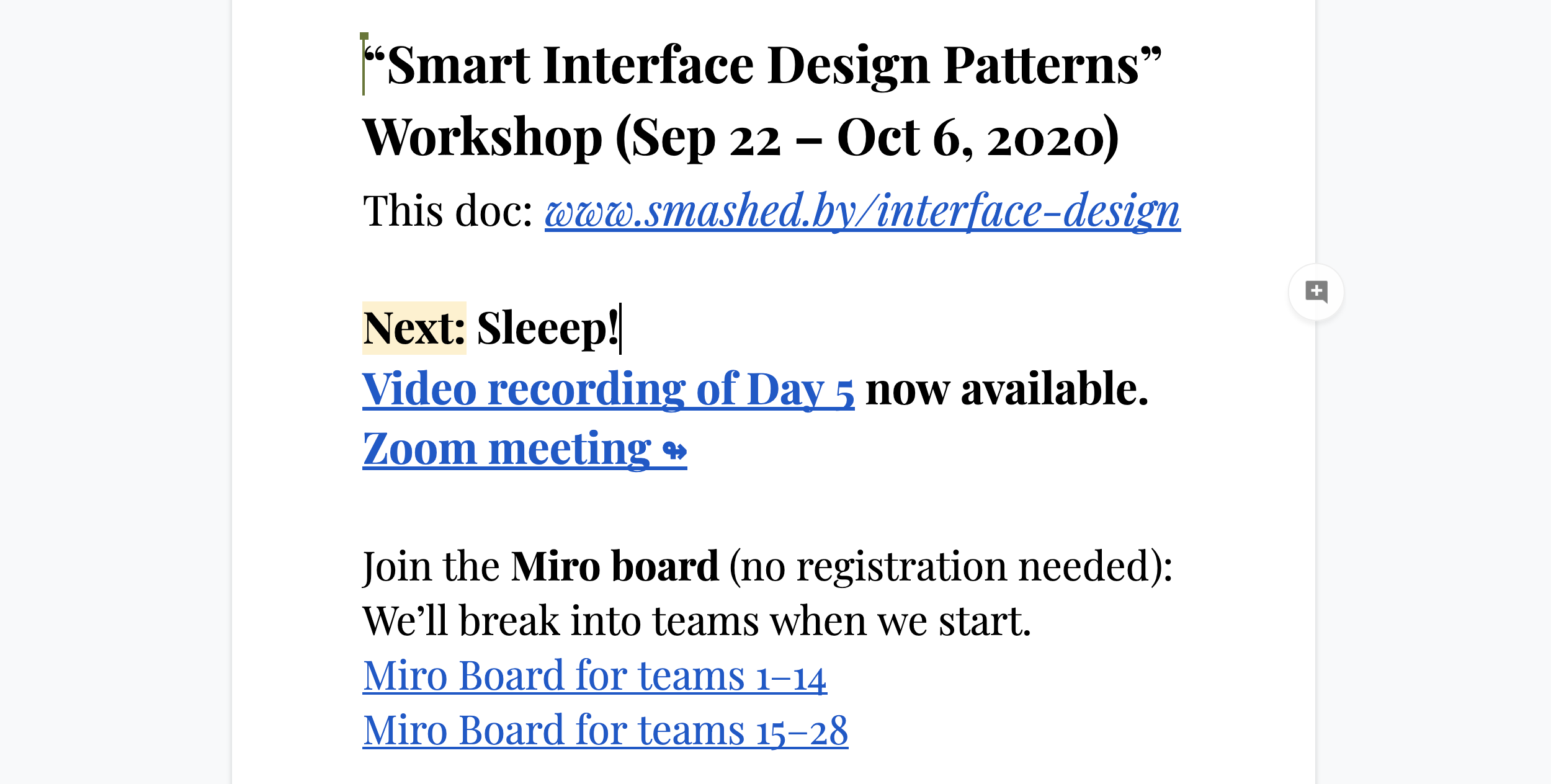
After testing nearly every video conferencing option available, Smashing settled on Zoom as the only fully accessible solution, with keyboard navigation and subtitles supported out of the box. A Slack channel was set up for each workshop so attendees could introduce themselves, share resources, and stay connected between sessions.
Each workshop also included a collaborative Google Doc containing links, video URLs, slides, and resources, where participants could take notes together and ask questions between sessions.

Every session had a dedicated team member — Beth, Amanda, or Jan — handling technical issues from missing URLs to frozen cameras, so the instructor could focus purely on teaching. This administrative support proved vital for maintaining a smooth experience.
[[BLACK_2]]Pricing and Timing Considerations
There was pressure to keep online content cheap, but Smashing also needed to fairly compensate instructors. The company settled on a 50/50 revenue split with workshop coaches, reasoning that preparing and delivering the same content online involves the same effort as in person.
Ticket prices matched in-person workshops: $350 early-bird and $450 regular for five two-and-a-half-hour sessions. The pricing was validated through usability interviews and sold out quickly.
Timing was another careful decision. With large audiences in both North America and Europe, Smashing settled on 6 PM Berlin time — noon in New York and 9 AM in San Francisco. Some workshops run in the European morning to accommodate attendees in the Asia-Pacific region.
Adjusting for the Virtual Environment
Online interaction moves more slowly than in person. Attendees may need time to settle in or contend with technical problems, and English is not everyone's first language across this global audience. Group exercises require time to switch between tools and windows, and participants tend to prefer chat for questions rather than speaking aloud.
The practical consequence: an online workshop runs about 10–15% slower than an in-person event, and instructors should expect more questions than in a physical venue.
Video recordings of each session were made available to attendees within hours of the session ending — the interviews identified quick access to recordings as critical, since work-from-home responsibilities can prevent full attention during live sessions.
Collaborative Exercises at Scale
Group design challenges presented a particular challenge for groups of up to 90 people. The requirement was to avoid forcing attendees to create new accounts while keeping a low learning curve for contributions. Smashing settled on Miro, a digital whiteboard tool that requires no registration to join a shared board.
The setup evolved into a Miro board with a central area for instructor guidelines and notes, surrounded by numbered tables arranged clockwise. Each table seats three or four attendees, with individual spaces for sketches and notes. Sessions begin with attendees joining the board and taking a seat by adding their name to their card.
Other instructors adapted in their own ways — some used Trello for shared notes and resources, while others used CodePen for live technical exercises. Cassie Evans' SVG Animation workshop, for example, produced a lively collection of animated critters from students.
Results and Lessons
The format worked, and the transition became essential to keeping the company viable. The most gratifying outcome was reaching people who could not otherwise attend — the virtual setting eliminated geographical barriers entirely.
What made the experience unexpectedly authentic was the shared environment. Everyone sits in familiar surroundings, using everyday work tools, connected through chat and video. The distance between attendee and speaker largely evaporates in this context.
Attendee feedback mirrored in-person workshop responses, which serves as the clearest validation. The content stays the same — only the setting and the pacing shift.
Looking Ahead: The Future of Online Workshops
After roughly 20 online workshops so far, with more scheduled in the coming months, the format has proven itself. Smashing Magazine intends to keep running online workshops at the same frequency, even once in-person events are viable again. The online model has opened up new possibilities that weren't previously on the table.
The appeal is personal as much as professional. The workshops have attracted a notably diverse and international audience, bringing a level of authenticity that's hard to replicate in traditional settings. For the team, that mix of perspectives has made each session genuinely compelling to run.
Reference Materials & Related Reading
- Counting Down To Bundles Of Smashing Joy And Workshops In 2021
- How To Become A Better Speaker At Conferences
- What I Wish I Knew About Working In Development Right Out Of School
- How To Design Effective Conversational AI Experiences: A Comprehensive Guide
 (cm, og, ra, il, mrn)
Explore more on