

What Counts as a Dark Pattern?
Before building a case against dark patterns, it helps to pin down the term. The definition used here comes from a previous article on the subject:
“User interface elements that have been carefully crafted to trick users into doing things they might not otherwise do, often utilizing psychological manipulation.”
The distinction matters. Annoying UI — say, an aggressive overlay — is not automatically a dark pattern unless it deliberately deceives the user into an action they wouldn't otherwise take. Keeping the definition narrow also keeps the arguments below applicable; a loose definition would stretch the business case too thin.
Why the Ethics Argument Falls Flat
Most people reading this are already convinced dark patterns are wrong. Colleagues and clients frequently are not. The reason often has little to do with moral blindness: stakeholders are under real pressure. Business owners worry about cash flow; marketing executives face relentless targets. In that climate, ethical objections are easy to rationalize away — people convince themselves nobody is being forced to do anything.
If the ethical argument won't move them, the business argument might. Three factors make dark patterns a poor choice for any company that cares about long-term revenue.
- Modern consumers are cynical, well-informed, and have endless alternatives.
- The web has put genuine power in consumers' hands.
- Dark patterns carry hidden costs that rarely appear in the metrics that got them approved.
Consumers Know They're Being Manipulated
Manipulative sales techniques predate the web by decades. The difference is that consumers used to be ignorant of them and had few alternatives anyway. Neither is true today.
A customer's phone holds instant access to every competitor selling the same product. Switching is trivial, and one annoying experience is enough to trigger it. A cynical stakeholder might respond that if the manipulation goes unnoticed, no annoyance occurs. That assumption is wrong.
Consider a usability test on a hotel booking site that used dark patterns. The participant commented that he hated the manipulative techniques on the page. Asked why he still used the site, he said he simply ignored them. He probably didn't — the tactics likely influenced him on a subconscious level. But critically, he was aware the site was trying to manipulate him, and that awareness created genuine resentment.
Users are savvier than many assume. They read about Facebook's psychological experiments and government action against hotel booking sites. They know websites attempt to manipulate them, and that knowledge alone pushes them toward competitors.
The Power of One Angry Customer
The web has given consumers a platform, and companies consistently underestimate the damage one person can do. The story of Hasan Syed illustrates this well. Unhappy with British Airways, he bought a promoted tweet that read:
“Don’t fly @BritishAirways. Their customer service is horrendous.”
The backlash reached the BBC, the Guardian, Fox News and other major outlets. When dissatisfied users organize collectively, the stakes rise further — the Cambridge Analytica fallout and subsequent government scrutiny of Facebook is a case in point. Public pressure has even pushed regulators like the UK's Competition and Markets Authority to act, with the CMA announcing enforcement action against misleading sales tactics in online hotel booking.
Worse still, online criticism is permanent. It surfaces in search results years later, amplified by review platforms designed to make complaint easy.
The business consequence is straightforward: lost repeat revenue, higher acquisition costs, and lasting brand damage.
The Costs You Can't See
Dark patterns do work in the narrow sense — they boost conversion. But the revenue they generate can be dwarfed by costs that never show up in the e-commerce dashboard.
A company selling kettles decided to sneak a water filter into shoppers' carts at checkout. Sales of filters rose sharply, and the e-commerce team celebrated. Elsewhere in the business, though, the picture looked different. Social media staff spent hours responding to complaints. Customer support fielded a surge of calls about refunds, each call costing £3.21 — more than the filter's profit margin. Returns processing added still more expense.
The pattern holds broadly: dark patterns are rarely as profitable as they first appear, and the costs are distributed across teams that don't share the conversion target.
An academic case against dark patterns can be persuasive in principle. But stakeholders often need something more tangible — a clear-eyed account of how manipulation undermines the very business goals it is meant to serve.
Building a Case That Sticks
If dark patterns are already in use, the moral argument alone rarely wins the day. You need evidence, and that means digging for it. The good news is that the material you need is usually already inside your company — you just have to know where to look.
Mine Public Complaints
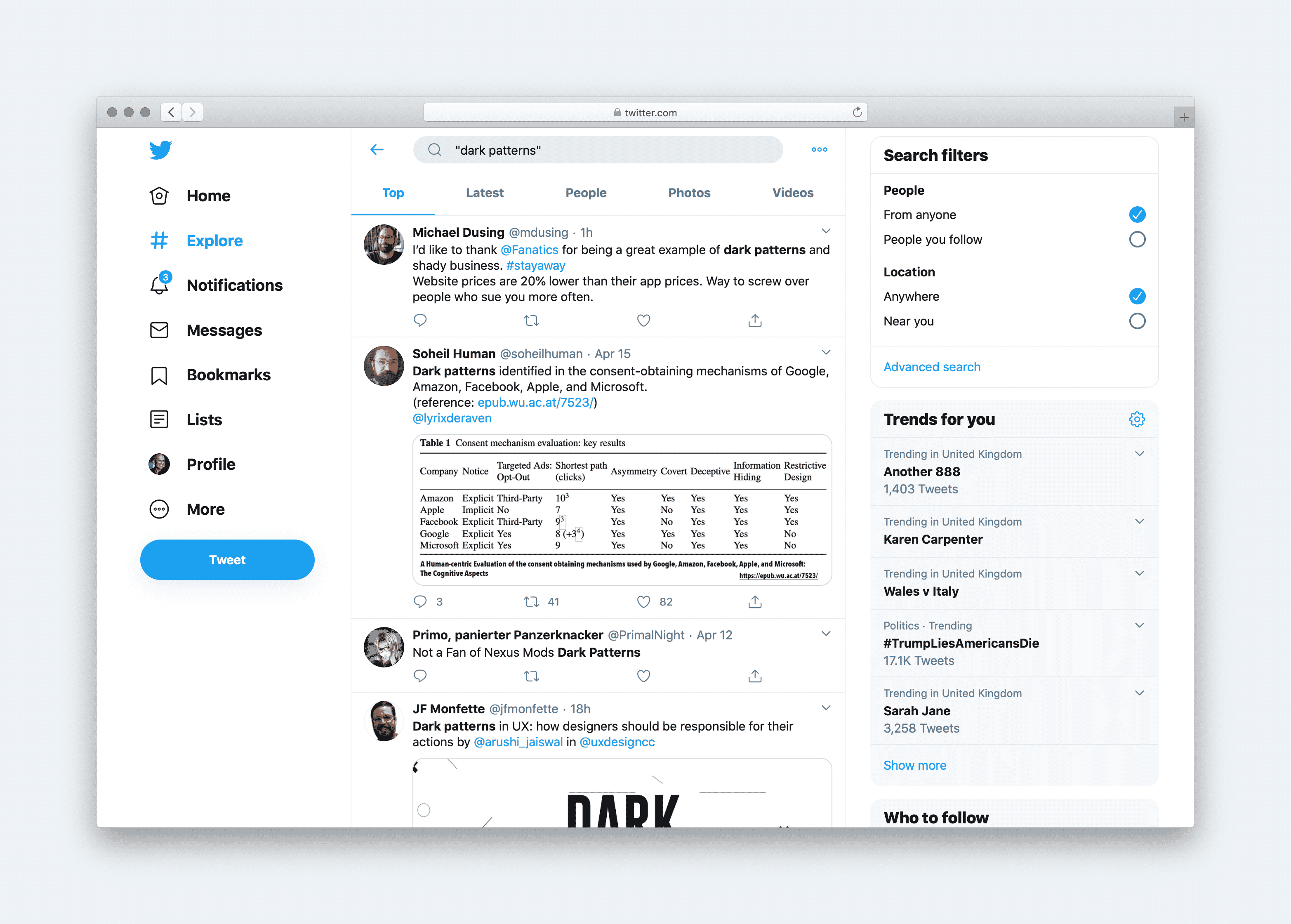
Start by searching for negative comments about dark patterns and your website. A lack of public complaints doesn't mean users are happy — it often just means they haven't vented yet. But when you do find complaints, they typically represent the silent dissatisfaction of a much larger group.
Talk to the Front Lines
Customer service, returns, and marketing teams interact with users daily. Ask them whether they’ve noticed any shifts since the dark patterns were introduced. Hidden costs — extra support tickets, higher return rates, or lost repeat business — often show up first in these departments, just as they do with the faulty kettle example.
Watch Real Users Struggle
Run usability sessions where participants interact with your site naturally. Avoid steering them toward the dark patterns by asking direct questions. Instead, ask whether anything on the site annoys them or feels off. Record these sessions; nothing convinces a stakeholder faster than watching a real user’s frustration in real time.
Run an Exit-Intent Survey
A simple one-question survey triggered on exit-intent can be revealing. Ask users why they decided not to take action, and provide a list of options. One of those options should be something like “the site felt manipulative or untrustworthy.”

If respondents select that option, you have direct evidence that users perceive the dark patterns and that those patterns are hurting conversions. The data becomes even stronger if you can compare responses between users who encountered dark patterns and those who didn’t.
The most persuasive evidence, however, connects dark patterns to financial loss. That link isn’t always precise, but you can estimate it. Suppose one in ten exit-intent respondents says they left because the site felt manipulative. That suggests removing the dark patterns could recover 10% of lost actions. Multiply that by your average order value, and you have a concrete dollar figure to present to leadership asking why the techniques should go.
That estimate may not be airtight, but it’s enough to make stakeholders pause — provided you present it well.
Timing and Tone Matter
One common mistake is bringing up dark patterns in a confrontational way, especially in a meeting where the person who championed them is present. Public criticism makes people defensive, and defensive people don’t change their minds.
A better approach is to speak with each key stakeholder individually. This avoids putting anyone on the spot and lets you tailor your argument to their concerns. A marketing lead may care about brand damage, while a finance person will respond to the hidden costs you’ve uncovered.
Most importantly, approach the conversation with sensitivity. Don’t imply that anyone was wrong to try dark patterns — that framing invites resistance. Instead, present the evidence you’ve gathered and the research you’ve done. Frame it as a nuanced issue requiring a careful balance. Be conciliatory, not accusatory.
This approach won’t work every time. But it will get you further than lecturing colleagues about ethics or implying their methods are unethical.
Further Reading
- “Design Patterns: Better Navigation UX With Navigation Queries,” Vitaly Friedman
- “Releasing The Ethical Design Handbook When We Needed It Most,” Ari Stiles
- “How To Build An Ethical User Research Practice At Any Organization,” Devin Harold
- “Pushing Back Against Privacy Infringement On The Web,” Robin Berjon



