Research Frequency Still Lags Behind Its Perceived Value
Product teams broadly agree that user research deserves a place at every stage of development. In a survey of more than 600 product professionals conducted for Maze's Continuous Research Report, developed with Atlassian, 83% of respondents said research should be conducted throughout the product development lifecycle.
Practice tells a different story. Only 36% of digital product teams perform research after launch. And 60% talk to customers no more than once a month, even though product decisions are made daily. That gap helps explain why 78% of respondents believe their companies aren't doing enough research or could do it more frequently. The usual obstacles: time, budget, respondent recruitment and tooling.
The stakes are measurable. Among survey respondents, 57% said research has a positive impact on customer satisfaction scores, 55% on product or feature adoption, 46% on active users, and 42% on revenue or profitability.
What Continuous Discovery Actually Looks Like
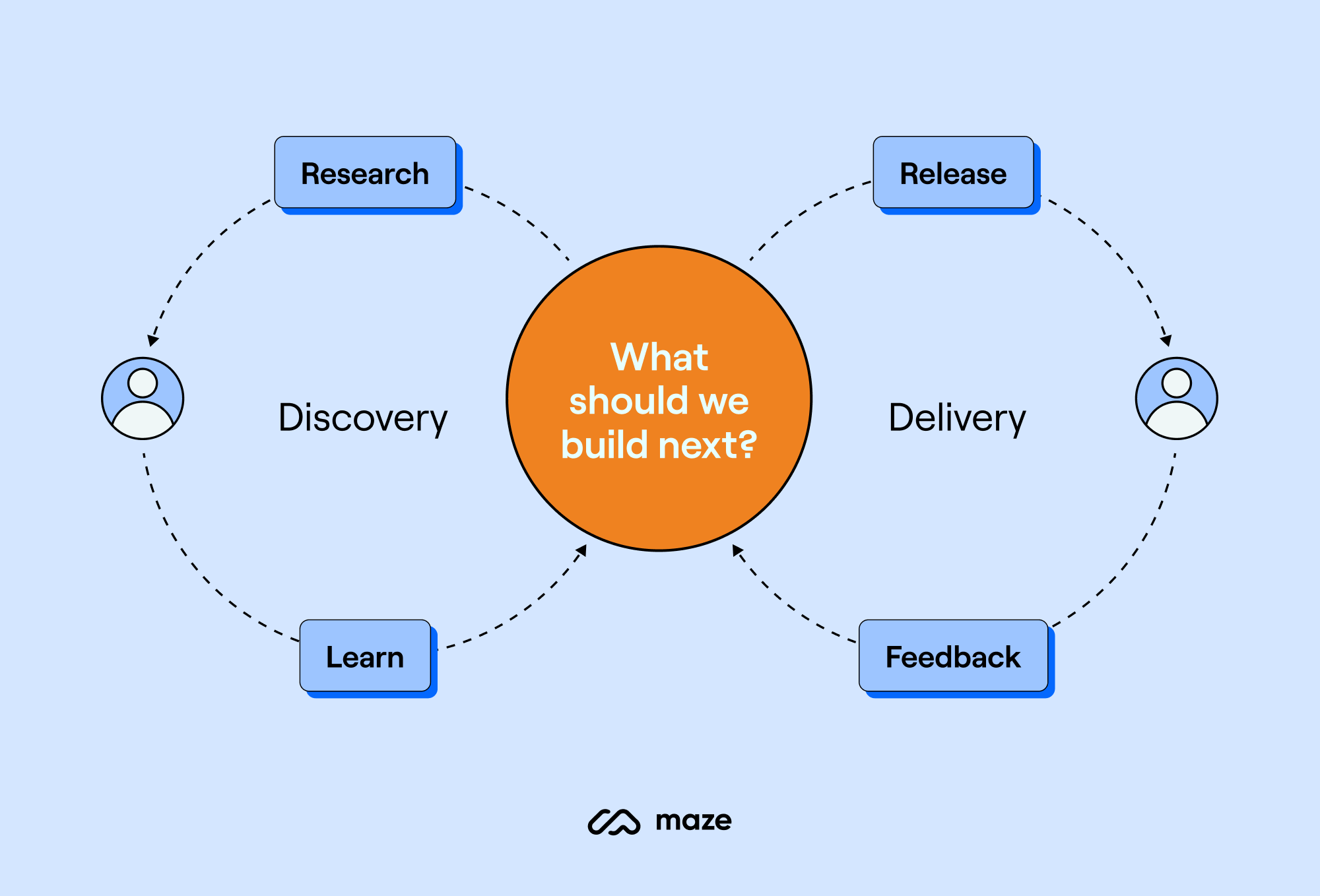
Continuous product discovery is built on a cycle of activities that repeat rather than terminate:

The distinction matters because too many organizations front-load research. Rachel Lynch, Research Manager at Productboard, points out the consequences:
"Many research resources are being put into the design process, problem discovery and solution testing, but not so much into post-launch reviews. I think that's a huge gap and a missed opportunity because you only know if something will work once you launch it. You should be using those same research tactics to try and figure out if you were successful once something has gone live."
Products are never finished — they are continuously debugged, updated and improved. Research should follow the same arc, drawing lessons from one release and applying them to the next.
A Product That Listens Stays Relevant
Research in the early stages reveals who your target users are, what they expect and what they hesitate about. But user needs evolve. Industries shift. Xiangyi Tang, Head of User Research at Pitch, frames ongoing research as a competitive necessity:
"Product organizations need to truly understand their customers to be competitive. With continuous research, they can constantly course-correct to work on the right problem and provide the right solution."
Consider product teams building software for the restaurant industry. Disruption has reshaped that market in recent years. Teams that reviewed market changes regularly with users could update their products accordingly or pivot before slower competitors. Continuous research functions as a form of active listening — the mechanism by which new features are developed, products are pivoted, or entirely new products are born in response to what users are saying.
Validation Before You Build
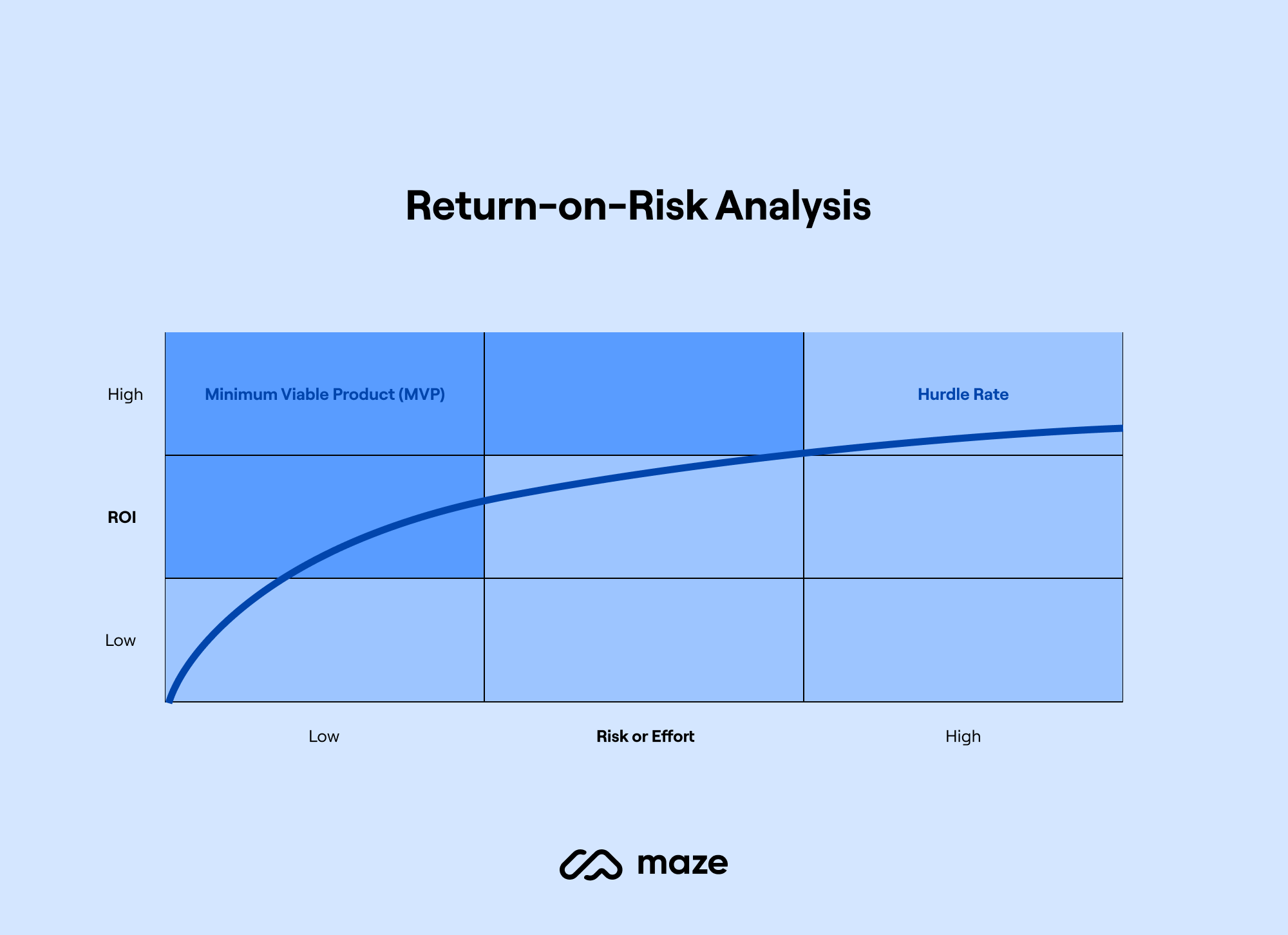
An MVP is a scaled-back product built with only the core features users need to derive value. Continuous research is what lets teams validate and refine product ideas before committing to development. The payoff is considerable: fixing an error after launch can cost up to 100 times more than catching it during development.
The illustration shows how smaller initial investments keep risk low, and how the effort to recover from a faulty product stays low as well. By focusing development on core features and then testing continuously, a product can evolve naturally into its best self — without burning resources on features no one needed.
Decisions Get Better With More Frequent Research
Survey data shows a direct relationship between research cadence and decision quality. Teams that conduct research weekly or daily report more effective decision-making than those doing it quarterly or yearly.
Overall, 74% of product professionals say research is effective or partially effective in shaping organizational decisions, while 14% call it highly effective. Delving into how that data is used:
- 42% of product professionals use data to inform all of their product decision-making.
- 49% of organizations use research findings for strategic decisions.
- 60% say recommendations from findings inspire new product opportunities.
The data from any single product has organizational reach. Lucy Denton, Head of Design at Dovetail, sees untapped potential beyond product roles:
"Today, research is really focused on understanding the user experience, which directly fits into the experience design of the product. It would be interesting to see how companies evolve to focus more on the customer in other functions like marketing, sales or customer support. They all talk to customers and need to understand the customers to do their job."
An ongoing stream of research can serve those functions too — reducing reliance on assumptions at every level and keeping the whole organization pointed at the customer.
Research at the Company Scale
Organizations are responding to the need for ongoing insight by spreading research responsibilities beyond dedicated researchers. Designers (69%), product managers (54%), marketers (28%) and even engineers (10%) now conduct research at their companies. This democratization lets more teams uncover customer needs directly, instead of outsourcing insight to a single function.
The most successful digital products receive ongoing updates and refinements, and are informed by data collected long after launch. When research is a continuous practice rather than a phase, products stay in sync with users, assumptions get replaced by evidence, and decision-making improves across the company.
Turning Discovery Into a Habit
Product discovery coach Teresa Torres frames the shift in modern product development as a move away from internal guesswork. “Historically, businesses made discovery decisions by just sitting in a room and thinking ‘what should we build?’ Over the last 20 years, we’ve seen an evolution toward including the customer a lot more in the process.”
The practical challenge is making that customer input a regular, structured part of how a team works, rather than a one-off event before launch. The following habits can help institutionalize continuous discovery.
Put It on the Calendar
The biggest hurdle is simply making time. Teams that run research monthly or more often rate it as more effective than those operating on a quarterly or yearly cadence. Torres recommends a weekly minimum: “at a minimum, weekly touchpoints with customers by the team building the product, where they’re conducting small research activities in pursuit of a desired product outcome.”
Start with a recurring 30-minute block if that’s all you can spare, then scale up as the habit takes hold.
Budget for Research From Day One
Research should not be an afterthought bolted onto a project. Post-launch validation and ongoing learning belong in the project proposal, timeline, and budget from the start. When research is scoped in from the beginning, it reads as a continuous learning cycle, not as a disconnected series of studies.
Choose Tools That Fit the Workflow
Tooling is often the limiting factor for teams trying to sustain a discovery cadence. The UX research tool market has expanded considerably, and platforms now bundle many of the capabilities researchers need. Maze, for example, is a continuous product discovery platform that combines prototype testing, surveys, card sorting, video recordings, participant recruitment, and automated reporting. The goal is to pick platforms that align with your development lifecycle and the mix of methods you intend to run.
Mix Methods With Intent
You don’t need to run every research method to get value. The trick is matching the method to the question at hand. Useful distinctions to keep in mind:
- Primary vs. secondary: primary data comes directly from your end users; secondary data draws on existing industry information.
- Qualitative vs. quantitative: qualitative research captures opinions and feelings to explain the “why” behind user behavior; quantitative research delivers numerical data to answer “what,” “where,” or “when.”
- Evaluative vs. generative: evaluative research tests a product or concept to improve a solution, while generative research builds a foundational understanding of users and the problem space.
Combining different approaches gives a fuller view of user behavior and can stretch your budget. For instance, you may opt for unmoderated studies or panels over moderated sessions that require live facilitation, depending on the objective and available resources.
Open Research Up to the Whole Team
Product managers, designers, marketers, sales, and support staff all have a stake in user insights, so research shouldn’t be siloed within a dedicated UX team. Atlassian’s Research Lead Caitlin McCurrie makes the case for democratization: “While I strongly believe that dedicated research professionals are a necessary component for a successful tech company, there will never be enough researchers to cover the range and volume of research needs within an organization. We will always need our teammates to engage in some form of research—whether collaborating with a dedicated researcher or running their own studies.”
Beyond just volume, involving multiple roles means the same data gets examined from different angles, often surfacing findings a single researcher might miss.
The Compound Effect of Regular Research
Many teams run research at the discovery stage or during validation, then stop after launch. The payoff of continuous research comes from repeating that cycle: every user interaction is another opportunity to find improvements, and the benefits accumulate far beyond what a single study can deliver.