
Most of what people read and publish online now lives inside a handful of large platforms. Twitter, YouTube, and Facebook-owned services dominate both content discovery and sharing. This arrangement lets anyone join a global conversation without paying for hosting or infrastructure. The catch: when a platform shuts down or pivots, everything users created there can disappear, a pattern the IndieWeb community documents extensively.
The IndieWeb offers a different path: build your own personal website, own your identity and content, and learn by making things for yourself. For developers, this approach doubles as a practical education in web fundamentals and a way out of platform dependency.
The Costs Of The Corporate Web
The "corporate web" describes the current state where a few large companies mediate most online activity. Their business model depends on capturing user data for advertising, and their products are engineered to maximize engagement, not user well-being. The platforms are free in monetary terms, but they require constant algorithmic curation to keep people active — and that curation is not designed to serve users' interests.
The downsides become obvious once you rely on these platforms for professional growth. Social media lets developers follow industry peers and learn from their shared content, which can be genuinely valuable early in a career. But over time, platform algorithms begin deciding what appears in feeds, introducing posts users never subscribed to. Taking a break from social media means missing everything shared during that time, with no practical way to catch up. Search functionality rarely helps you find something you glimpsed weeks prior.
Sharing has its own problems. There is constant pressure to follow trends and build with the latest tools, not because they solve real problems, but to stay visible to potential employers. Platforms impose character limits, moderation policies, and feedback mechanics that make publishing feel intimidating. And platform rules can change at any moment: accounts have been removed due to corporate legal decisions, taking down a user's content and identity with them.
For people in geopolitically restricted regions, some platforms are entirely inaccessible. The result is a system where users lose control over what they see, when they see it, and whether their own work stays online.
Why Own Your Content
The central IndieWeb principle answers the ownership problem directly: put your content on your own domain, where no corporation can revoke access to it. Your identity lives in one canonical place rather than being split across disconnected platform profiles.
This shift is remarkably freeing. Instead of building things aimed at maximum audience size, you build for yourself first. That reverses a common developer habit of judging work by its reach. Publishing on your own site removes the pressure of seeking validation through a platform's metrics. A personal blog can be about documenting your process, including beginner-level material you might otherwise hesitate to publish.
The IndieWeb also emphasized community and open-source contribution in ways that matter for learning. Editing wiki pages, filing GitHub issues, organizing meetups, and giving talks are all ways to participate — and they are activities that build real skills. For many, this fosters a sense of belonging that is harder to find in the corporate ecosystem's one-way consumption model.
A Brief Introduction To IndieWeb Principles
The IndieWeb emerged as a recognized movement around 2017, when talks like Jeremy Keith's tour of IndieWeb building blocks started reaching wider audiences. It is a community of personal website owners who share a set of principles and tools for re-creating social interaction without centralized platforms.
Its defining tenets include:
- Taking ownership of your identity — maintaining one canonical personal domain instead of scattered accounts.
- Using tools you built yourself — making and actively running your own software for your own needs.
- Documenting your journey — publishing what you are learning at whatever level, without shame about being a beginner.
- Contributing to open source — helping others improve their sites, and building community through code, documentation and events.
IndieWebCamps As A Learning Environment
Community meetups called IndieWebCamps give participants hands-on time with their personal sites. These events are dedicated work sessions for improving your own build, solving problems, and asking for help from people who have found and fixed similar issues. The format aligns with the community's core ethos: progress the web by practicing on your own corner of it, side by side with others doing the same.
Over time, this leads to a sense of ownership that no platform can match. Learning happens through long-term engagement with a project you operate every day — choosing the stack, writing content, fixing issues — rather than consuming others' work through a feed.
A Personal Site As A Learning Tool
Building a personal website from scratch is a rare opportunity in a corporate job, where changing "base code" or choosing a framework can be a bureaucratic ordeal. For many developers, the chance to handcraft every element inside a <head> tag is a refreshing departure from the countless discarded "Hello world" experiments. When the product being built is yourself, the stakes and the rewards feel different.
A full from-scratch build is not mandatory for an IndieWeb presence. Services like Micro.blog support IndieWeb hosting, and established CMS platforms such as WordPress have IndieWeb integration. For those who want more control, static site generators are a popular middle ground. Eleventy, for example, is a common choice among IndieWeb users; many publicly share their site code on GitHub, which makes it easy to study and adapt existing approaches.
Building a personal site forces a refresh of foundational skills: HTML, accessibility, and CSS, with the freedom to experiment with modern features without approval. The process of IndieWebifying a site introduces a useful set of standards and concepts:
- Jamstack — a stack that generates static code with no dependence on a web server;
- Microformats — HTML extensions that represent common published items like people, locations, and posts, providing an API to site content;
- Micropub — a standard API for creating content on a website;
- Microsub — a standardized way for reader apps to interact with feeds;
- Webmentions — a standard for notifying another site of an interaction;
- IndieAuth — a federated login protocol enabling sign-in to other services using your own domain.
Owning content naturally leads to interest in connecting with APIs of established platforms and automating syndication, a practice known as POSSE. Automation is optional; publishing on your own domain and manually sharing a link on Twitter already adheres to the core principle. For those who want to automate, tools like IFTTT can connect an RSS feed to Twitter, and many developers share their own custom syndication builds on GitHub.
The learning loop extends beyond posting. Moving content from a corporate site back to a personal server creates motivation to optimize the build and deployment process — a type of problem that may never appear in a day job. That spirit of experimentation turns the personal site into a playground where one can break, fix, and improve without deadlines or censorship.
This ownership also shifts how writing feels. Social media can seem like a tiny stage with a massive audience, whereas a personal blog offers a larger production with a controlled audience. Without comments, the author retains control over interaction, and there is ample room for uncensored expression. As a result, many find themselves blogging more and using social media primarily as a distribution channel, accepting that an algorithm may bury content there in a way it never can on their own site.
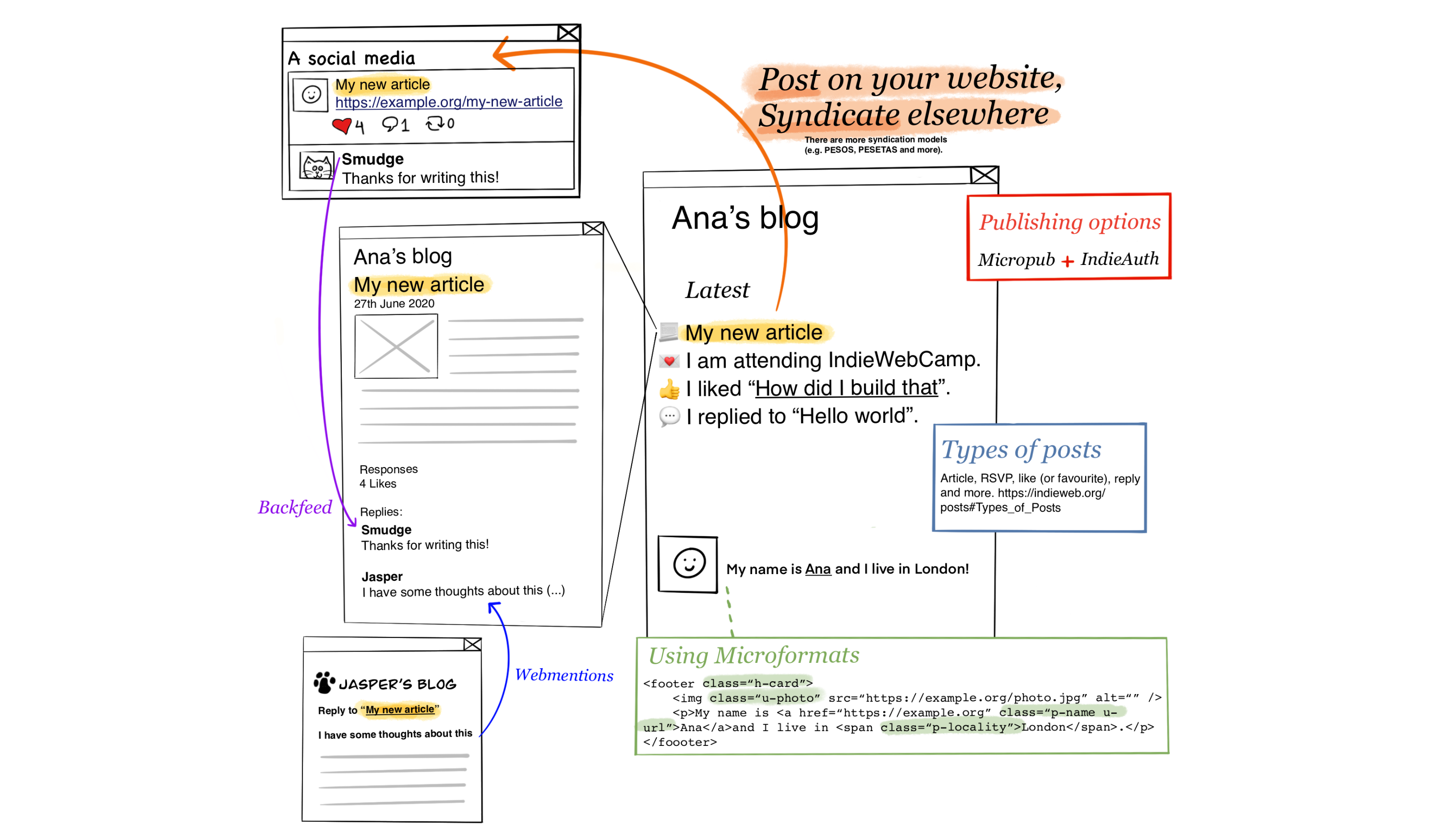
Webmentions and publisher services allow the original post to display interactions that occur on social media. This requires a Webmention endpoint. Building one from scratch is possible and well documented, but services like Webmention.io host endpoints, and tools like Webmention.app can automate sending. Bridgy goes further by sending Webmentions for likes, replies, and reposts from social platforms, enabling backfeed of those interactions to the original post.
The result is a single, fixed archive that is always available, combining the reach of the corporate web with a personalized touch. Scrolling through one's own growing archive is a source of joy, and the site remains a constant work in progress — a space to call one's own.
Getting Started With IndieWeb
The IndieWeb community is open to everyone. The first step is simple: buy a domain name and build a homepage. That alone gives the world a single, permanent place to reach you.
Participation can extend beyond building. Community members organize events, meet great creators, and engage with broader topics like privacy and ethics. Personal websites often surface content and perspectives that algorithms on social platforms would never show. The community is active with an online chat room and weekly meet-ups.
There are several welcoming entry points: the getting-started guide, IndieWebify.me, and community-authored IndieWeb Guides. Many personal blogs also publish their own introductions, each carrying a distinct voice that might align with a particular learning style.
The IndieWeb principle is that there is no single right way — only your way. It isn't about following trends; it's about building something that works for you.


