Why Ethics Is a Business Strategy, Not a Constraint
For years, the default approach to user experience has treated privacy as an afterthought. Data collection was liberal, consent was buried, and choice architecture was routinely optimized toward the company's interest rather than the customer's. The predictable result: aggressive ad-blockers, built-in tracking protection in browsers, and regulation like GDPR and CCPA that now dictate how user data can be handled.
The pressure is not going away. The question is no longer whether product teams should respect users, but how they can do so without undermining their own performance targets. That's a difficult balancing act, and it's where most organizations get stuck.
Moving Beyond Dark Patterns
The web is full of interactions engineered to extract decisions people never meant to make. Hidden checkboxes, ambiguous copy, and convoluted unsubscribe flows are common not because they are the only option, but because they have become the accepted norm. When something is normal, it feels risky to do otherwise — even when laws are changing and user expectations are shifting.
What if the ground shifts further? Consider what would happen if these trends continue to intensify:
- You can no longer access the personal data that has been feeding your marketing engine.
- You cannot track customers once they leave your website.
- Ad-blocking becomes widespread and your scripts are routinely filtered out.
- Marketing teams face legal constraints they were never trained for.
- A competitor discovers a viable business model that doesn't rely on surveillance.
- Privacy and transparency become a source of competitive advantage.
These scenarios are not hypothetical. Many business models currently thrive on deception, but only until the norm is broken. The companies that will survive that breakage are those that are already experimenting with compliant and sustainable alternatives.
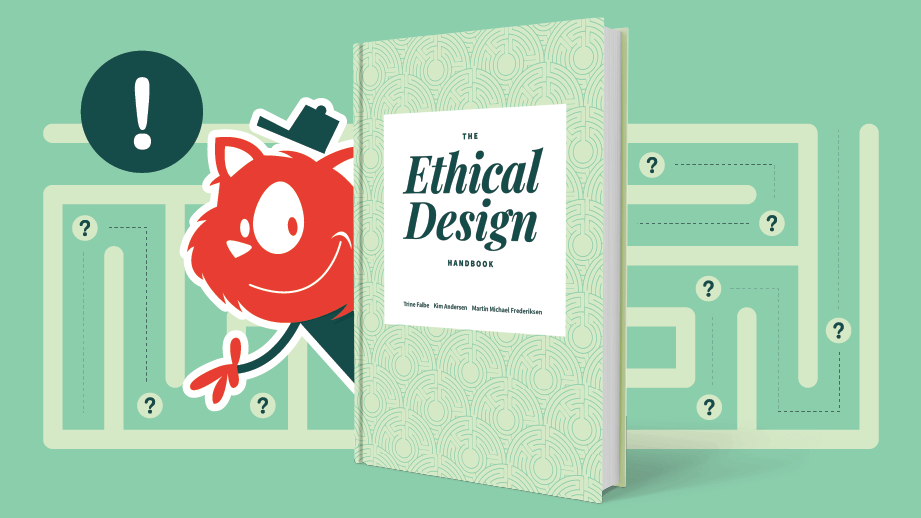
The Ethical Design Handbook is a practical playbook for that transition. It targets designers, developers, product managers, and legal or executive teams who need a concrete framework for moving away from manipulative patterns. The book outlines how businesses that embrace ethical constraints can actually become healthier and more profitable in the long run.
What's Inside
The goal of the book is to provide a working framework, not just theory. It addresses a core challenge: how to build products that respect customer decisions while keeping the business metrics healthy.
The content covers the practical side of compliance and honest design, including how to tame data collection and rewrite the ambiguous copy that often does the quiet work of a dark pattern. Strategies are grounded in the realities of GDPR and CCPA, making the guidance useful for teams who must ship products that are both user-friendly and legally defensible.
Changes have to happen at multiple levels — in the way requirements are defined, the way interfaces are designed, and the way marketing success is measured. The book connects these moving parts, walking through how a team can influence positive change from within rather than waiting for legislation to force the issue.
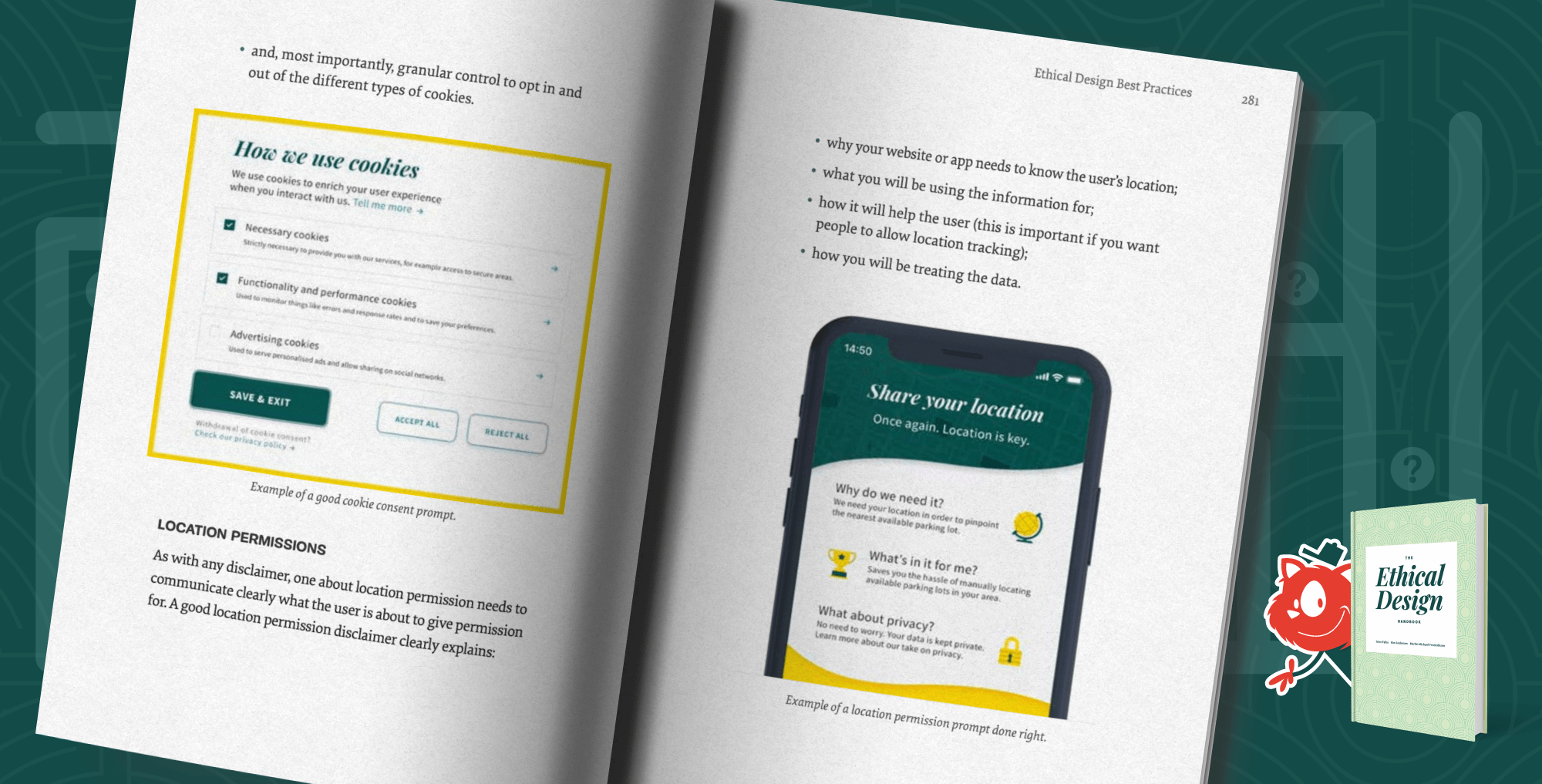
A free sample of the book is available, including a full chapter that gives a solid sense of the approach and depth covered in the rest of the volume.
What’s Inside the Book
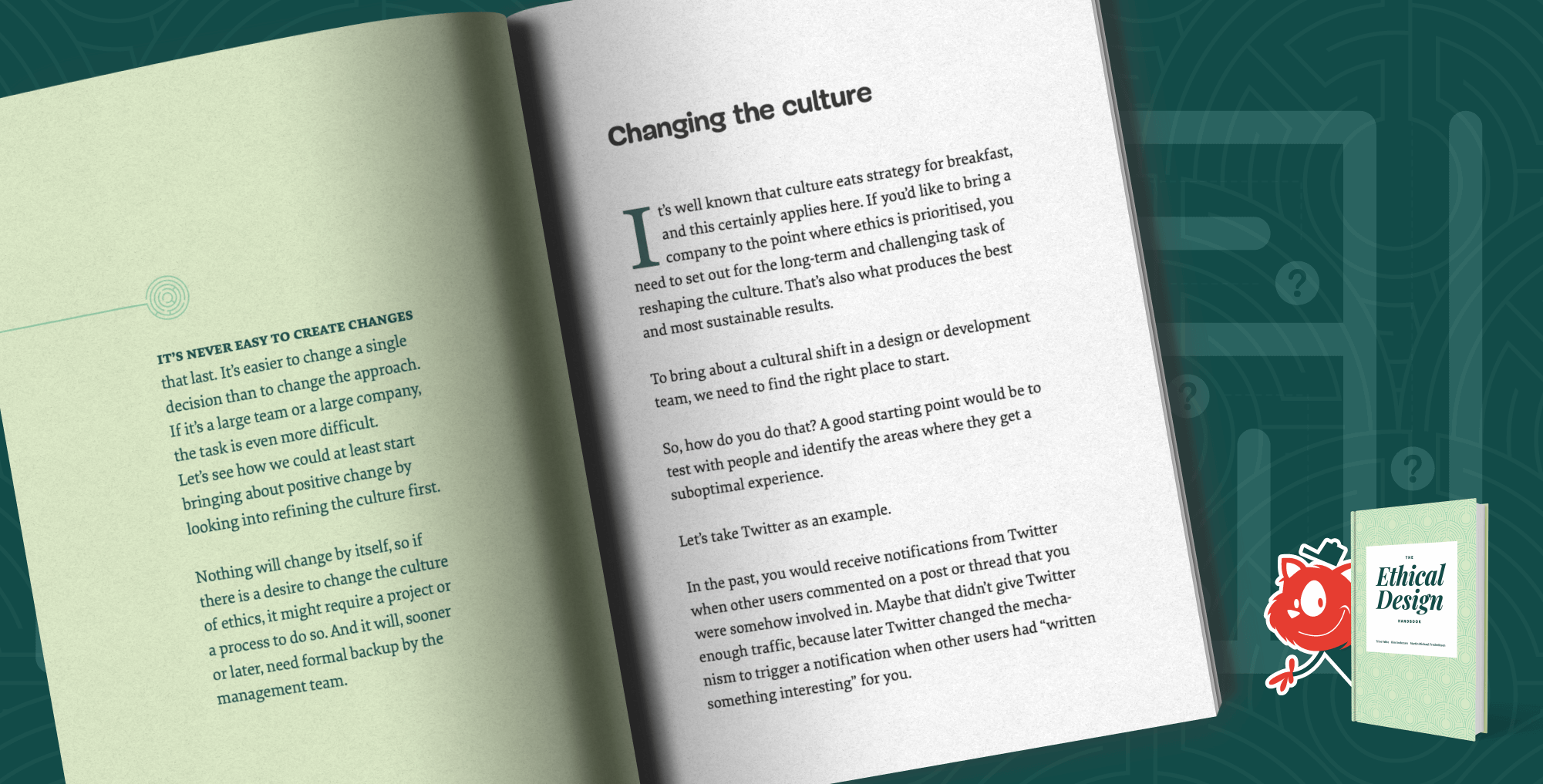
The book opens by defining ethical design in the context of modern digital business, then moves through six knowledge-packed chapters that build on each other. The authors start with how ethics fits into design practice, arguing that designers must understand the consequences of their work. Next, they explore real-world methods for making change happen within teams and companies — including how to challenge decisions, apply risk-assessment thinking, and set up ethical governance models.
Later chapters cover respect-driven design, a topic that ranges from involving users in projects to accessibility techniques and designing specifically for children. The authors then make the business case for ethics, showing how traditional metrics like KPIs and roadmap planning can measure ethical impact. They introduce The Ethical Design Scorecard, a tool for evaluating the ethical level of products and practices, and offer practical guidance on cookie disclaimers, terms and conditions, and data collection. The book finishes with blueprints and tips to help you launch your first ethical design project right away.
Here’s what readers will be able to do after working through the material:
- Define and explain what ethical design is,
- Justify and prove a business case for ethical decisions,
- Measure and track the impact of ethical design,
- Grow a sustainable business on ethical principles,
- Strike the balance between data collection and ethics,
- Embed ethical design into your workflow,
- Get started with ethical transformation.
Format, Pricing, and Availability
The book is 368 pages, written by Trine Falbe, Martin Michael Frederiksen, and Kim Andersen. The eBook is available now in PDF, ePUB, and Amazon Kindle formats, and print copies ship in early March 2020. The eBook is DRM-free and included free with a Smashing Membership. The print edition is a quality hardcover with stitched binding and a ribbon page marker, and it comes with free worldwide shipping and a 100-day money-back guarantee.
Print + eBook: $44.00
eBook only: $19.00 (free for Smashing Members)
You can download the PDF, ePUB, or Kindle versions directly. The print ISBN is 978-3-945749-83-8.
Meet the Authors
Trine Falbe is a human-centered UX strategist, designer, and teacher who works in the intersection between people and business. She is deeply passionate about ethical design and designing for children, and she speaks at conferences and advises on UX strategy in business projects.
Martin Michael Frederiksen is a serial entrepreneur with a practical appreciation for the crossroads between business and digital development. He has published the books Cross Channel and the CEO’s Guide to IT Projects That Cannot Fail, and he works as an independent consultant for businesses that need a devil’s advocate when testing new strategies and ideas.
Kim Andersen left print media for digital design after training at an international advertising agency. With a remarkable memory, he leaves design meetings with an empty notebook and returns with detailed drawings where nothing has been forgotten. He owns the digital design studio Onkel Kim, taking on design tasks that are ideally the most difficult and complex ones.
The Authors’ Note
The authors have aimed to create a focused handbook with applicable, long-living solutions and strategies to introduce positive change in companies riddled with dark patterns and questionable practices. They acknowledge there is quite a bit of work to do on the web, but their hope is that readers will be equipped with enough tooling to slowly move a company toward a more sustainable and healthy digital footprint.
The book was produced with support from the Smashing community. The eBook is and always will be free for Smashing Members, and members also get a friendly discount when purchasing the printed copy.
Technical Details
- ISBN: 978-3-945749-83-8 (print)
- Quality hardcover, stitched binding, ribbon page marker
- Free worldwide airmail shipping from Germany (check delivery times)
- eBook available as PDF, ePUB, and Amazon Kindle
- Print + eBook bundle available directly from Smashing Magazine
Further Reading
- How To Prioritize User Security When Collecting Offline Data
- Everything I Know About UX Research I First Learned From Lt. Columbo
- Build Design Systems With Penpot Components
- Scaling Success: Key Insights And Practical Takeaways
The book is part of Smashing’s ongoing effort to promote best practices in design and development. With a focus on practical, long-lasting solutions, The Ethical Design Handbook equips professionals to tackle the pressing ethical challenges in today’s digital landscape.