
UX Maturity Is an Organizational Trait
Individual skill alone will not produce great user experiences at scale. As Chapman and Plewes (2014) put it:
“Achieving great UX design is not just a function or talent of individuals, it is an organizational characteristic.”
UX maturity describes the presence and sophistication of UX across an organization — the processes, philosophies, and tools behind product development, not just the capabilities of the people in UX roles. Practitioners are therefore also advocates and educators, responsible for pushing their organizations forward on the maturity continuum.
Frameworks help here. Models such as the one Chapman and Plewes define describe stages from “Beginning” (essentially no UX) to “Exceptional” (UX fully integrated into business processes, with plentiful resources, leadership understanding, and a supportive culture). Natalie Hanson’s 2017 blog post collects and compares several such models.
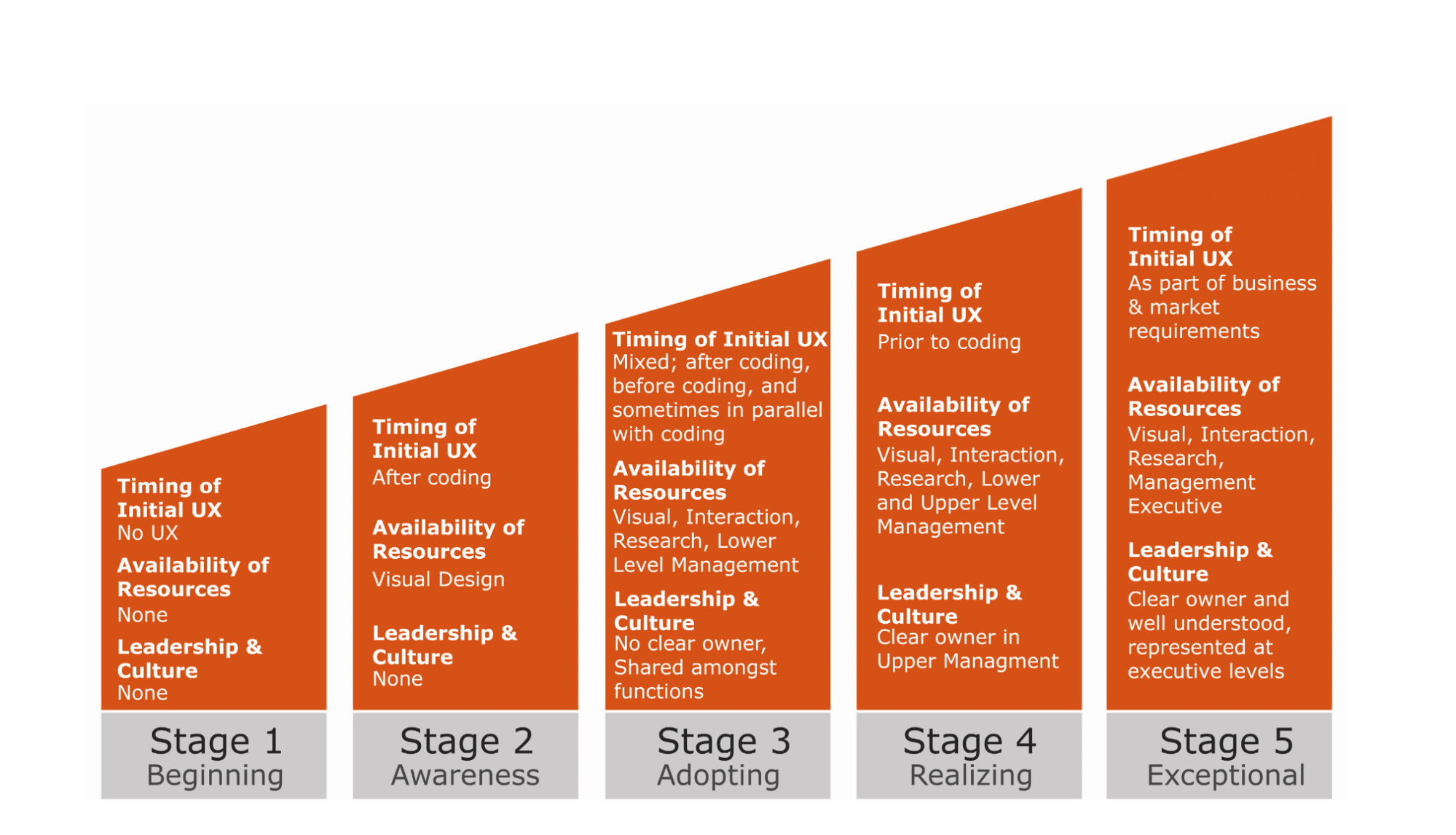
Most organizations sit somewhere beyond the earliest stage where no UX resources exist — but many are still at beginning or awareness stages. In those environments, practitioners often face frustration over limited support and understanding. Moving the organization forward matters not just for the field, but for the people using the products: better maturity leads to better end-user experiences.
The following six tactics can help practitioners and managers grow UX maturity. They do not need to be implemented sequentially; multiple tactics can and should run in parallel. However, some, like mentoring, may be impractical in very low-maturity settings:
- Finding and utilizing UX champions. Useful in the beginning stages to plant seeds and open doors.
- Demonstrating the ROI/value of UX. Justifies more investment early on and continued investment later.
- Knowledge sharing and documenting UX work. Less relevant in the very earliest stages; creates institutional memory once UX activities begin.
- Mentoring. Best in middle and later stages; grows individual skills, builds shared understanding, and improves knowledge transfer.
- Education of UX staff on tools and areas of expertise. Relevant at all stages.
- Education of non-UX staff on UX principles and processes. Beneficial at all stages.
Because growing UX across an organization is a larger challenge than improving one’s own skills, it is worth examining the specific tactics that work best in low-maturity environments. This article covers the first two: leveraging UX champions and making the business case for UX.
Understand the Landscape Before Acting
Models provide a shared vocabulary and a sense of direction, but they do not change an organization by themselves. The task is to move beyond theory and apply concrete tactics. Knowing where the organization sits on the maturity spectrum helps in choosing which tactic to deploy — and how to frame it for leadership and colleagues.
Two Tactics for Early-Stage Maturity
The work of growing UX maturity in the earliest stages is largely about gaining entry and proving value. Two tactics are particularly suited to that context.
Finding and Utilizing UX Champions
A UX champion is someone who believes in the value of UX and is willing to advocate for it inside the organization — even if UX is not part of their formal role. Champions open doors, create opportunities, and help legitimize UX work when there is little institutional support for it. Practitioners should identify and cultivate champions among stakeholders, product managers, developers, and other non-UX colleagues who already see the value of user-centered design.
Effective champions are not just sympathetic listeners; they actively speak up in planning meetings, resource discussions, and other decision-making forums. They can help secure initial projects, pilot programs, or simply a seat at the table. In return, practitioners should support champions with clear, honest information about what UX can and cannot do, and with evidence that helps them make the case internally.
Demonstrating the ROI and Value of UX
At the beginning stages of maturity, UX practitioners need to justify investment in UX activities before there is much evidence of their impact. Demonstrating return on investment (ROI) for UX is challenging in any organization, but especially so where UX is new and unproven. Still, making the business case is a critical tactic for generating support for more UX work.
Practitioners should track and communicate the value of their UX efforts — showing how usability testing, research, and design changes reduce costs, increase conversions, lower support burden, or otherwise contribute to business outcomes. It is important to express value in terms business leaders already understand: not abstractions about user delight, but measured or clearly projected impacts on metrics they care about. As maturity grows and more evidence accumulates, this same tactic continues to serve — but the conversation shifts from justifying initial spend to preserving and expanding existing investment.
Growing UX Maturity: Champions and ROI as Leverage Points
When UX is immature in a large organization, practitioners often face an uphill battle. Progress depends less on individual design skill and more on strategic positioning. Two tactics stand out for organizations at the early stages of UX maturity: identifying and cultivating UX champions, and demonstrating the return on investment (ROI) of UX work. Both are aimed at creating broad organizational impact rather than isolated successes.
Tactic 1: Find and Cultivate UX Champions
Champions are individuals who enthusiastically promote the growth of an idea or innovation within their organization. Research has consistently shown that champions are critical for overcoming the social and political barriers that block innovation. In the Chapman and Plewes UX maturity model, moving an organization out of the earliest stage is nearly impossible without them.
A champion does not need to be a UX expert or practitioner. The role is about advocacy: pushing for UX as a concept, arguing for its growth, and securing budget and headcount. Effective champions exhibit a recognizable set of behaviors:
- Pursuing the idea.
- Expressing enthusiasm and confidence about the success of the innovation.
- Persisting under adversity.
- Getting the right people involved.
- Building networks.
- Taking responsibility.
One additional trait is essential: champions need to be well educated on the idea they are promoting. A champion who does not understand how UX processes work, how to integrate them into existing workflows, or what basic outputs and outcomes to expect cannot effectively sell the value of UX to others. The UX practitioner’s job is to provide that education through conversation, examples, and resource sharing.
Champions map directly to several Chapman and Plewes factors. They are positioned to influence leadership and culture over time, and they can identify the right moments to insert UX into existing processes.
Championing typically happens informally. An organization at the fledgling stage of UX is unlikely to create a formal role for it; instead, champions promote UX as part of their everyday duties. The practitioner’s goal is to find these people, educate them, provide real examples of UX making a difference, and work with them to spot opportunities for broader integration.
Being deliberate about where to invest time is crucial. These questions can help filter potential champions:
“Who are people willing to spend time and energy on ideas they believe in? Who might be most receptive to UX working on a product or service they are in charge of? Who has the ability to create and maintain networks? Who would see an almost immediate benefit to having UX improve their product? Who has been expressing dissatisfaction with current design and development processes? Who can you develop a good and ongoing relationship with? Who believes in the organization or product and continuously pushes for both to grow and improve?”
Start with the largest possible list of candidates, then remove names as you apply these filters. The remaining names are the people worth pursuing.
A Champion in Action: Logistics Company Case Study
Finding a champion is not always a long search. In one case at a large international logistics company, a UX consultant identified effective champions within a month of starting and saw meaningful change within three.
The company claimed to be customer first, but the rhetoric was not reflected in practice. UX maturity was inconsistent: some products were at the adopting stage, while others, including the project the consultant joined, were still at the awareness stage with no UX processes at all. Past UX efforts had been scattered one-offs, driven by small teams addressing issues raised by major clients. When budgets contracted, UX titles were among the first eliminated.
The company was in the middle of a backend technology transformation, consolidating disparate entities onto common platforms. The consultant was brought in to infuse UX into an already defined process, one focused on speed to production, where developers did the design based on requirements from large groups of product owners.
The approach started with listening: sitting in on meetings, interviewing client stakeholders, and mapping relationships between products, projects, people, and goals. There was significant appetite for UX work, but little for incorporating the process into the existing breakneck pace. The team found a foothold by contributing through testing in key areas.
The pivotal move was taking on a research and design project with a product owner identified during preliminary interviews as a potential champion. This individual was highly motivated, well connected to powerful people across the company, and, critically, owned a product essential to the overall endeavor’s success. The champion was not an executive and had no authority to compel action, yet they demonstrated every trait associated with innovation champions:
- Pursuing the idea: Traveling, attending meetings, educating themselves, and pushing for UX growth outside their typical duties.
- Expressing enthusiasm: Maintaining a positive attitude and readjusting without giving up when challenges arose.
- Persisting under adversity: Facing constant pushback from colleagues who doubted the product could accommodate research and redesign.
- Getting the right people involved: Leveraging a decade of relationships to bring executives into meetings when needed.
- Building networks: Making introductions and connecting people across products and teams, without needing to be present in every meeting.
- Taking responsibility: Reviewing all work, learning UX processes themselves, and advocating for UX even while delegating tasks.
The impact was substantial. The foothold gained through the champion opened ears among key executives and led to a broader shift toward “walking the talk” on being customer focused. By the time the engagement ended, the team had left behind a library of reports, a defined process for integrating UX into technology building, and a philosophy that customer-focused words needed to be backed by customer-focused behavior. The champion had secured a permanent UX hire for their product, built a backlog of UX projects, and created a wider network of UX practitioners than had previously existed.
Tactic 2: Make the Business Case with ROI and Value Metrics
UX practitioners often measure their work by whether it creates a satisfactory, efficient, or enjoyable experience. But decisions in most organizations are scrutinized for their impact on the bottom line. The reality is that growing UX requires justifying it in terms of return on investment. ROI, though, is not limited to money.
Nielsen Norman Group notes that ROI is important because it encourages buy-in, which is essential for growing UX in organizations unfamiliar with its value. NNG also identifies three myths that prevent teams from calculating UX ROI:
- The ROI of UX is all about money.
- The ROI of UX has to be perfectly accurate.
- The ROI of UX has to account for every detail.
Overcoming these misconceptions within the organization is part of the work. The metrics used to tell the ROI story depend on the product and industry. For an e-commerce site, conversion and sales are obvious. But other metrics — speed to complete a task, cart abandonment, or app store ratings — can be just as persuasive.
Naturally, many executives want to see the financial benefit of their decisions. A business case is necessary for anything that costs money or resources. In its simplest form, ROI is the value or profit gained divided by the cost of the investment. The number should be greater than one, indicating a positive return. What counts as cost and return varies by product. Tools exist to help with the calculation, including a website ROI calculator from Anders Hoff and a set of six different calculators from Human Factors International, covering everything from increased conversion and productivity to reduced training costs.
Moving beyond pure monetary return requires research and analytics. Product teams typically collect analytics even if they are not invested in UX, but it is worth connecting with the people who own that data to ensure the right things are being tracked. Useful metrics to consider include:
- Finding information and navigating: Time to complete a typical workflow, errors encountered, and drop-off rates before critical destinations.
- Ratings and qualitative feedback: App store or industry platform ratings, and comments that may point to UX issues.
- Use and time spent: Visits or time on site, recognizing that more time is not always better — paying a bill or applying for services ideally takes less time, not more.
- Service and support calls: Volume of contacts related to usability, such as login issues or inability to self-serve basic account functions. These have direct, known costs, and reducing them is a measurable gain.
The right metric depends on the audience. The goal is to choose the measure that speaks clearest to those whose approval is needed.
The Evidence Ledger: Medical Insurance Provider Case Study
A large medical insurance provider, formed through acquisitions of smaller companies, had agents working on disparate systems. When the company moved everyone onto a single new platform, the rollout was phased by geographic region. User experience was not part of the plan — there were no UX roles and no budget for them.
The first phase went badly. Independent agents stopped running policies through the provider altogether, and exclusive agents flooded the call center, needing step-by-step help with basic tasks like running quotes and binding policies. The company paused subsequent releases.
At that point, a usability workstream was brought in. Budget was tight, so the team had to prove its value immediately. They began with interviews and usability testing with end users, then produced design recommendations ranging from small tweaks to major overhauls. Some were adopted; others were deemed infeasible. The fixes were released to phase one agents, and the rollout resumed.
Future budget for UX had to be approved by an executive committee. Project leadership knew they needed compelling evidence. In a workshop, they identified the key metrics: user satisfaction, call center volume, and the number of quotes run, among other industry-specific measures.
Benchmarking proved essential. The number of quotes run had not been purposefully tracked in phase one, so there was no baseline for comparison. Setting that benchmark going forward made future evaluations possible.
A combination of user surveys, interviews, and data analytics told the story. Phase one users had the lowest satisfaction, but it was trending upward. Users of the UX-improved phase two started with higher initial satisfaction. Call center volume was dropping. The project leadership presented the findings to the executive committee as part of their request for continued funding — and it was approved.
A few years later, UX was a permanent part of the project, with a dedicated budget for testing and design revisions before every release. It had become a mandatory component for future projects and digital products.
Picking Your Battles, and Your Allies
Neither tactic works in a vacuum. Finding the right champion is about understanding the political landscape of your organization; demonstrating ROI is about speaking the language of the business. The first without the second is just enthusiasm, and the second without the first often gets ignored.
Start by identifying the people who already have influence, not just those with a job title. A senior engineer who is frustrated by late-breaking design changes can be a powerful ally. A product manager who feels the pain of building features nobody asked for sees the value of research before you even present it. The goal is to find someone who can open doors for you and amplify your arguments in meetings where you aren't present.
When you do get that audience, do not talk about usability heuristics or design principles. Talk about the things that matter to them, like conversion rates, task completion times, and support ticket volume. You need data from your own product to make the case, and it doesn't have to be from a formal lab study. Session recordings, support logs, and simple A/B tests are all credible sources of evidence.
The Bottom Line on Advocacy
Growing UX maturity is not a one-off activity. It is a sustained effort of identifying the right opportunities, pairing them with the right people, and backing every argument with observable evidence. You are not just teaching people what UX is; you are demonstrating what it does for the product and the business. In less mature organizations, these two specific moves can shift the conversation from opinion to fact, and from cost to investment.
The next article in this series focuses on the internal processes that document completed UX work and the mentorship required to reach higher maturity levels. The final part addresses the education needs of both UX staff and non-UX colleagues.