Home/SRE & Ops/MTIA 300: Meta’s First Training Chip with Built-in NICs and Communicat
SRE & Ops
MTIA 300: Meta’s First Training Chip with Built-in NICs and Communication-Offloading Engines
MTIA 300 is the first of Meta’s family of in-house training and inference accelerators optimized for training ranking and recommendation models. We’re sharing how MTIA 300’s built-in NIC chiplets allow it to meet the communication needs associated with training recommendation models with superior performance over general-purpose GPUs. By co-designing MTIA’s communication library, HCCL, alongside t
CW
Chris WiltzMeta Engineering
·August 24, 2026·Data Infrastructure
Training Accelerators Have a Networking Problem—Meta’s Answer Is Built In
Training recommendation models is a distinct infrastructure challenge. Unlike large language models that demand massive floating-point throughput, recommendation models are bottlenecked by communication between the accelerators doing the training. Their embedding tables can hold over 99% of the model’s parameters, which requires hybrid parallelism that generates frequent AllReduce, AllToAll, and AllGather collectives across hundreds of accelerators. On traditional chips such as GPUs, those communication operations compete with training computation for the same resources, often leaving expensive hardware idle.
Meta’s MTIA 300—the first member of the Meta Training and Inference Accelerator family optimized for training ranking and recommendation models—takes a fundamentally different approach. Instead of treating communication as an afterthought handled by general-purpose compute cores, Meta co-designed MTIA 300 alongside HCCL, a communication library built from scratch to match the hardware. The result makes communication a first-class citizen in the chip’s design rather than a competing workload.
NICs Inside the Package, Not Across the PCIe Bus
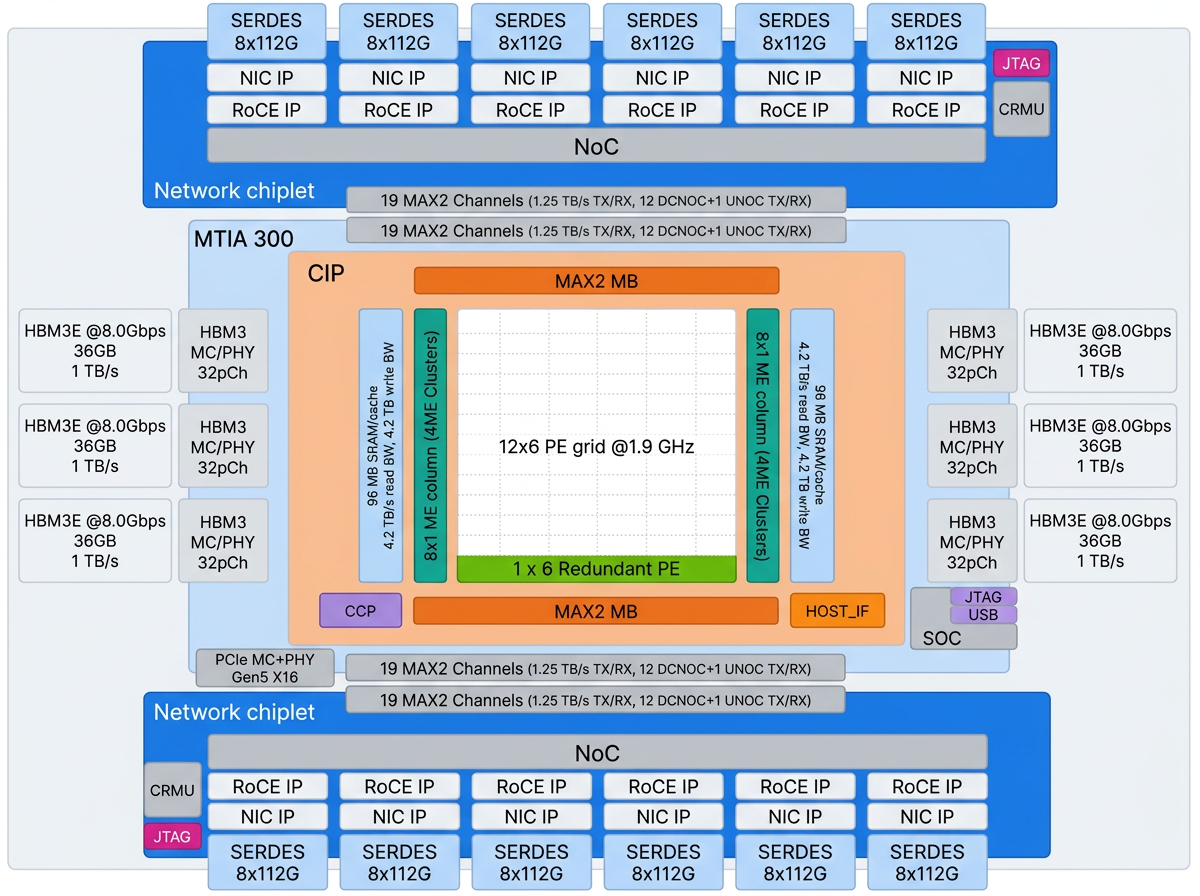
In conventional GPU architectures, the CPU must mediate between the accelerator and the network, creating a host-device-NIC bottleneck. MTIA 300 eliminates that by placing the network interface directly inside the chip package. Two network chiplets, each containing six custom 800 Gbps RDMA NICs, provide 1.2 TB/s of total I/O bandwidth without crossing a PCIe bus.
Because all 12 Ethernet-based NICs are identical, they can be flexibly assigned for two purposes: scale-up communication within a rack of 16 nodes at up to 1 TB/s, and scale-out communication across racks at 200 GB/s. As model requirements shift, operators can reconfigure the split by changing the network configuration instead of swapping hardware. To keep per-transaction latency at a minimum, MTIA 300 introduces express doorbells: the work request write itself serves as the doorbell, saving an additional memory read and roughly 800 ns per operation.
Figure 1. The MTIA 300 chip architecture. Diagram of MTIA 300 chip.
Dedicated Engines Offload Communication
On GPUs, collective communication libraries like NCCL execute collectives as kernels that consume streaming multiprocessors—the same hardware needed for training. When collectives run alongside training kernels, both slow down. MTIA 300 avoids that contention by including 16 dedicated message engines (MEs) alongside its 12×6 grid of processing elements (PEs). These MEs handle all communication independently of compute.
Each ME includes:
An RISC-V core for orchestrating workloads
An NIC interface that routes requests to the correct NIC
A near-memory compute (NMC) block that performs reductions at 128 bytes/cycle
The NMCs sit at the chip edges next to HBM and cache, delivering more than 2.8 TB/s of reduction throughput—more than double the I/O bandwidth. This allows line-rate execution of AllReduce and ReduceScatter collectives without touching the compute grid. The isolation is striking: running large GEMMs concurrently with collective operations introduces less than 0.5% degradation to compute throughput. Traditional GPUs can see degradation over 20% under the same conditions because communication and compute share resources.
HCCL’s Compiled Communication Model
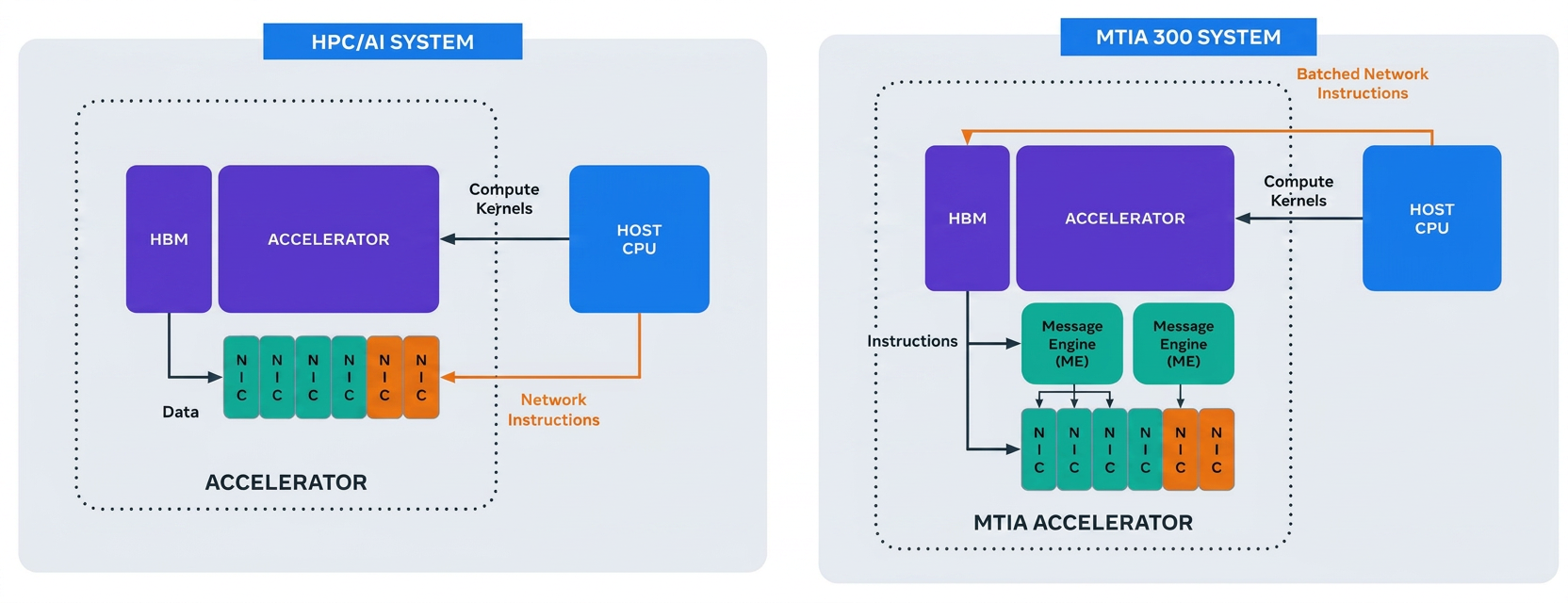
HCCL was designed with MTIA 300 from the start, so it does not drive communication from the host during execution. Instead, it compiles each collective into a complete set of subgraphs—arrays of work-queue entries with explicit dependencies—and dispatches those to the MEs for fully autonomous execution. Once work reaches the device, the host is uninvolved; the CPU is only needed to copy instructions into HBM.
Figure 2. A comparison of traditional accelerator design with host-based network instructions with MTIA 300’s offloaded communication model.
This compiled model integrates with PyTorch’s c10d and torchcomms interfaces. Collectives traced through torch.compile compile into the same graph as compute operators. HCCL chooses topology-aware algorithms that exploit the asymmetric bandwidth between scale-up and scale-out links, minimizing traffic across racks where bandwidth is constrained.
Inference workloads gain two additional execution paths. One-sided communication lets PEs submit work directly via express doorbells. Device-triggered collectives allow compute kernels to signal hardware-offloaded communication on a parallel stream without breaking graph execution.
Production Numbers and What’s Next
In production, HCCL delivers up to 940 GB/s of communication bandwidth within a single rack. On a 150-billion-parameter production-recommendation model running across 40 accelerators, MTIA 300 completes total communication 3.9 times faster than the equivalent GPU cluster.
The hardware also opens new co-design strategies. With 216 GB of HBM3E, MTIA 300 can handle larger local batch sizes, reducing the number of trainers needed and cutting communication overhead. Its 1:1 CPU-to-accelerator ratio supports CPU offloading of numerically intensive optimizer operations. High network bandwidth allows using higher-precision datatypes without sacrificing latency.
These architectural principles extend beyond recommendation workloads. As AI inference moves toward reasoning, agentic, and long-context use cases, communication patterns change: messages become smaller, more frequent, and more latency-sensitive, with tighter per-collective budgets. An architecture that treats the network as a first-class constraint—optimizing for latency and message rate, not just raw bandwidth—is well positioned for those demands, and the patterns established in MTIA 300 and HCCL form the foundation for Meta’s next-generation AI silicon.
At the 2026 Open Compute Project Global Summit, Meta is sharing the next generation of open networking infrastructure, including: Our first liquid-cooled network rack (IcePack), and 102.4T switch platform (IceCube). Flattened Planar Fabric (FPF), a multiplane backend scale-out fabric that fundamentally changes how GPUs connect to the network MetaRoCE, our open-source AI transport protocol. Launchi