Simulating Data Center Cooling Without Touching Live Systems
Meta's data centers run on tightly controlled environmental systems, and small miscalculations in those controls can have serious consequences. That makes live experimentation risky. To test new cooling strategies safely, Meta has built a digital simulator that replicates the thermal behavior of its facilities.
The simulator combines two modeling approaches. The first is physics-based: it embeds equations describing relevant thermal processes, so the model respects physical laws when representing novel situations. The second is statistical data science, which leverages information gathered across Meta's fleet of data centers. This hybrid design matters because model predictive control — algorithms that interact with a model to forecast a data center's response to particular conditions — requires a highly accurate system model to work effectively.
Why Not Just Use Data or CFD?
Numerical models built from sensor data can predict a building's energy consumption with high accuracy under normal operating conditions. But those models may fail to generalize when conditions fall outside what the training data represents — for example, extreme weather events. They are also not reliable for predicting the behavior of data centers that do not yet exist.
At the other end of the spectrum are computational fluid dynamics (CFD) simulations, which Meta uses to quantify and visualize fluid dynamics in detail. CFD can model previously unseen conditions and designs, but it demands substantial computational power and long run times.
Thermal simulators — sometimes called gray box models — sit between these two approaches. They solve thermal balance equations to describe conditions in an individual room or row, producing results quickly with minimal input data. That makes them useful for studying a data center's response to extreme weather or for training reinforcement learning algorithms in a virtual environment.
Building the Simulator
The dynamic model is built from first-principle physics and uses building-modeling languages including Modelica. Setting up a simulation for a particular data hall requires static, site-specific details: geometry, construction materials, HVAC configuration, component efficiencies, and system settings. The control strategies governing HVAC and water equipment are then re-created numerically using the Control Description Language, expressing them as functions of indoor and outdoor conditions.
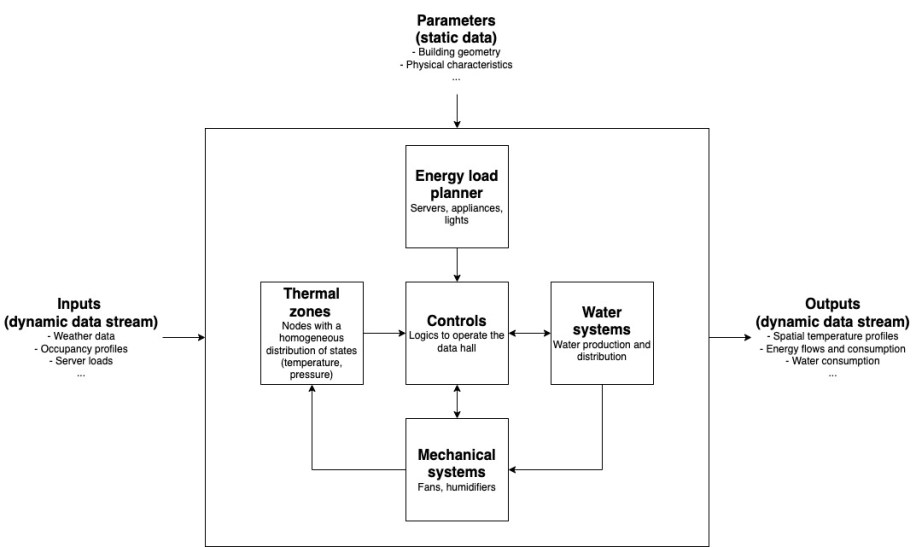
Once the model is assembled, the user inputs a time series of the variables whose impact they want to evaluate — temperature, energy, water consumption, and similar parameters.
Validating Against a Texas Winter Storm
To test whether the simulator could handle conditions well outside normal operating ranges, Meta modeled one of its data centers during the February 2021 winter storm in Texas. That event began with a 70°F temperature swing, then kept temperatures below freezing for 10 days, reaching as low as -2°F.

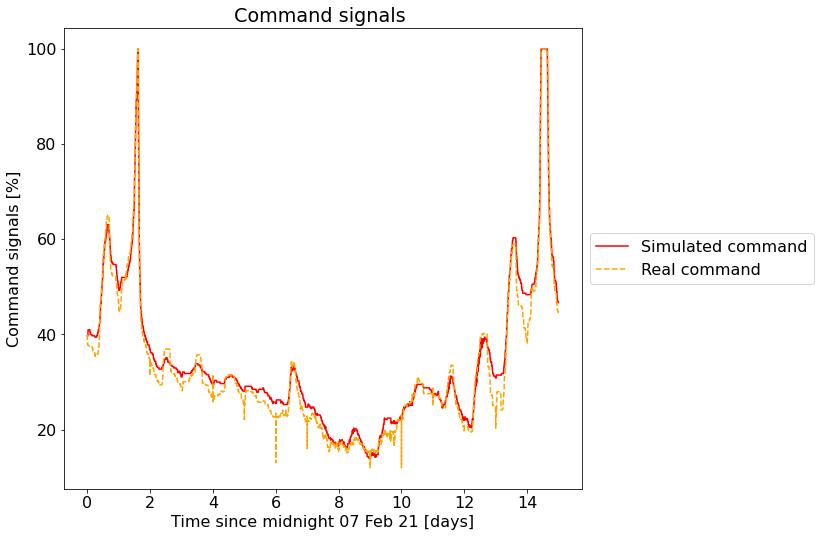
The simulation was run using conditions recorded at midnight on February 7, 2021, and covered the subsequent 15 days. The only inputs were four parameters: outside air temperature, temperature set point, supply fan airflow set point, and server load. No other operational data was added.
The simulator successfully reproduced the behavior of the HVAC economizer — which controls the mixing of hot and cold air — as it tried to stabilize the data hall's internal temperature. The simulated command signal varied between 15 and 100 percent of the system's range, essentially the full operational envelope.
The temperature of the supply air entering the data hall is influenced by both outdoor temperature and heat from the server rooms. Modeling it requires simulating the entire control loop, mechanical equipment, and server room using only physical principles, without fitting sensor data. Over the 15-day period, the simulated supply air temperature showed a mean absolute error (MAE) of 0.5°F when compared with measurements. The error distribution was centered at 0°F with no visible bias or drift, and the model captured the dynamics of the temperature control system accurately, especially in the first and last days of the period.
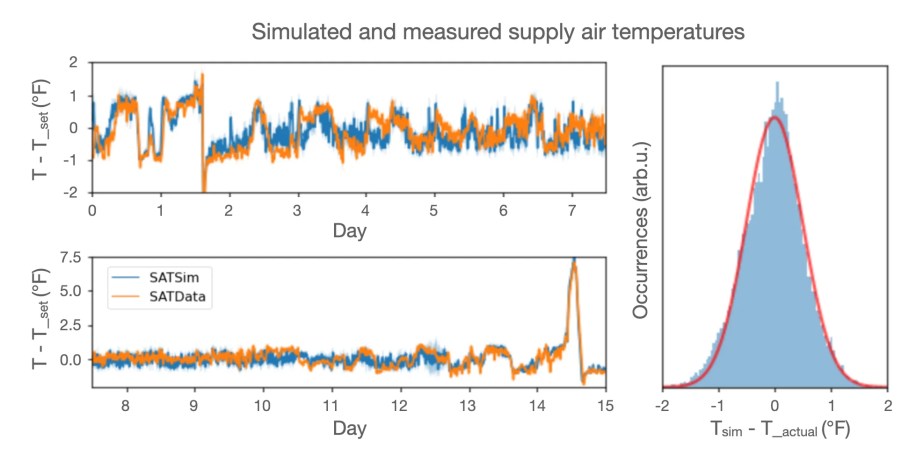
Because the model relied only on physical principles and the four external inputs, its accuracy in this extreme scenario indicates genuine predictive power rather than interpolation from historical data.
Validation on a Wider Range of Dates
Beyond the winter storm case, Meta validated the simulator on 24 random dates spread across 2021. These dates covered a wide range of weather conditions, and the simulator achieved an MAE of 1.3°F for supply air temperature across those periods.
Where the Simulator Is Headed
According to the International Energy Agency, data centers use about 1 percent of global electricity and contribute roughly 0.3 percent of global CO2 emissions. Meta reports that its operational data centers have achieved net zero carbon emissions, run on 100 percent renewable energy, and are LEED Gold certified. They also average 32 percent less energy use and 80 percent greater water efficiency than the industry baseline.
Meta's stated goal is to restore more water than it consumes by 2030. The Physical Modeling Team plans to extend the simulator's role by training it to predict and optimize both energy and water consumption, which would support better control strategies and testing of new facility and equipment designs. The team is also working with data science and AI groups to pair these models with machine learning methods — including reinforcement learning — to identify optimal operating points in real time. Additional research is exploring hybrid approaches that combine advances in physical sciences and machine learning to further improve the efficiency, reliability, and sustainability of Meta's infrastructure.