Meta's ads recommendation stack is a portfolio of many ranking models, each tied to a different product surface or advertiser objective and each carrying its own architecture, training data, and serving constraints. Researchers advance that portfolio with what Meta calls techniques — anything that makes a ranking model better, whether architectural pieces like Wukong factorization layers or Interformer interaction networks, richer data representations, training optimizations, or training and inference efficiency work. The follow-on problem is distribution: a technique proven on one model almost never copy-pastes onto the next, and techniques have a shelf life, so value depends on how quickly each proven idea reaches the full fleet.
Why the propagation problem is combinatorial
Propagating a growing inventory of techniques across a diverse fleet produces an expanding space of technique-model combinations, and two constraints bite at once.
The first is engineering bandwidth. Adapting a technique the standard way means a domain expert studies how it interacts with a specific model's architecture, generalizes it, and tunes it to that model's constraints. That yields the strongest results and remains the process for the highest-revenue models, but each adaptation demands deep familiarity with both the technique and the target model, capping throughput while the adaptation opportunity grows much faster. The second constraint is compute: every attempt costs a training run, so a finite budget raises the question not just of which techniques to try but of how to navigate configurations without burning capacity on attempts that mostly produce suboptimal gains.
Standardizing model design and automating propagation came first. A template-driven approach organizes models into a small set of reusable, composable building blocks, so a technique validated once at the template level propagates automatically to every model built from that template. Over the last two years this shipped 5,000+ technique-model combinations while cutting per-model engineering time by 92%. What standardization could not handle was the judgment calls — which technique is worth propagating to which model, how wide a hyperparameter search should run, why a model shows no gains, how to detect and resolve failures. Those decisions consumed enough human bandwidth to keep the fleet from converging within a few weeks of a technique being proven.
The three capabilities agents now drive
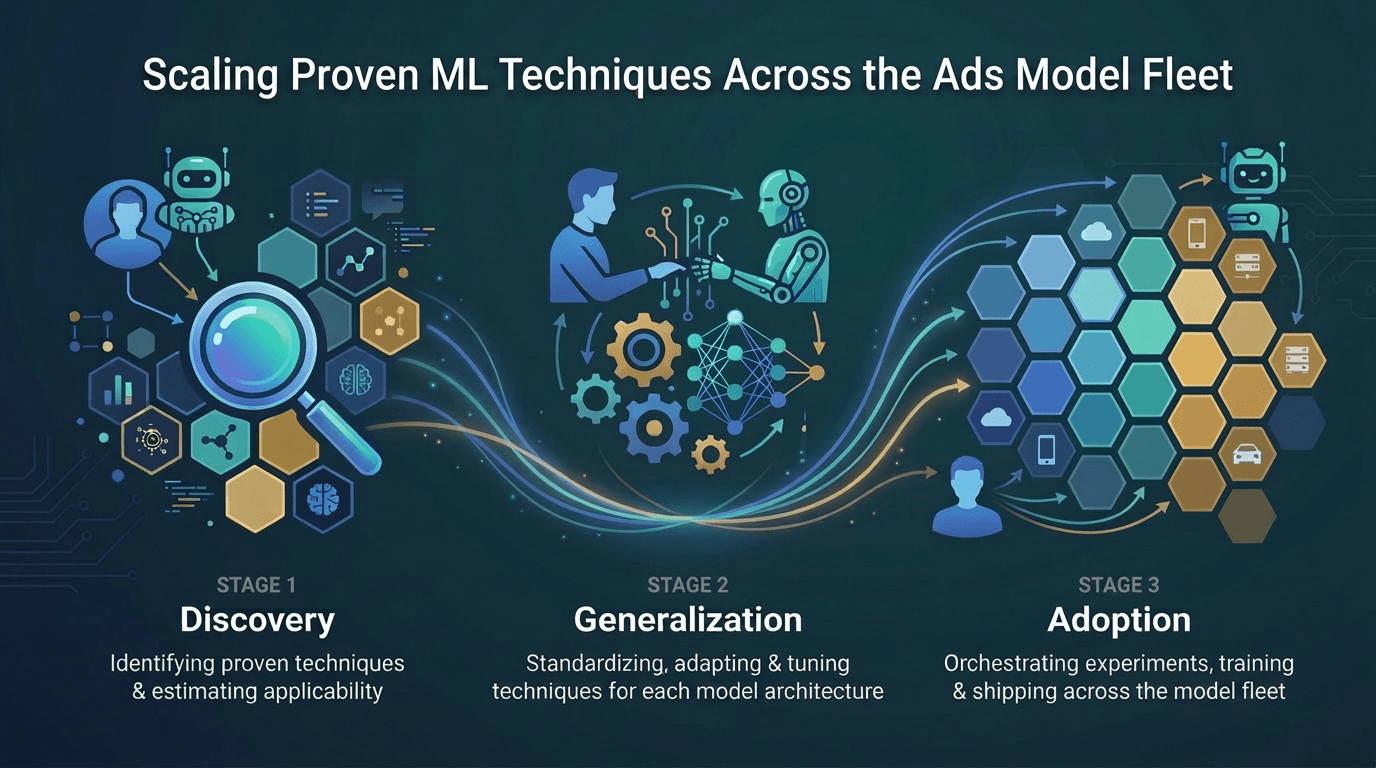
Meta's propagation system is organized around three capabilities, all of which agents now supercharge by taking on the judgment-heavy, non-deterministic decision making:
- Discovery: maintain a live view of which techniques are proven and estimate how well each transfers, producing a prioritized set of technique-model candidates ranked by expected impact.
- Generalization: make a proven technique work on models it was not designed for — once per template for template-built models, and with per-model adaptation, where the deepest technical reasoning happens, beyond what templates cover.
- Adoption: turn validated adaptations into shipped models at volume: launching experiments, managing asynchronous multi-day training runs, monitoring convergence, diagnosing and recovering from failures, and assembling proposals that can land.
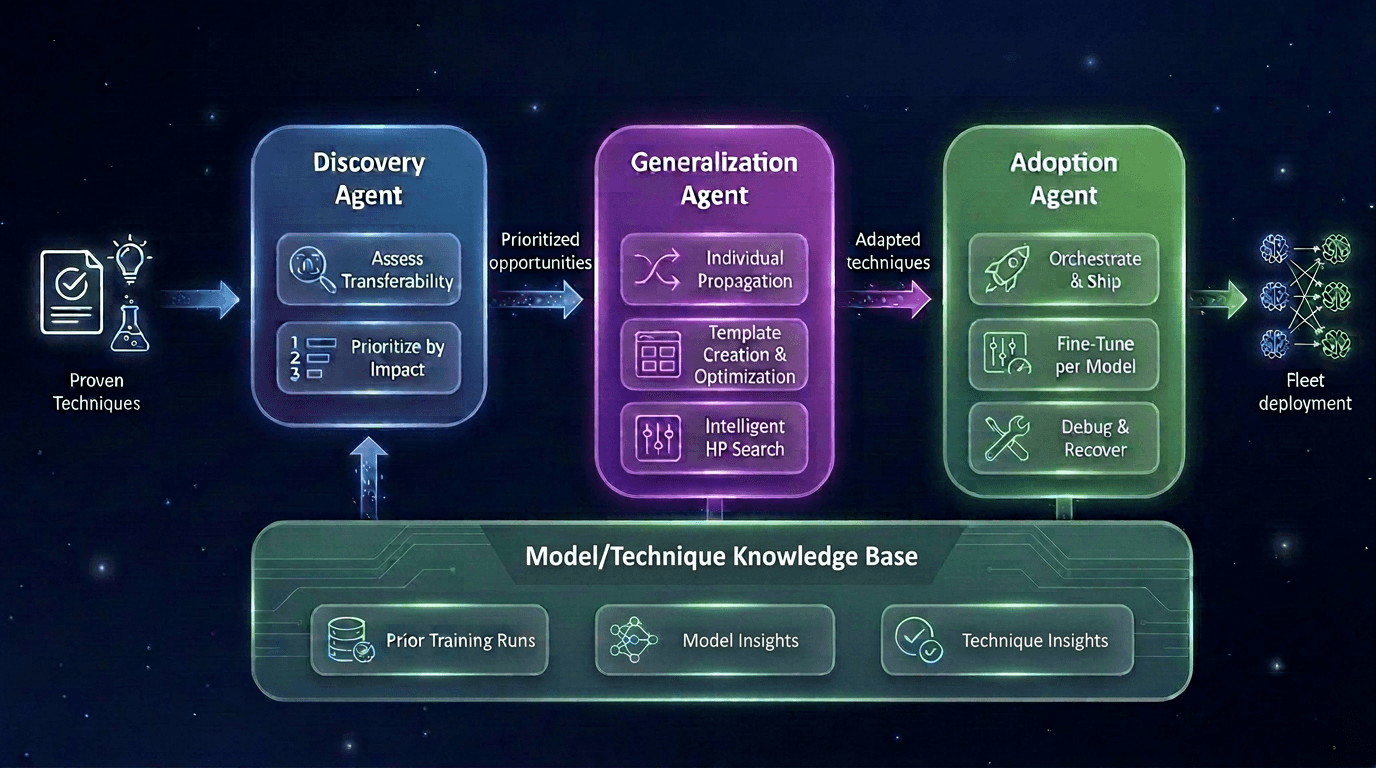
Agents pair LLM-based reasoning with specialized ML tooling to decide which adaptations to try, diagnose and mitigate failures, navigate hyperparameter search spaces efficiently, and manage capacity across hundreds of concurrent jobs. They draw on a shared knowledge base — an accumulated record of prior training runs, model architectures, and technique outcomes — so each agent builds on prior learning instead of starting from scratch.
Discovery: fleet-wide assessment instead of one model at a time
Discovery asks what proven techniques exist and how applicable they are to each model. Domain experts used to answer both, tracking research and results across the organization and applying domain knowledge to judge applicability, one model at a time and within the limits of what any one expert knows. Agents instead draw on the shared knowledge base and assess the entire fleet at once, estimating transferability and emitting technique lists ranked by expected impact. Engineers review the assessments and make the decision.
Generalization: two flavors, one compute lever
Generalization re-implements a technique proven on one model so it applies to models with different architectures, feature representations, training data, and serving constraints. The core idea usually transfers; the implementation almost never does. Customization ranges from retuning hyperparameters to adapting features to what the target model already consumes or resizing the architecture to fit an inference budget, up to redesigning the technique outright — and how far to go is a judgment call.
- Template generalization: agents help build, evaluate, and improve the templates themselves — proposing template optimization hypotheses from proven techniques, launching experiments across representative model sets, evaluating results, diagnosing failures, and iterating across the multi-day loops template development requires. Validating a technique once at the template level costs a fraction of adapting each model separately.
- Bespoke generalization: for the highest-revenue models, still customized individually, agents learn alongside ML engineers during the technique's initial application to a small number of models. They track each change and outcome — configuration adjustments, hyperparameter tuning, failure resolutions — and encode what works, what doesn't, and which decisions are model-specific versus generalizable. The agent then proposes and tests adaptations for the remaining models while the engineer reviews and steers.
Using millions of prior training runs and each target model's properties, agents start from the configurations most likely to work, let each round of runs narrow the next hyperparameter search, and stop low-value experiments early. Across select technique-model combinations, Meta reports a median 4x reduction in training compute.
Adoption: shipping at fleet scale
At adoption, agents ship generalized techniques model by model. Fine-tuning differs by route: techniques applied individually get a search for the best configuration of technique bundles for that specific model, while template-built models get an auto-research loop on top of the template to tune each model for gains the shared configuration alone does not deliver. When an infrastructure issue, training divergence, or data pipeline error strikes, integrated debugging and recovery diagnose root cause and apply targeted fixes or retries.
Hundreds of concurrent workflows make scheduling a global optimization problem over a fixed compute budget, which Meta says is where it is currently investing. Agents rank concurrent jobs by revenue importance, technique potential, and deadline proximity, and reclaim capacity from stalled or low-value runs so GPUs stay on the highest-value work rather than idling or queuing behind lower-priority experiments. The human role shifts to oversight at decision points — approving plans and setting priorities — at 3x greater productivity (each engineer handles 3x more technique-model adaptations), compressing the path from proven technique to shipped model.
Validation at Every Stage of the Loop
A technique that comes out of an agent pipeline is held to the same bar as one an engineer hands over. It must improve offline predictive metrics such as normalized entropy (NE) without regressing on guardrails like training or inference cost, and it must deliver a statistically significant win in online A/B testing before it ships.
A single evaluation at the far end of the process is not enough to steer an agent that runs across stages for days. Because each stage produces a different artifact, each gets its own set of metrics.
Discovery
Agents pick which models a given technique should be tried on, and in this stage we track the precision and recall of those choices. Precision is the fraction of selected models where the technique eventually ships; recall is the fraction of all viable models for that technique that the agents surfaced. Recall carries more weight, since a model skipped here never gets a second look, while precision keeps compute from being spent on techniques that go nowhere.
Generalization
Here we confirm that a technique still pays off on models other than the one where it was first proven. Every generalized technique runs first against scaled-down copies of models, which screens many technique-model adaptations cheaply. Survivors then face a representative set of full-size models, where they must lift NE and satisfy all guardrail metrics before adoption can be considered.
Adoption
Correctness is judged on the same predictive performance and guardrail metrics as before, but this is the most operationally expensive stage, with experiments lasting days — so agent productivity is measured too. Two numbers stand out: how many human interventions an experiment requires to finish, which reflects the engineering effort still involved, and what share of issues the agents diagnose and mitigate on their own.
People remain central to the process, reviewing key decisions, confirming judgment calls and giving final approval on what ships.
From Pilot Results to Default Workflow
On the strength of early results, Meta is scaling agent-driven workflows toward becoming the primary way techniques are propagated across its model fleet. Fully rolling out a proven technique to every applicable model currently takes more than a year, and the goal is to bring that down to three months. That target requires roughly 5x higher end-to-end throughput from the agent workflows, so that propagation keeps up with innovation instead of lagging behind it.
The planned investments focus on agent intelligence: better generalization quality, capacity efficiency and execution, delivered through self-evolving learning in which agents refine their strategies from accumulated outcomes rather than depending only on heuristics supplied by humans.
Propagation is one piece of a larger push to agentify every aspect of the end-to-end model development lifecycle across ranking AI — exploration and hypothesis generation, propagation, experimentation and production launch.
In that system the agents act as the scaling layer, intended to make sure each proven innovation reaches its full potential across the model fleet.