Why Teams Are Cutting Off the Front End
User expectations keep climbing, and the pressure to ship fast keeps rising with them. Development teams have more tools than ever to build quickly, which means the bar for what counts as acceptable quality is always moving. The traditional all-in-one CMS approach often gets in the way: you get a bundled front end you didn't choose, constrained by the language, themes and plugins of the platform. Headless architecture removes that constraint by separating content authoring from content presentation, letting teams engineer the user experience directly rather than adapting to whatever the monolithic tool provides.
This is not a new idea, but it has taken hold across the industry as teams increasingly opt for specialized tools that do one job well. A headless CMS focuses on authoring and exposes content through APIs. The "headless" quality — the absence of a user-facing front end — is exactly what gives it flexibility. Because these systems are designed to serve structured data, they slot cleanly into modern front-end stacks built with tools like Vue.js, static site generators such as 11ty, or anything else that can consume an API.
The Practical Payoff of Decoupling
Separating the authoring environment from the delivery layer creates a clean boundary between systems. That boundary is an API, and it changes how you can evolve your product over time. When your front end and back end are coupled, upgrading means dealing with the constraints of the larger system. With a headless setup, you can swap out the front end or the back end independently as requirements shift, new tools appear, or your team's expertise changes.
This separation is also what makes headless attractive for specific, demanding use cases. The flexibility matters when your requirements don't fit the mold of an all-in-one product:
- Fine-tuning every step of the checkout flow in eCommerce is far easier with a headless commerce option than with out-of-the-box templates.
- Optimizing for Time to First Byte might mean using a static site generator that rebuilds content on change from a headless CMS API.
- Security-conscious teams can lock the authoring environment behind a firewall and consume it from a simpler Jamstack front end.
- Serving identical content to web, native apps and third-party widgets is straightforward when all clients speak to the same CMS headlessly.
eCommerce as a Case Study
Consider Shopify. You can use it as a complete flow, where its templates and out-of-the-box functionality dictate the checkout experience, and your redesign options are limited to what the platform allows. Or you can use its headless option, where you take responsibility for building every view the user sees, and Shopify merely processes the financial transaction.
The second path is more work. You build every screen. But you control every pixel, every line of code running on the user's device, and every interaction that affects conversion. You retain the benefit of the platform's transaction processing backend while removing its front-end constraints. If your team is fighting the limitations of the current commerce setup — heavy front end, cumbersome UI, or poor accessibility — headless makes it considerably easier to fix those problems directly.
Avoiding Platform Lock-In
All-in-one platforms bundle a lot of commitments. You commit to a database, a programming environment, themes and plugins. Those commitments become friction when a new initiative arrives or design requirements turn strict. A new project may demand a technology stack that the off-the-shelf solution doesn't accommodate, forcing you to compromise on design or user flow — or to rebuild around it.
Headless architecture sidesteps that lock-in. Because your data is accessible via APIs, you can change the front-end framework, remove expensive production infrastructure in favor of static site generation, or switch CMS providers entirely without rebuilding your front end from the ground up. The API layer makes such swaps far less disruptive than they would be in a coupled system.
That flexibility extends to content distribution. When content is consumed as structured data, it can live on your website, in native applications, and in syndicated feeds without extra work. This gives products a stronger chance at longevity and lets content flow smoothly across multiple delivery channels.
Not every project demands that freedom, though. If you don't have strict design or performance requirements and just need a working website quickly, headless may be overkill. When you lack dedicated engineering support and need to be a few clicks away from launch, an all-in-one solution still makes sense. You can defer headless until the idea proves itself and the team has the capacity to manage the added complexity.
The decision ultimately comes down to whether the constraint is helping you or hindering you. If your requirements fit comfortably within an all-in-one tool and your team is productive with it, there is no reason to split front and back end. If you are running up against those limitations, headless gives you a direct way to solve the problems causing the friction.
When the Architecture Needs to Bend, Not Break
The value of a headless setup often reveals itself most clearly when something goes wrong. A clean API boundary between content and presentation means a change on one side doesn't force a rewrite of the other.
Swapping the Backend Without Scrapping the Frontend
Cost structures can become a reason to migrate. One team built a publishing system for dozens of authors on a hosted headless CMS. The authoring experience and API were excellent. Then the company decided to scale the program to a few thousand users. Pricing at that level wasn't published, and when the vendor provided a quote, it didn't make business sense. Because the frontend was decoupled, the team replaced the CMS entirely without touching the user-facing code.
Usage limits create a similar pressure. Airtable's flexible authoring UI pairs with a documented API that is great for prototyping: scrape data into a base, have experts edit it, then power production views and embeds. That pattern works until write volume exceeds the hard limit of 5 requests per second, which triggers a 30-second lockout. As data grew, one project hit that ceiling regularly. Mitigations like throttles and splitting data into separate bases only delayed the problem. The eventual fix was to build minimal editing features into the DynamoDB-backed system that had been reading the data all along, trading the polished UI and its request limits for scale and lower monthly costs.
Refreshing the Frontend on a Schedule You Choose
Legacy organizations often carry a mix of tech stacks across products, plus pressure to modernize. In one case, a team was asked to build new views and widgets on a headless CMS for integration into existing products. The frontend team ran an internal contest to see who could build the best prototype from the CMS's API endpoints. The winner used Riot.js, a small data-driven component library in the vein of Vue.js. The project shipped, and then the engineer who championed Riot.js left the company. What had been an exciting, speedy development pattern rapidly became tech debt nobody else wanted to support.
The remedy was the architecture itself. Since the CMS was decoupled from presentation, the frontend was rewritten with more widely used libraries without any backend changes.
Performance can also justify a frontend refresh. Ghost's hosted platform worked well for a personal blog, but Time to First Byte was slow. The post content was available via its API, so the author built a statically generated frontend on S3 and CloudFront that reused the Ghost-written content but served it faster.
Headless CMS as a Service
A wave of SaaS vendors have built their entire product around headless delivery. They offer a friendly authoring environment coupled with clean API endpoints, with low-cost entry plans. Most provide a solid core feature set: static asset hosting, saved revision history, and documented localization support. They tend to differ most in the authoring UI and the capabilities of their content APIs.
| Vendor | Content Editing | API |
|---|---|---|
| ButterCMS | Forms with a Word-style WYSIWIG-editor, with a toggle to HTML code. You can configure a one click full preview by linking your frontend template URLs. | REST API preview showing full JSON available in overlay on the same screen as content editor. |
| Comfortable | Forms-based editor; did not see how to set up a 1-click-in-context-preview. | REST API endpoint link available in the editor mode, GraphQL available soon. |
| Cosmic | Forms with a Word-style WYSIWIG-editor, with a toggle to HTML code. You can configure your own preview URLs to pull the draft JSON. | REST API. Can view a full JSON in 2 clicks from the Object editor. |
| DatoCMS | Forms-based editor, can set up a plugin to enable a full page preview. | GraphQL API with an API explorer. |
| Storyblok | Forms-based editor, visual edit mode, with a full page preview. | REST API, one click to full JSON from the editor mode. |
| TakeShape | Forms-based editor, with a live preview configurable by uploading templates. | GraphQL API with an API explorer. |
Patterns That Make Headless Interesting
GitHub as a Content Hub
Running a CMS on top of GitHub reuses the user management, version control, and approval workflows your team already has — no new accounts to provision. Review history appears alongside content edits in the same interface. Tools like Spacebook sit on top of GitHub and can be paired with Netlify for a cleaner markdown editing surface. The preview capabilities now built into GitHub's web editor also lower the barrier for editors who don't write HTML, especially the view-rich diff that renders markdown changes in full preview.
For those exploring options, the JAMstack community maintains a list of over 85 CMS tools, sortable by whether they are GitHub-based.
Familiar Tools, Headless Delivery
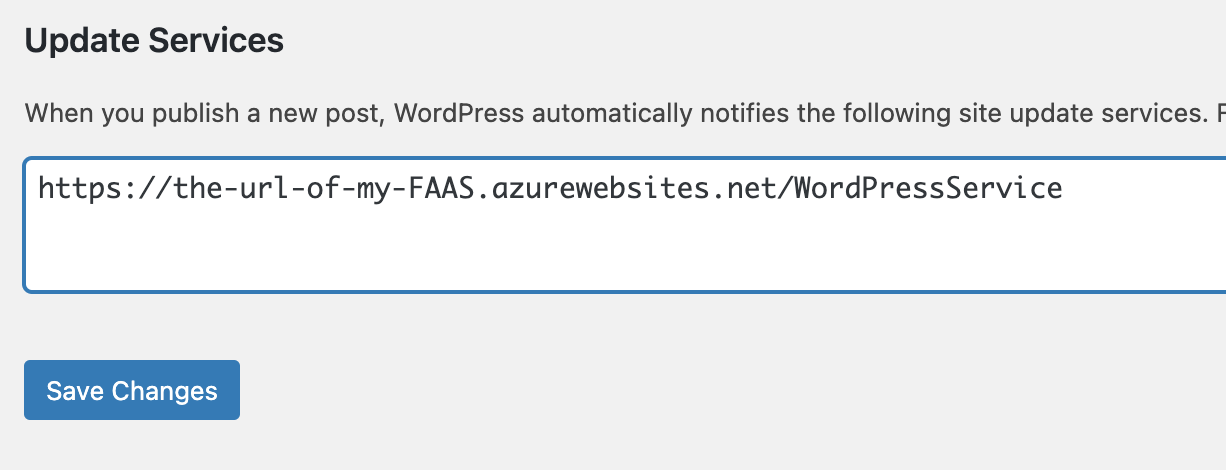
An existing WordPress install already ships with API endpoints, which lets editors keep using an interface they know while the frontend is built freely. The REST API is well documented and enabled by default: a fresh install will return JSON from https://example.com/wp-json/wp/v2/posts. The WordPress settings page has an update service field for URLs to ping when content changes, which is exactly the hook needed to trigger a serverless function that pulls the latest JSON and pushes it into a build pipeline.
When Several Sources Must Become One Site
The state of California has used a headless architecture to build emergency response sites that combine editorial content with frequently changing data. The setup pairs a headless WordPress write flow with a serverless function that listens for update pings, fetches the post JSON from the WordPress API, and writes the content to a GitHub repository. Each page has a human translation written to the same repo, as are data points that change a few times a day, like topline statistics.
Every write to the repository triggers a static site generator build. That gives the team a complete, easily reviewable log of each update, with the ability to revert through normal GitHub processes. The architecture was assembled by Carter Medlin, who wired the WordPress-to-FAAS-to-GitHub pipeline from scratch in a couple of days, running on a serverless Microsoft Azure function for minimal cost and maintenance.
The frontend was built with the 11ty static site generator. For a site that sees traffic spikes whenever pandemic announcements hit, the static frontend removes a significant risk during high-concurrency moments. The 11ty community emphasizes performance and accessibility, with public leaderboards and a lightweight core architecture. The choice supports the requirement that state-built tools work for every Californian — including on low-bandwidth connections and with assistive technology. Web components add functionality to the frontend while keeping JavaScript payloads minimal.


Evaluating Headless Options
The range of headless tools is wide, and the right choice depends on priorities. The following areas are worth probing before committing.
Authoring Environment
- How easy is it to author documents?
- How simple is it to attach structured data?
- Are layout options sufficient for editors?
- Are preview features adequate?
- Can content approval workflows enforce process?
Content API
- What queries are available against the API?
- How granular is the content structure?
- Are there hard limits — like Airtable's request cap?
- Does scaling require putting a CDN in front of the content API?
- How easy is localization to add?
- How difficult will it be to extract all your data if you change providers?
Cost and Administration
- Is pricing per user — and what happens at scale?
- Would self-managing an open-source install make more sense?
- Are user accounts easy to administer?
- Does the product integrate with existing single sign-on?
- Has it passed security audits? Does it support two-factor authentication?
Versioning and Review
- Is content versioned so rollbacks and edit history are practical?
- Can unpublished versions be shared for review, with restricted access?
Asset Handling
- How easily can authors upload images, PDFs, and other files?
- How straightforward is it to route those uploads into an image optimization pipeline?
The Trajectory of Headless Architecture
Examining the headless ecosystem reveals a common pattern: headless tools deliberately narrow their functional scope while exposing integration points for larger systems. This unbundling of features becomes increasingly valuable as architectures grow in complexity. Smaller, purpose-built tools make it easier to control cost, security, maintenance overhead, and hosting demands than managing a monolithic codebase.
One important caveat is that most headless solutions expect some coding effort. Yet as frontend development shifts toward pre-assembled component libraries and ready-made designs populated with your own content, it is reasonable to anticipate more drop-in combinations of specialized services that require little to no custom code.
The ideal backend for a given project may already exist as a SaaS subscription or an open-source self-hosted package. Such a service could connect without code to an off-the-shelf frontend that fits all your requirements. Stackbit already demonstrates this convergence, pairing a headless CMS with its no-code frontend builder. With Stackbit's WYSIWYG page editor, you can stand up a site and then select from multiple headless CMS vendors to manage all of the site's data.
Throughout this article, we have explored use cases where decoupling the content layer helped companies respond to shifting requirements. Headless models remain attractive whether the motivation is architectural flexibility, finer control over the user experience, or planning for the long-term sustainability of a service. As this space evolves, expect more opportunities to combine these tools and ship better products with less manual effort.
Additional Resources
- Headless CMS — a catalog of 85 CMS tools filterable by GitHub-based hosting.
- Headless Commerce — Shopify's overview of the approach.
- GoTrue JS: Bringing Authentication To Static Sites With Just 3kb Of JS by Divya Sasidharan, Netlify.
- WordPress Integration API — an open-source project from California's government digital team.