A Finite-Resource Mindset for the Backbone
As Meta’s service portfolio has grown, so has the strain on its backbone production network, which interconnects points of presence (PoPs) and hundreds of data centers (DCs) worldwide. Each service—Ads, Storage, News Feed, and others—acts as a distinct customer of this shared infrastructure, with its own requirements for growth, agility, bandwidth, availability, and latency. In the past, the company focused on fully protecting the network, an approach that created supply and efficiency bottlenecks. The shift now is toward treating the network as a finite resource that must be explicitly planned, managed, and shared.
To address this, Meta has developed and deployed Network Entitlement, a contract-based resource reservation framework presented at SIGCOMM 2022. It allows bandwidth to be reserved per service, per region, for predefined periods, with clear service-level objective (SLO) guarantees attached to each agreement.
Why Traditional Traffic Management Falls Short
Several structural challenges pushed Meta toward a contractual model:
- Heterogeneous capacity use: Services have wildly different traffic patterns. Some send sudden bursts at intervals, while others stream continuously. As the number of services with varying priorities grows, efficiently packing this diverse demand into shared capacity becomes difficult.
- No fault isolation: Classic quality of service (QoS) prioritizes critical traffic but does not isolate one service from another’s surge. A spike from a single misbehaving service can degrade performance for its QoS peers and for lower classes.
- Murky accountability: Without isolation, attributing a disruption to a service’s bursty traffic or to poor network management requires lengthy forensic analysis. This operational churn worsens as more services join the network.
- Inflexible long-term SLOs: Services need SLO guarantees over long horizons, but WAN capacity is sourced opportunistically and unevenly across regions. The combination of non-uniform capacity, weak isolation, and unclear accountability makes sustainable guarantees hard to deliver.
- High planning tax on services: Services can forecast compute and storage needs as consumable entities, but network forecasting historically demanded deep knowledge of topology and constraints—such as estimating traffic growth across
O(N^2)data center pairs. This process does not scale.
How Network Entitlement Works
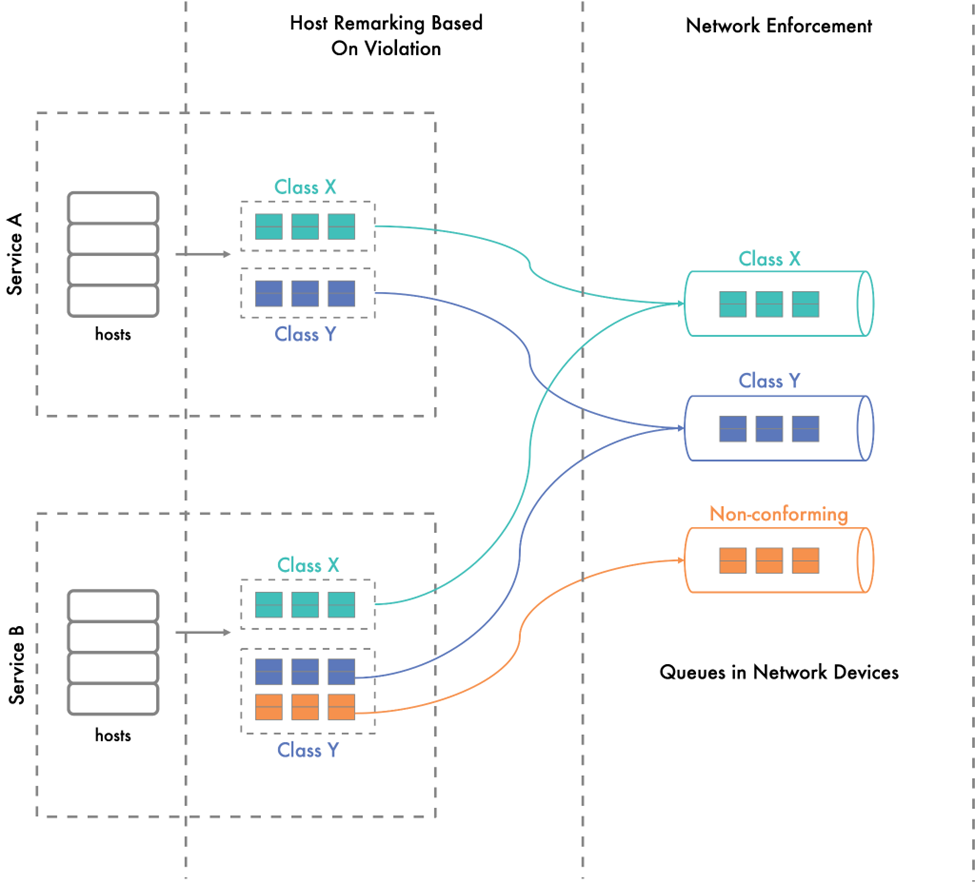
Under Network Entitlement, a service secures a bandwidth quota per region per class of service (CoS), bundled with an agreed SLO. This contract defines the relationship between the service owner and the network operator. Traffic within the quota—conforming traffic—receives the guaranteed SLO. Traffic beyond the reservation—nonconforming traffic—is not forcibly blocked. It is allowed to flow if capacity exists, but it receives no SLO and is re-marked to a lower priority class when congestion at end hosts or network devices threatens other services.
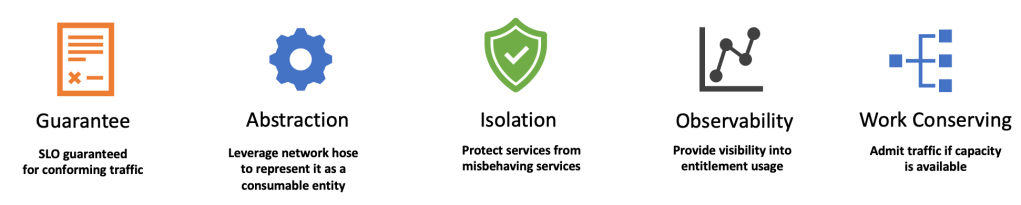
The framework is built around five design properties:
- Reliability through isolation: Misbehaving services that exceed their contract have their excess traffic down-marked, protecting conforming traffic in the same CoS.
- Accountability with guarantees: The contract sets equal expectations. If a service stays within its entitlement and the network fails to support it, the network team owns the incident. If the service exceeds its approved entitlement, the service is accountable for misuse. This removes ambiguity from troubleshooting.
- Abstraction via the hose model: Services plan for aggregate traffic originating or terminating at a data center, eliminating the need to model a full traffic matrix. This reduces the contextual load on service teams and aligns with Meta’s existing hose-based long-term planning approach.
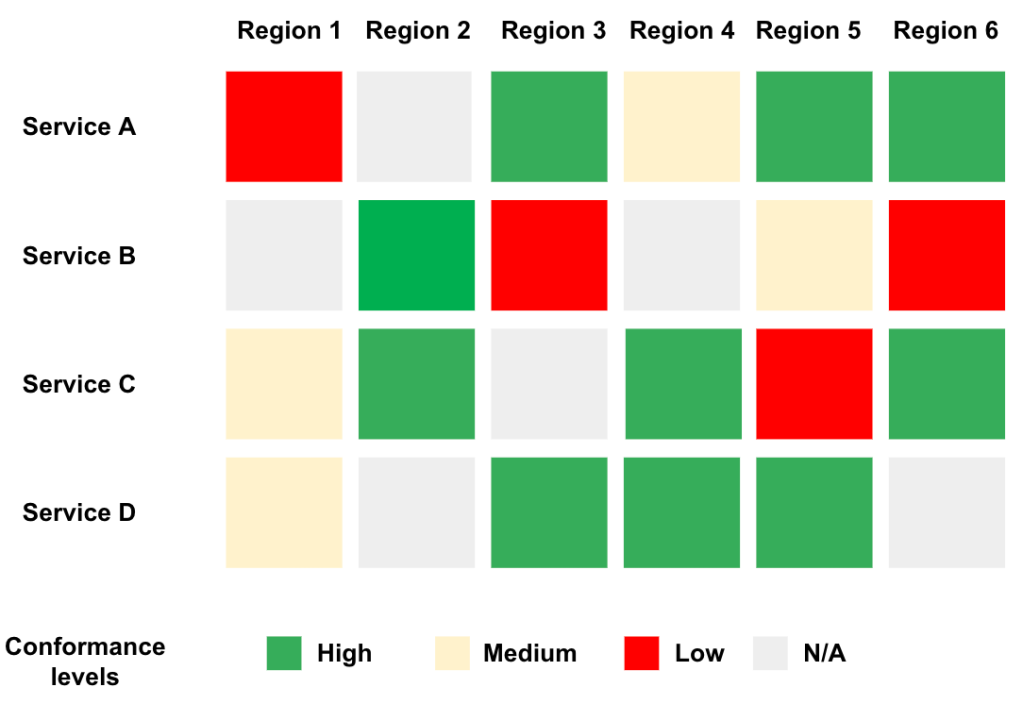
- Observability: Each finalized contract comes with a report on service consumption, including conformance levels per region and per service. This allows both teams to spot anomalies. Metrics from both the network and the reporting services are used to measure performance against the guaranteed SLO.
- Work-conserving behavior: The network only enforces entitlement during congestion. Nonconforming traffic is never proactively dropped or throttled when spare capacity is available.
Inside the Framework: Four Components
The Network Entitlement system is composed of four distinct parts:
Contract abstraction. The starting point requires services to forecast future bandwidth needs. The contract codifies bandwidth, SLO guarantee, duration, and accountability expectations, expressed using the hose model, which already underpins Meta's long-term planning. This gives service owners a familiar, consumable view of network resources.
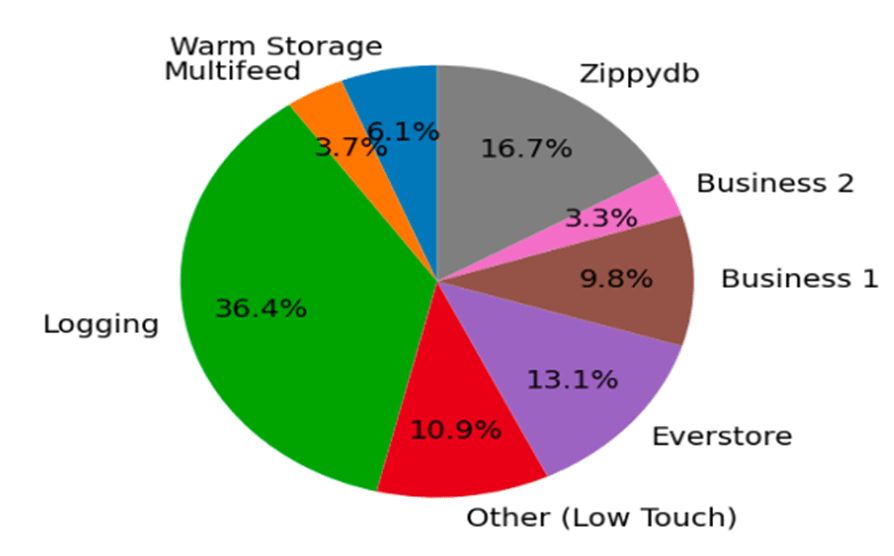
Dynamic SLO-based guarantee service. To support long-term SLOs, the granting system pre-analyzes potential failures and changes, such as fiber cuts. By synthesizing demand, failure scenarios, and available capacity, it dynamically adjusts the approved bandwidth per service based on SLO targets. Because this analysis is computationally heavy, Meta separates services into high-touch and low-touch categories—the small set of high-touch consumers account for most usage. The granting system applies different entitlement logic to each group, significantly cutting operational overhead.
Runtime enforcement system. A distributed enforcement mechanism works at the end hosts, marking packets into the appropriate QoS class based on the contract. The system evaluates traffic in real time and re-marks nonconforming flows. Any excess traffic, such as a service exceeding its entitled class, is marked as nonconforming and led to a separate, lower-priority queue in network devices.
Policy verification with production drills. Network teams validate the framework’s policies through real-world test drills every few months. These exercises introduce actual congestion while carefully controlling service traffic, verifying both service isolation and bandwidth guarantee effectiveness.
Outcome: A Clearer Operating Model
Network Entitlement establishes a contractual framework that reframes how services and the network team interact. It provides isolation for conforming traffic, clearly defines accountability, simplifies planning through abstraction, and remains efficient by conserving unused capacity. The result is a network that can protect its high-priority workloads while accommodating growth and agility for all its customers.