

If Nobody Answers, Will the Answers Dry Up?
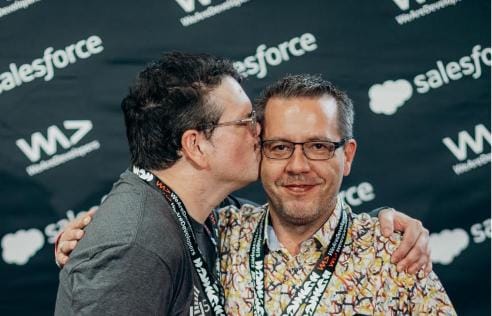
About a year ago, I was offered a last-minute slot at the WeAreDevelopers World Congress in Berlin. I don't usually say yes to international speaking invitations, but this one arrived at the right time and place — and with the right person. I agreed on one condition: Ben Dumke-von der Ehe, an early community hire at Stack Overflow who lives in Berlin, would join me on stage. We shared a topic we both cared deeply about, but came at it from different viewpoints. The organizers accepted.
What follows is that presentation, delivered Friday, July 10th at the CityCube in Berlin. At its center is a human story about how Ben and I first met. To quote what I said on stage: the long version is that we changed one another’s lives. The short version: unicorns.
Ben deserves his own say — he has told it publicly, and his account is extraordinary, including how he left Stack Overflow, returned, and then departed again. I told Ben from the start that I owed him a significant debt: I was doing this talk largely because of him.
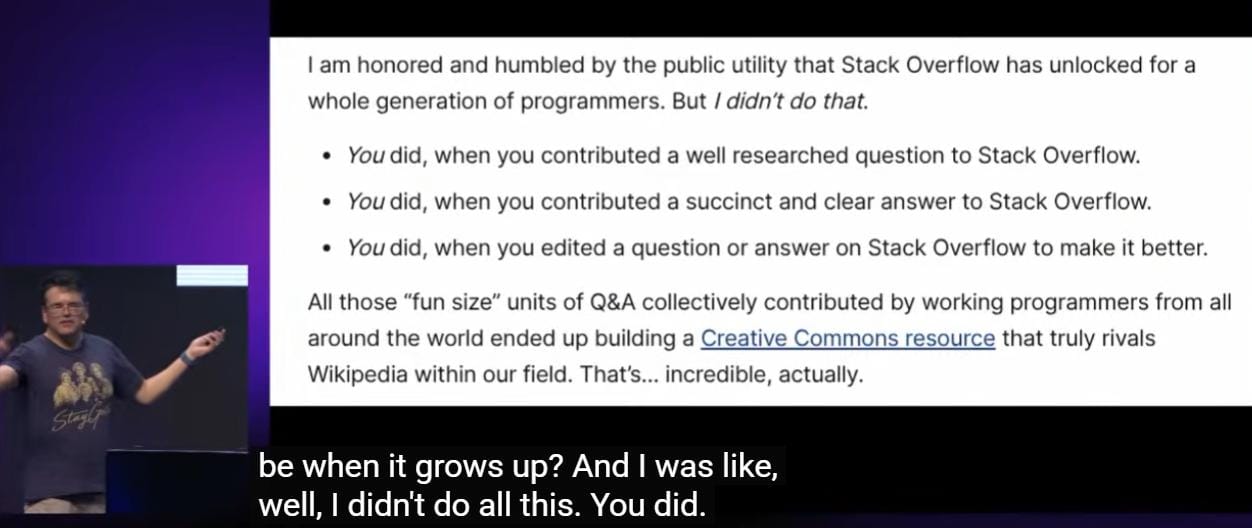
That debt extends beyond Ben to every person who contributed to Stack Overflow. We built it collectively under a bedrock Creative Commons license, a foundation that honors the effort people put into their individual posts, which layered into a shared commons and became the hugely influential Stack Overflow dataset.
When Answers Arrive Without the Wait
Leading with the obvious: it is okay that most ordinary programming questions now pass through LLMs. That result actually aligns neatly with what Stack Overflow has long aspired to be:
Passively searching and reading highly ranked Stack Overflow answers as they appear in web search results is arguably the primary goal of Stack Overflow. If Stack Overflow is working like it’s supposed to, 98% of programmers should get all the answers they need from reading search result pages and wouldn't need to ask or answer a single question in their entire careers. This is a good thing! Great, even!
The constant flood of duplicate questions is another knot LLMs have cut that I believed was nearly unsolvable.
When you’re asking a question on a site that doesn’t allow duplicate questions, the problem space of a site with 1 million existing questions is rather different from a site with 10 million existing questions... or 100 million. Asking a single unique question goes from mildly difficult to mission almost impossible, because your question needs to thread a narrow path through this vast, enormous field of prior art questions without stepping on any of the vaguely similar looking landmines in the process.
Watching an LLM map a barely-recognizable rephrasing of an old question onto its answer is genuinely remarkable. Fewer duplicates and faster answers may well be the ideal outcome.
The Cost of Whispering in Private
But it raises a harder question: what happens to the commons when knowledge exchange goes silent — when everyone is privately whispering to models? What happens to the communities where programmers learn from each other, the same communities where Ben had so much fun becoming a programmer, ultimately hired for doing what he loved?
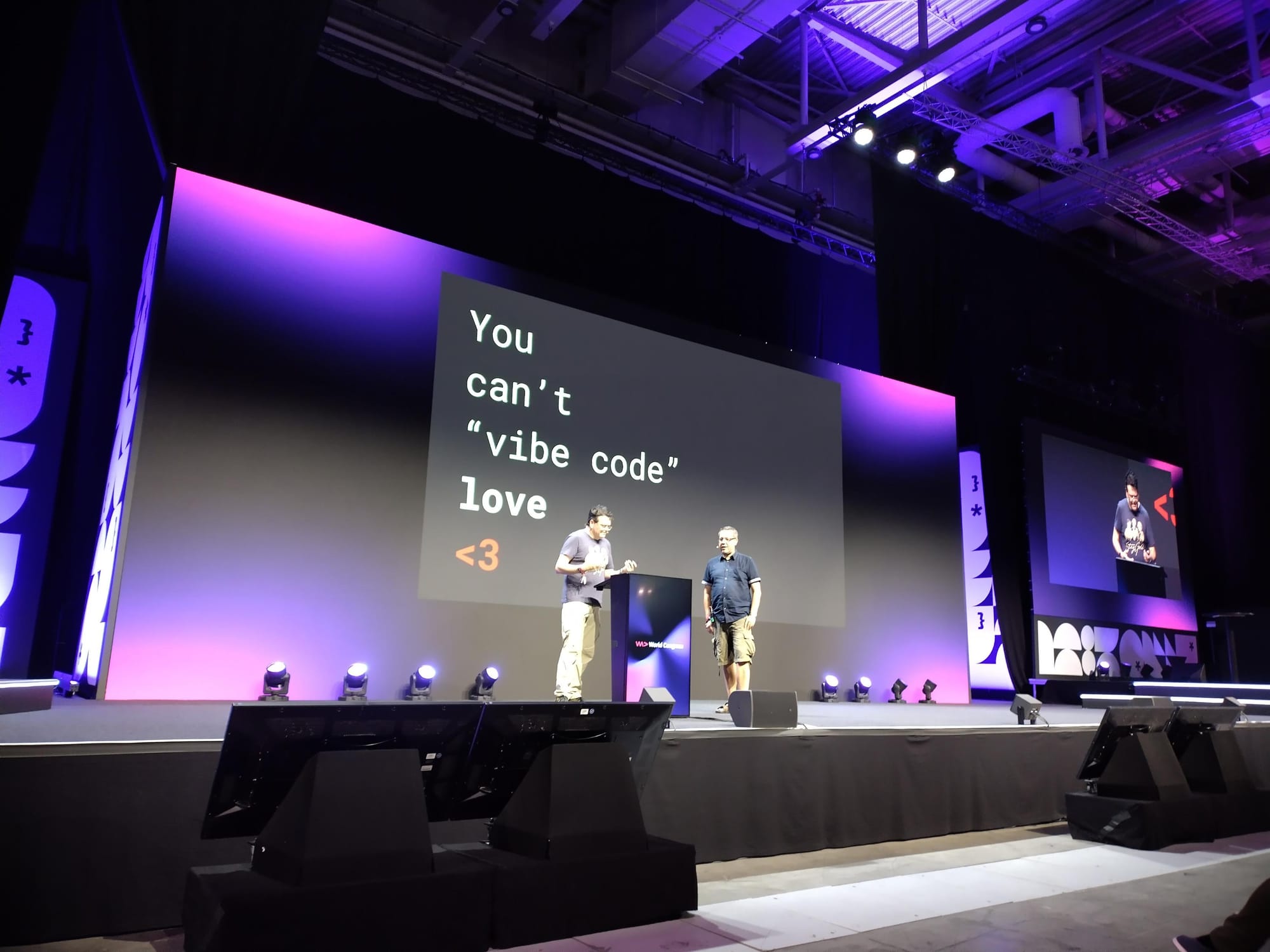
You cannot “vibe code” your way into that.
If we don't intentionally protect and build for the commons, where will the models get their next generation of training data? How will we continue the practice of shared knowledge — and the love in that practice — without the shared space to do it in?


