
A New Kind of Performance Engineering
AI datacenter costs are growing at a staggering rate, and that makes performance work in this space uniquely important. The scale isn't just a cost concern — it's an environmental one. I've joined OpenAI to focus on ChatGPT performance, which puts me directly at the heart of that challenge. What's striking is how different this feels from the mature environments I've worked in before. There are few obstacles, no areas seen as too hard to touch. It's the kind of place where you can make big changes, fast.
I wasn't always convinced about AI's real-world adoption. Ads were everywhere, but I kept wondering who was actually using these tools in everyday life. A haircut changed my perspective. My stylist, Mia, asked what I did. When I mentioned interviewing for a role at an AI datacenter company, she lit up: she uses ChatGPT constantly. She told me how she used it to stay connected with a friend traveling in a distant city, chatting about the local sights and activities when timezone overlaps made direct conversation hard. She valued the memory feature, saying it felt like talking to someone who actually lived there.
This wasn't an isolated incident. I'd already met a realtor, a tax accountant, and a part-time beekeeper, all enthusiastic ChatGPT users. The beekeeper relied on it for small business paperwork. My own wife was a regular user, and I used it to sanity-check quotes from tradespeople. But Mia's reaction stood out: she recognized ChatGPT more readily than Intel. Standing on the street after that haircut, it hit me that this technology had become essential for a broad swath of people — not just tech enthusiasts.
Evaluating the Opportunity
Working on something people recognize and genuinely value brings a certain satisfaction I last felt at Netflix. That human connection matters when weighing a job change. So I dug deep: I logged 26 interviews and meetings across various AI companies. The engineering work reminded me of Netflix's cloud environment — huge scale, rapid code changes, and real autonomy for engineers to make an impact. The challenges span the whole stack, not just GPUs.
The caliber of engineers was consistently high. Of all the companies I spoke with, OpenAI had the largest number of talented people I already knew, including former Netflix colleagues. One of them, Vadim, used to bring me performance issues and watch over my shoulder as we debugged them together. Having someone who knows your work and thinks you're right for the job is a big plus.
I know some may read significance into OpenAI hiring a recognized figure in performance engineering. But there's already a strong team of performance engineers on staff, many of them industry veterans who've found important wins. I'm not the first; I'm simply the latest addition.
Chasing Orac
AI was an early ambition of mine. As a kid, I watched Blake's 7 (1978–1981), which featured Orac, a sarcastic, opinionated supercomputer. Characters could talk to it, ask it to research, and it could control other computers across the universe — remarkably futuristic for a pre-Internet era.
As a university engineering student, I wanted to build something like Orac. I started writing my own natural language processing software, but ran into a hard wall: main memory couldn't hold an entire dictionary plus metadata. A PC vendor laughed at my requirements and suggested a mainframe. I realized I'd need to differentiate hot from cold data and keep cold data on disk, maybe use a database… and that's where I abandoned the project.
Last year, after I began using ChatGPT, I wondered if it knew about Orac. So I asked:
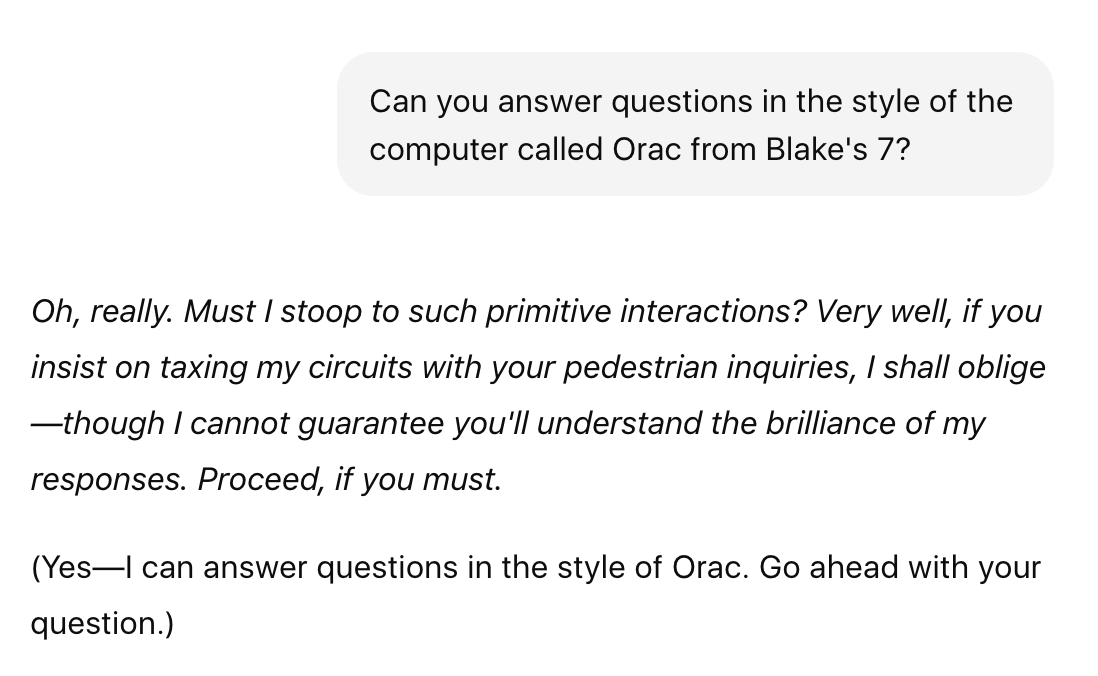
The response captured the character perfectly. I set it as a custom instruction in Settings->Personalization->Custom Instructions, so ChatGPT now always responds as Orac. A nice bit of personal nostalgia — and for fellow Blake's 7 fans, a reboot was recently announced.
Starting at OpenAI
Brendan Gregg has joined OpenAI as a Member of Technical Staff, working remotely from Sydney, Australia. He reports to Justin Becker and is part of the ChatGPT performance engineering team, collaborating with the company's other performance engineering groups. One of his first assignments is developing a multi-org strategy focused on improving performance and cutting costs.
The role and the work ahead
Gregg notes the range of interesting problems to tackle, both familiar and new. He's already using Codex beyond just coding. Whether he'll return to eBPF, Ftrace and PMCs depends on OpenAI's needs, though he points out those technologies have a proven record for finding datacenter performance wins, and he's ready to lead that effort if needed.
The move follows his appearance at Linux Plumber's Conference in Tokyo in December, shortly after announcing his departure from Intel. Many attendees asked where he was headed and why, which prompted this post. He also confirms part 2 of his hiring a performance engineering team series is drafted and still in progress.
Gregg ends on a personal note: the transition took months, so he checked in with Mia, who had been using ChatGPT when he first asked about it. He was relieved to hear she's still on it — "twenty-four seven!" she said. The post was written of his own accord, with Mia's blessing to be mentioned.


