
Breaking the Roadmap Doc Habit
Most product teams start planning the same way: open a document, write down questions about the problem, and circulate it for comments. Shopify UX Director Katarina Batina argues that this routine limits what a team can imagine. A doc that states a vision like “creating an amazing tool for buyers to shop omnichannel surfaces” does not reveal the underlying problem or the available opportunities. “You lose all of the creativity that is expected to come up with really unique ideas,” she says.
Swapping the doc for a visual canvas changes the cognitive approach. “What’s great about tools like [FigJam] and not always starting with a doc is it breaks your brain a little bit,” Batina explains. “When you break your brain before solving a hard problem, it means you're likely to have a new perspective on that thing. It might actually have more creative solutions.” Working from a shared template pushes product managers to be explicit about metrics, key problems, proposed solutions, guiding principles, key assumptions, and dependencies, while freeing the rest of the team from linear, text-first thinking.
Structuring the Offsite
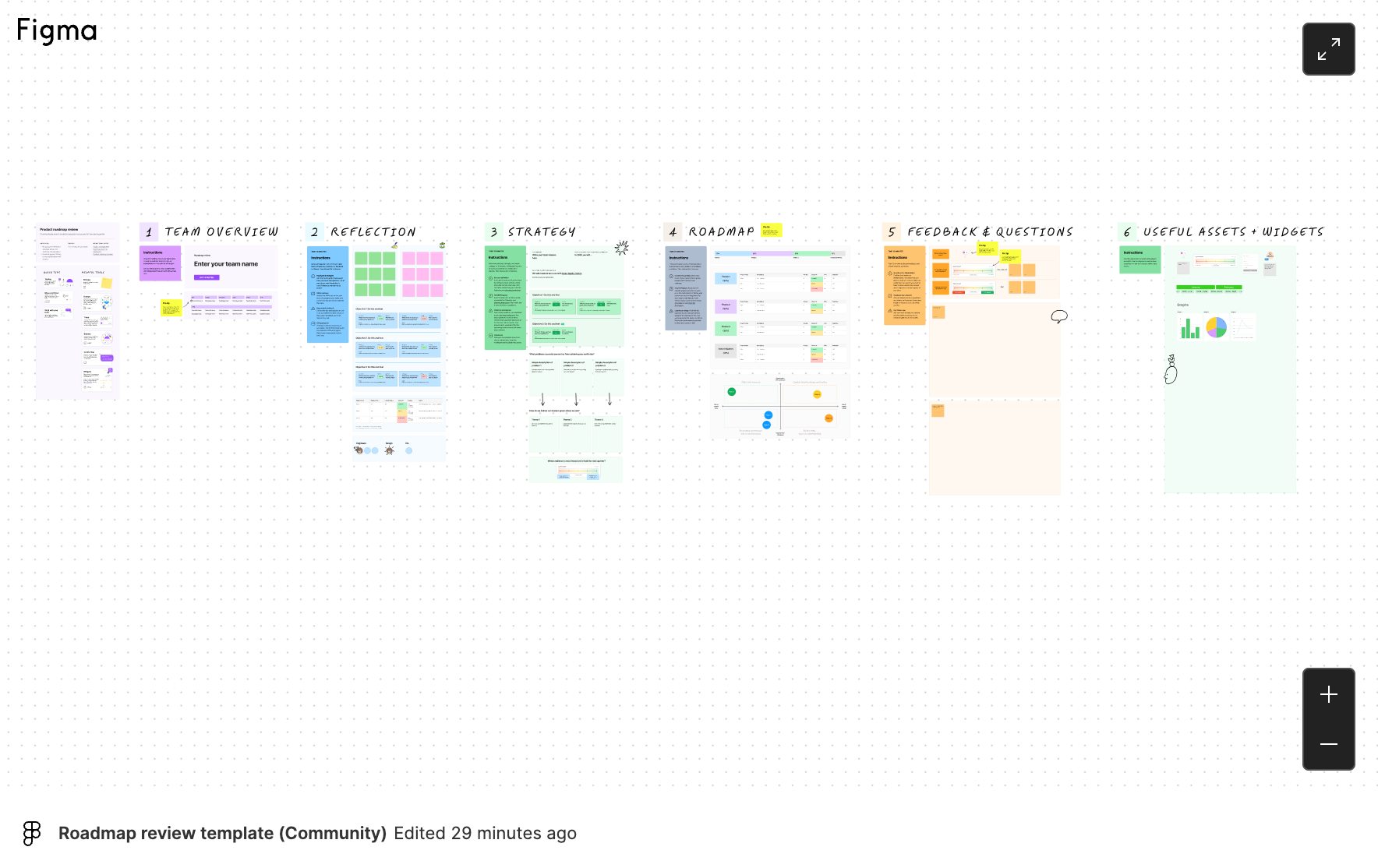
When a process is already broken, a template can help dismantle it. But templates can also build structure where none exists. For the first time, Batina and her colleagues used a FigJam template to guide their annual in-person planning session.
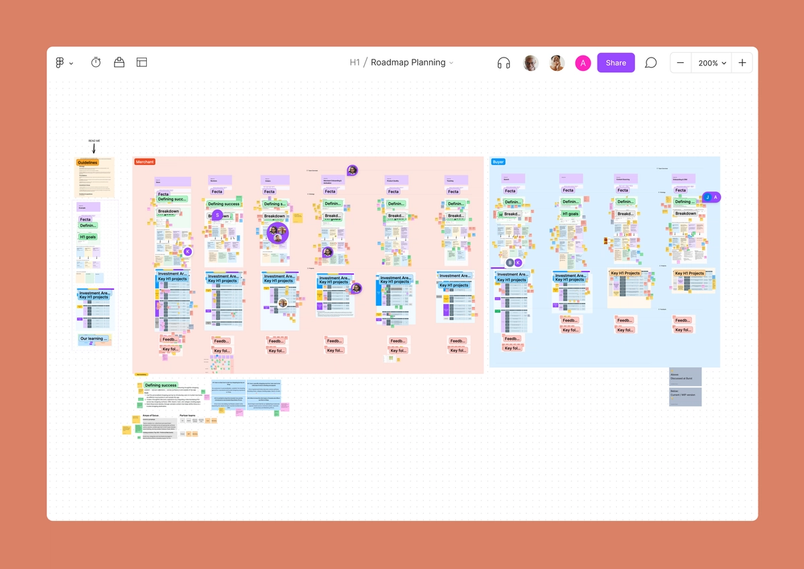
Remote work had made these gatherings directionless. “Because we’re so remote, we sometimes struggle to figure out what we should do when we get together,” she says. Filling out the template ahead of time gave everyone a shared baseline to discuss in person. As decisions were made, the team updated the canvas in real time, preserving strategic choices without relying on photos of sticky notes.
From Words to Shared Images
The medium matters as much as the decision itself. “Design is the form factor for where strategic product decisions are discussed, and Figma is that tool for us,” says Batina. “Rarely is it desired that those are getting hashed out in Google Docs or other written tools. Figma truly is the love language of decision-making.”
Visual tools also widen who gets to contribute. “We're not just design-driven,” adds Sebastian Speier, a Senior UX Manager. “We're trying to develop a strong forward-leaning vision. And when you're just working with words, it's very hard to do that unless you are very good with words.” In large meetings where 20 people collaborate at once, assuming everyone can articulate a vision in a document is unrealistic. Sharing a link to a project or dropping a snapshot of it can convey an idea faster than a written description and invites participation from people who do not think primarily in prose.
Figma truly is the love language of decision-making.“Figma truly is the love language of decision-making.”
Sketching the Conversation
Even the best ideas rarely arrive fully formed. They shift as the team tests their boundaries, and that creates a clarity problem. Batina keeps a scratch Figma file open in every strategic leadership meeting. While others speak, she sketches and pushes the result into the chat, asking, “Is this what you’re talking about?”
The payoff is immediate. “Suddenly everybody's, like, ‘Absolutely,’ or, ‘Oh my God, no,’ or half the room splits immediately and it cost you nothing,” she says. The sketch lets her steer the conversation: “You're saying, ‘Hm, what did you mean then?’ and starting to get the shape of the thing.” Rapid visual feedback pulls the room toward a shared idea far more quickly than abstract discussion. It also simplifies buy-in later; stakeholders and customers can agree on something they can actually see.
This kind of friction is intentional. Internal processes at Shopify are built to challenge business as usual, favoring big swings over incremental change. As Batina notes, executives there are not interested in copying competitors. “They are not interested in how [another company] does something; they want uniquely fitted solutions for our customers. That bar forces us to think about how we do things differently.”


