
The Songwriting Mechanics Behind “The Walk”
It’s not every day that a pop track opens with a xylophone-like hit that you can’t quite name, then builds into a wall of distorted guitar noise and synth harps. Imogen Heap’s “The Walk,” from Speak for Yourself, pulls off that trick—and a few dozen more—without ever breaking its 4/4 stride. The tempo is conventional, the meter is standard, but the key signature alone sets the piece apart: E♭ minor is a rare choice for a song engineered to lodge itself in your memory.
The track’s real genius is in its layers. On first listen, the vocals carry the melody. On repeat plays, you start to pick out the components that make the mix feel alive: a sirenlike keyboard that haunts the upper register, a second piano shadowing the first, a harsh bass buzz anchoring the low end. There’s a zither buried in there, too, alongside the standard electronic drum kit and what sounds like a muffled wind chime. Percussion duties are split between the expected drum hits and the odd texture of synth harps. Little whooshes, snits, and zips punctuate the gaps between phrases.
That first instrument—the one that opens the track—is genuinely hard to identify by ear. It looks like a small, bright strike in a spectrogram, followed by a decay that lingers slightly longer than a piano string would. Whatever it is, it gets reused as a recurring motif rather than a one-off ornament.
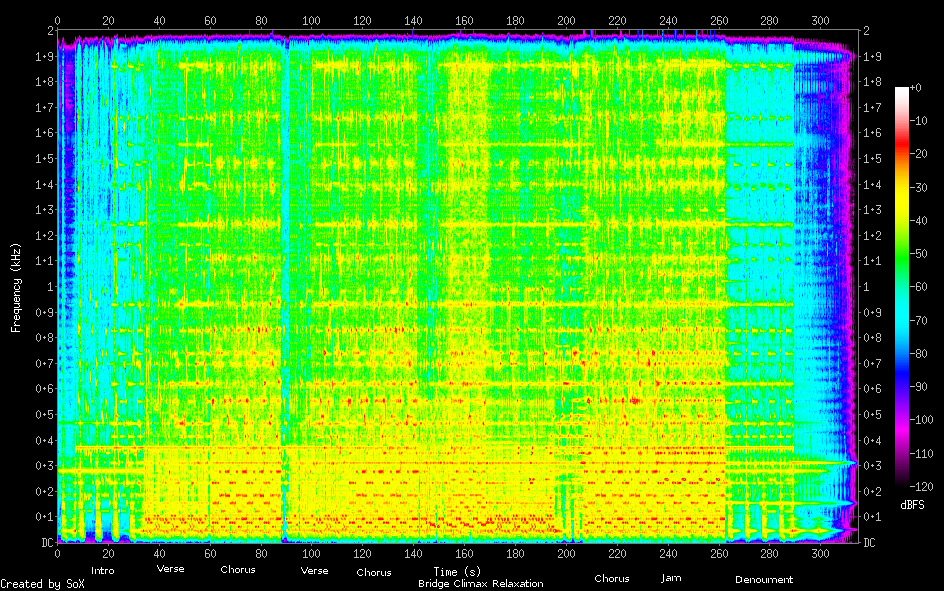
Structurally, “The Walk” is built around a simple rising couplet that functions as the thematic spine. Four repetitions of that aAaAaAaA pattern appear across the song, and Heap organizes the entire arrangement into four major blocks, each split into a low-intensity half and a high-intensity half. The exception is block three, which subdivides further into an aAbB sequence. The first two blocks are straightforward verse-chorus pairs, and instrumentation stays relatively consistent through them.
A brief silence at the 60-second mark resets the energy, and a second verse-chorus pair follows. Then comes the climactic section at 2:20—again, structured as a low/high pair. The breathless lines that follow are punctuated by a haunting descending figure that repeats four times starting at 2:50. In a stereo mix, that figure appears only in the right/left pair, which is why a single-channel spectrogram shows just two occurrences.
The guitar distortion shows up on the spectrogram as a broad band of high-frequency noise filling the entire range at 2:35. Right after that, the instrumentation pulls back for the “freeze—awaken forever” passage, where Heap’s voice drops through the lower harmonics, sliding visibly down the frequency plot. It is one of the sparsest, most effective moments in the song.
Lyrically, the middle section reads like the emergency chatter of a starship AI under attack:
Big trouble losing control
Primary resistance at a critical low
On the double got to get ahold
Point of no return one second to go
No response on any level
Red alert this vessel's
Under siege total overload
All systems down they've got control
In that frame, lines like “You’re as close as it gets without touching me” and “I feel a weakness coming on” evoke the shutdown of HAL 9000 from 2001: A Space Odyssey. The song then reads as a story of a noncorporeal system surrendering under fire—a theme about having control of your own state removed. “I don’t want to feel like this” lands differently in that context, fitting the dark key signature perfectly. Whether you take that interpretation or the more obvious one about falling for someone you’d rather not, the engineering behind the track is the same, and it’s a masterclass.


