
Composable Commerce Without the Complexity
Composable commerce projects have a tendency to balloon in scope, which is how they end up missing targets and burning budget. The architecture should serve the business goals, not the other way around. When designs become disconnected from clear objectives, costs run away fast. The following principles keep composable commerce initiatives grounded and pointed at measurable outcomes.
Define the Outcome Before the Architecture
Most teams pursue composable commerce for one of three reasons:
- Frontend focus: Faster, more personalized user experiences to lift revenue.
- Integration focus: Connecting specialized tools to measure and improve metrics like acquisition, retention, and returns.
- Backend focus: Streamlining operations such as fulfillment and inventory management.
If you are migrating from a monolithic platform, implement the minimum changes needed to hit one of those goals. Anything beyond that is redundant work that delays impact and may become obsolete when priorities shift.
Your Monolith Can Stay—As the Backend
For frontend- or integration-focused projects, the recommended first step is to keep the monolith intact and treat it purely as an API.
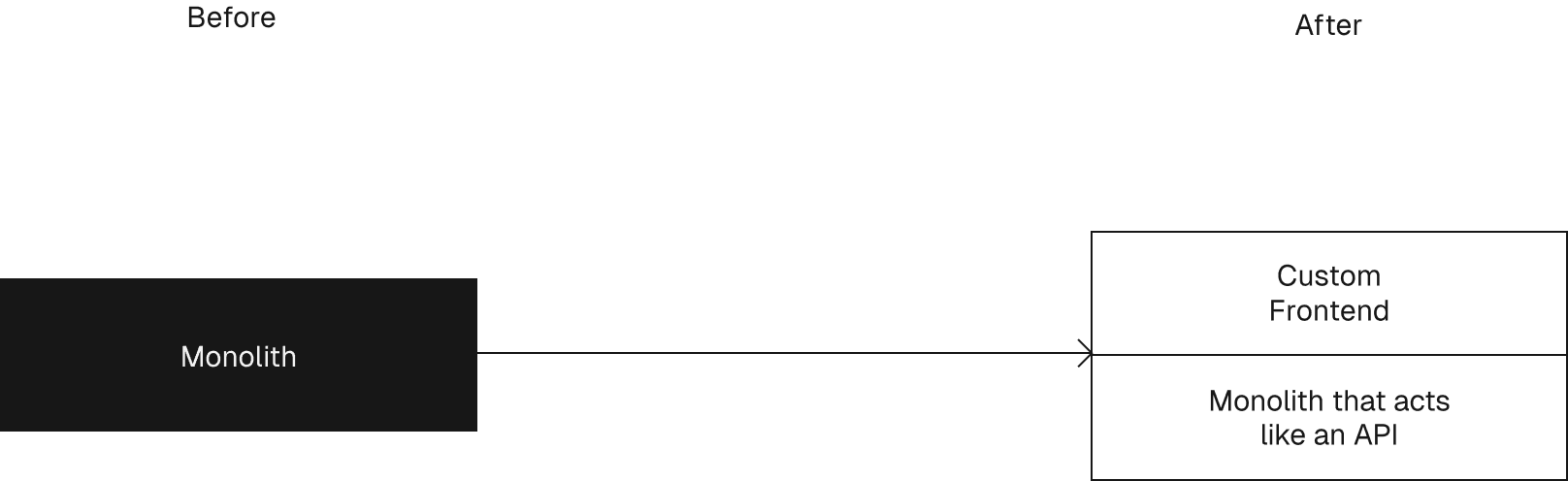
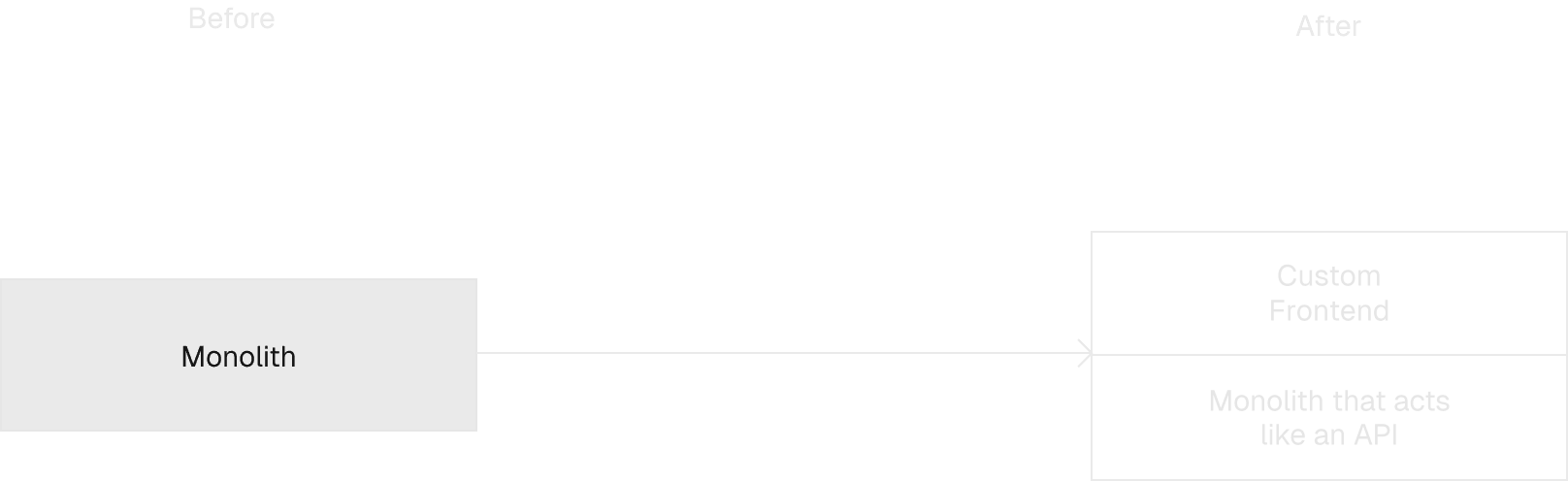
This creates a decoupled architecture in two parts: the existing monolith as the source of truth, and a new headless frontend consuming its APIs. You are not replacing the commerce backend yet. That incremental path offers two clear advantages:
- Higher velocity: Deploying the frontend separately enables faster builds and iteration, and tightly scoped projects deliver value sooner.
- Lower risk: Backend processes stay untouched, irrelevant components are not modified, and marketing and merchandising teams keep working as usual without retraining.
Frontend Migrations Can Stay Lean
If the goal is integration or backend optimization, don't sink time into redesigning the user experience. A "low effort" frontend doesn't mean low quality—it means keeping UX changes to what the backend or integration work requires. Redesigning during migration expands scope and slows delivery. AI-assisted tooling can reproduce the existing experience in the new headless architecture quickly, with migrations often completed in weeks when UX is unchanged.
When backend optimization is the only objective, start with a bare-bones frontend to decouple from the monolith, then progressively swap in a composable backend. If frontend experience is the priority, update only the pages and flows tied to immediate business needs and keep the monolith for everything else.
Middleware Is Usually Optional
Modern frontend frameworks such as Next.js can function as the integration layer, making a separate middleware tier unnecessary in most cases. Middleware becomes a cost center that delays business impact unless the roadmap explicitly includes multiple backend replacements. Its occasional justification in highly complex, multi-backend environments should be weighed against the real complexity it introduces.
Simplify and Reduce Dependencies
Choose tools that map directly to the business problem. AI-driven development has lowered the cost of building custom solutions enough that smaller teams can build in-house instead of relying on vendors. When external vendors are necessary, prioritize ones with open APIs and flexible SDKs over those imposing rigid roadmaps.
Key Takeaways
The formula for successful composable commerce is narrow scope and iterative delivery. Do the smallest project that achieves the objective.
- Pursue incremental changes scoped to specific goals, not wholesale transformation.
- Prefer simplicity and avoid unnecessary complexity or dependencies.
- Use modern tooling like Next.js and AI-driven development to accelerate results.
Architecture decisions that stay aligned to business outcomes keep composable commerce efficient and risk-managed instead of becoming an expensive exercise in abstraction.


