

Why Solution-First Thinking Fails
Most digital projects begin with a solution already in mind. Teams declare they need a new app, a homepage redesign, or an AI feature before anyone has clearly defined the problem. This approach imposes preconceived ideas rather than addressing actual user needs. The result is predictable: many projects never deliver real value.
The Core Model methodology takes the opposite route. Instead of starting with solutions, it begins with a hypothesis about what users are trying to accomplish and then works backward to define the essential content and functionality. The framing is simple: start from the answer to a user task, not with a solution.
Seven Questions, In Order
The entire Core Model reduces to asking seven questions sequentially, with the first six providing the foundation and the seventh driving implementation:
- Who are we trying to help, and what’s their situation?
- What are they trying to accomplish?
- What do we want to achieve?
- How do they approach this need?
- Where should they go next?
- What’s the essential content or functionality they need?
- What needs to be done to create this solution?
The discipline of asking these in a fixed order matters. One large organization’s head of digital, when introduced to the framework, admitted that the questions were familiar but had never been asked in a connected, structured sequence. That structure is what creates alignment across departments, bringing content creators, designers, developers, customer service, subject matter experts, and leadership onto the same page.
Preparation often starts before any workshop. Facilitators and key stakeholders identify candidate cores based on priorities, gather existing user insights and business objectives, and form initial hypotheses. The workshop then refines those hypotheses rather than beginning from a blank slate.
The Six Elements of a Core
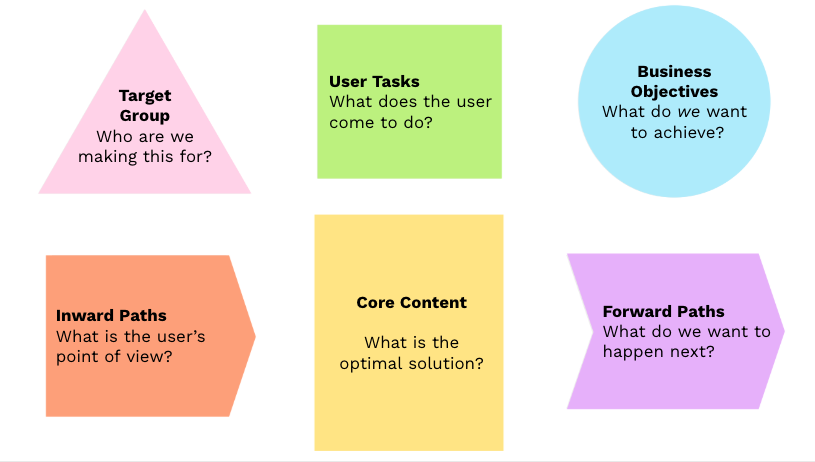
Each core sheet documents a user need and the organization’s intended response through six connected elements.
Target Group: Build Empathy, Not Personas
Skip the detailed persona documents. The Core Model asks teams to form quick proto-personas grounded in real situations: a parent researching childcare options late at night, a small business owner checking tax requirements between client meetings, a new resident navigating unfamiliar public services in a second language. This humanizes users and surfaces the emotional and practical conditions that shape their needs.
User Tasks: The Real Goal
What is the user actually trying to accomplish? The task might be making an informed decision about a major purchase, finding the right application form, understanding the next step in a complex process, or checking eligibility for a benefit. User research — often using top task methodology — should define these tasks, and they should anchor every subsequent decision.
Business Objectives: Defining Success
A digital core must serve the organization as well as the user. Clear goals might include increasing online self-service adoption, reducing support costs, improving satisfaction and loyalty, meeting compliance rules, or generating leads and sales. For teams using OKRs, these objectives map naturally to Key Results under a broader Objective. They also provide the measurement framework for evaluating success.
Inward Paths: How Users Arrive
Understanding entry points goes beyond search engine findability to include the user’s entire approach and mental model. Key questions include:
- What scenarios trigger this need?
- What terminology does the user use to describe the problem?
- How would they phrase the need to Google or an LLM?
- What emotions or urgency accompany their task?
- Which channels or touchpoints do they use?
- What knowledge do they already have?
Mapping these angles ensures content meets users where they are, not where the organization assumes them to be.
Forward Paths: What Comes Next
A well-formed core never leaves the user at a dead end. Teams define what the user should do after engaging with the content: take a specific action to continue their task, explore related options, connect with support, or save and share progress. These forward paths chain cores together into coherent journeys.
Core Content: The Solution Last
Only after the first five elements are mapped does the team define the actual content and functionality. Decisions follow from the earlier context: what information is essential, what features are required, what tone is appropriate, and what format serves the need best.
Action Cards: Implementing the Core
The final output of the process is not just a document but a set of action cards that answer the seventh question. Each card records what needs to be done, who owns it, when it must be done, what resources are required, and what constraints apply.
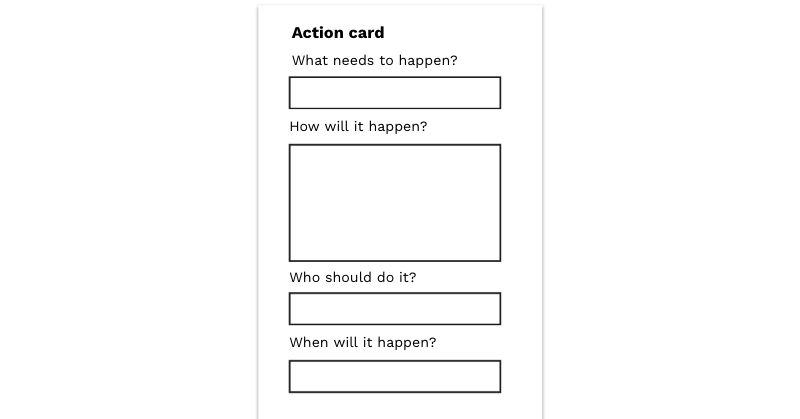
These cards turn the workshop’s insights into concrete, assigned next steps.
Core Pairs: Better than Groups
A distinctive element of the Core Model is the core pair: two people from different disciplines or departments working on a single core sheet together. This pairing has several advantages over group work:
- Cross-disciplinary insight: A subject matter expert teams with someone who brings a fresh perspective.
- Built-in quality control: Partners spot each other’s blind spots and challenge assumptions.
- Simplified communication: One-on-one conversations are more effective than unfocused group debate.
- Shared ownership: Both participants take commitment to the outcome.
- Knowledge transfer: Ideas flow naturally between different backgrounds.
The ideal pairing combines content and design, business and technical, or expert and novice perspectives. A single individual with both deep knowledge and fresh thinking on the same domain is rare; a pairing achieves that balance much more reliably.
Aligning Teams, Not Just Pages
The Core Model solves two distinct alignment problems. Within a digital team, the practitioner perspectives usually diverge: content focuses on narrative, design on interface, development on implementation, business on organizational goals. Using the Core Model, all of them organize around a single description of the user and the task. As one UX designer described it, on the flip side of the old experience: instead of handing off wireframes with unstated reasoning behind design decisions, teams share a common understanding of the intended outcome.
Cores also align teams that rarely work together but share the same user across the journey. Marketing sees how its campaigns link to service delivery; product teams understand how individual features fit a larger path; support gains context on user issues; content creates information that supports the entire experience. Organizations that map these core flows create continuity that users otherwise experience as frustrating silos.
The Core Model supplies a neutral structure for these conversations — particularly valuable in traditional organizations where ownership of content is already scattered across departments.
Running the Workshop
The workshop format adapts to the scope of the project, but for complex initiatives involving multiple stakeholders, the ideal is a full-day (six-hour) session.
First hour — foundation: Introduction to the methodology (15 min), sharing user insights and business context (15 min), reviewing hypotheses developed beforehand (15 min), then discussion (15 min).
Hours 2–4 — mapping cores: Core pairs work through the six elements for about 120 minutes, with brief sharing between pairs and in plenary. Facilitators intervene as needed.
Hours 5–6 — presentation and action: Pairs present findings, followed by group refinement, then creation of action cards and next steps.
The structure is flexible. Teams already familiar with the method can run focused sessions that take as little as 30 minutes. Smaller projects might complete in two to three hours. Remote teams can split the work into multiple shorter digital sessions.
Environmental options include:
- Analog: Paper core sheets.
- Digital: Virtual workshops on Miro, Mural, or FigJam.
- Hybrid: A digital canvas in a physical meeting room, pairing in-person dynamics with digital records.
All downloads and templates are available here.
Pair composition remains the most important success factor. Each pairing should include someone who deeply understands the domain paired with someone whose perspective is fresh. That combination prevents both tunnel vision and aimless brainstorming while cultivating natural, ongoing skill-sharing across the organization.
It is important to manage expectations about the workshop’s outcome. A Core Model session produces a brief — a blueprint that specifies content priorities, design direction, technical requirements, and an action plan. Actual solution development happens later, guided by that brief and completed by the relevant specialists. That careful separation keeps the thinking strategic at the ideation stage and protects latitude for expert implementation afterward.
Putting the Core Model into Practice
Applying the Core Model starts with drafting an initial hypothesis rather than convening a full team. Identify a core area where user pain and business impact are evident, collect existing user insights and objectives, and form a provisional statement of what that core should accomplish. Map out the key stakeholders across relevant departments before proceeding.
Next, assemble cross-functional core pairs that represent opposing but complementary viewpoints. Pair content creators with designers, business leaders with technical specialists, subject matter experts with user advocates, and veterans with newcomers. The goal is to surface tension and blind spots early, before decisions harden.
Guide each pair through the seven standard questions in sequence:
- Who are we helping, and what is their current situation?
- What are they trying to accomplish?
- What do we, as the organization, want to achieve?
- How does the user currently approach this need?
- Where should they go next in their journey?
- What content or functionality is essential to that next step?
- What actions are required to build that solution?
Finally, translate the discussion into an action plan. Record specific next steps on action cards, assign clear ownership for each item, set a timeline with milestones, and define how success will be measured.
Why the Framework Works
The Core Model succeeds because it formalizes common sense. The questions are simple, but their ordering ensures that teams articulate the desired outcome before narrowing on a particular solution. Starting from the answer rather than with a predefined solution prevents premature problem-solving and keeps attention on what actually serves user needs and organizational goals.
The method applies equally well to conventional websites, multi-channel content systems, and standalone digital products. In each case, it tightens collaboration, clarifies priorities, and yields more effective outcomes than ad-hoc planning.


