Duo’s Super Bowl Bet: A Five-Second Play for the Internet’s Attention
For most brands, a Super Bowl commercial is a 30-second, multi-million-dollar gamble on spectacle. For Duolingo, the strategy was to condense that ambition into a five-second spot starring the owl mascot’s more “unhinged” side. The ad, which aired regionally during the big game, features Duo turning to reveal a swelling backside until a second Duo pops out to the sound of a notification, delivering the reminder to “Do your Duolingo.” Simultaneously, the mobile app pushed a notification to users in the viewing markets to resume their lessons.
That moment of absurdity was deliberate. “As a social-first brand, our approach to marketing is to generate word-of-mouth and conversation,” says James Kuczynski, Global Creative Director at Duolingo. “The goal was to create a WTF moment.” Achieving that required several weeks of synchronized effort across marketing, engineering, and the design studio teams.
The goal was to create a WTF moment.“The goal was to create a WTF moment.”
Why a Five-Second Format Won
The decision to enter the Super Bowl arena was driven by data as much as ambition. The event is the country’s most-watched live broadcast, offering a prime opportunity to capture earned media. Previous campaigns had shown that big broadcast events prompted users to engage with lessons during breaks, and a push notification sent during a prior Super Bowl had generated exceptional engagement.
Budget dictated format. With a 30-second slot averaging around $7 million, the team studied examples like Reddit’s 2021 approach and opted for a shorter, cheaper slot. The bet was that a five-second bit of oddity would trend on social media and generate tens of millions of impressions—a more efficient use of spend than a conventional spot. The idea was also a callback to the “buttception” widget that had gone viral the previous summer. “We said, ‘Let’s bring this to life, make it a big moment, and get traction on social media,’” says Briana Woods, Marketing Program Manager. “So we decided to amplify it.”
From Brainstorm to Big Idea
The marketing team initiated the creative process in September after securing the time slot, beginning with a cross-functional brainstorm. The overarching prompt: “How do we hack and own the Super Bowl conversation in 5 seconds?” Teams split into breakout groups, working in a FigJam file to develop concepts that would elicit strong reactions on social media, fit the brand’s tone, and extend beyond the single spot.

Initial instincts leaned toward celebrity talent to ensure impact, but costs quickly ruled that out. “Then we realized that Duo is well known, and he’s the talent that we want to focus on,” says Woods. The winning concept—which survived two rounds of voting and a second meeting—came from a category of ideas labeled “Just cuz…the internet will share.” It leaned on existing Duolingo lore and the viral widget to create a meme-ready moment without external stars.
Engineering the Push
Executing the spot meant more than just animating frames. Because the ad aired in specific markets—New York, Los Angeles, San Francisco, Miami, Detroit, and Pittsburgh—the team needed to synchronize a mass notification send. The target was four million learners in five seconds, a rate roughly 80 times the company’s standard limit. “None of our tooling then was going to be up to the task, so we had to invent something new,” says Paul Rothenberg, Senior Technical Program Manager.
Iterating on Art and Audio
The animation itself relied on Duolingo’s internal design capabilities. “Figma is universally the design tool of Duolingo from all the UX screen flows to illustrations, so it was the natural choice,” says Nick Forshee, Creative Director of Design Studio. The team produced vector art in Figma and animations in After Effects, spending considerable time on fine details to keep the humor light rather than alienating. Forshee notes they ran “a ton of studies on the lighting, the shine, the shading, the actual butt growing.”
The five-second piece hinged on four pivotal frames, each requiring 6 to 10 iterations. The goal was ensuring each frame could function as a standalone screenshot for meme culture. “Every decision had to be very intentional,” says Forshee. “We stuck with making sure each frame was something somebody could screengrab and turn into a meme.” The team also built loops of the artwork timed to specific beats, allowing the content to pair with trending audio on platforms like TikTok.
The Final Word and Sound
Copywriting was a battle of concision and inclusivity. Early versions like “Do your language lesson” were rejected for readability and proportions, while “Do your Spanish lesson” was too exclusionary. After two months, the team landed on “Do your Duolingo,” a phrase that works across its subject offerings. “It’s become a common phrase—‘I did my Duolingo this morning’—and it works whether you’re doing math, music, German, Spanish,” says Forshee.
The audio required an unconventional source. Forshee, claiming an unusual talent, recorded roughly 200 armpit fart variations to capture the right comedic effect. The chosen version sounded optimistic, with a rising note that complemented the animation’s reveal. This was layered with Duolingo’s signature correct-answer chime to produce a final sound that was both absurd and instantly recognizable to its users.
Built for a five-second window
The engineering challenge had three parts: deliver a push notification at extreme speed, keep the site stable under a traffic surge, and clean up legacy code so the app ran efficiently. “For a five-second commercial, there needed to be exactly no engineering overhead at all,” says Paul, “meaning it couldn’t do anything except to send that note to those people at that time. There’s really not an off-the-shelf solution for that.”
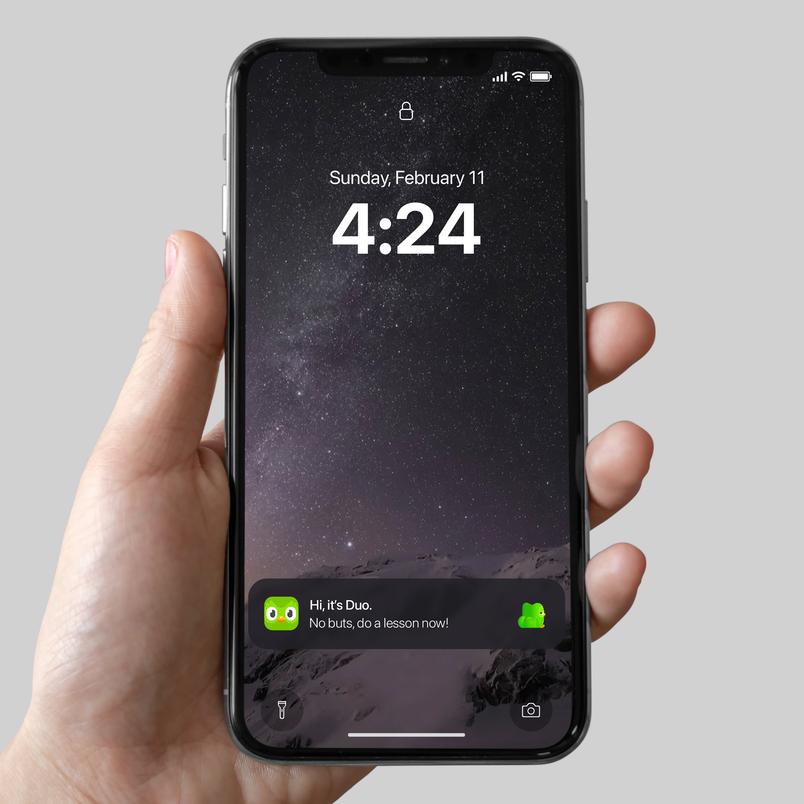
Industry peers who had tackled similar problems offered starting points, but the live nature of the Super Bowl removed the luxury of a precise delivery time. Approaches that work within a window of minutes were useless here—the team had only seconds. Since multiple options carried only “medium confidence, at best,” Paul says the plan was to test early and iterate. “The strategy was to get to testing as soon as possible.”
The first implementation was simple and prototype-ready. Early tests showed solid average send speeds but “odd distributions in the length of time it was taking for the messages to be received.” Iteration smoothed out those inconsistencies and pushed speeds past the original goals: the notification reached 95% of eligible learners within 3.9 seconds of the ad airing, and 99% within 5.7 seconds.
The response was immediate. Social media lit up with praise for the ad’s oddity, and industry creatives ranked it among the most inventive of the night. “Lovable and weird, the Duolingo Bird cements himself as a cultural icon both on and off social,” write Chloe Bayhack and Caroline Mortensen of FCB in Adweek.
“Creativity thrives in constraints,” says James, pointing to the tight five-second format and the mix of perspectives from across the company. The audience played a role too—many of the owl’s most unhinged moments originated as learner memes. “We just take those ideas and embrace them,” James says.