
Learning From the Top Down: Why Filling Knowledge Gaps Beats Starting From Scratch
There’s a conventional image of how programming is learned: master the fundamentals first—memory management, networking, operating systems—and then build abstractions on top of that solid base. But for many working developers, the path runs in the opposite direction. You ship projects using tools you only partially understand, and only later circle back to discover how they actually work.
That “backwards” approach is both common and effective. A typical example: you set up a website with Apache, spend years building on that foundation, and eventually realize you have no idea how HTTP actually works. So you learn HTTP. You didn't need it to build the site, but it becomes essential for understanding why things behave the way they do—and for debugging when they don't.
The Missing-Fundamentals Problem
This style of learning has a real downside when you start with high-level frameworks. Learning Ruby on Rails, for instance, abstracts away SQL, sockets, and HTTP. You can be productive without touching any of them, but you also don't naturally pick them up along the way.
The shift is more pronounced than it used to be. Fifteen years ago, a web developer was far more likely to be configuring a Linux server from the command line—installing packages, editing config files—and developing fluency in shell tools as a byproduct of the job. Today, deploying to a platform like Heroku means you hardly need to know a server exists. Networking is similarly abstracted away in modern web frameworks, where you simply define routes and handler functions. The abstractions do more, but they're also leakier; to do truly great work, you sometimes need to look underneath.
Fill Gaps, Don't Rebuild the Foundation
It's tempting to respond to knowledge gaps with a lecture about what “kids these days” should know. That's ineffective and boring. People will keep learning abstractions first, largely because they're fun and let you get real work done immediately. The goal, instead, is to help fill in relevant gaps when the need arises—without drowning people in fundamentals they've already internalized.
Practically, that means anchoring explanations in what your audience already knows. This is a key nuance: missing one concept doesn't mean you know nothing. A professional programmer who doesn't understand binary internals still has a deep reservoir of related knowledge. An explanation that assumes total ignorance wastes their time. Instead, identify the one thing they're missing and connect it directly to their existing mental models.
Avoid overwhelming readers by tackling more than one conceptual gap at a time. Make it clear what the single wall you're addressing is. Even though every reader brings a unique mix of knowledge, many gaps are shared—often arising from a widespread "I didn't realize X for a long time." These are the sweet spots for effective writing.
Bugs: The Abstractions' Weak Points
The most natural way to learn what lies under an abstraction isn't a textbook—it's a bug. When a performance issue is traced back to a TCP setting, the bug doesn't just present a problem; it clearly demonstrates the connection between the high-level HTTP request and the low-level protocol handling it. Each bug typically teaches you one or two things about that specific layer, making it an organic step-by-step method for deepening your understanding.
Faster Paths: Skipping to the Good Parts
Teaching by filling in specific knowledge gaps is also more efficient. When you know your reader is already using a tool, you can skip the basics entirely and focus on the non-obvious details that will make a difference. Consider a bash cheat sheet designed for people who already know what $VAR means, what stdout is, and what an array looks like:
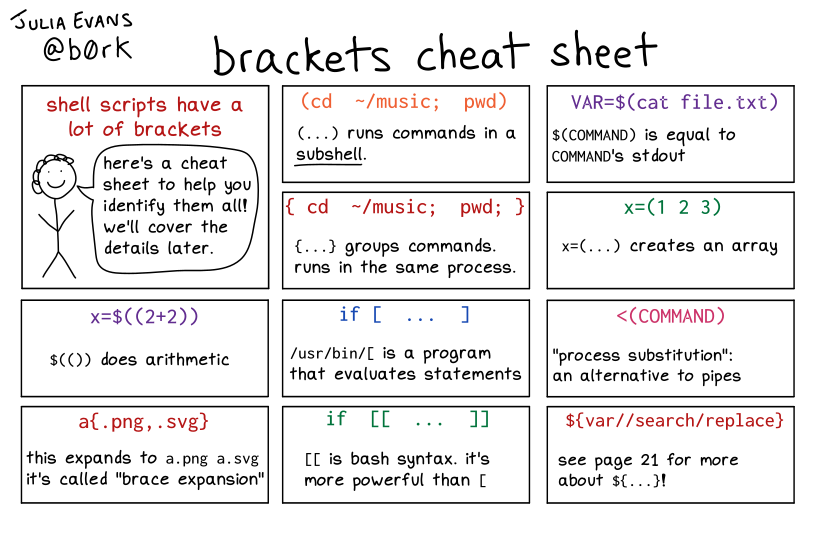
With that assumed base, you can immediately address the material that might surprise even experienced scripters: that /usr/bin/[ is a program (a prerequisite to understanding bash's builtin of the same name), that the curly brace in a{.png.svg} has no relation to the one in { command1; command2 }, or that you can use ${} for search and replace. This approach turns a topic that could be a full tutorial into a readable, high-signal guide.
This is a deliberate editorial choice. For a guide targeting intermediate users, the goal isn't to explain what bash is but to dissect its more subtle mechanics—variable assignment, the inner workings of if-statements, and quoting in edge cases. The material is tailored precisely to the audience's known blind spots.
Adopting a Tutor's Mindset
Adapting the explanation to the audience—often someone you've never met, will only have their attention for a short window, and may never encounter again—demands quick analysis. Just like a drop-in math tutor with 20 minutes per student, you ask, listen, and identify which small, critical piece of knowledge will fill their gap. Often, the learner already understands a great deal and just needs clarification on one specific point. Jumping to conclusions about their ignorance is a disservice.
The internet is a drop-in tutoring center at scale. You have no data on your readers, and their time is limited. That reality dictates a focused teaching style: one concept, precisely targeted, explaining what sits beneath a tool's surface. Abstractions are useful daily working layers, but the skill set of a great engineer lies in knowing when and how to peel them back.


