

The American Dream Needs a Rewrite
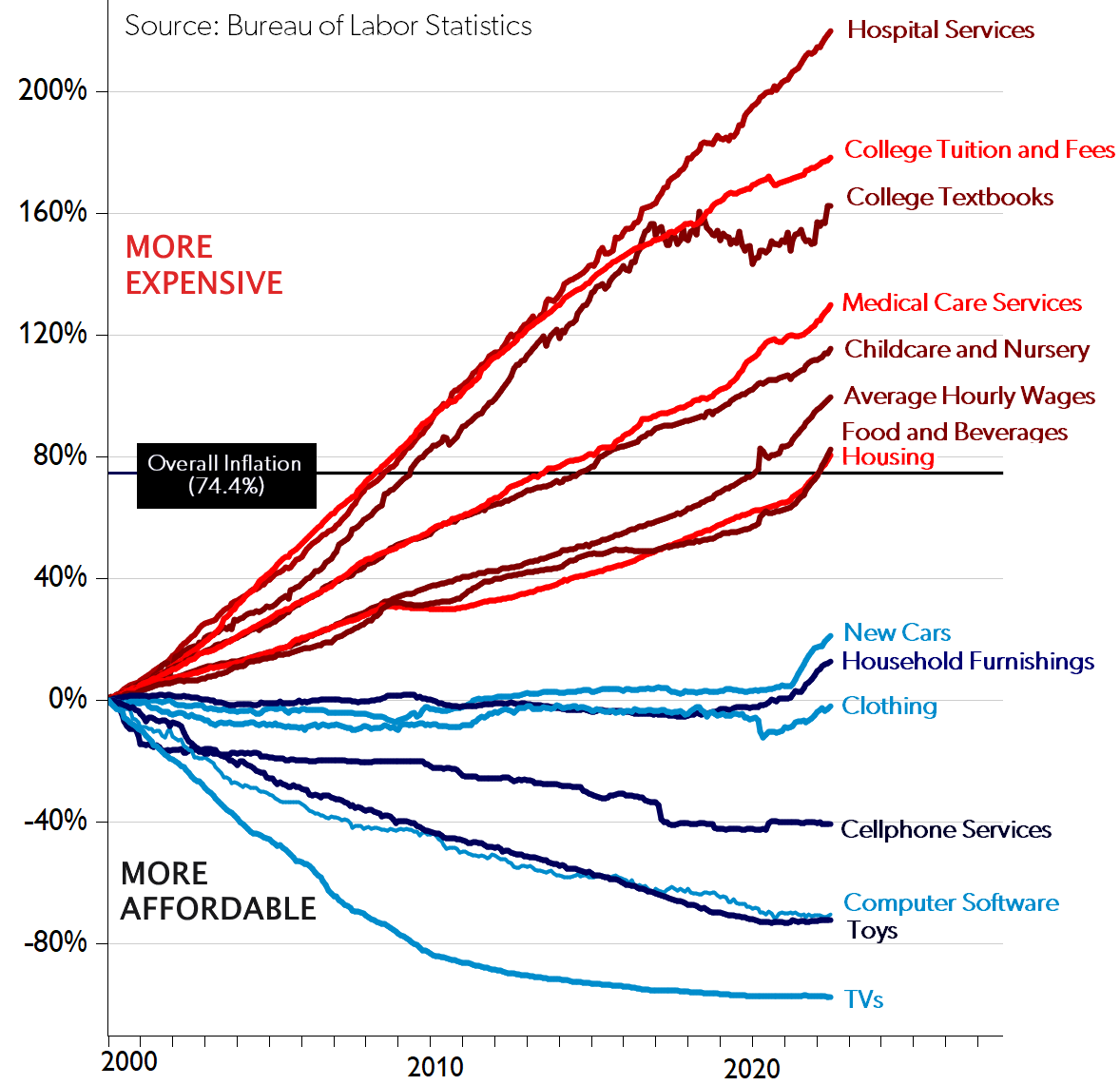
Stack Overflow co-founder Jeff Atwood is arguing that the American Dream, as currently practiced, is failing too many people. Housing, healthcare, and education costs have risen far faster than wages and inflation. Wealth is increasingly concentrated: the top 1% of households control 32% of all wealth, while the bottom 50% hold just 2.6%. And in the last presidential election, 42% of adults living in America—144 million people—did not vote and had no voice in the outcome.
Atwood is responding with both immediate charity and a longer-term commitment. His family has made eight $1 million donations to nonprofits addressing urgent needs:
- Team Rubicon — mobilizes veterans to help Americans prepare for, respond to, and recover from natural disasters.
- Children’s Hunger Fund — supplies resources to local churches in the U.S. and abroad to support impoverished community members.
- PEN America — defends writers against censorship, supports writers in crisis, and amplifies the work of incarcerated writers.
- The Trevor Project — works to support young adults seeking acceptance.
- NAACP Legal Defense and Educational Fund — advances racial justice and reduces inequality through legal action.
- First Generation Investors — teaches high school students in low-income areas investing fundamentals, providing real money to invest and encouraging financial literacy.
- Global Refuge — supports migrants and refugees through community-based legal and social service partners nationwide.
- Planned Parenthood — provides essential healthcare services and resources.
Over the next five years, Atwood also pledges half of his family’s remaining wealth toward long-term efforts aimed at keeping the American Dream attainable for everyone.

From Cashier to Cofounder
Atwood’s own path began in rural Virginia and West Virginia. His parents struggled with alcoholism until a divorce forced the issue; he credits them with teaching him how to receive love and reflect it outward. He attended public school in Chesterfield County, Virginia, and graduated from the University of Virginia in 1992. To pay tuition, he worked as a part-time Safeway cashier earning the federal minimum wage, supplemented by Pell grants and scholarships. Tuition then was about $3,000 per year; at state schools today that figure has reached $23,000, roughly eight times higher over three decades.
Digital Democracy Was the First Step
In 2008, Atwood and co-founder Joel Spolsky built Stack Overflow, a Q&A site for programmers with a Creative Commons knowledge base. The site ran democratically: questions and answers were ranked by votes, and community moderators were elected using ranked-choice voting. It was, in his words, a digital democracy—of the programmers, by the programmers, for the programmers—and it became a commercial success.
But Spolsky pushed further, arguing that digital democracy alone wasn’t enough. That insight led to Discourse, an open-source platform designed for constructive, empathetic community discussion. Communities set their own boundaries democratically and moderate strongly to enforce them. The goal: digital democracy and empathy, where participants see one another through their screens.
Atwood says he always viewed Stack Overflow and Discourse as projects for the public good that happened to be corporations. He earned millions, which he assumed was the endpoint of the American Dream. Then he watched a high school production of The Outsiders and recognized the real meaning of “stay gold”: sharing the American Dream, not hoarding it.
Unequal by Design
The American Dream, as Atwood sees it, is rooted in the Declaration of Independence—Life, Liberty, and the pursuit of Happiness—but it is not equally available. In 2024, he says, enough Americans voted for a vision of the dream he doesn’t understand. Roughly 34% of eligible adults did not vote; another 7.6% are ineligible, including noncitizens and people convicted of felonies. The vote, he argues, failed to represent everyone.
His proposed fixes are concrete: make Election Day a national holiday, adopt universal mail-in voting, and use ranked-choice voting so every vote carries more weight. He also points to state and local election boards and the Federal Election Commission as institutions that need strengthening.
Atwood is candid about how wealth distorts perspective. “I no longer bother to look at how much items cost,” he writes, conceding that accumulated wealth distances his family from ordinary American life. Even so, he calls billionaire-level wealth “unamerican,” citing Pew data showing the top 1%’s share of national wealth rose from 24% in 2012 to 30% in 2021.
He distinguishes his approach from the Buffett Pledge, which would transfer most of his fortune to philanthropy upon his death. Atwood believes that timeline is too slow. He’s holding back only enough for his children’s college educations and a home purchase—because parenting is the toughest job he’s had, and he worries about their future—and intends to allocate half of what remains within five years.
One Dream, Two Paths
Atwood acknowledges the American Dream contains two paths: one of hate and one of love. His family is pledging half their remaining wealth to an American Dream “founded on love.” He offers starting points for longer-term efforts:
- Support organizations that make it easier for Americans to vote in the next congressional and presidential elections, before democratic institutions are further damaged.
- Fund nonprofits with a proven record of protecting democratic institutions.
- Found a new organization modeled loosely on the RAND Corporation, modernized like Lever for Change, to map realistic paths toward preserving the American Dream within or outside the current system.
- Recognize that all states are purple, not red or blue, and that Americans share more policy common ground than they realize—splitting would only echo the divorce Atwood experienced growing up.
- Start locally: vote in city and state elections, support independent local journalism, volunteer with a local organization and listen to the people it serves.

Atwood is asking others to do two things: support organizations effectively helping those most in need right now, and make public dedications of time or funds over the next five years toward long-term efforts keeping the American Dream fair and attainable for coming generations.


