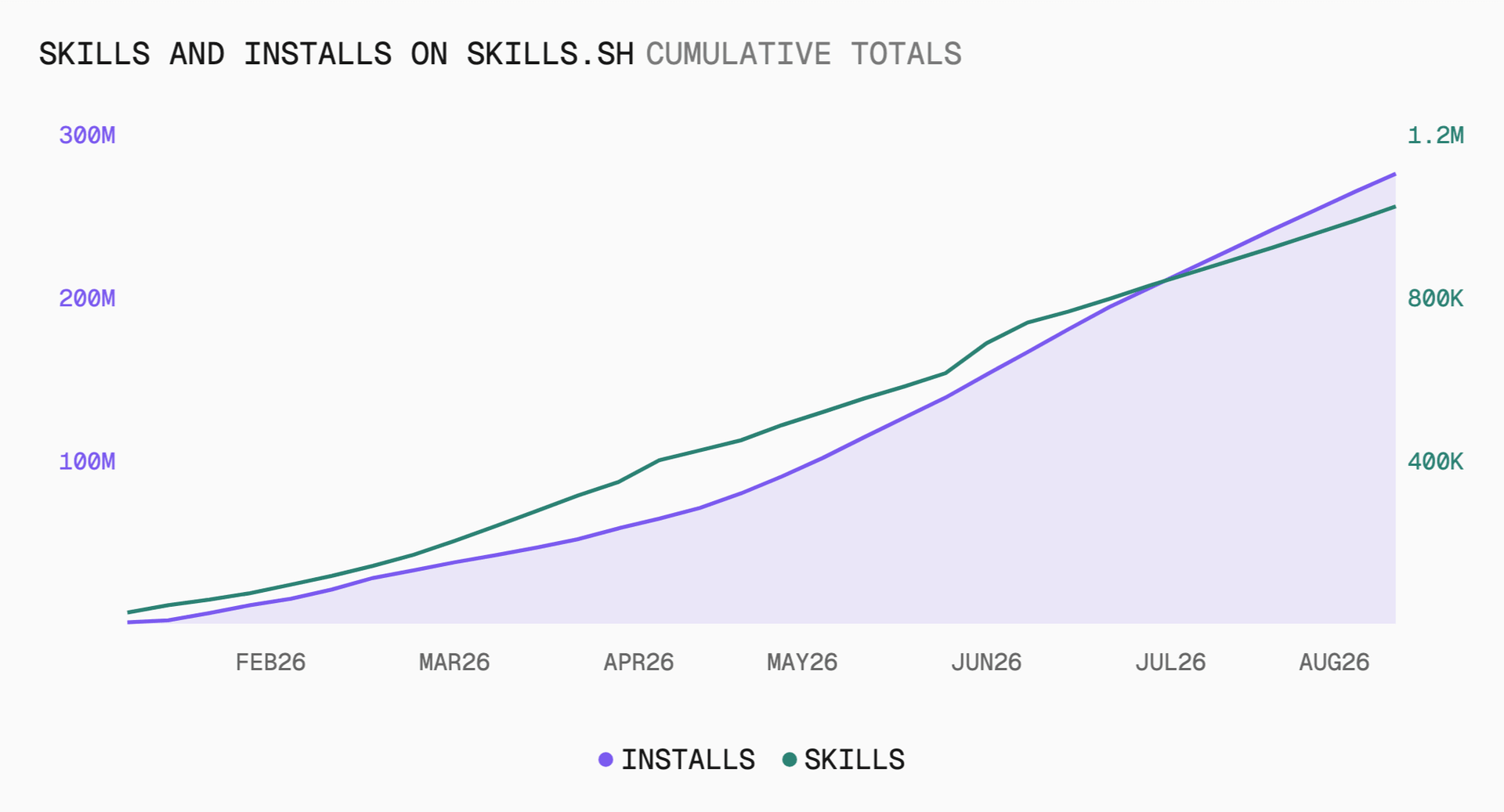
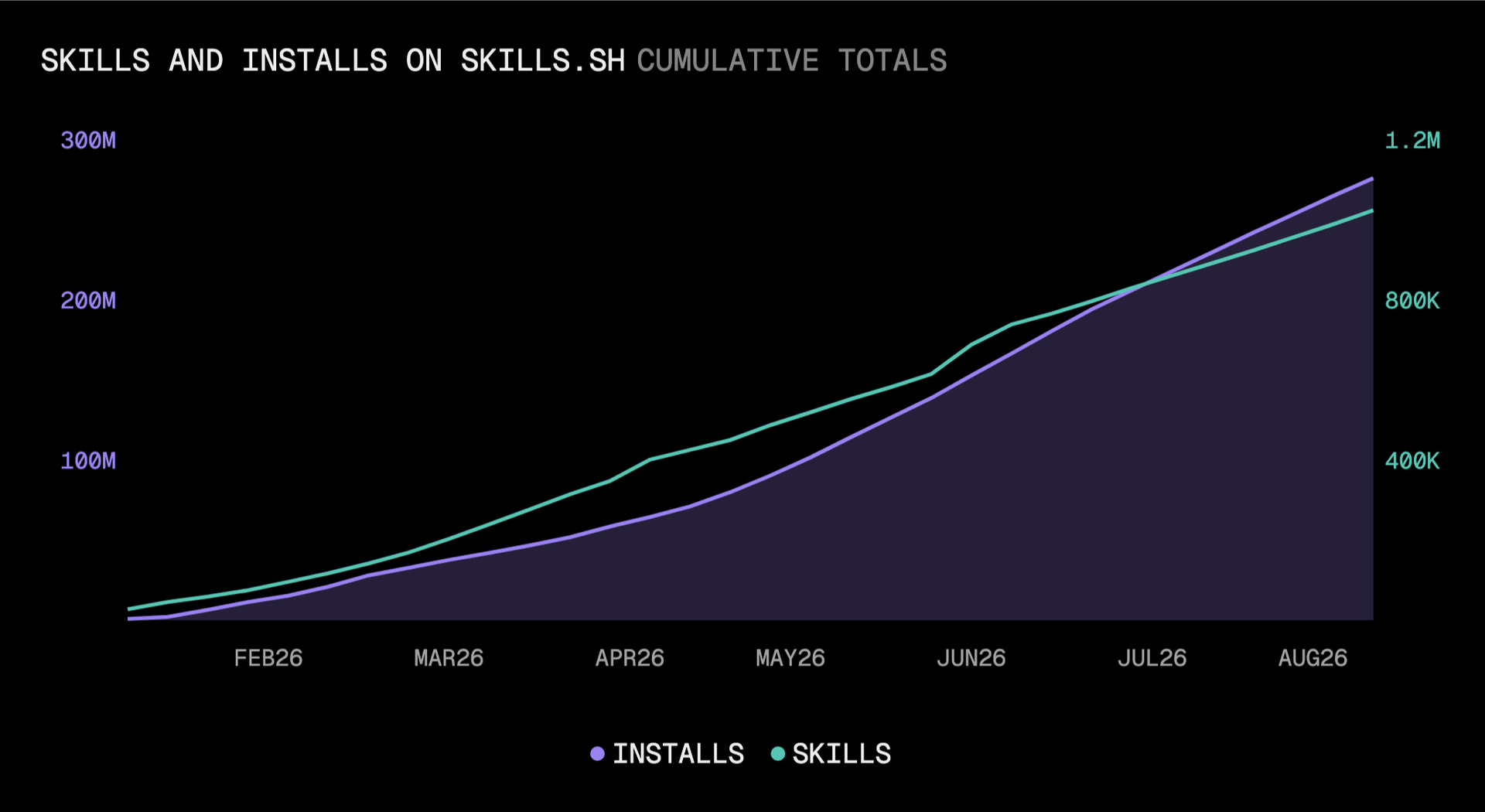
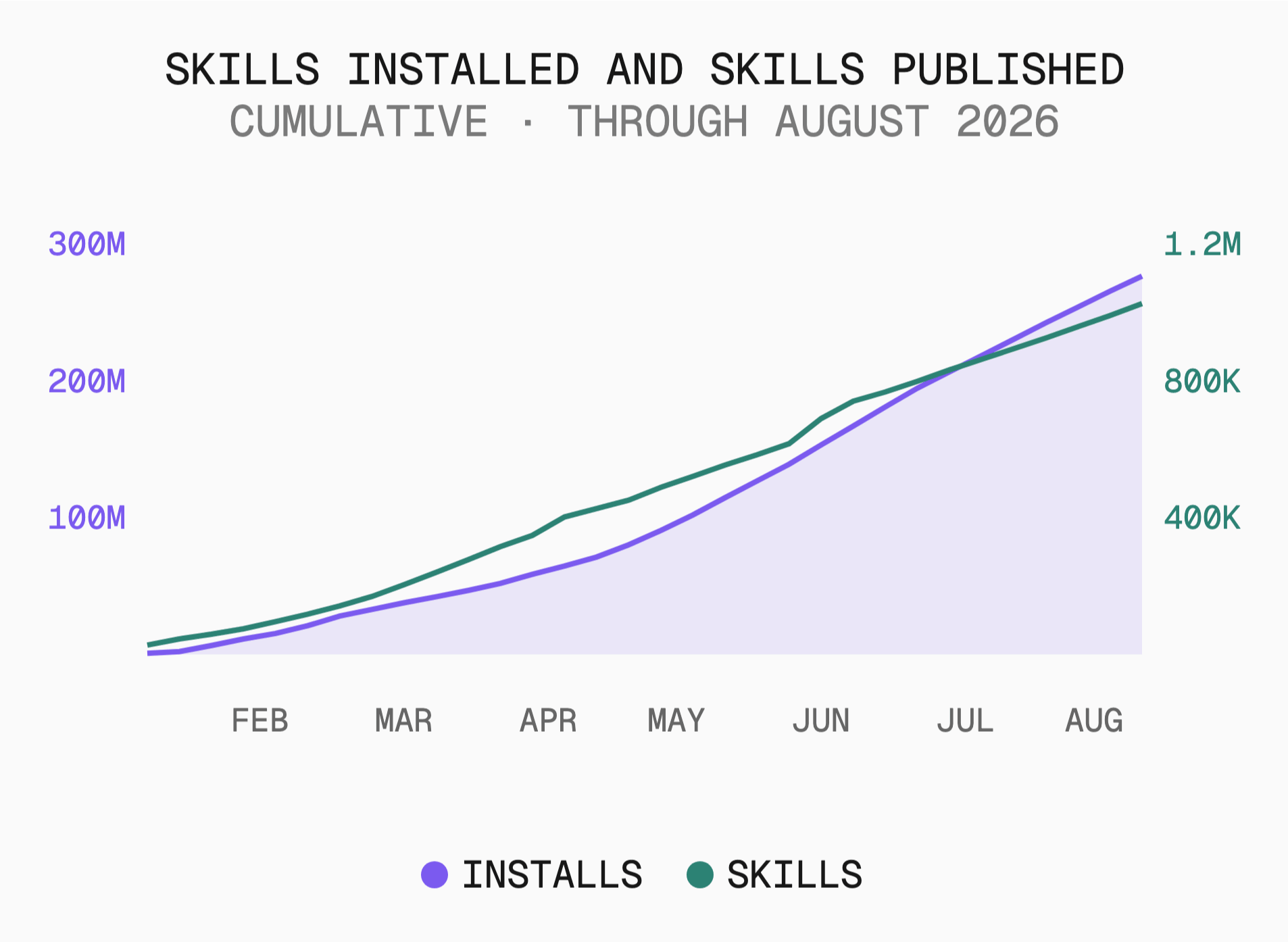
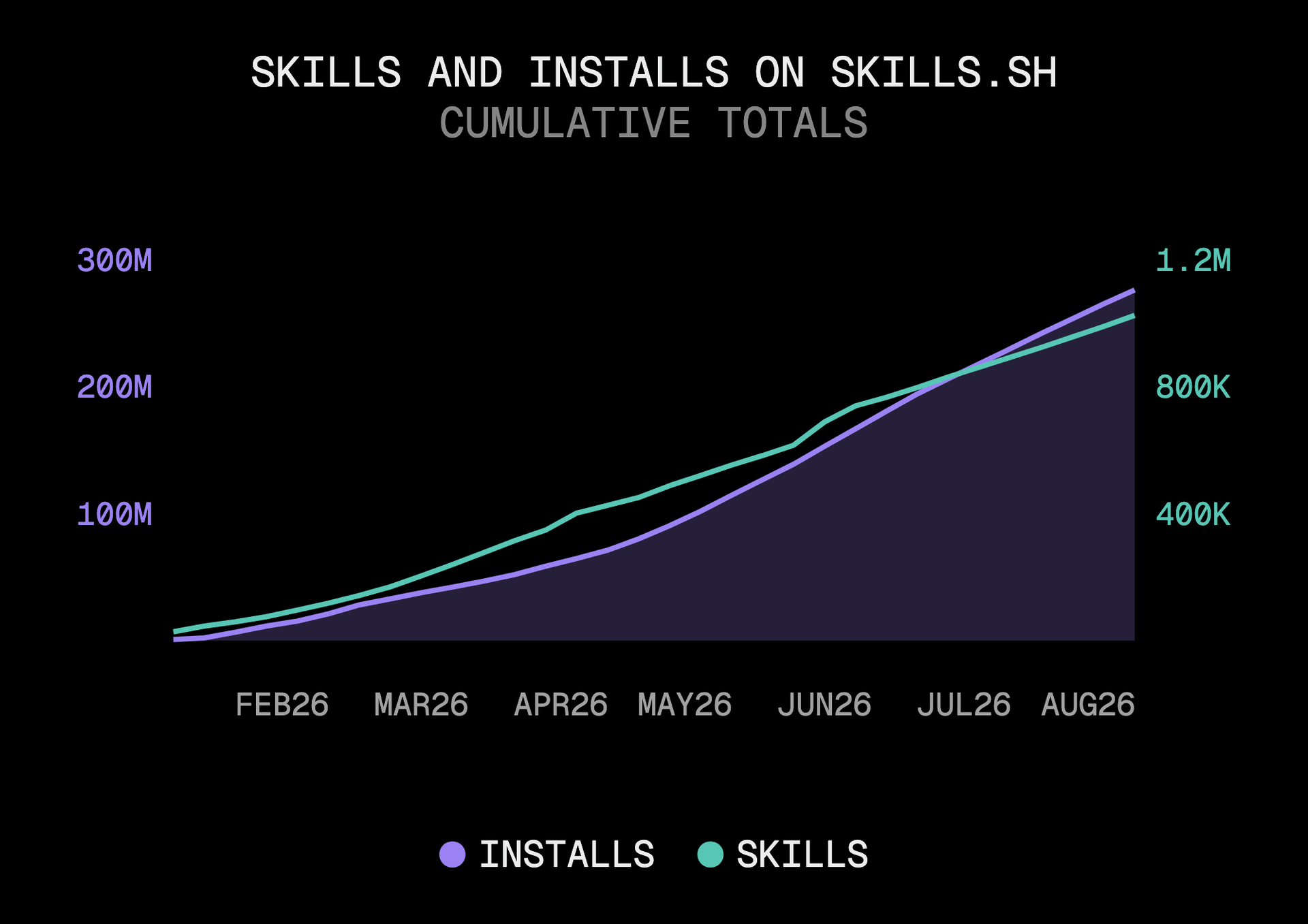
Anthropic introduced Agent Skills in October 2025; Vercel launched the skills.sh registry three months later. Within seven months the registry passed one million listings and recorded nearly 280 million installs.
A skill is reusable instruction for a specific job, handed to an agent that is capable but generic. Agents can perform many tasks; what they lack is the knowledge of how a given person, team, or company does that work. A skill carries that context, and it can be nothing more than a file written in ordinary language.
Supply is technical, demand is not
The registry's most-installed skills were classified by the kind of work they help agents perform; together they represent more than four-fifths of all installs. Listings indicate supply, installs indicate demand.
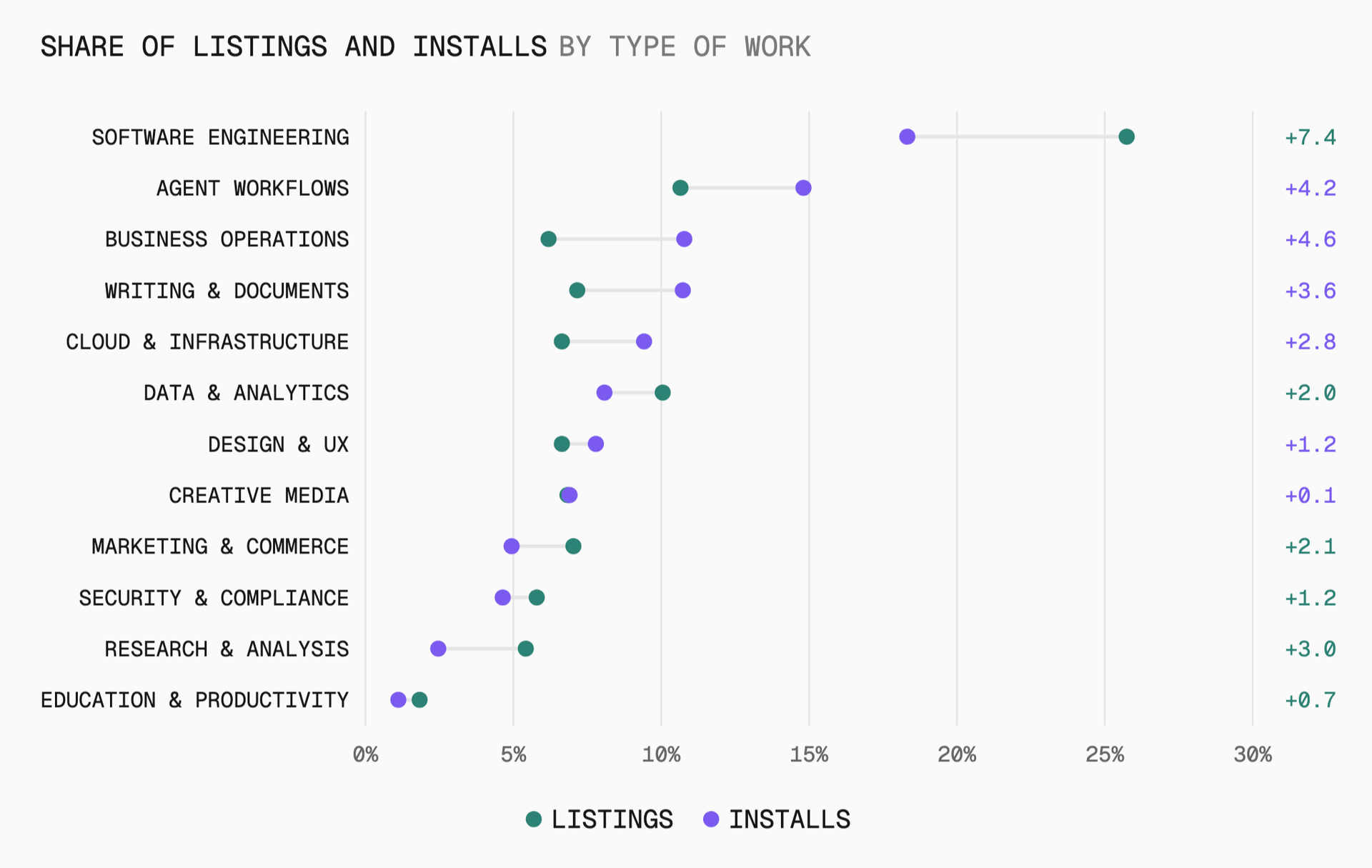
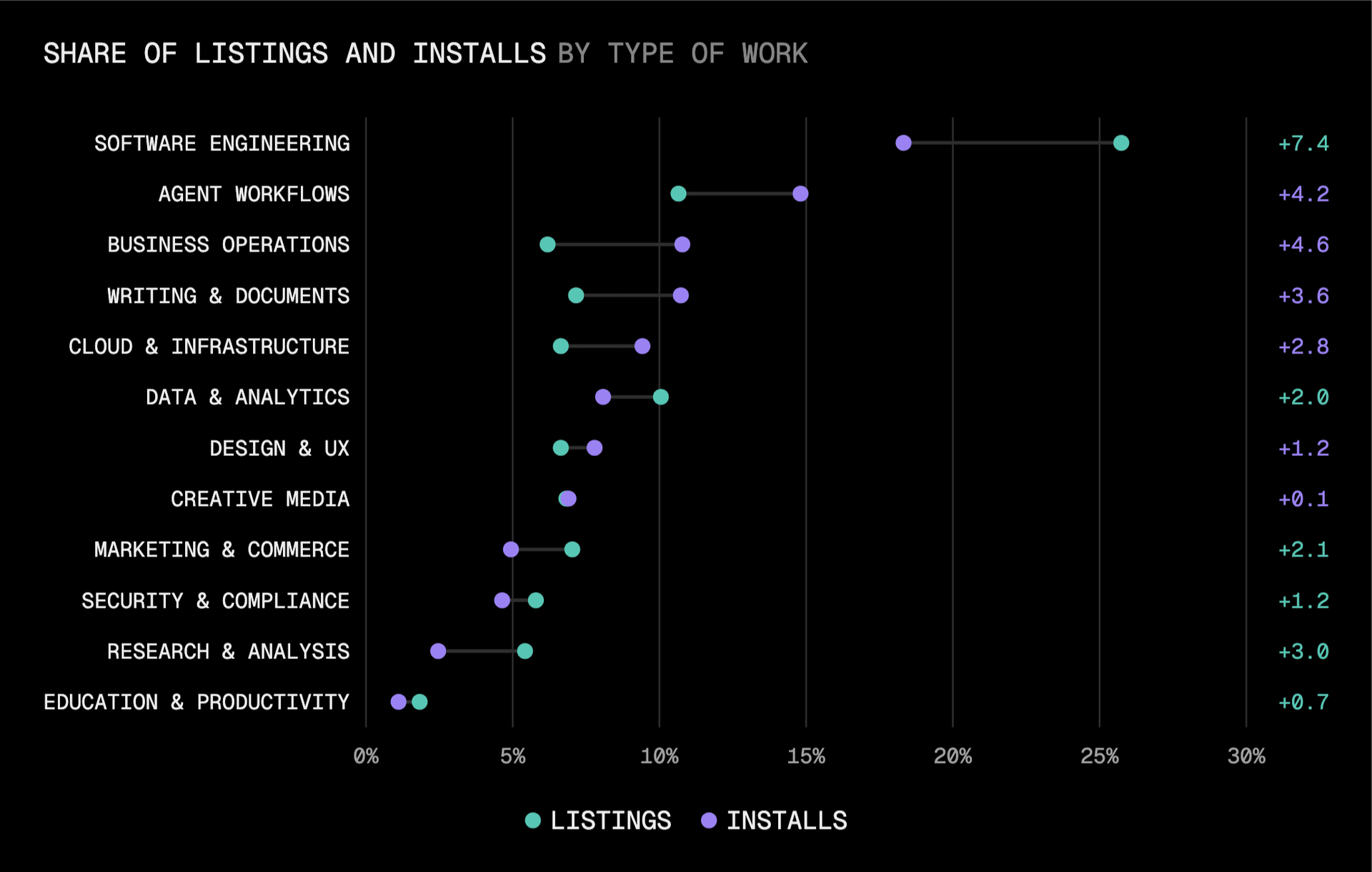
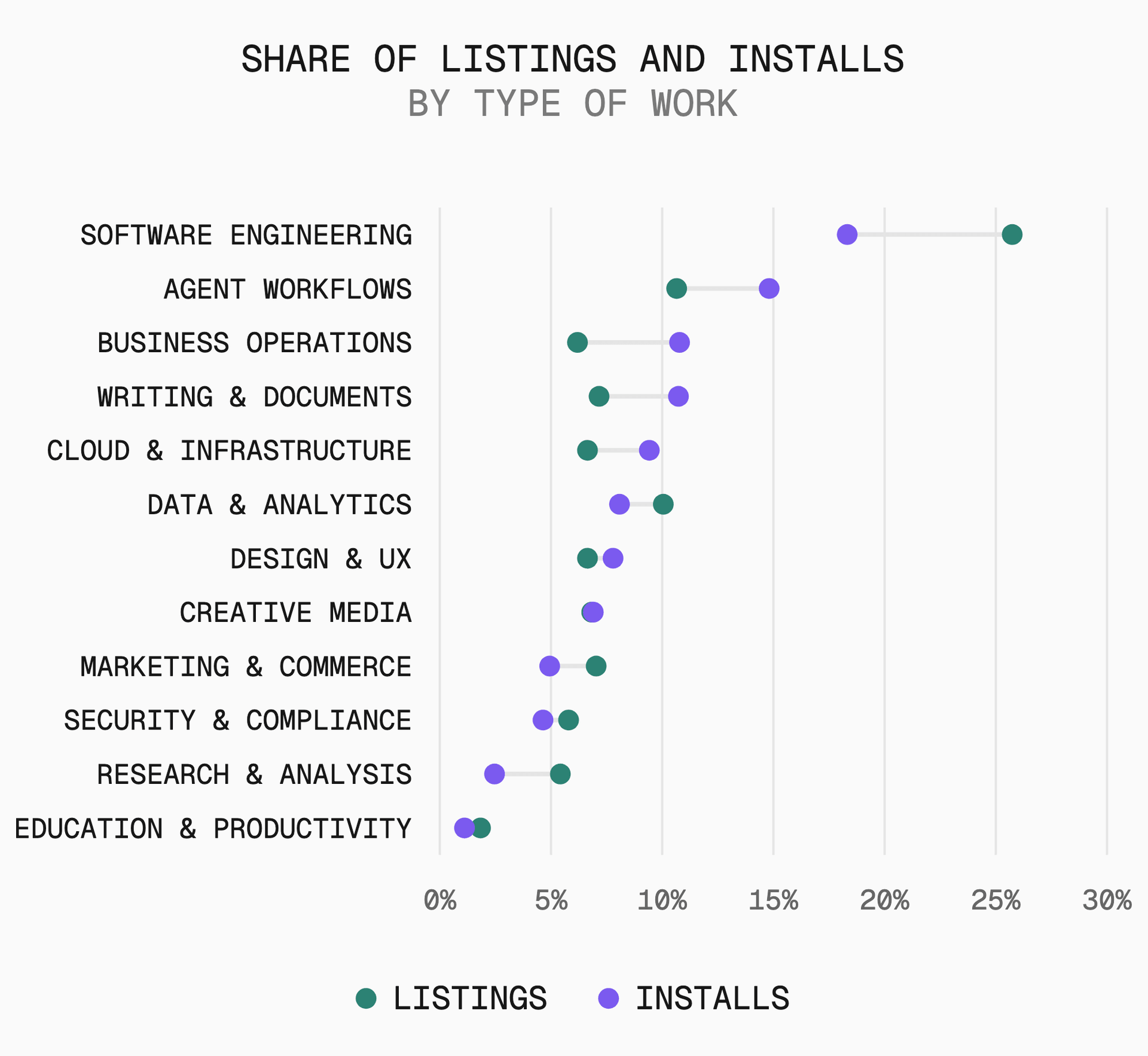
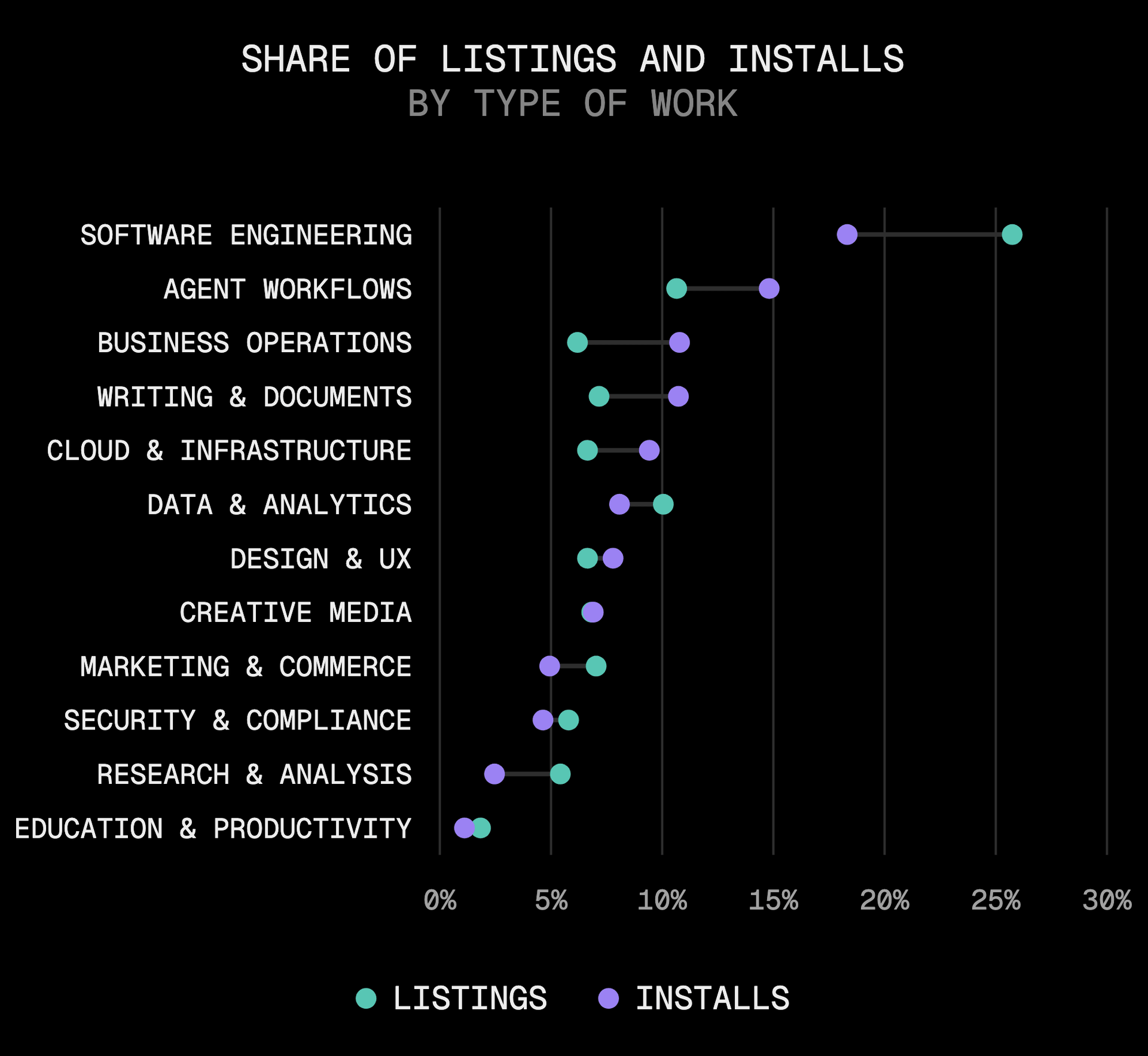
Listings skew technical: more than half teach software engineering, agent workflows, data, infrastructure, or security, and software engineering alone is about a quarter. Installs are spread much wider, with no category above a fifth. Software engineering leads at 18%, agent workflows follow at 15%, and business operations and writing sit at nearly 11% each.
Install-to-listing comparisons show the same split from another angle.
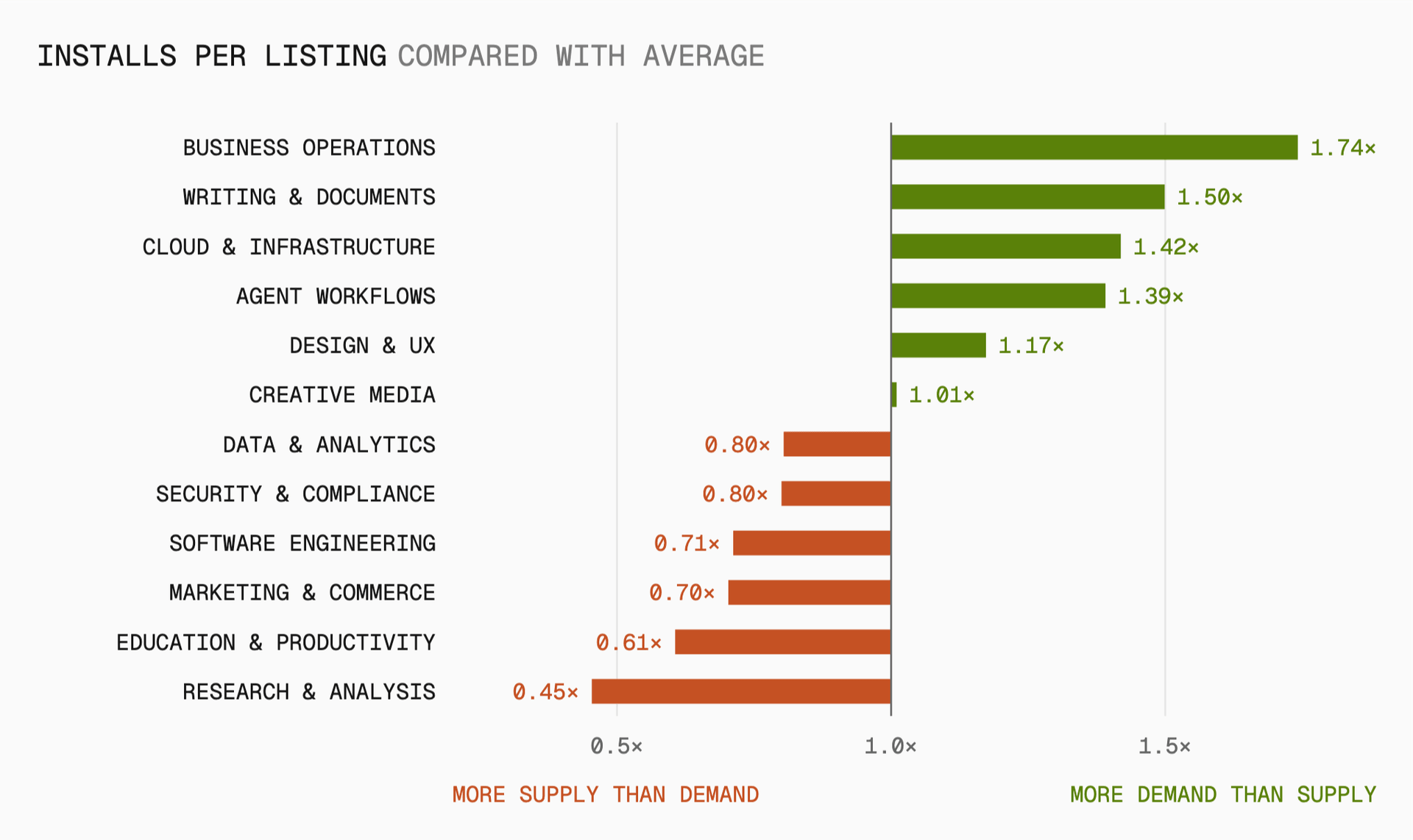
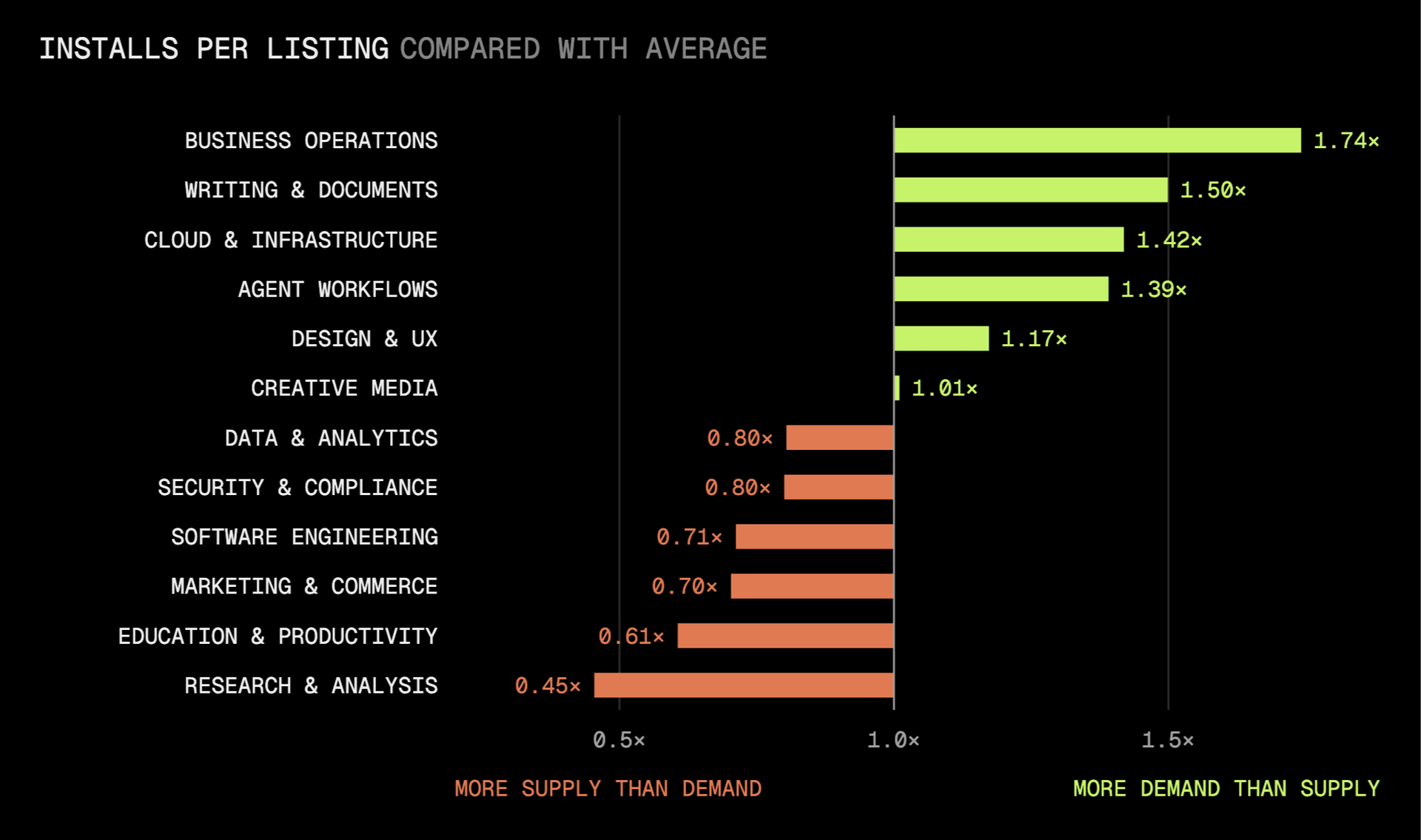
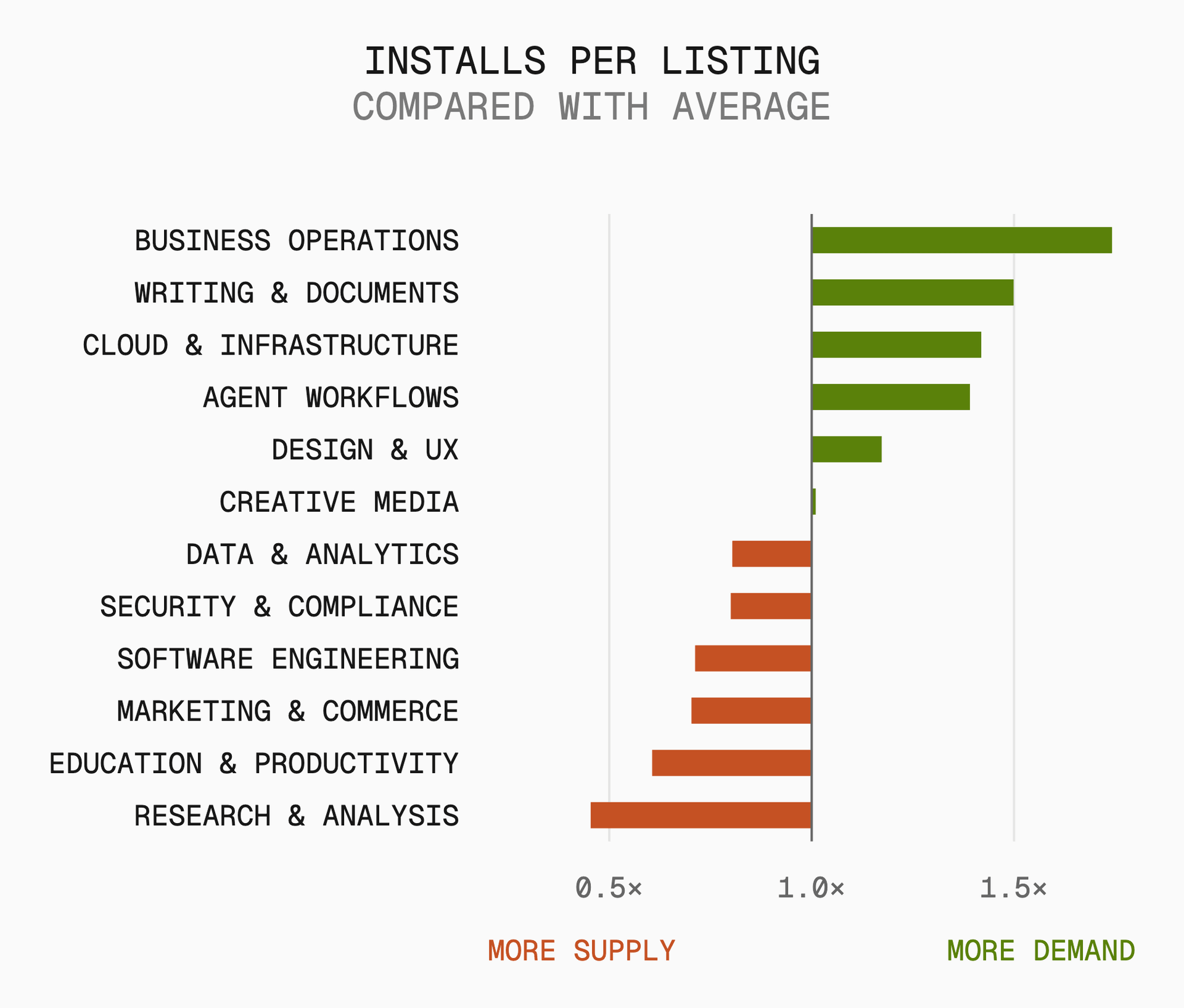
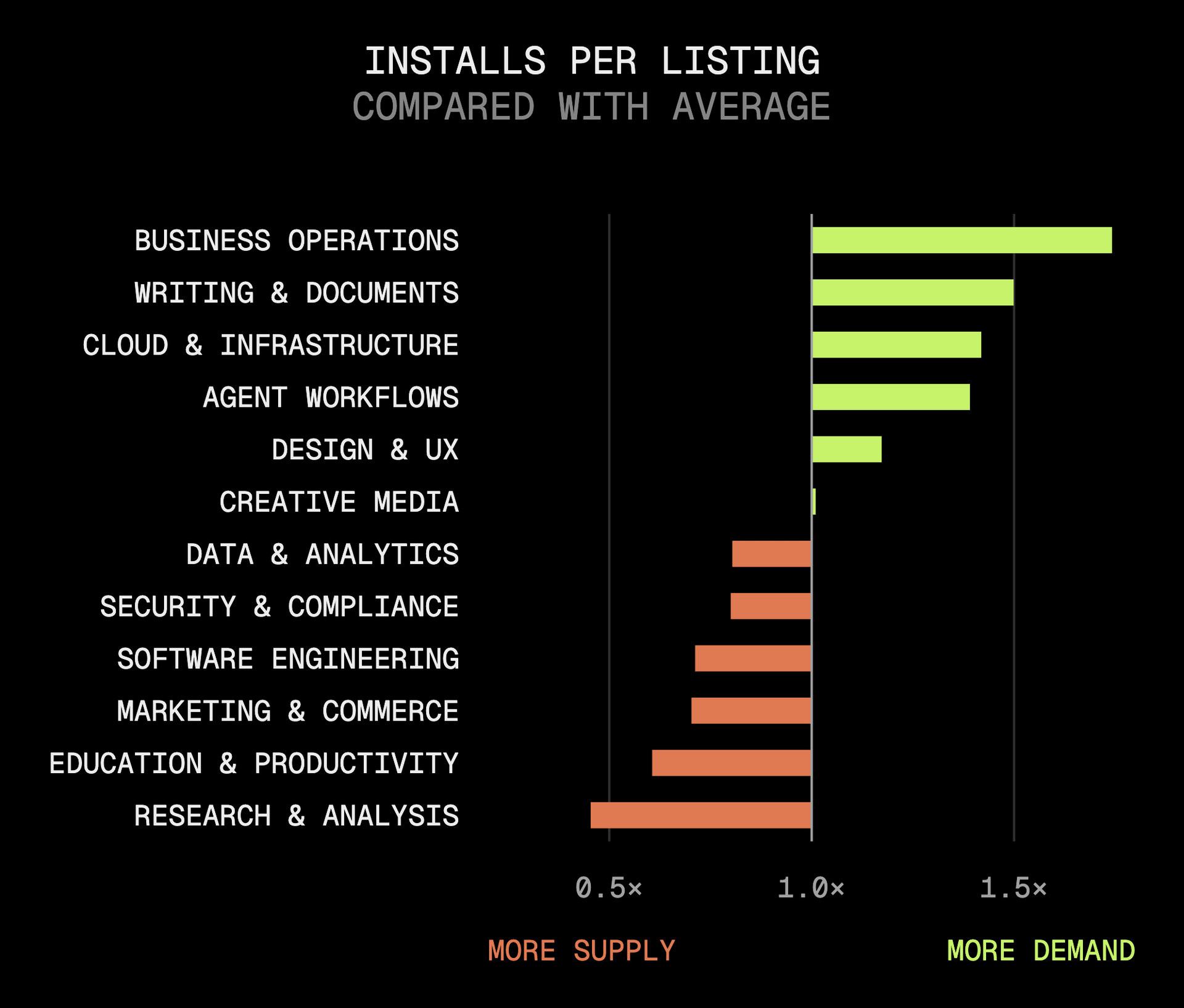
Business operations, writing and documents, and cloud and infrastructure draw the most installs per listing, because that demand is divided among fewer skills. An average business operations skill pulls 74% more installs than the average skill, writing and documents 50% more, cloud and infrastructure 42% more. Software engineering, education and productivity, and research move the other way: roughly 30%, 39%, and 55% fewer installs than average, respectively.
Writing a skill requires understanding a job, while installing one only requires wanting that job done. Most skills are technical because they originated in developer tooling; installs span every part of a company because agents are useful there.
A busy catalog, a concentrated outcome
Agent workflows and automation take 14.8% of installs in the classified dataset, second only to software engineering, and they are the largest category among listings with at least 100,000 installs.
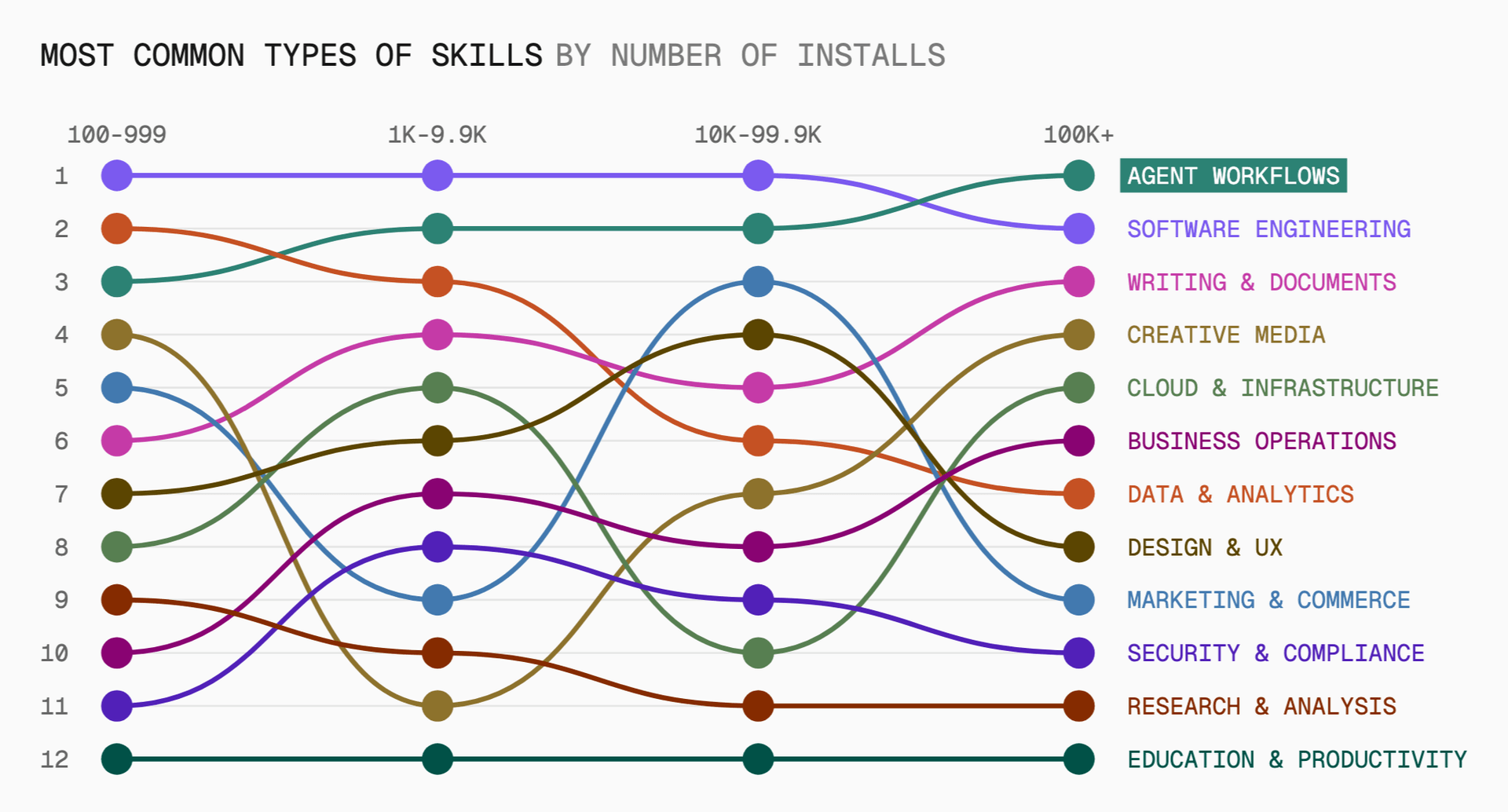
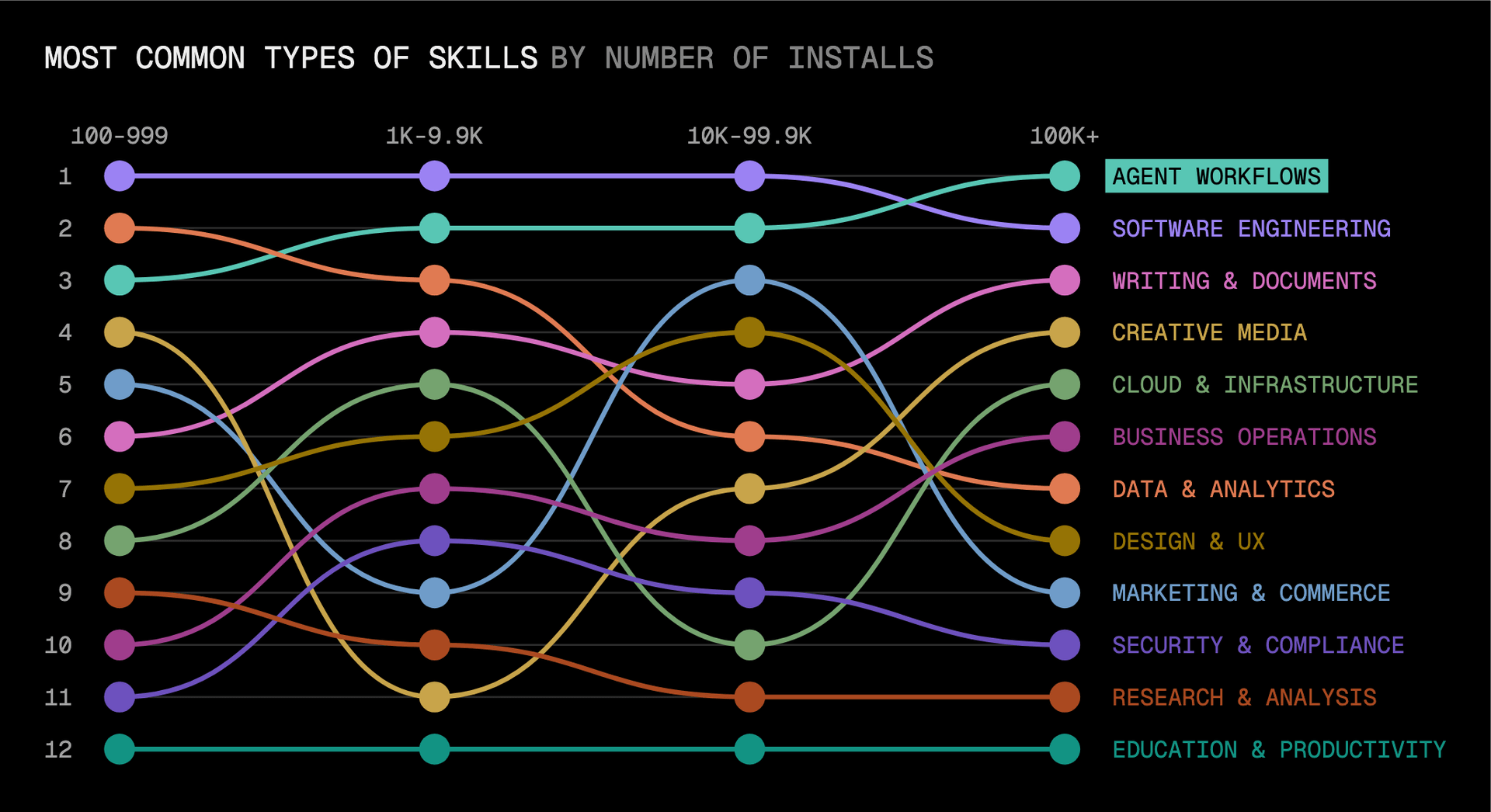
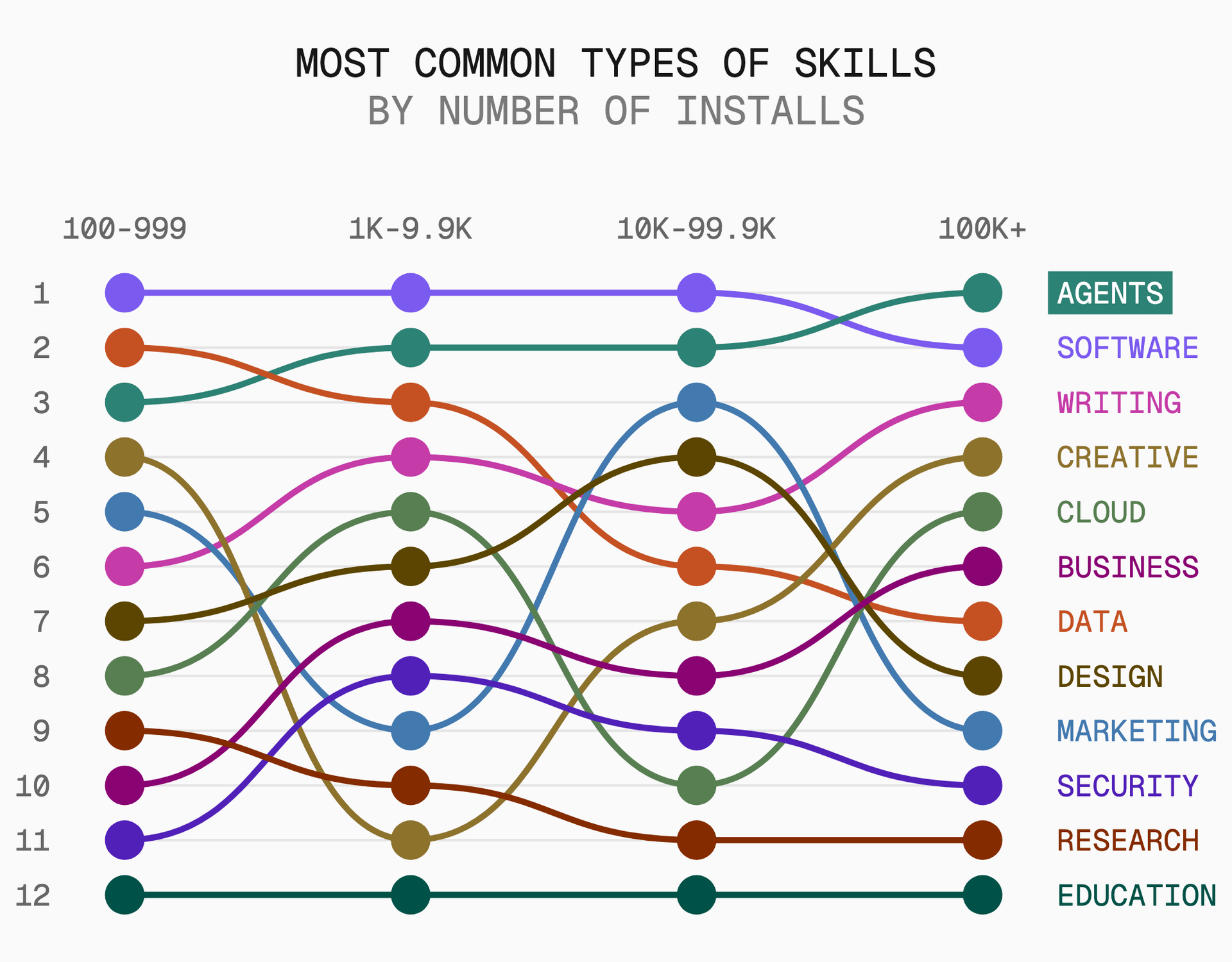
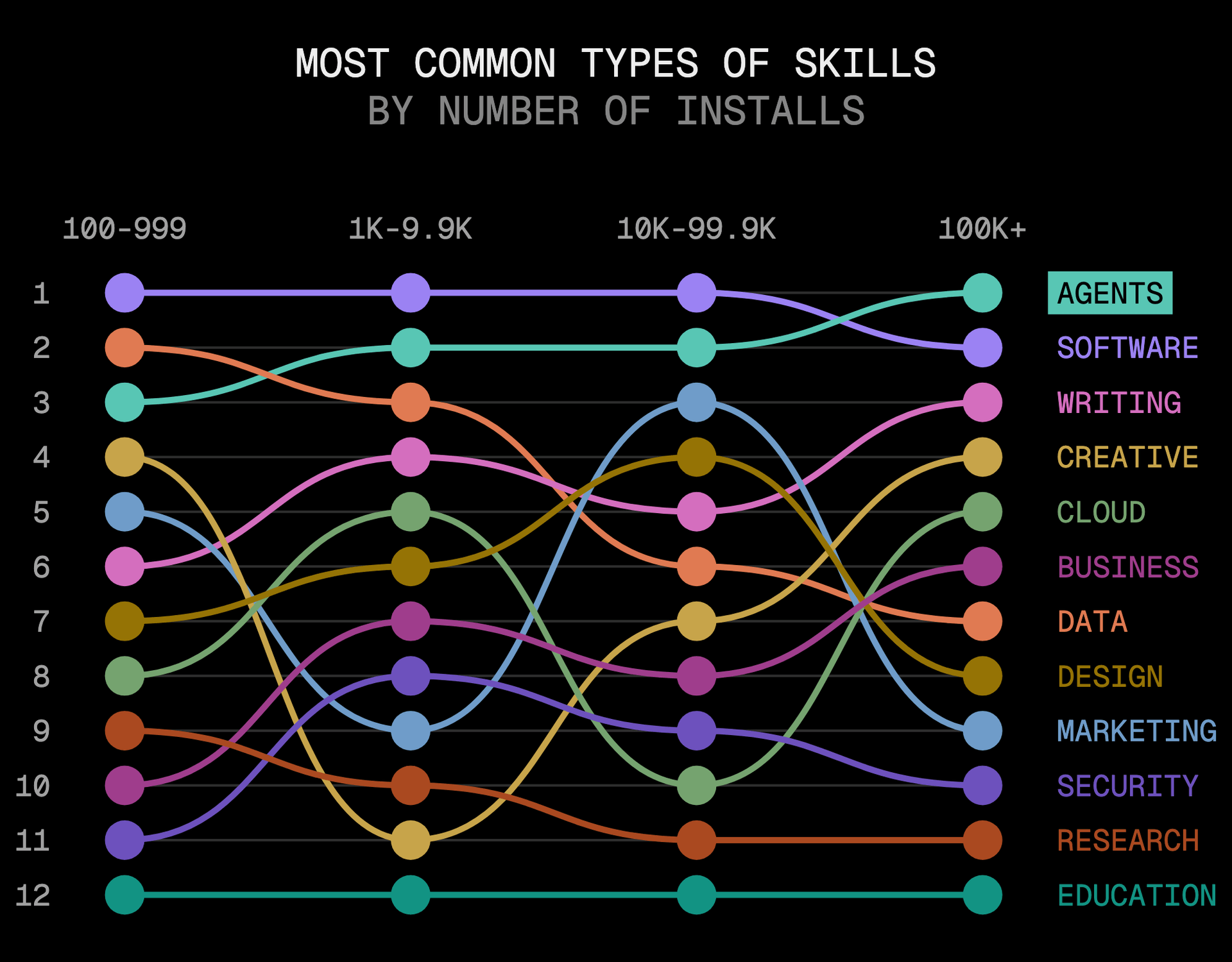
These skills teach planning, work routing, tool use, and browser automation — abilities that travel between jobs. A contract-review skill is bound to contracts; a planning skill applies to whatever the agent takes on. Agents are thus being used to improve agents, and since agents also help write skills, the catalog expands by refining the machinery that builds it.
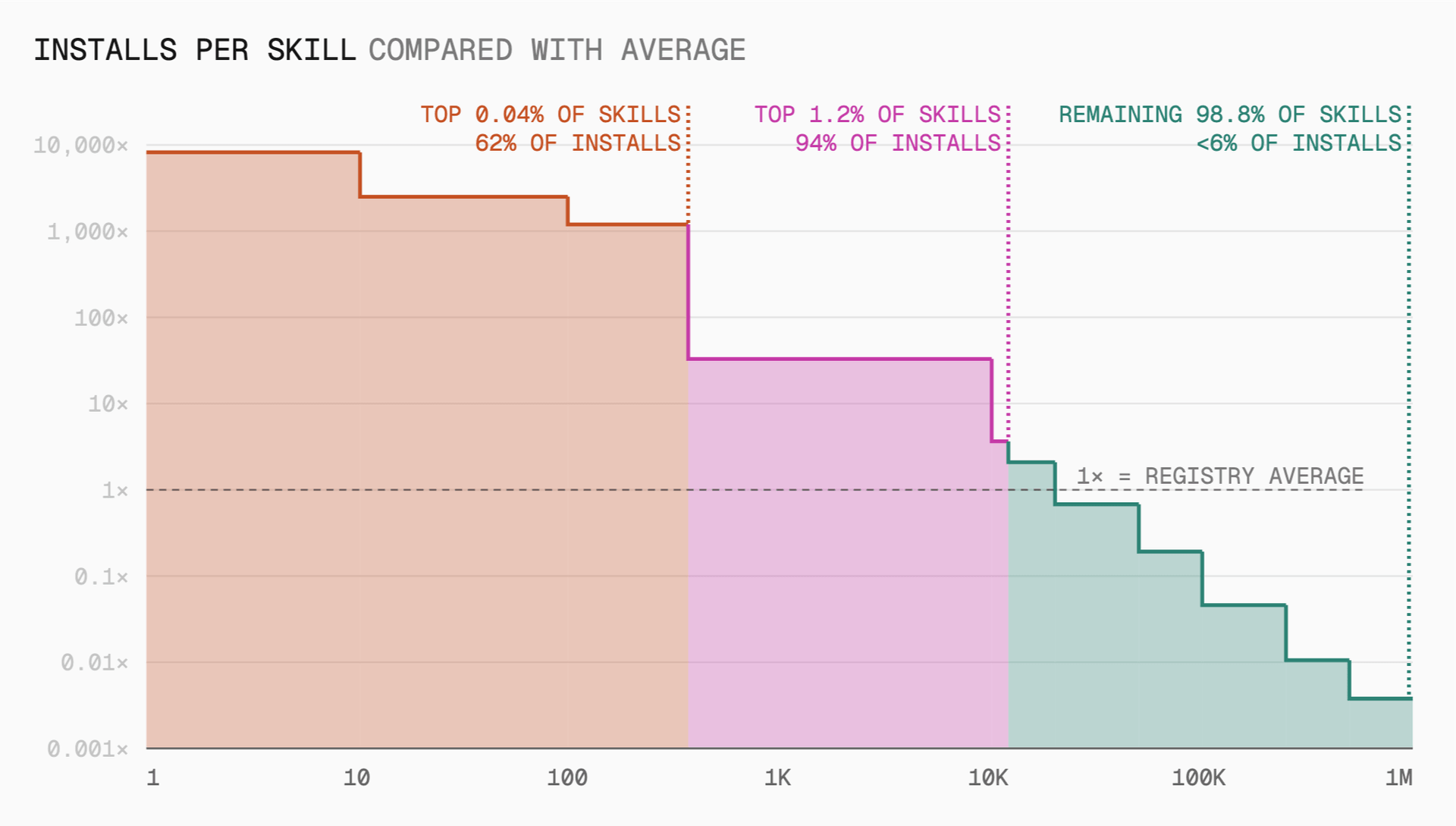
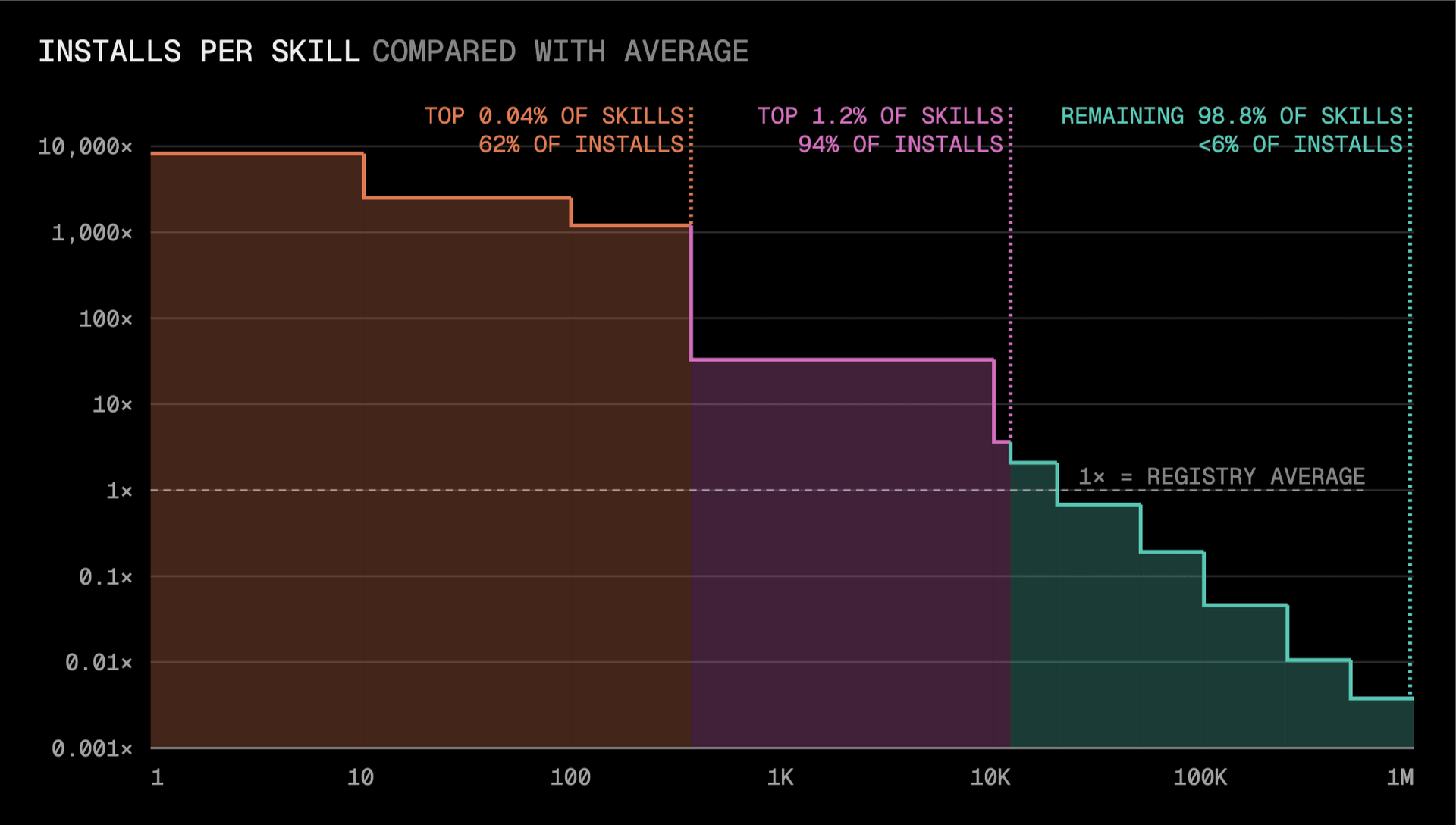
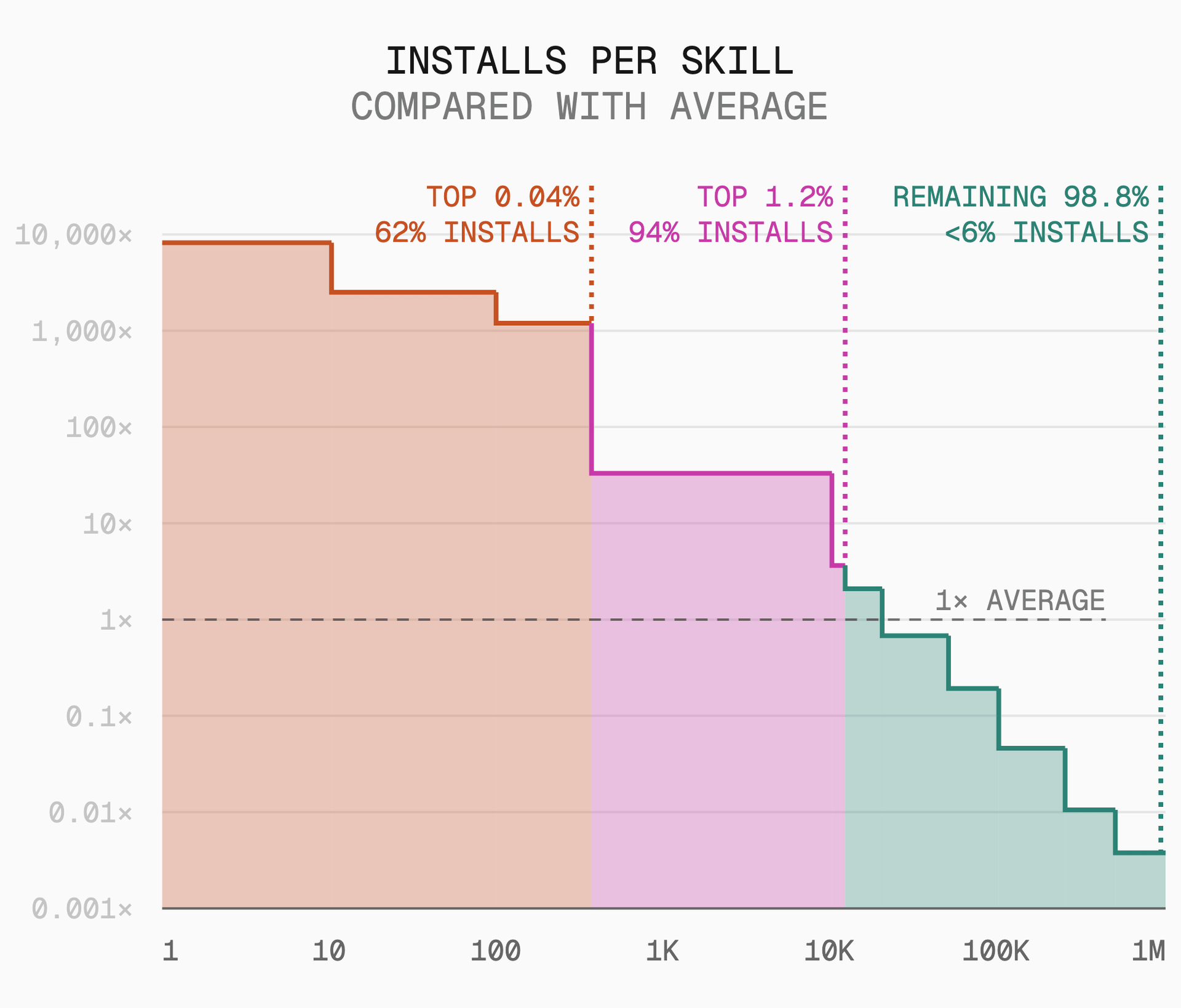
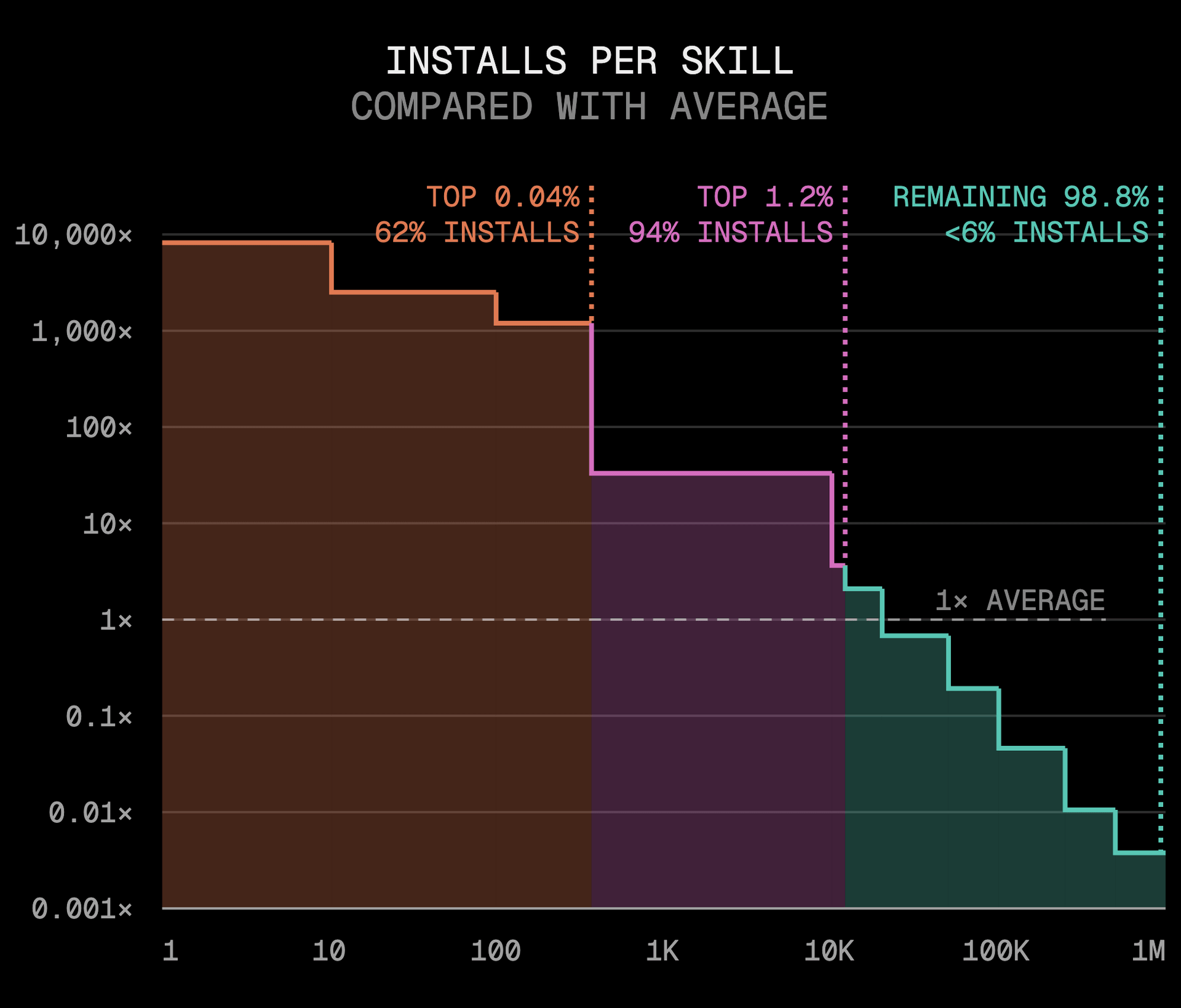
Installs are highly concentrated. Nearly half of all skills were installed exactly once, while 375 skills — 0.04% of the registry — hold 62% of installs. The top 1.2% account for 94%. Yet no single skill dominates: even the most-installed one takes under 1% of all installs. Skills compete job by job and stack across them. A team that picks one expense-report skill has little reason to add another, but can pair it with skills for spreadsheets, research, and presentations. Each job produces its own winner, and the winners collectively carry most installs.
Portability decides the winners
Classifying skills by whether their work is shared across industries or specific to one shows that cross-industry tasks — cleaning a spreadsheet, deploying a website — recur everywhere from banks and hospitals to law firms and restaurants. They make up 66% of classified skills and 87.5% of installs, and average 3.6 times as many installs per listing as industry-specific skills.
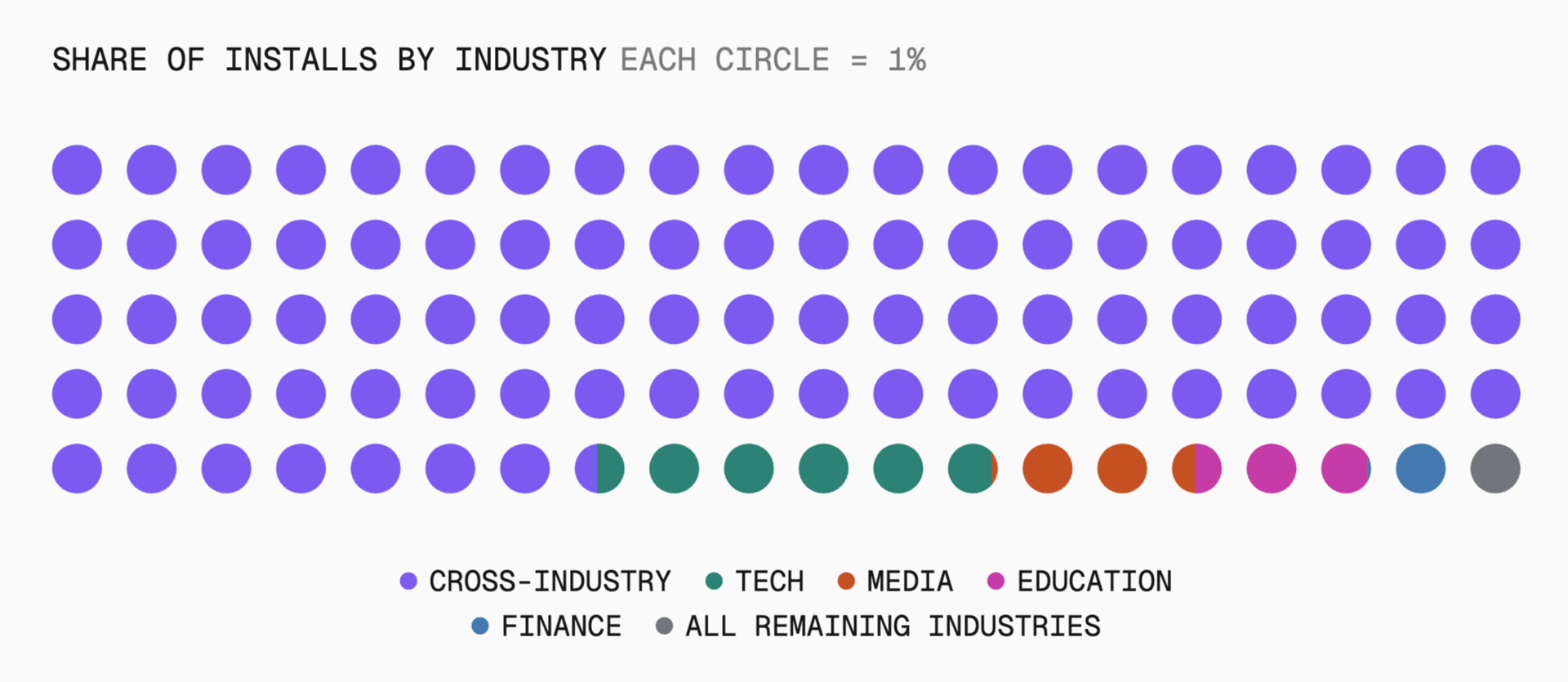
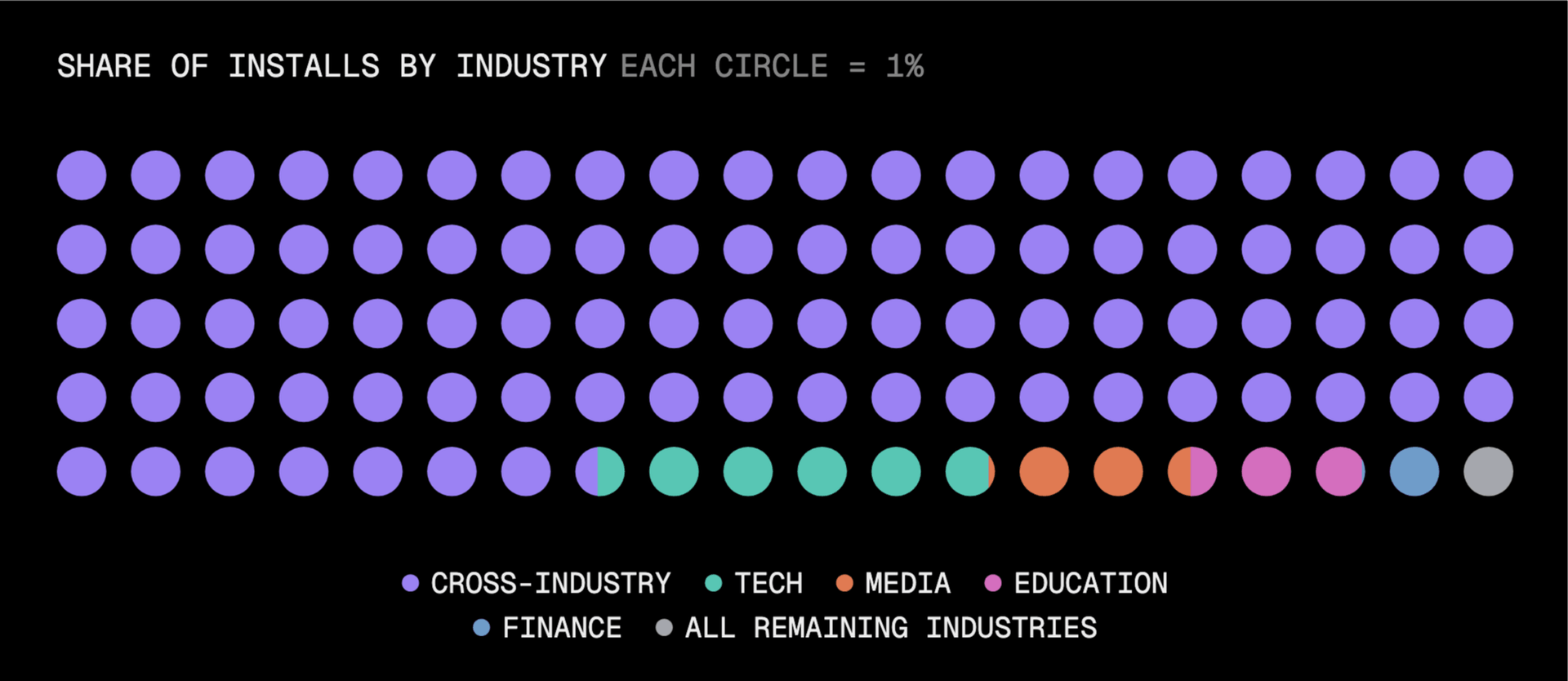
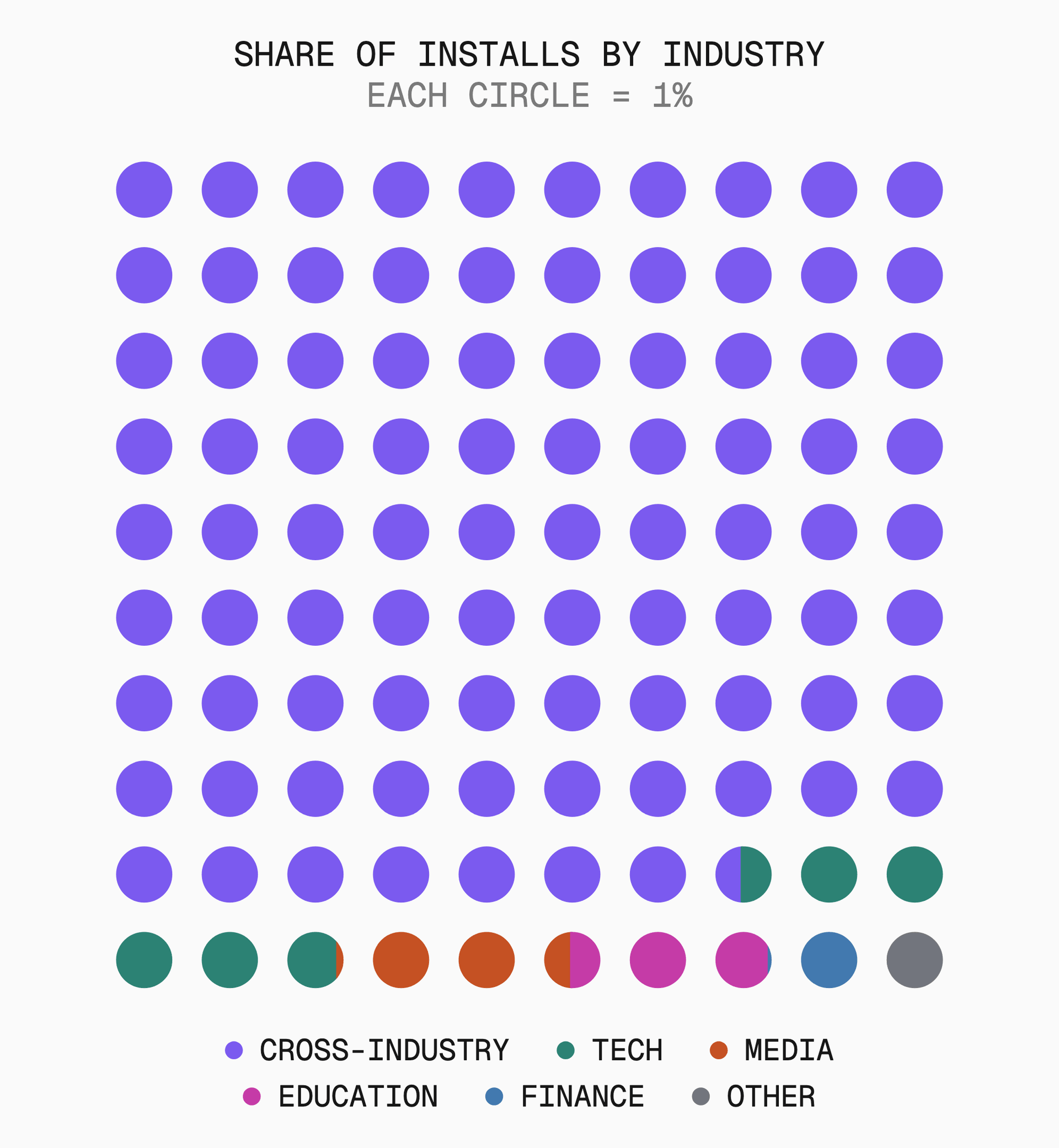
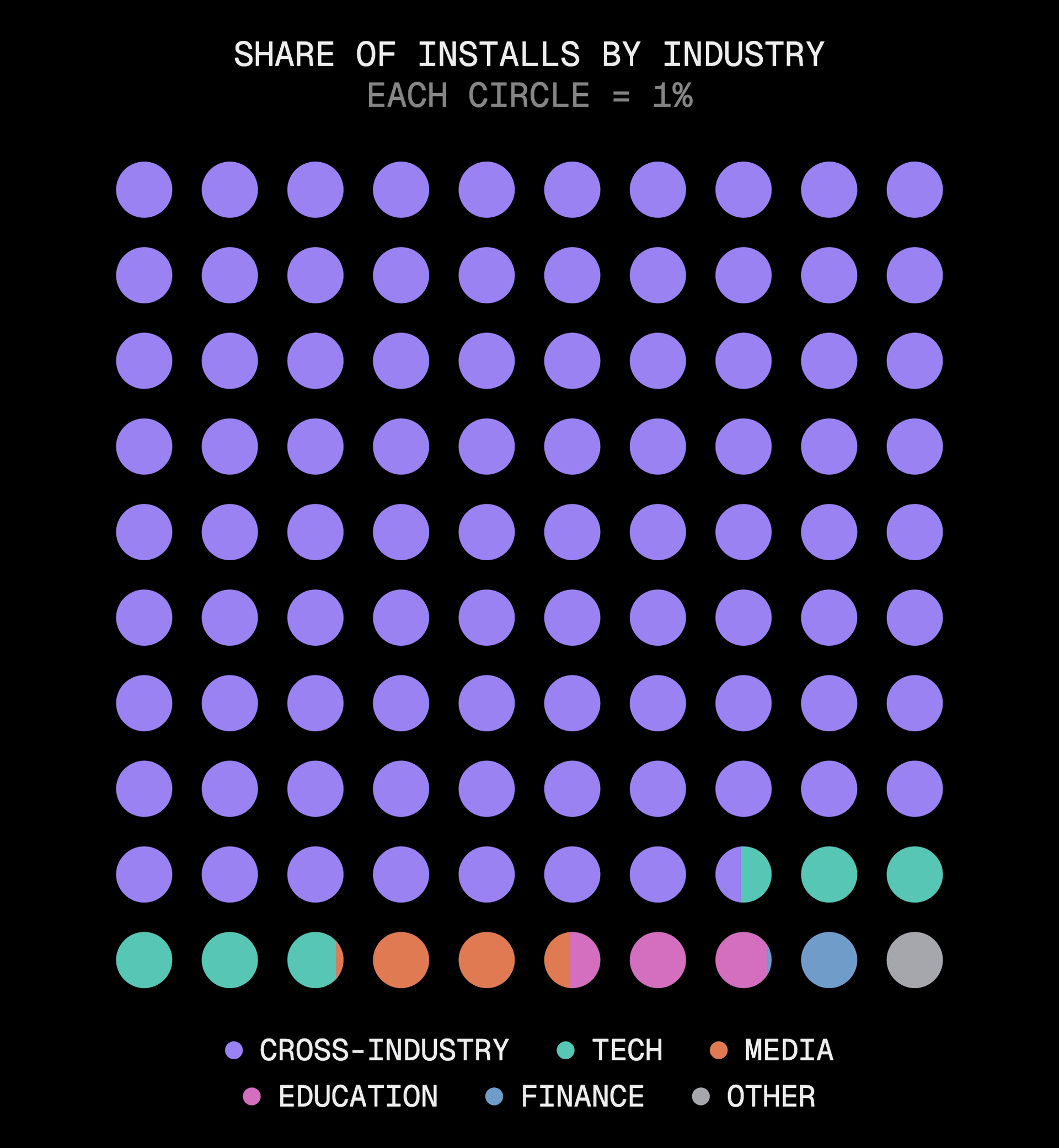
Only one in eight installs is tied to a particular industry. The advantage is portability, whether a skill reaches across jobs or across industries: the most-installed skills are the ones the most people can use.
Creation outpaces established software markets
Much of a job's judgment has to be made explicit in a skill: the steps, the definition of good, the way to check the result. The underlying capability already comes from the agent and its tools, so the skill only adds job-specific instruction. That makes skills faster to produce than conventional software.
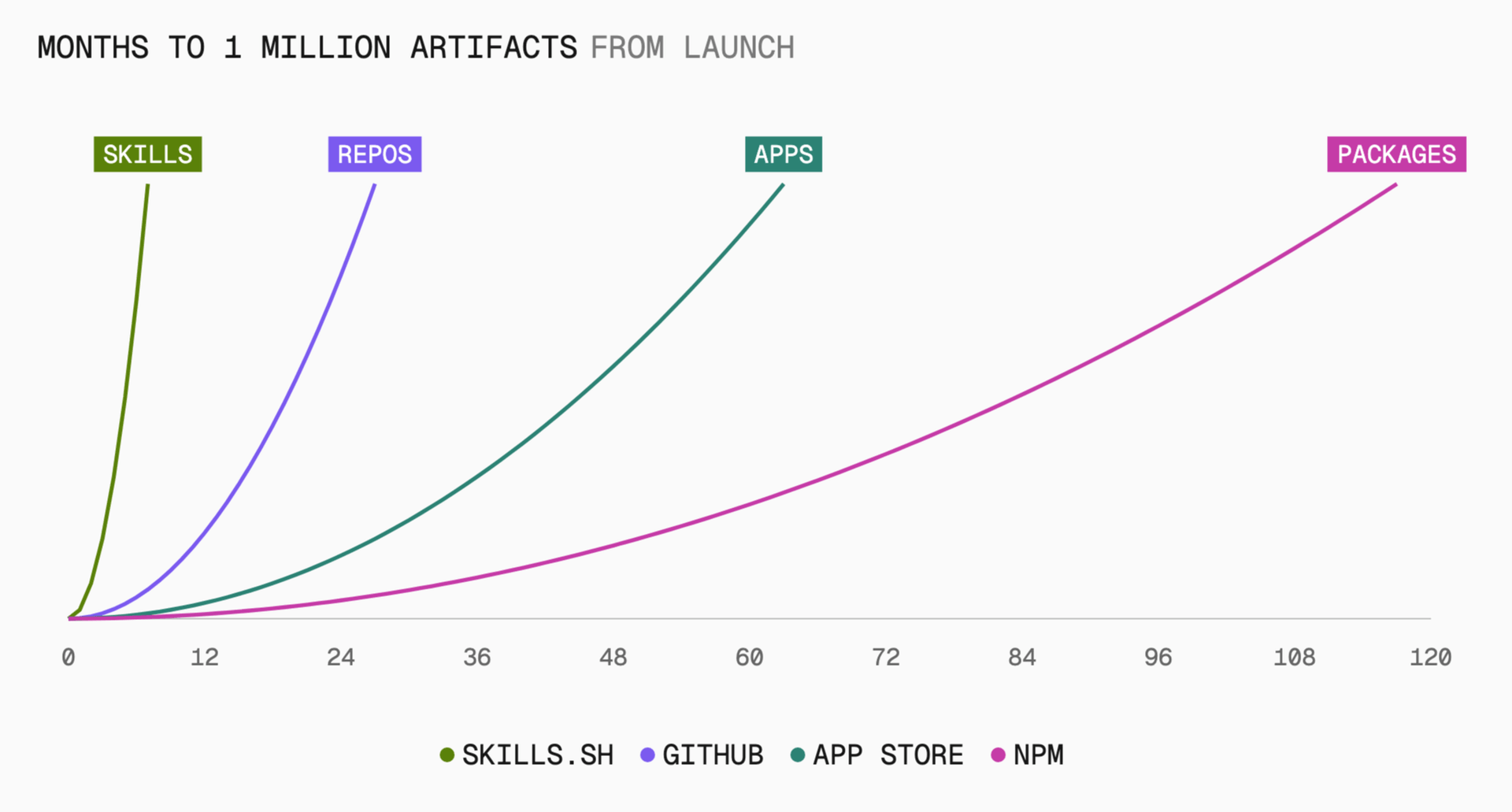
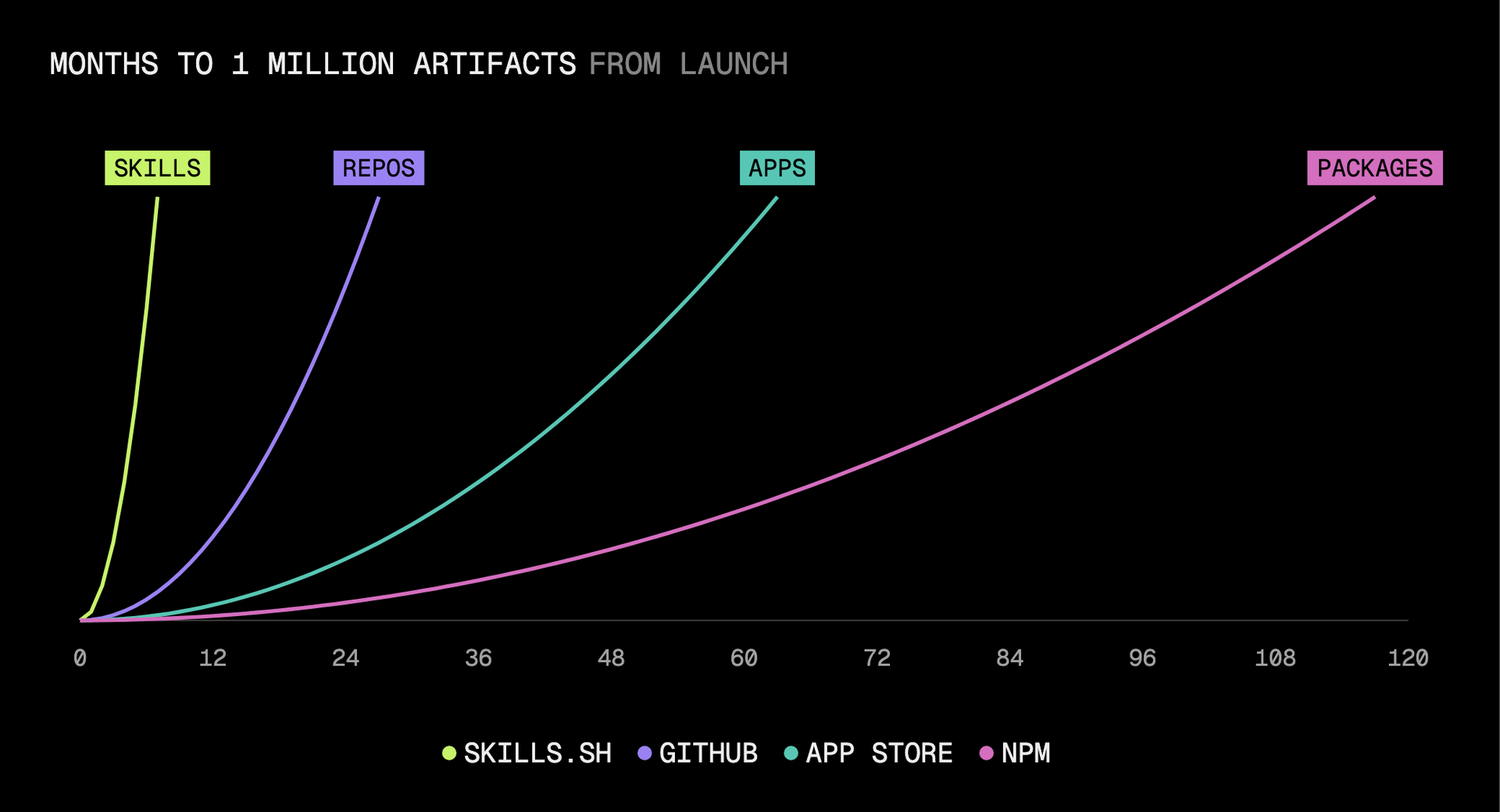
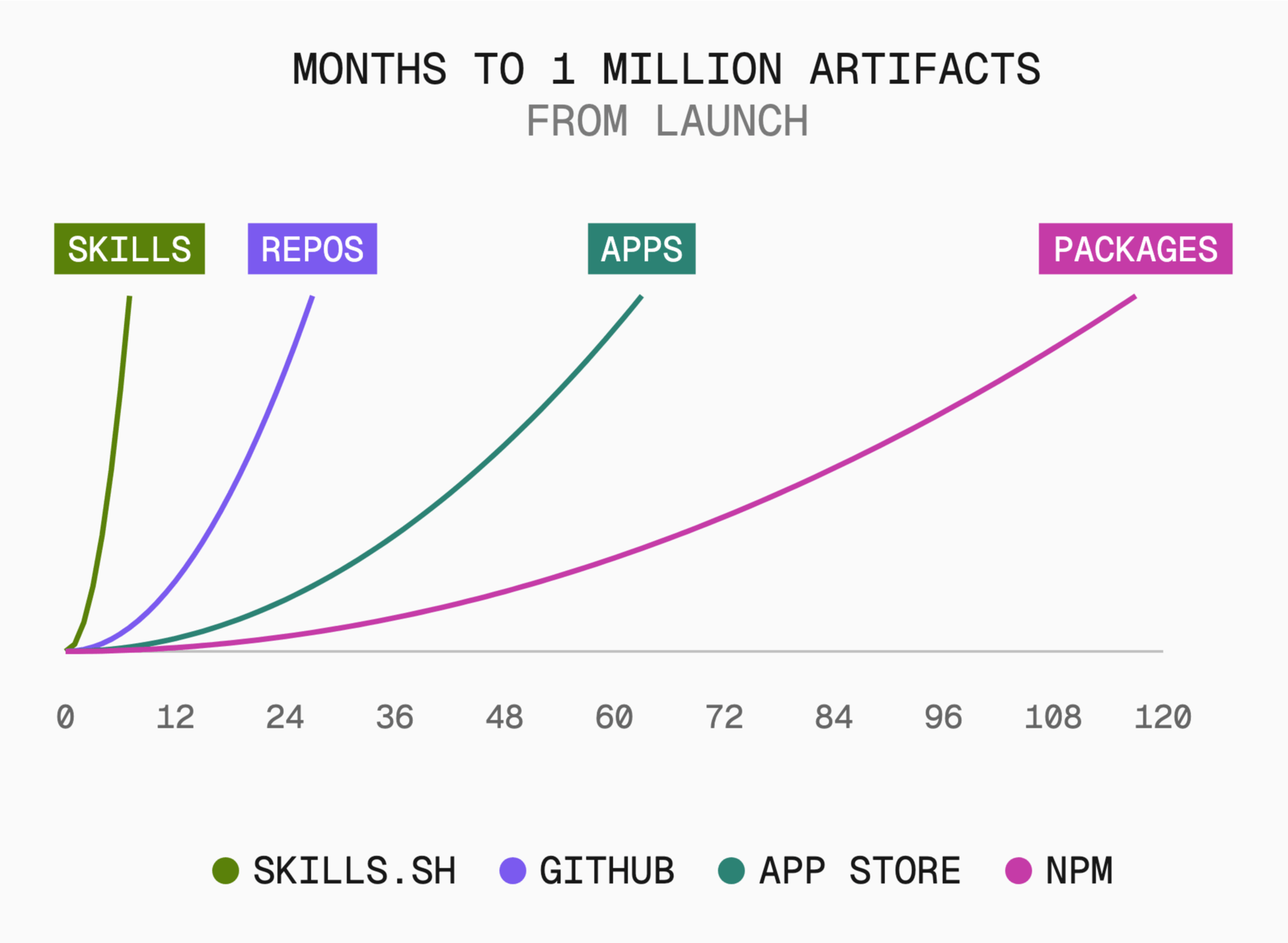
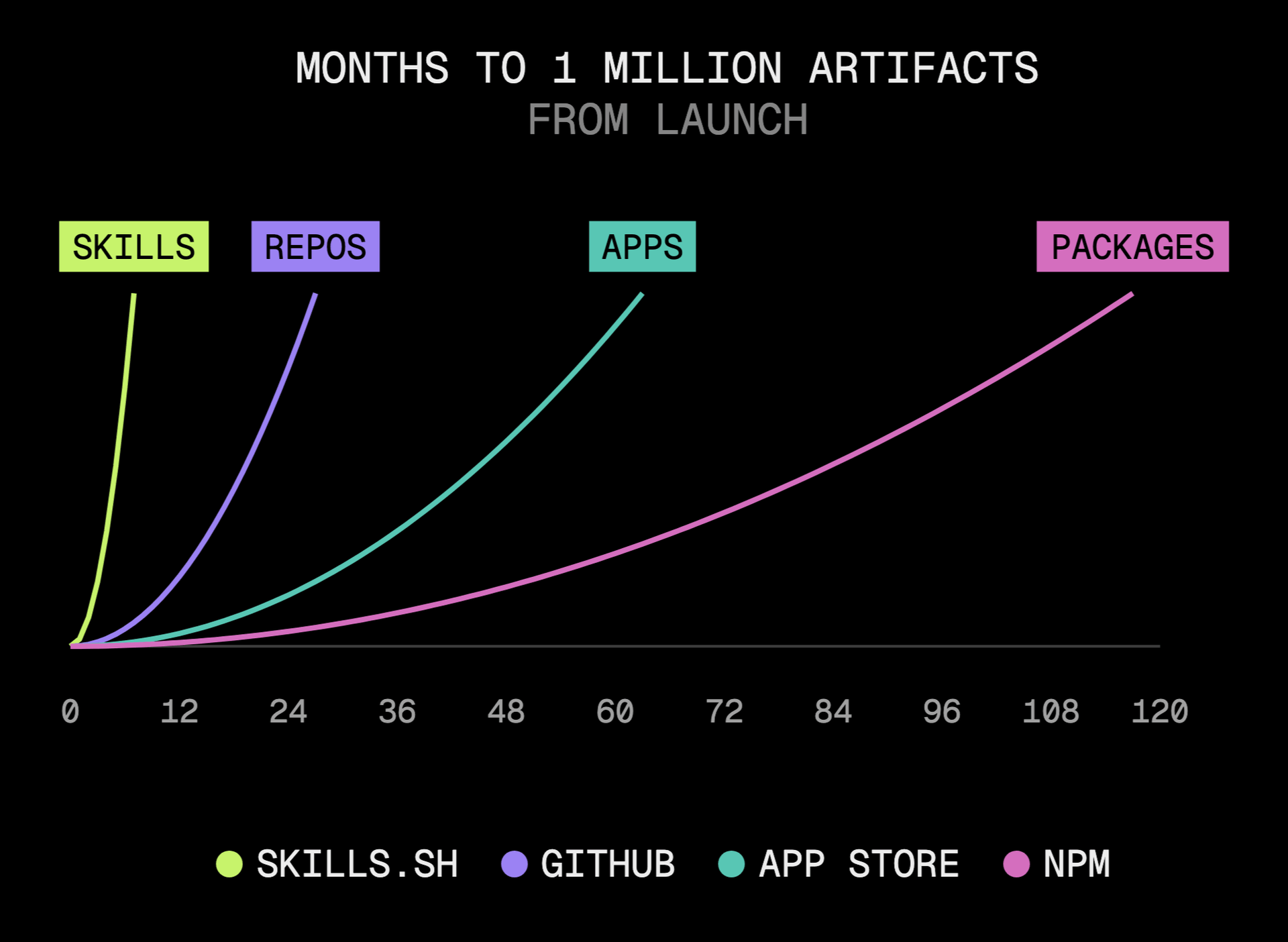
The registry took seven months to reach one million skills. GitHub needed 27 months for one million repositories, the App Store 63 months for one million apps, and npm 117 months for one million packages. Far more people can describe how work should be done than can program a computer, and a finished skill installs across agents without being rewritten. A larger pool of authors combines with software's reuse, which is what drives the growth.
Where the value moves next
The first million skills taught agents what everyone knows; the next million will teach them what only you know. As public skills and better models make general expertise available to every team, it becomes the baseline rather than an edge, and differentiating value shifts toward company-specific judgment — when a customer gets a refund, what can ship without another review.
The measure of a skill will shift as well, from popularity to effectiveness. Install count is today's best quality signal, but better models raise the bar: a skill earns its place only if the agent does the job better with it than without it, which is what skills' own tests and benchmarks will measure.
Meanwhile the public catalog keeps growing as supply catches up to demand, and organizations build on top of it, writing down the knowledge only they hold and maintaining it as they maintain code.
Measurement notes
- Catalog totals count unique registry listings.
- Install figures come from aggregate registry counters; they do not represent unique people or necessarily independent choices.
- Function and industry findings describe a classified sample, not the full catalog.
- Each analysis uses the latest complete data available, and figures may be revised as the data and methodology improve.