
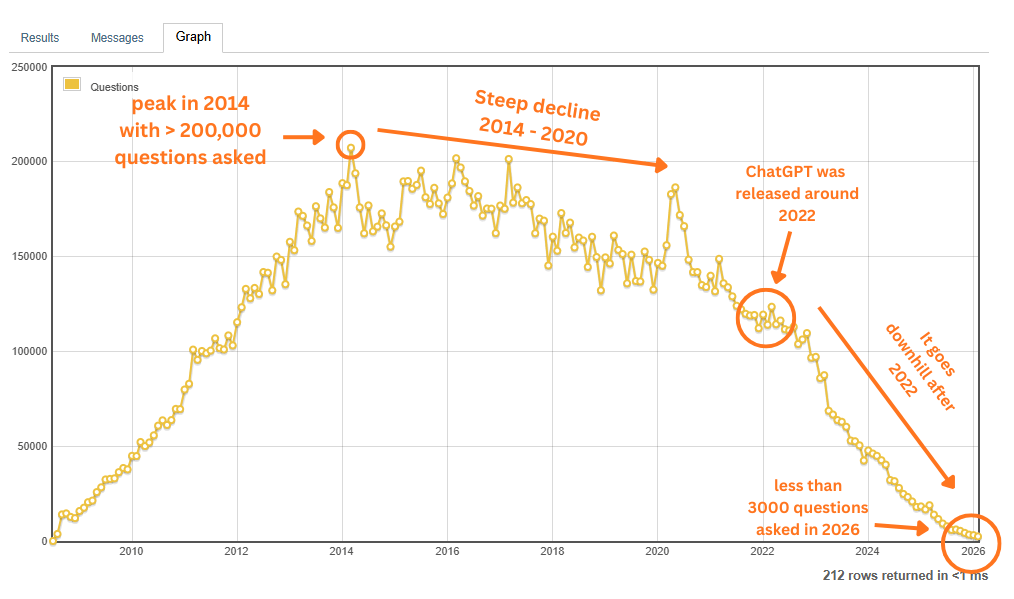
Usage data from Stack Overflow shows questions peaking around 2014, when more than 200,000 were posted in a single month. In 2026, monthly volume struggles to reach 3,000. AI is the obvious suspect, but the decline set in well before ChatGPT arrived in late 2022.
The moderation curve
By community accounts, moderation has been a leading driver of the drop since the 2014 peak. Growth forced Stack Overflow to find a way to police hundreds of thousands of monthly questions — the scaling wall every forum-based community eventually hits. The route chosen, as documented in the site's moderator tooling history, was aggressive:
On Stack Overflow, we close or delete questions that can't be answered straight away – it's not very sociable, but it scales wonderfully.
The emphasis fell on quality over quantity, with duplicates suppressed wherever possible. Questions then served Google searches for answers that already existed rather than attracting new ones. The community also drew inward, raising the barrier for beginners. Being made to feel foolish for asking is a poor incentive to keep learning.
Generative AI finished the job. It returns answers without judgment and without delay, which explains the preference for asking an LLM instead. The concern, though, extends past Stack Overflow to the wider ecosystem: are we still asking questions at all, and still trying to improve?
What AI can and can't do
Claims that AI outwrites programmers usually rest on competitive programming results. Research on AlphaCode concluded that it "achieves human-level problem solving skills and code writing ability as shown by performance in programming competitions." Contest problems, however, are not what most developers do — and being a software developer is far more than that.
Where AI-generated code has been studied, the differences are concrete. Cornell research found:
AI-generated code is generally simpler and more repetitive, yet more prone to unused constructs and hardcoded debugging, while human-written code exhibits greater structural complexity and a higher concentration of maintainability issues.
MIT research holds that AI can write good code but cannot think and make decisions the way an engineer does — not yet, at least without running into a lot of bugs. Copy-pasting generated code unexamined invites serious bugs and possible vulnerabilities. VeraCode tested 100 AI models for security flaws and reported that 45% of AI-generated code contains them — a significant cost for anyone who vibe-codes without thorough checks.
Adoption is close to universal regardless: GitHub's August 2024 survey of AI in software development found over 97% of respondents had used AI inside or outside work, quite apart from employers mandating it in existing workflows.
It is not all downside. Harvard Business Review research found AI effective at helping solve problems through enhanced effectiveness, with the trade-off that AI workflows produce less motivation. Creativity and the problem-solving approach needed for unique everyday challenges remain hard to replicate. As with any tool, AI has limits, and without human craftsmanship behind it the tool is nearly useless.
"The effectiveness of the tool is determined by the skill of the craftsman who created it and the ingenuity with which he utilizes it."
Craig D. Lounsbrough
The greater danger is over-dependence, which risks shrinking the next generation of code craftsmen.
A checklist for using AI
Four questions are worth asking whenever an LLM enters the development loop:
- Am I asking smaller, specific questions? Step-by-step verification beats eyeballing an entire system at once, and keeps the developer doing the work rather than delegating all of it.
- Am I evaluating the output when it's finished? Do you understand what it did, and would you be comfortable modifying or maintaining the result if you knew a better approach?
- Am I checking the tool's references? This leans more toward research than raw code output: where are the answers coming from, are the sources good, are there others, and is the tool citing a fictional source rather than tried-and-true approaches?
- Have I tested the work? Did the tool understand the task and account for edge cases? Knowing how people use an application is something a machine is less inclined to grasp than a human — which makes this perhaps the most important check.
Who trains the next model?
If nobody asks questions, what trains future AI? Technologies change: CSS has moved considerably with nesting, view transitions, container queries and more, so CSS written even a few years back already looks different. Solutions learned from decades-old code go stale. A quiet question-and-answer ecosystem plausibly leaves LLMs lagging — speculation, but easy to imagine.
Stack Overflow's service over the years stands: it got people asking, answering, thinking. Whether LLMs will do the same is the question worth asking now. Co-founder Jeff Atwood's framing still applies:
Stack Overflow is you. This is the scary part, the great leap of faith that Stack Overflow is predicated on: trusting your fellow programmers. The programmers who choose to participate in Stack Overflow are the "secret sauce" that makes it work.



