

Separating Content from Presentation
Modern deployments have moved past the simple either/or of static versus server-rendered. Cloud infrastructure and continuous integration now let teams blend static files, dynamic updates, and serverless APIs into a single workflow. One piece rarely gets the same attention: where content actually lives. A headless CMS decouples content storage from rendering, which changes how resilient and flexible a site can be.
Why the Monolith Paints You into a Corner
Traditional monolithic CMS platforms bundled everything into one package: a database, content administration interfaces, rendering logic, asset storage, routing, and often a template engine. That sounds convenient, but it came with a cost. The system was opinionated about how you worked. As a developer, you had two unsatisfying options:
- Submit to the system. Learn the platform deeply, follow its rules, and stay productive as long as your requirements match its design. Deviations become painful — whether that means building a front end the tool can't express or scaling infrastructure you don't fully control.
- Work around the system. Hack in plugins, bolt on external services, or patch the core to get what you need. This buys short-term flexibility but leaves you with an unmaintainable, Frankenstein-like setup that will eventually bite back.
Both paths stem from the same flaw: content definition and storage are mixed with view creation inside a single codebase. The flow of a request shows how tightly coupled everything is. A client requests a URL, a router maps it to parameters, a renderer asks the data layer if content exists, and only then does HTML get produced. Every step happens under the CMS's rules.
Freedom at the Edge
A headless CMS removes this constraint by giving you a clean API to read content, nothing more. You decide routing: on the client, via a proxy, on a Node server — it's your choice. You decide rendering: PHP templates, a Go serverless function, or a client-side framework. This decoupling means you can change "the head" as often as needed. If your team moves from Laravel to Next.js or from Remix to 11ty, your CMS stays put.
That boundary is also an error boundary. In a monolith, a rendering bug can take down content delivery just as easily as a full database can. With a headless system, the causes of failure are separated, giving you clearer ownership of your stack and more ways to cope when something goes wrong.
The Jamstack Baseline
Jamstack takes this decoupling to its logical extreme. At build time, a static site generator pulls all content from the CMS and pre-renders everything. The result is static files served in read-only mode. This setup is easy to deploy, extremely fast to serve, and secure: there are no authentication endpoints or databases exposed at runtime and no write access on the host.
Content updates arrive only through a rebuild. Once you press publish in the CMS, a webhook triggers the hosting service to generate a new version. That works well until it doesn't. When sites grow, builds slow down. Waiting minutes — or in some projects, 30 minutes — to push a correction is simply not acceptable for mission-critical updates.
Mixing Static and Dynamic Delivery
A headless CMS makes it possible to query content from more than one place, which lets you keep static pages as a robust baseline while pulling time-sensitive data dynamically when needed.
If you serve a page statically but an article or price needs to go live at a specific moment, you don't have to wait for the next build. Fetch that particular content from the CMS on the client side instead. The framework's APIs let you mark these spots explicitly, leaving the rest of the page static. If the CMS is unreachable in that moment, users still see the statically generated version with the older content.
This approach also gives you a practical preview mode. Editors get a separate deployment that loads unpublished content via the CMS API, so they can review their work before it goes out — a genuinely useful option for teams producing content around the clock.
Incremental Regeneration as a Middle Ground
Client-side fetching covers content that needs to appear instantly. But there's another layer between that and the full build. With incremental static regeneration, the server handles updates for you after a defined period has passed. The site still serves static HTML, but once that content's validity expires, the framework invokes a serverless function that rerenders the page and replaces the original file.
In practice, this creates three points where your headless CMS is accessed:
- At build time, to generate content for the whole site
- At client-side runtime, for pages where speed of publication matters most
- In serverless functions, to regenerate pages incrementally as they age
The result is a delivery model that scales with your needs. You want static resiliency, dynamic immediacy, or something between — the boundary is now yours to draw.
Failing Gracefully: What Soft Coupling Means In Practice
Those three connection points don’t just serve different user scenarios; they also imply different content freshness. Real-time client-side fetching is the shortest-lived and most current. Incremental static generation is older but still relatively fresh. Build-time output is the oldest, with its age depending on how often you trigger rebuilds — every content change shortens its lifespan, while code-only rebuilds let it age longer.
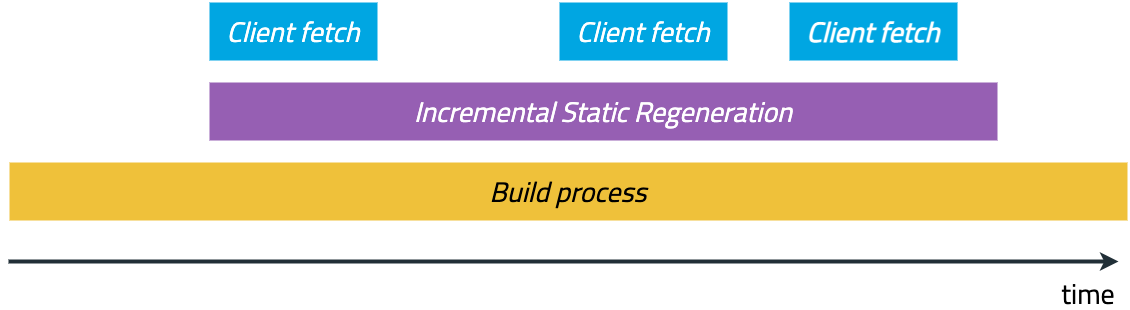
That adds more touchpoints between the site and the CMS, but here’s the crucial detail: every one of those connections is allowed to fail. A failed client-side fetch simply means the visitor sees the incrementally generated page. If that layer fails too, the build-time output covers the gap. Each step degrades cleanly to the next, which is what makes the coupling “soft” in the first place.
The examples use Next.js because it delivers these benefits with minimal developer effort — Storyblok’s hooks make data fetching essentially a one-liner. The same soft-coupling pattern works with any framework or server setup.
Consider a plain Express.js server that renders content on every request. A route that pulls fresh content each time feels immediate, but it also makes the CMS a single point of failure:
app.get('/*', function (req, res) {
  var path = url.parse(req.url).pathname;
  console.log(path);
  path = path == '/' ? 'home' : path;

  Storyblok.get(`cdn/stories${path}`, {
    version: 'draft',
  })
    .then((response) => {
      // Render content to HTML.
      res.render({
        story: response.data.story,
      });
    })
    .catch((error) => {
      res.send(error);
    });
});
If the bridge to the CMS is down, the page fails entirely. Adding a cache-first layer reverses that: serve cached content immediately, then update in the background when the CMS becomes reachable again:
app.get('/*', function (req, res) {
  var path = url.parse(req.url).pathname;
  console.log(path);
  path = path == '/' ? 'home' : path;

  // Loading the cached content.
  let content = contentMap.get(path);
  if (content) {
    Storyblok.get(`cdn/stories${path}`, {
      version: 'draft',
    }).then((response) => {
      // Update in the background.
      contentMap.set(path, response);
    });

    return res.send(content);
  }

  // Fetching the real content.
  Storyblok.get(`cdn/stories${path}`, {
    version: 'draft',
  })
    .then((response) => {
      contentMap.set(path, response);
      res.send({
        story: response.data.story,
      });
    })
    .catch((error) => {
      res.send(error);
    });
});
Add revalidation metadata, and that background refresh can be tied to an interval, so you only hit the CMS when you know content might have changed:
app.get('/*', function (req, res) {
  var path = url.parse(req.url).pathname;
  console.log(path);
  path = path == '/' ? 'home' : path;

  // Loading the cached content.
  let content = contentMap.get(path);
  if (content) {
    // Check if the revalidation window has elapsed.
    if (content.fetchedDate + content.revalidate < Date.now())
      Storyblok.get(`cdn/stories${path}`, {
        version: 'draft',
      }).then((response) => {
        contentMap.set(path, {
          response,
          fetchedDate: content.fetchedDate,
          revalidate: content.revalidate,
        });
      });

    return res.send(content.response);
  }

  // Fetching the real content.
  Storyblok.get(`cdn/stories${path}`, {
    version: 'draft',
  })
    .then((response) => {
      // Store with some metadata for revalidation.
      contentMap.set(path, {
        response,
        fetchedDate: Date.now(),
        revalidate: 3600000, //in ms
      });
      res.send({
        story: response.data.story,
      });
    })
    .catch((error) => {
      res.send(error);
    });
});
For returning visitors, combine this with client-side stale-while-revalidate caching, adding yet another fallback layer to the stack.
The Bottom Line
A headless CMS, at its core, draws a clean line between managing content and presenting it. That separation does more than simplify editorial workflows — it removes the assumption that one rendering strategy fits every page. Server-side rendering works better for some content, static generation for others, and a headless architecture supports both, pure or mixed.
What matters most is that flexibility doesn’t have to come at the cost of resilience. By wiring the CMS into a site through multiple layers — build-time, on-demand regeneration, runtime client fetches — incidents on any single connection become manageable rather than catastrophic. Every layer that fails hands off to the one before it.
This is just one way to shape that architecture, shifting your site from dependent on a single dynamic request to gracefully serving content no matter which system in the chain is struggling.


