
Frameworks, the Platform, and the Fear of the Local Maximum
John Allsopp opened the Web Directions Developer Summit by admitting he feels ennui with web development, and he positioned himself as a weary presence who would return after each talk for Q&A. His central argument: front-end development has reached a "local maximum," a term borrowed from calculus for how the tools that got us here have flattened our rate of change. The productivity boost, he said, is offset by tools that limit imagination; our mental models make it easy to rebuild the same websites and leave us out of touch with what modern browsers can do. The View Transitions API — a progressive enhancement since 2023 — was his example of a native superpower that could subvert the SPA model yet remains only experimentally supported in React.
The Keynote Case Against the Stack
Jono Alderson prefaced his talk with "You're gonna hate me," then argued that frameworks like React are Rube Goldberg machines built around limitations that no longer exist — Netflix still mailing DVDs when we could be streaming. He walked through browser capabilities in 2025 that developers overlook (including a teaser slide for Lee Meyer's later talk on scroll timelines) and admitted during the break that he was nervous about provoking anger by bashing frameworks.
Meyer notes that he shares that spirit through the narrower lens of CSS Scroll-Driven Animations — and that a decade earlier, after Joe Gregorio's "stop using frameworks" talk, he adopted Google Polymer for a major project. It turned out closer to a framework than a library, without React's battle-testing: its own peculiar build process, reliance on a browser feature that never became standard, and a promised future that never arrived. He rewrote everything, and Polymer was eventually deprecated.
Over coffee, Alderson and Meyer discussed how LLMs trained on oceans of React reinforce the assumption that every web app must be an SPA — "It's only gonna get worse," Alderson said — unless good dependency-free examples of what browsers can do start appearing.
Scrollytelling on Stage
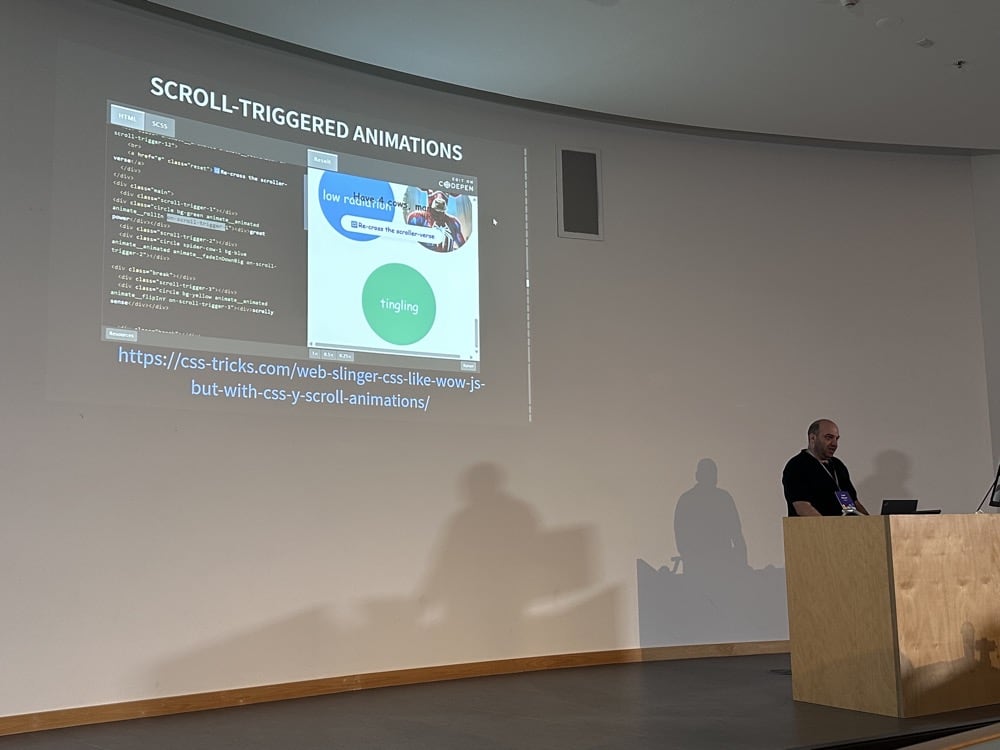
Meyer's "Supercharged Scrolling With CSS" opened with a self-deprecating joke: "I have a feeling some of you might be scrolling on your devices as we speak, so I urge you to look up — and let's scroll together for the next half hour." Rather than launch into experiments, he first earned the topic's relevance, name-checking high-profile New York Times scrollytelling, including the Pulitzer-winning "Snow Fall," whose link Allsopp dropped into the livestream chat. Kris Howard later wrote that the session introduced her to the term scrollytelling itself.
Long code snippets don't translate to a stage, so Meyer used reveal.js — which he had previously used for an online presentation at Games For Change — and its automatic animations between code blocks to show how newer CSS syntax compresses older code. He presented the discovery of his demo's building blocks as deliberate rather than the chaotic trail his CSS-Tricks articles have followed since 2024.
For the final demo, a show of hands split evenly on whether to fight the bad guy unarmed or run away, which he hadn't planned for. He let the antagonist kill the hero, made it seem unbeatable, then refreshed, scrolled in the opposite direction, climbed a ladder, collected a lightsaber, and killed it — Star Wars imagery having appeared in talks all day, to the point that Allsopp joked it was a theme he hadn't gotten the memo about. The applause was audible on the livestream despite no audience mics. With time dilating (research links high public-speaking anxiety to that effect), he ran short on slides, so he replayed the demo and discussed its subtext: the scrollytelling pixel guy as novelty toy or as ergodic literature, an autobiographical allegory.
Feedback afterward included someone who said a traditional tutorial would have been fine but the playful direction felt refreshing — unaware that Meyer's first blog was playfulprogramming.com — and another who called it their favorite talk and praised him for mentioning the Torah as an illustration of the meaning of scrolling.
AI Platforms, Fragments, and Authorship
Rupert Manfredi's "What's Beyond the Browser" demoed "Telepath," a prototype computer with no browser and no apps, composing UIs on the fly to meet user needs. He envisions developers creating fragments and services that AI synthesizes into tailored experiences, arguing web development was never really about learning React hooks but about solving user problems: critical paths, information quality, and creativity. Meyer connects this to how his CSS-Tricks writing works — fragments of expression that gain meaning when woven into a larger tapestry — and notes that if basic functionality becomes trivial, developers can focus on problems nobody has solved yet.
Beau Vass's "A False Sense of Accessibility" showed automated audits flagging non-issues while missing critical failures, sometimes making accessibility worse when followed blindly — for instance, flagging a decorative image lacking alt text when adding it could actively harm screen-reader users. The real problem is treating a Lighthouse pass as the goal; tools recognize only what they're taught, and AI trained on a broken web reproduces its mistakes. Vass argues laws and regulations requiring people to care will change the game more than AI, though Meyer notes AI can already simulate how a screen-reader user might attempt a task and surface friction (BrowserStack does this today). Accessibility, he writes, can't be added at the end like a topping; the responsibility is shared across design, content, engineering, and testing, and needs direct input from people with disabilities.
Ending Notes
Meyer frames the conference's afterglow through Chris Coyier's remark that his greatest pride was not a single accomplishment but the "aggregate moments" of sustained focus on professional passions — here, a year obsessing over animation timelines. He invokes Zeno's arrow paradox (if motion could be paused, a landing plane would be at rest at every instant) and Aristotle's answer that only the flow of time exists. His favorite feedback arrived while waiting on a delayed flight: a graduate developer amazed by "the scroll section in the Dev Summit" — a section, not a talk, as if it blended into a two-day narrative flow, foreshadowing a web that unfurls like an infinite scroll.



