

Zag.js: State Machines for Design Systems
Design systems promise consistent, reusable UI components, but their implementation often bogs down in state management. State machines—architectures that change behavior in response to input, much like a light bulb toggling between on and off—offer a structured alternative to ad-hoc logic. Zag.js fuses these two ideas into a framework-agnostic collection of UI component patterns for React, Vue, and Solid.js.
Announced by maintainer Segun Adebayo in April 2022, Zag.js includes a set of common components: accordion, menu, dialog, and more. Its innovation is that each component's state and logic run through a state machine, independent of any framework. That means the same reliable behavior is portable across JavaScript ecosystems without rewriting the underlying logic per framework.

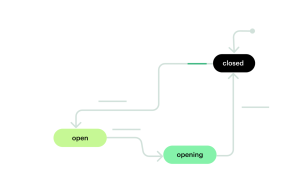
The project ships with a state machine visualizer so you can explore the states and transitions for each component. Created for the team's own debugging needs, it doubles as a clear tutorial into the careful state coverage Zag.js provides.
Maintainer background and motivation
Sage (as Segun prefers to be called, after his favorite anime) started professionally as a freelance UI designer. After noticing engineering took longer than expected, he learned to code—both to understand the gap and to build his own solutions. That journey led to Chakra UI, his open source React component library.
As Chakra UI grew, supporting React, Vue, and other frameworks became messy. His team found themselves copying React code into Vue projects, then trying to pipe bug fixes back across framework-specific forks via DMs. "It turned out to be a huge mess," Sage said. The realization that this wouldn't scale pushed him toward a new architecture, spending over ten months building Zag.js—named for a sharp change in direction—as a way to share logic across frameworks without duplication.
Contributing to Zag.js
Zag.js fits developers interested in finite state machines, React, Vue, Solid.js, accessibility, and UI/UX work. The repository and its README outline the project's vision and contribution path. For questions, the Zag.js Discord community is active.
Beyond the codebase, Sage's full story is featured in the GitHub ReadME project.
Staff pick: GitHub Docs
Ashley Bass from GitHub's Education team selected GitHub Docs as her open source favorite. The official documentation for docs.github.com lives in the github/docs repository and relies on community contributions. Earlier in 2022, four MLH fellows spent 12 weeks contributing there, highlighting the project's accessibility to newcomers.
Experience with HTML, JavaScript, TypeScript, or technical writing qualifies you to jump in. The contributing guide walked those fellows—and any new contributor—through their first pull request.
More ways to get involved
- Watch maintainers demonstrate their projects live on GitHub's Twitch channel, Fridays at 1 pm ET.
- Revisit past maintainer conversations on GitHub's YouTube channel.
- Follow GitHub Community and author on Twitter for Open Source Friday Spaces updates.
- Follow All In, a community promoting diversity, equity, and inclusion in open source.


