

Open Sauced: Data-Driven Onboarding for Open Source Contributors
Finding a welcoming open source project can be one of the hardest parts of getting started. Even with initiatives like Hacktoberfest and the Open Source Welcome Committee, contributors often struggle to locate repositories that match their skills. Open Sauced takes a different angle: it uses data to connect contributors with projects and to help maintainers understand their communities.
The Open Sauced ecosystem consists of three products. The original platform, built in 2016, provides structured onboarding through a dashboard built on the GitHub GraphQL API. Maintainer Brian Douglas (“bdougie”) describes its purpose: “Open Sauced exists to encourage open-source contributions. I personally don’t have a ton of extra time to learn and contribute to projects I am interested in and need help gathering my thoughts. I do this through Open Sauced, a place where I can take notes on projects and track my contributions.”
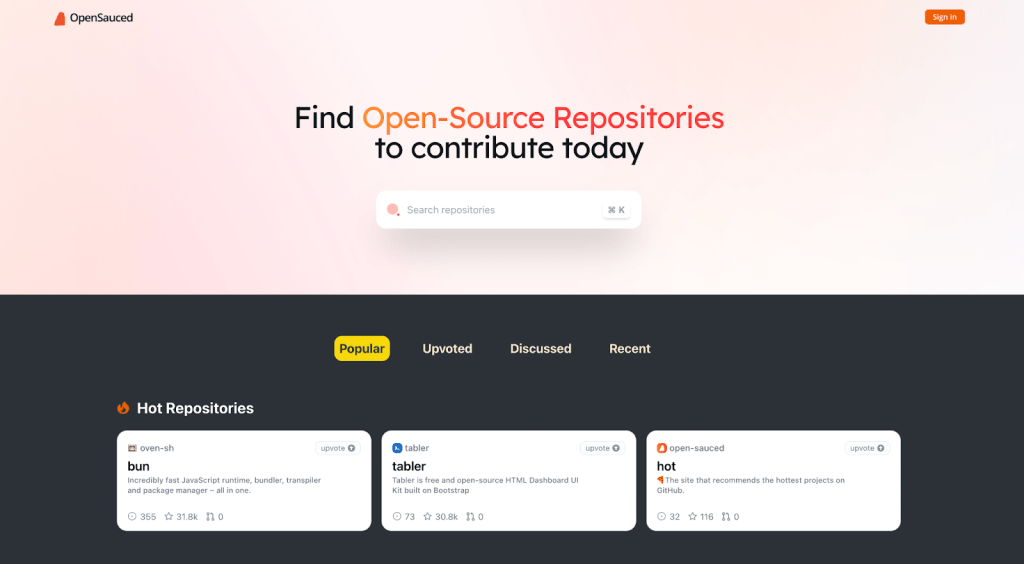
In late 2021, the project expanded with Hot Open Sauced, which recommends repositories based on popularity, discussion activity, upvotes, and recency. A third product, still in development, targets maintainers by offering actionable insights for attracting and retaining contributors.
About the maintainer
Brian Douglas is the Founder and CEO of Open Sauced. His open source journey began when he reached out to Chad Scira, maintainer of a Slack auto-invitation tool, for help. Scira’s prompt and supportive response inspired Douglas to get involved in open source communities. He went on to work at companies like Netlify and GitHub before creating Open Sauced to continue that cycle of knowledge sharing.
Follow Open Sauced and Brian’s work via:
- The Open Sauced Twitter account
- The Open Sauced YouTube channel
- Open Sauced on GitHub
- Jamstack Radio
- This Developing Story
Getting involved
Contributors can start by browsing the repositories in the Open Sauced organization. Each repo includes README documentation and contribution guidelines. The most active repositories are Open Sauced and Hot Open Sauced.
The community welcomes code contributions, sponsorships, and non-code involvement. Those interested in design, project management, or technical writing can find opportunities via the Discord community. A good entry point for non-coders is joining the triage team, where volunteers help label, prioritize, and organize issues.
From the author’s experience, Open Sauced was a career accelerant. Contributing a React dropdown component in August 2021 provided the confidence to contribute to other projects like Astro and Sharing Excess. The experience also offered context to better support both maintainers and first-time contributors, and a foundation for writing and speaking about open source journeys — especially valuable for those new to Developer Advocacy.
Staff pick: Testcontainers
This month’s staff pick comes from Benny Muskalla, Senior Software Engineer on GitHub’s Copilot team. His favorite project is Testcontainers, a Java library for JUnit tests that provisions lightweight, disposable instances of databases, Selenium web browsers, and other services running in Docker containers. Beyond Java, Testcontainers supports Go, Node, Rust, and Python.
Muskalla values Testcontainers because “it makes it super easy to setup external services for integration tests, setup whole networks of services with a few lines of test code, enables complex proxy setups within an integration test. I can’t imagine how all those scenarios would be tested without Testcontainers.”
Contributing to Testcontainers
Developers interested in using Testcontainers can consult the official website. For contributors, the contribution guide outlines how to help. The maintainers are especially interested in bug reports, documentation fixes, and support for new modules.
Stay in touch
- Join GitHub’s Twitch channel on Fridays at 1 pm ET for live maintainer walkthroughs.
- Rewatch past maintainer conversations on GitHub’s YouTube channel.
- Follow GitHub Community on Twitter for updates on Open Source Friday Twitter Spaces.
- Follow All In, a community promoting diversity and inclusion in open source.
- Read past editions: May featured Sharing Excess; June featured Modos; July featured Zag.js.


