Sharing a Notion page publicly is a single toggle, and that alone makes it useful for material that would otherwise need its own site: a product roadmap, a job posting, a press release or an announcement. What a public page does not give you is a custom domain name, any analytics, or anything beyond the feature set Notion ships with.
That gap has produced a line of workarounds that pull data out of Notion and treat it as a CMS, documented by Krzysztof Kowalczyk (blog with Notion and Netlify), Ben Borgers (Notion as a blog CMS) and Tony Faieta (Notion as a CMS for a Gatsby site). Each approach works, at the cost of a decent amount of effort.
Fruition: a domain in front of a Notion page
Stephen Ou's Fruition takes a different route. It is entirely free and also a bit of effort to set up, but when it is done you have your own domain serving a Notion page, plus some control over it — adding fonts and scripts, for instance.

The heavy lifting is handled by Cloudflare Workers. What makes the setup appealing is ongoing maintenance: open Notion, change the content, and you are finished.
Super and the limits of the approach
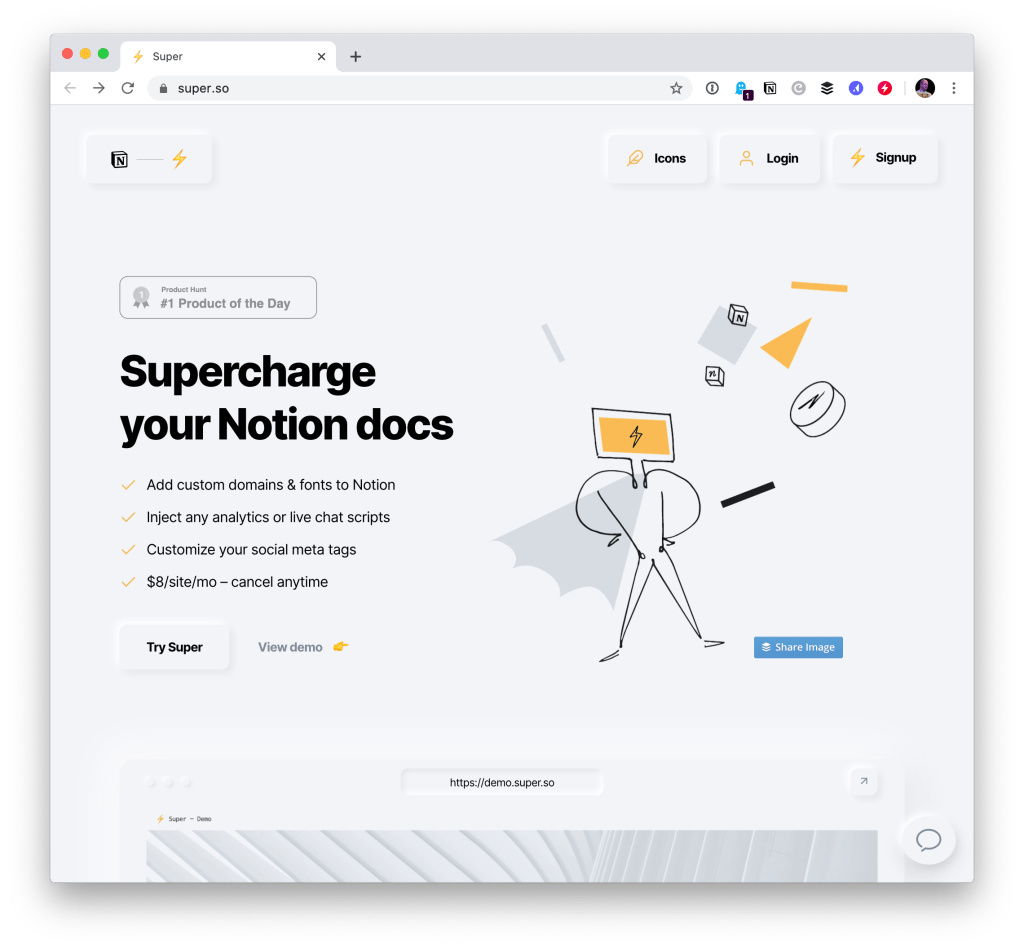
Fruition's setup complexity is its main drawback. Super is the alternative to look at for something easier and perhaps more flexible.
None of these tools are official Notion products or affiliated with the company. There is also a real risk that they break if Notion decides it doesn't care for its pages being used this way. Notion has said for a while that it would like to offer an API; that will be the real answer to all of this, and a proliferation of third-party products is likely once it exists.



