MotorTrend Overhauls Its Platform for Speed
MotorTrend, the automotive media brand owned by Warner Bros. Discovery, was running its digital operation on a legacy stack that was holding it back. Long build times, a cumbersome release process, and an inflexible CI/CD setup meant the engineering team spent more time managing infrastructure than shipping features. The goal wasn't a full redesign; it was a platform upgrade that could keep pace with the content and engineering velocity the brand needed.

From Weekly Releases to On-Demand Deployments
MotorTrend's previous infrastructure—a self-managed pipeline built on GitHub, Jenkins, and AWS—created serious bottlenecks. A single Release Candidate governed the entire deployment process, meaning one failing feature could delay everything for weeks. The path from idea to production was slow and rigid, limiting how often the team could ship.
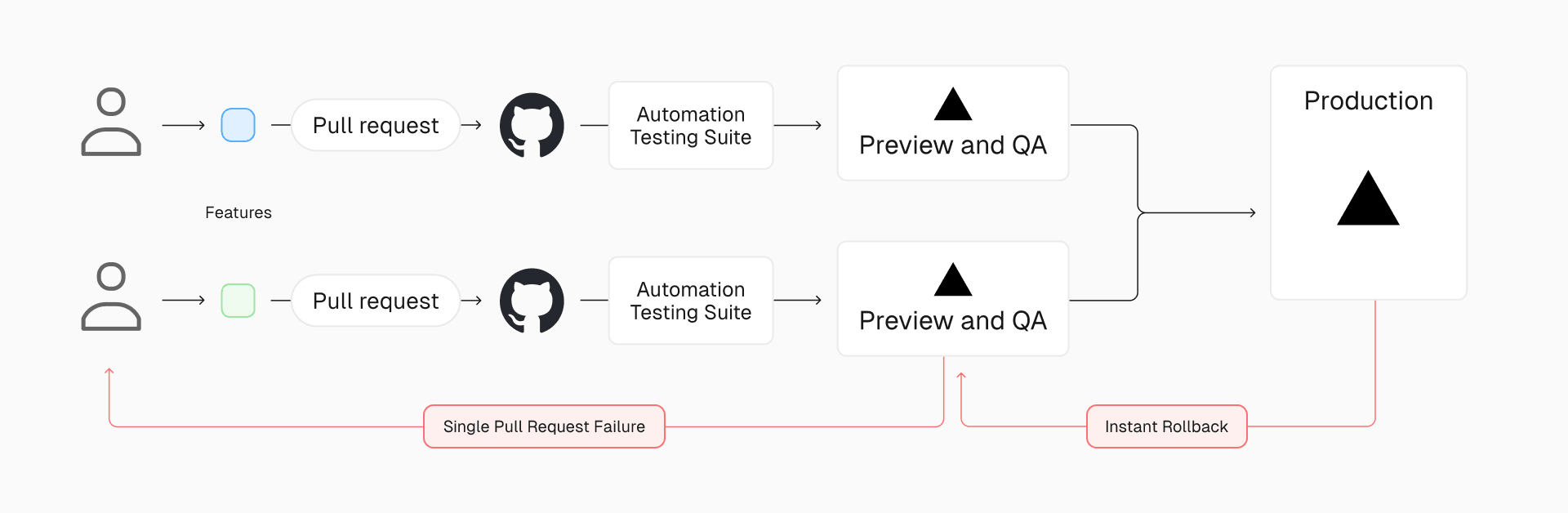
Moving to Vercel changed that dynamic. Build times dropped by as much as 7x, and the average feature release timeline collapsed from 18.9 days to roughly 10 minutes. Instead of syncing to a release train, developers can now push, preview, and promote features to production any time, independent of what else is in flight.
Vercel creates deployments per git branch by default. Only the main branch promotes to production and customer domains, while every other branch gets an isolated, authenticated preview environment. That means teams can test production-grade code without colliding with each other's work, and there is no need to build and maintain custom CI/CD logic. Once a prototype is ready, Product and QA can review it via preview URLs and the Vercel Toolbar; after approvals and tests pass, a pull request merges and Vercel builds and deploys the app.
"With Vercel, Instant Rollbacks and Preview URLs are top-notch. We've been able to release and test so much faster."

Arun Kambhammettu, Senior Software Engineering Manager, Warner Bros. Discovery
Killing the Build Bottleneck
Compiling approved code for production used to take around 42 minutes—a major drag on developer momentum. After adopting Next.js and deploying on Vercel, that same build now takes just 6 minutes. The faster turnaround means developers see their changes live almost immediately, reducing context switching and keeping the iteration loop tight.
Consistency across environments was another pain point. Differences between staging, development, pre-production, and production caused friction that has since disappeared. With everything running on Vercel, the team no longer sees environment drift between stages.
"Previously, we faced challenges with environment differences across staging, development, pre-production, and production, but once we moved everything to Vercel, it was seamless. We didn't notice any environment differences at all."
Arun Kambhammettu, Senior Software Engineering Manager, Warner Bros. Discovery
Performance as a Business Driver
Faster builds are only part of the story. By running on Vercel's Framework-defined Infrastructure (Fdi), MotorTrend avoids managing complex cloud infrastructure for its Next.js app. The Vercel Edge Network also speeds up page loads for end users, which has a direct business impact: faster site speeds lead to more ad impressions per page view and higher revenue without any redesign work.
The optimization work is ongoing. MotorTrend is using Vercel Speed Insights to monitor Real Experience data from actual users and guide continuous improvements. The team is also migrating its APIs to Next.js to improve performance, scalability, and maintainability. With sections like News and Buyers Guides already on Vercel and the rest of the site following, MotorTrend is betting on a performance-first architecture as its growth strategy.


