Astrology Meets the Collaborative Canvas
Astrology has been around for millennia, but it has traditionally been a solitary pursuit—a private consultation with the cosmos about love, work, or timing. In recent years, however, that dynamic has shifted. According to a Pew Research study cited by Figma, 29% of Americans now believe in astrology, a figure that outpaces the percentage of Americans using Snapchat in 2022. Millions are engaging with popular apps like CHANI and Co-Star.
Figma’s community is exploring how these divination tools can move from the personal sphere into the shared workspace. Product Designer Danielle Baskin created Moonlight, an app built in Figma that positions tarot as a social ritual for reflection. Figma itself launched a persona quiz at the end of 2022 that has been taken over 26,000 times.
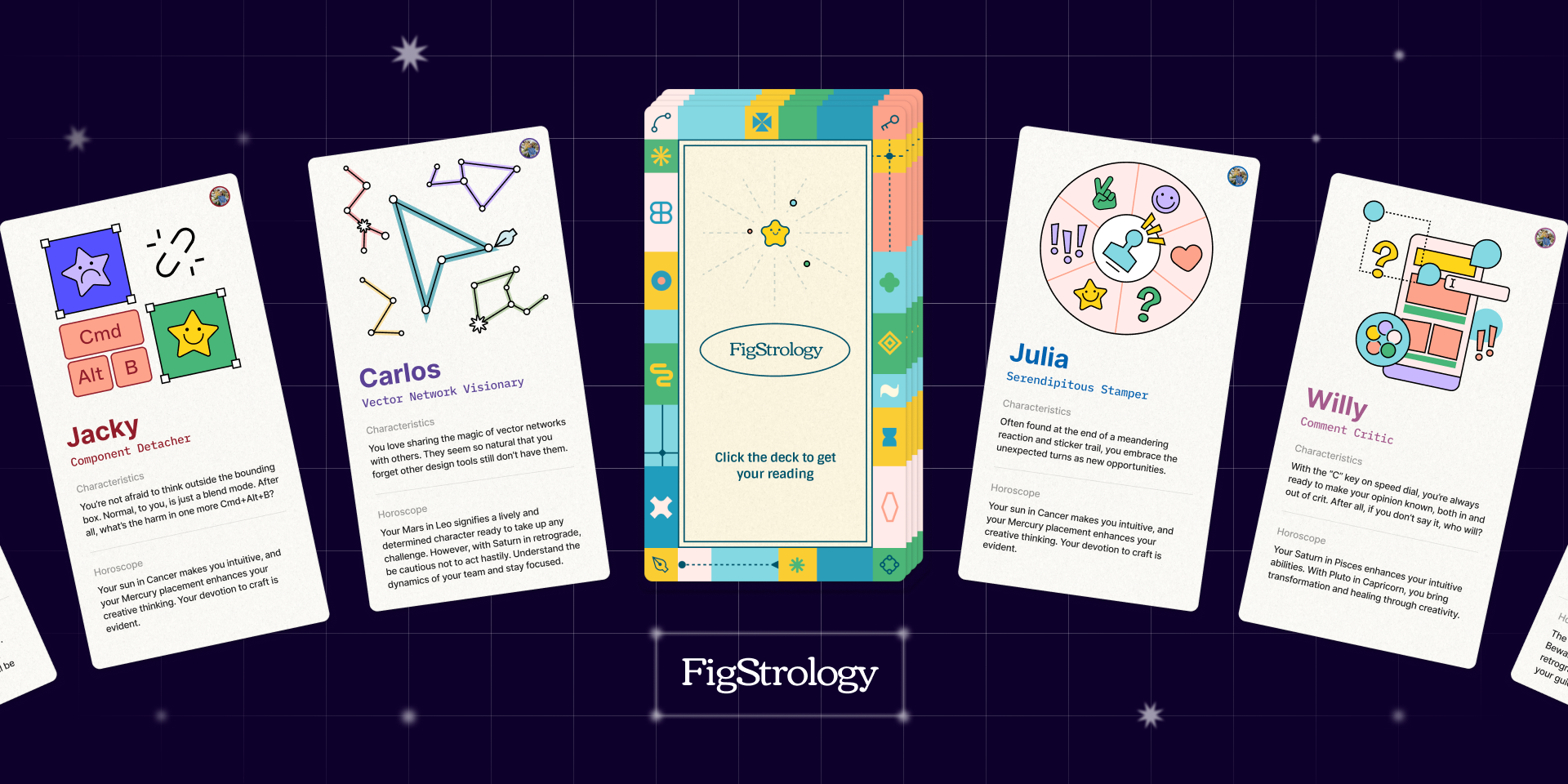
The latest experiment is FigStrology, a FigJam widget built by Software Developer Willy Wu and Product Research Intern Jacky Huang. The widget uses machine learning to analyze the stickies and activity in a FigJam file, generating an astrological persona and horoscope based on the current "cosmic conditions." We spoke with Wu and Huang about the project.
Why Astrology Resonates
For Huang, the interest began during the pandemic, when they discovered tarot card readings on YouTube. The pick-a-card format, where viewers choose a deck and hear a reading for that pile, felt remarkably accurate. "Horoscopes are like having someone tell you something about yourself that you might not fully recognize or realize in the moment," Huang said. "At the end of the day, we all want to be recognized, heard, and be seen and understood by others—even strangers." The appeal is partly that it's flexible, Huang added: "You can take it or leave it."
Wu frames the draw in terms of community. "It helps to know that I'm not alone. There are other Pisces out there," he said. For young people facing uncertainty, astrology offers both belonging and a sense of guidance. "On some primitive level, it's just kind of nice to see a horoscope—it's like a piece of advice from a wise sage."
From Photo Booth to FigStrology
The idea for the widget came from one of Huang's favorite FigJam tools, the Photo Booth widget. "I was like, 'Wow, I wonder if there's a way we can connect this idea of behavior and activity in Figma or FigJam with something fun like the Photo Booth,'" Huang recalled. The question became: What if a widget could generate horoscopes and personas based on what you did in a file?
The signs themselves aim to highlight the diversity of working styles. "Other people's strengths can be your weaknesses and by working together, you can achieve something greater than you can alone," Wu said. The widget is designed to invite users to explore their differences: whether you're good at systems thinking, thrive in unstructured environments, prefer the spotlight, or do your best work behind the scenes.
Joy as a Design Principle
The playful tone of FigStrology isn't accidental. Wu points out that widgets are multiplayer by architecture, built "to be collaborative from the ground up." FigJam, in his view, is more than sticky notes; it's an ecosystem of collaborative tools. "You do your best work when you're connected with others, when you're able to have these serendipitous moments, when you can high five," he said. "Joy and fun are not a thing you turn on at the end of the workday."
The team drew inspiration from a Config 2023 talk by Product Manager Mihika Kapoor, Design Manager Jenny Wen, and Product Designer Kee Yen Yeo on putting joy on the roadmap.
For Huang, who grew up in a rural suburb in South Carolina after immigrating from China, the concept of fun at work was absent from early definitions of labor. "In immigrant culture, there's such a big focus on work—as a means to survive, to exist," they said. Their first experience with Figma and FigJam was "magical," and the maker culture at Figma allowed them to co-create an astrology widget. "I'll continue to look for that in everything now," Huang said—choosing windier paths over the most practical ones.