

Resumes That Travel Well
Before you start sending applications across borders, the first thing to fix is the document that opens every conversation: your resume. The rules of good resume writing apply everywhere, but an international application adds a layer of complexity. What works in your home market may confuse or even alienate a hiring manager elsewhere.
The key is targeted adaptation. You are not rewriting your career history for each application; you are reframing it for a specific employer and a specific region. That means researching local expectations before you write a single line.
A good example of why this matters: in Malaysia, including personal details such as marital status or date of birth is standard practice. In many Western markets, that same information is at best irrelevant and at worst a red flag for bias. Choose what you disclose deliberately. The resume must also signal that you have done your homework on the region and genuinely want to be there.
Length, Format, And First Impressions
- Keep it to two pages or fewer, regardless of experience level.
- Use a clean, readable font such as Lato, Merriweather, or Helvetica.
- Write tight summaries for sections like About Me or Key Achievements; no repetition, no fluff.
Show Impact, Not Job Duties
A list of responsibilities tells a recruiter what you were supposed to do. A list of achievements tells them what you actually delivered. Whenever possible, back up your claims with numbers.
For instance, instead of saying you built a feature, describe the measurable outcome:
Developed a social sharing feature using Android Studio, which increased downloads by 150% in the first three months.
That kind of statement, with a concrete KPI, differentiates you from the dozens of applications that only describe tasks.
Word Choice Signals Competence
- Open bullet points with strong action verbs: built, led, deployed, reduced, developed, automated, managed, re-architected, implemented, designed, overhauled.
- Use precise, industry-specific adjectives like scalable, fault-tolerant, multi-threaded, or robust to demonstrate depth of expertise.
Tailoring: A Little Goes A Long Way
Tailoring is not about rewriting the entire document. It can be as simple as writing a personalized cover letter, adjusting the introductory paragraph to explain why you want to work for that specific company, using the terminology from the job posting, or positioning your achievements to match the employer’s market needs. The goal is to show that you have researched the company and can speak its language — literally and figuratively.
For a deeper dive into developer resume strategy, consult resources like the advice from hiring managers published on Stack Overflow and FreeCodeCamp.
Matching Your Search to the Place You Want to Be
A reliable international job search combines four different channels: job boards, networking, recruitment agencies, and direct Boolean searches. Each one has a different strength, and using them together gives you both breadth and precision.
Job boards are best when you want specificity — a particular country, company, or niche market. Aggregators such as Indeed, LinkedIn Jobs, SimplyHired, and Monster work better as an overview, showing you where the most hiring is happening and in which sectors. The key is to use boards that let you filter by “relocation” and “visa sponsorship,” so you are not wasting time on positions that will not work for you.
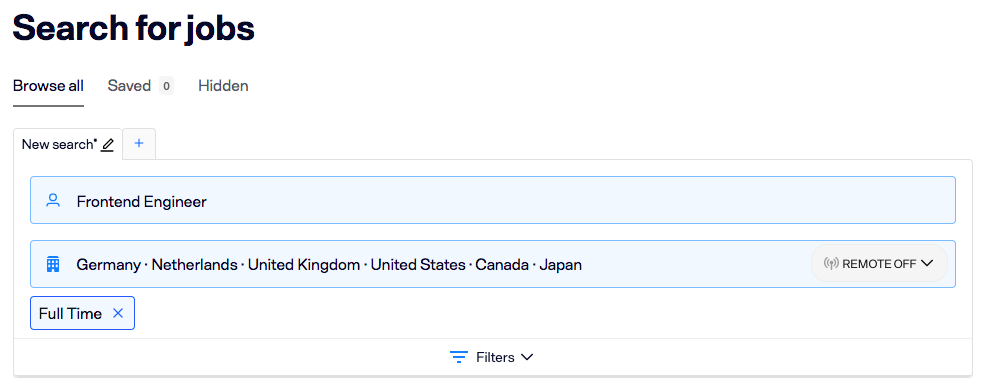
On AngelList Talent, for example, you must complete your profile before you can filter. Open the Filters tab and look for the “Immigration” section, then choose “Only show companies that can sponsor a visa.” You can find your search parameters at https://angel.co/jobs.

If you skip that filter, you will simply see every job that matches your other criteria, including those with no visa sponsorship at all.
Niche Job Boards for Specific Markets
Several boards are built specifically for developers looking to relocate. These are worth checking for verified employers that already offer relocation benefits:
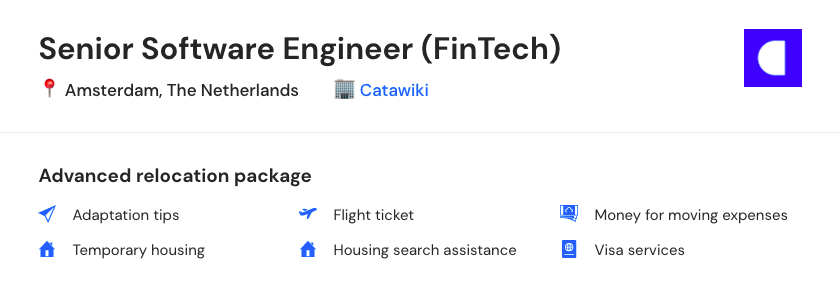
- Relocate.me — a board for IT professionals, mainly software engineers, with listings across Europe, Asia, and North America from employers offering relocation packages. The listings detail what each package includes, which makes comparing easy.
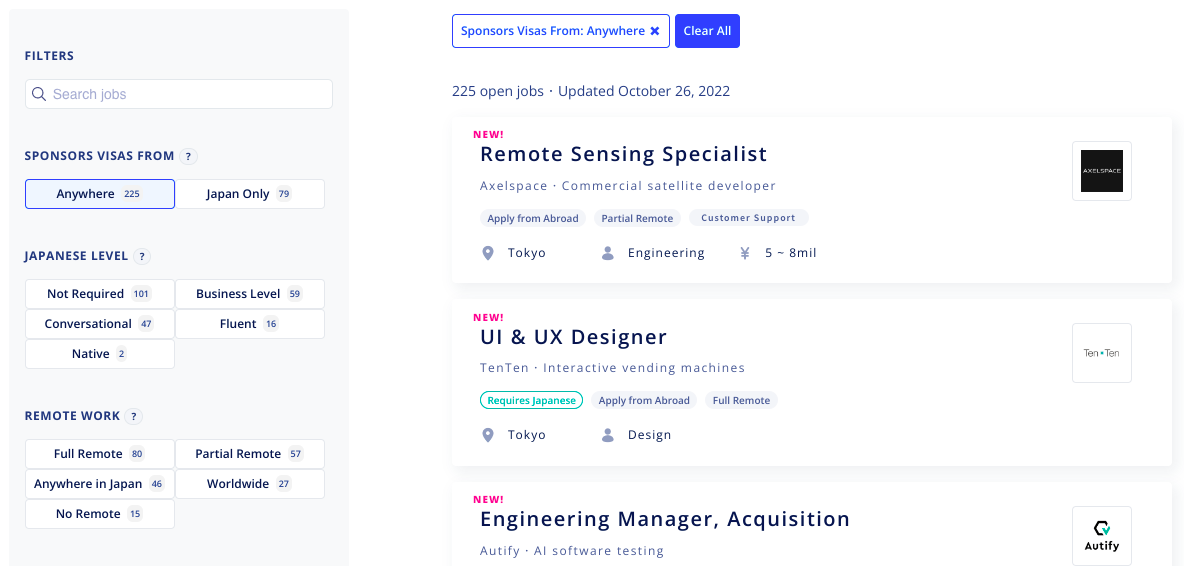
- Japan Dev — a curated board for tech jobs in Japan. The “Jobs with Relocation” button on the home page takes you to a filtered list, and most roles are for software developers and programmers, though other developer-adjacent positions appear too.
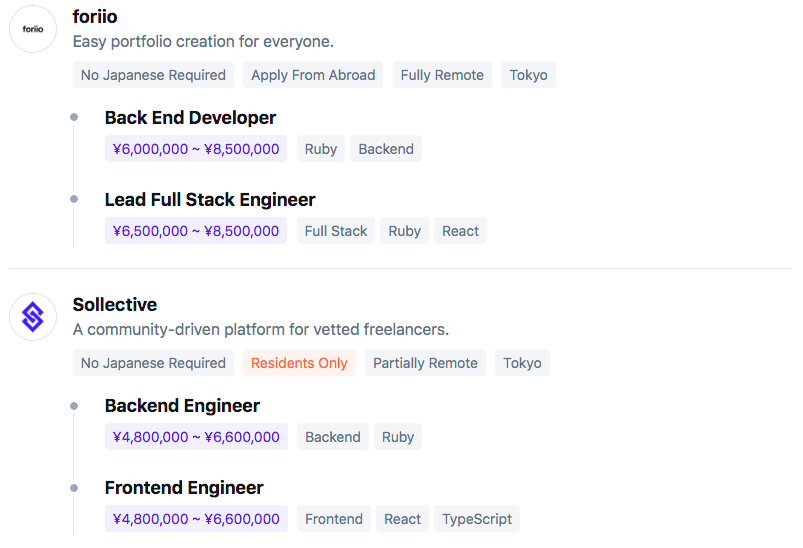
- TokyoDev — another Japan-focused option, this one lets you filter with labels like “No Japanese Required,” “Apply From Abroad,” and “Residents Only.”
- Landing.Jobs — focused on tech roles in Europe, with particular emphasis on Portugal. Use the “Visa & work permit” filter section and select the options relevant to you.
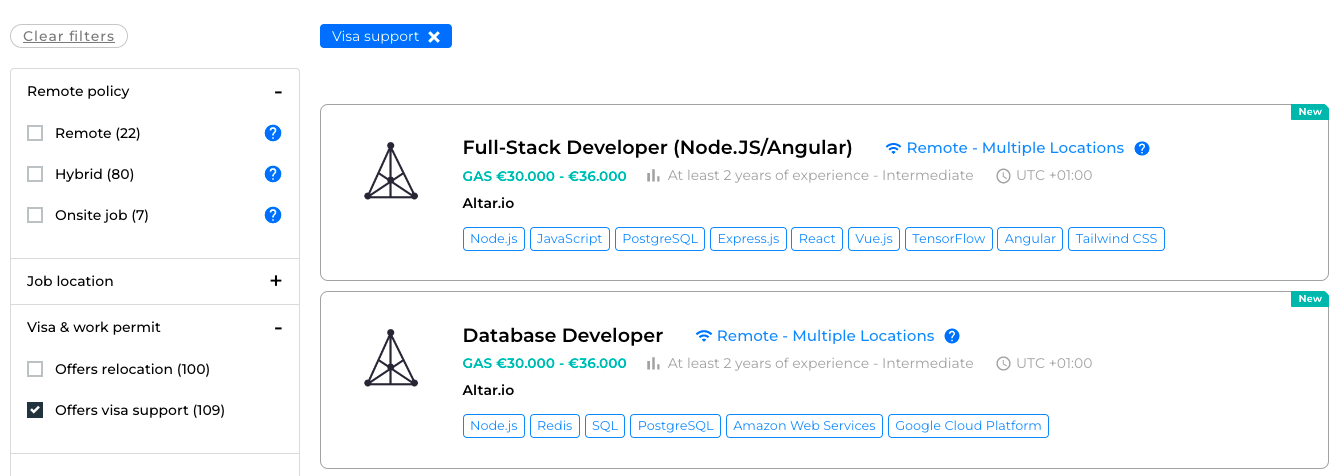
- SwissDevJobs — for IT positions in Switzerland, with a modern interface. The advanced filters include a simple checkbox to show only jobs providing visa sponsorship.

- Arbeitnow — Berlin-based, covering positions in Germany. It makes filtering for visa sponsorship and other criteria straightforward.
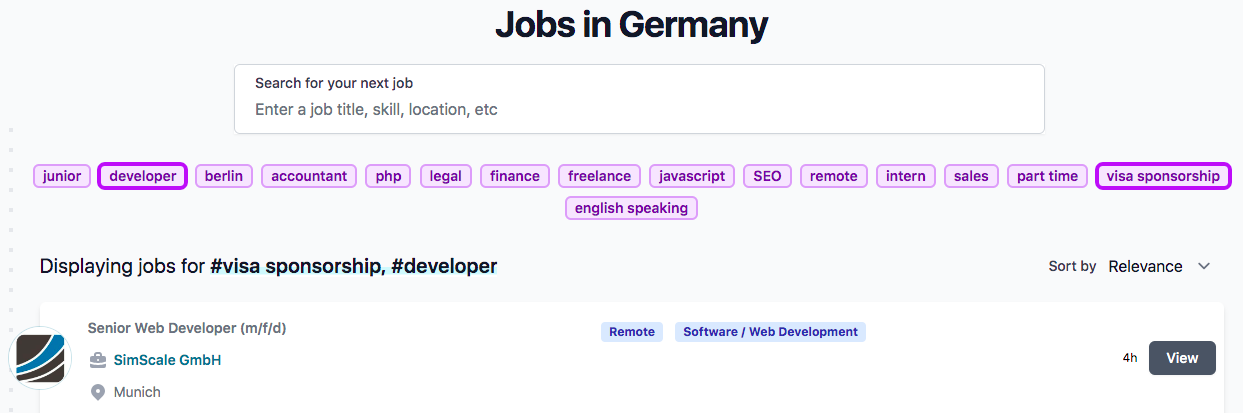
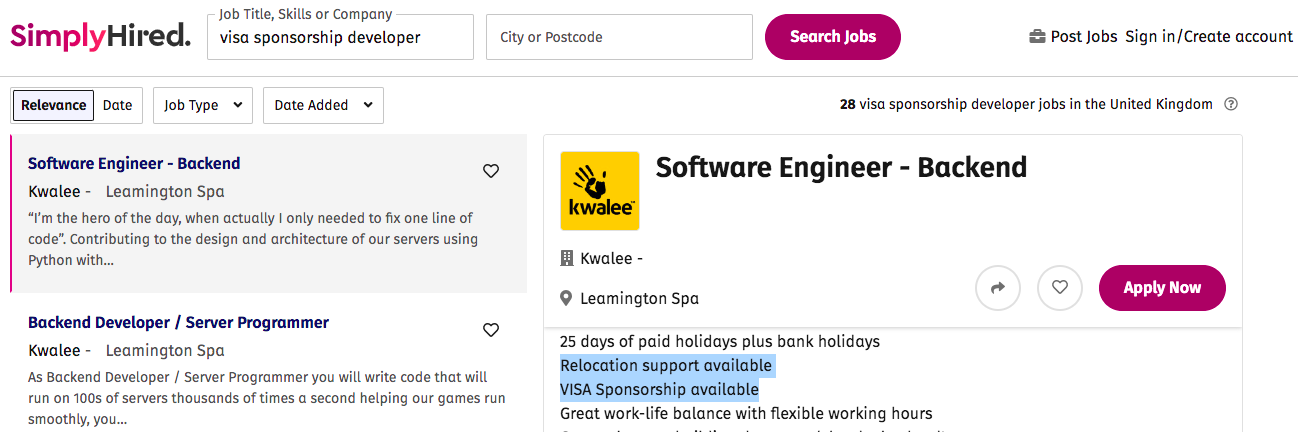
On the larger aggregators, the approach is different. Rather than relying on built-in filters, you should add keywords like relocation, visa support, or visa sponsorship directly to your search alongside your job title. For LinkedIn, this works by appending those terms in the keywords tab and selecting your target city or country.

Use the same method on Indeed, Monster, and similar sites. Yes, you may still get some irrelevant results, but the keywords do most of the filtering for you.
Networking and Referrals
Networking is slower but has a higher payoff per contact. Social networks — LinkedIn, GitHub, Twitter, even Instagram — let you reach hiring teams and business leaders directly. Keep an eye as well on industry signals like Hacker News' Ask HN: Who is hiring? thread and TechCrunch coverage. These show where investment and hiring momentum are building, and give you names of companies worth approaching directly through social media or their own sites.
Using International Recruiters
Many tech companies outsource international hiring to specialist recruiters, so going through an agency can be a genuine advantage — not just for finding the right role, but for getting the full picture on a company's relocation policy, benefits, and working culture. Agencies like Global Skills Hub, Zero to One Search, Toughbyte, Orange Quarter, and TechBrainJobs are reasonable first points of contact for developer-specific placement support.
Boolean Search for Unadvertised Roles
Boolean logic is a way of combining operator terms to make searches that return very precise results. It lets you find live vacancies that may never be advertised on job boards, including positions sitting openly in applicant tracking systems from companies you know you want to work for. The theory sounds heavier than the practice — the searches are simple to write.
There are five operator terms you need:
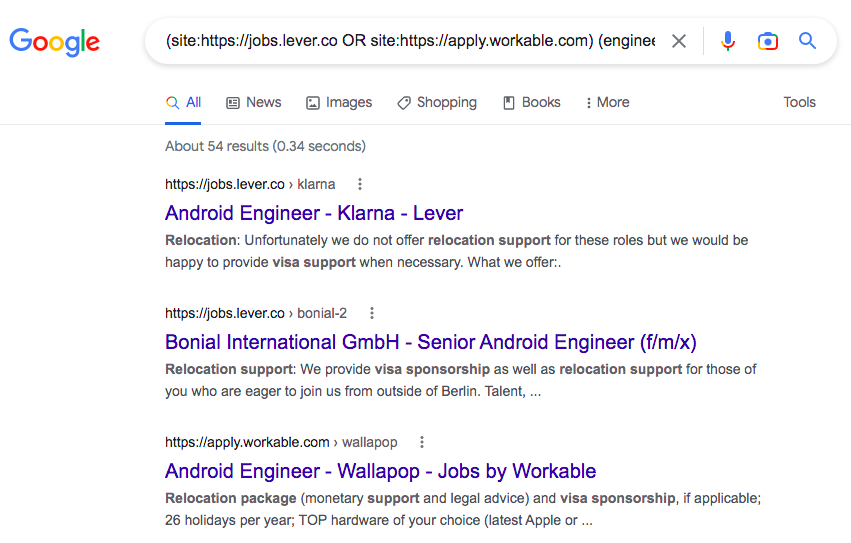
AND— for searches that must include multiple keywords, e.g., developer AND javascript AND python.OR— for searches where one of several keywords is enough, e.g., web developer OR software developer." "— to match an exact phrase, e.g.,"mobile developer"will not return other kinds of developer roles.*— to match a prefix, e.g.,*Engineerwill also return Engineering Manager.( )— to group criteria, e.g., software developer (startup and python).
You can target a specific employer's hiring portal directly. For example, to find developer roles that offer relocation support at companies using Lever or Workable:
Kip Brookbank has written a useful LinkedIn article on using Boolean searches to source a job — worth a look to see the approach in practice beyond this basic outline.
Making the Strategy Work
When you combine these four methods, you end up with a workflow that is highly targeted. Job boards and aggregators give you a broad map of the market; niche boards with relocation filters surface the roles that are actually viable for you. Recruiters supply guidance and context that a page listing never will. Networking opens the door to referral-based applications, which historically perform far better than cold submissions. Boolean searches strip away the noise and get you straight to relevant current openings, many of which are barely visible elsewhere.
The point is that finding an international developer role does not have to be a lottery. With this toolkit, the search is something you can run methodically, using free or low-cost tools, and the signal-to-noise ratio is much higher than leaving a job search to natural algorithmic fate.
Build an Application Plan Before You Apply
Once your resume is international-ready and your job sourcing channels are active, the next step is a deliberate application strategy. A structured plan keeps you focused and signals professionalism to employers who are already evaluating how you’ll handle the logistics of relocation.
Five channels cover most ground:
- Job boards and aggregators. Use every digital channel available to surface relevant openings.
- Company websites. Go directly to target employers or refine your search with Boolean operators.
- Referrals. Your network and its news are one of the most personal and effective routes in.
- Direct HR outreach. LinkedIn is your primary tool for contacting a company’s human resources team.
- Red-flag screening. Learn to spot poor job ads — Workable has useful examples — and check Glassdoor and Blind for employer reviews. A quick check can save you from a damaging career move.
Interview Prep: The Dos and Don’ts That Matter Abroad
With exacting technical candidates, the fundamentals of interview preparation sometimes get lost between assessment tests and high-stakes hiring loops. For an international role, a few non-negotiables apply.
Do:
- Research the company deeply. Understand its history, mission, and current direction so you can speak to them intelligently.
- Prepare for likely questions. Practice answers covering everything from coding to critical thinking, teamwork, and time management.
- Draft your own questions. Asking informed questions demonstrates genuine interest and gives you a chance to evaluate the employer.
- Show up on time. Tardiness is an immediate disqualifier in most interview processes.
- Reiterate your relocation plan. International employers want to know how you’ll manage the move, not just that you want it.
Don’t:
- Badmouth past employers. Negative comments signal a lack of professionalism and poor exit behavior.
- Make relocation your sole motivation. If the job seems like a means to an end, interviewers will question your commitment to the role itself.
- Say “I don’t know” without a recovery plan. Mistakes are acceptable; instead of admitting ignorance outright, offer to follow up with the answer after the interview.
- Ask about salary or perks during the interview. The discussion comes later unless the interviewer brings it up directly. Still, know your market value in case you’re asked.
- Forget the details on your resume. You will be asked to elaborate on specific points. Not knowing your own resume back-to-front looks unprepared.
Negotiating the Offer and Compensation Package
Salary discussions are about more than the number on the contract. This is the moment to align on relocation support, tax implications, IP rights, and benefits.
- Research first. Understand what tech talent earns in the target market for a company of its size, and set a rough expectation for your own package.
- Let the employer offer first. Rather than stating your number, ask for their offer and see if it aligns with your research and relocation needs.
- Clarify the relocation package. Confirm what’s covered — travel, accommodation, temporary housing — and at what stage of the process.
- Negotiate broader benefits. Commute costs, training budgets, and other perks should be put in writing as part of the full offer.
Additional items to settle before signing:
- Expat tax exposure. Check whether you’ll pay more tax as a foreign worker in the host country.
- Intellectual property terms. Confirm what rights you retain over work you create during employment.
- Contract enforceability. International employment agreements can be ambiguous; review employer rights, e-signature legality, and governing law carefully.
Relocation: A Pre-Travel Checklist
Relocating for work is an emotional and financial journey. A pre-travel checklist helps you manage the transition smoothly.
- Learn about your destination. Study local transport, customs, and basic language nuances to soften the culture shock.
- Visit in advance if possible. A scouting trip lets you meet landlords, colleagues, and neighbors before the big move.
- Price out the cost of living. Use resources like Numbeo to see how far your salary stretches across rent, food, and local travel.
- Read your relocation package closely. Know exactly what’s subsidized, from travel to temporary accommodation.
- Include your family in planning. Relocation takes a toll that’s not just financial. Involve family members early and account for the emotional weight of leaving your home country.
Finding a developer job abroad is a labor of love — one that has to take stock of everything from financial planning to tweaking and perfecting your resume for an international audience.

The preparation is substantial, but the payoff is a career change and a life change. With an in-demand skill set, the effort of a well-run international job hunt opens doors around the world — the world is, quite literally, your oyster.


