
Screen Flicker, PWM, and a Laptop Headache
After switching to a new laptop, the author experienced daily headaches—an unusual occurrence. A colleague suggested the screen might be flickering, and a web search for the laptop model introduced a possible culprit: pulse width modulation (PWM). Some panels dim by rapidly cycling power on and off, which can be perceptible to sensitive users, even if not consciously visible.
The Panel Lottery
One unexpected discovery is that Lenovo does not disclose the exact monitor panel supplied with a laptop at order time. Different units of the same model can ship with panels from various manufacturers, and these panels can behave quite differently. This phenomenon, commonly called the “panel lottery,” has been documented by sources such as Notebookcheck.
Recording Flicker with Slow-Motion Video
To diagnose potential flickering, slow-motion videos were taken of the screens of three laptops:
- The older ThinkPad X250 (panel: LP125WF2-SPB2), which caused no issues.
- The new ThinkPad T14s (panel: R140NWF5 RA), the suspected source of the headaches.
- A colleague’s ThinkPad T14 (panel: N140HCR-GL2), also problem-free.

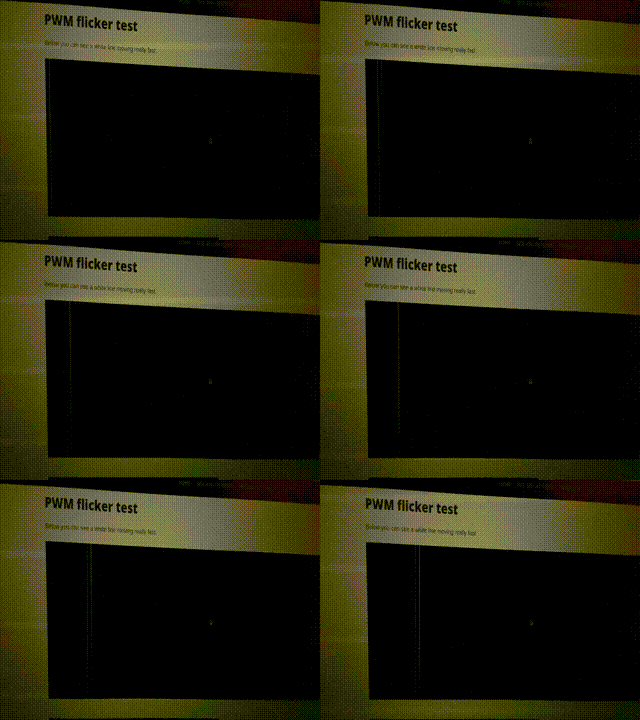

The slow-motion results were puzzling. Both the old and new laptops show visible banding artifacts on video, yet only the new one is associated with discomfort. If the new screen’s pattern were the cause, it is unclear why the old screen, which exhibits a similarly intense visual pattern, would not also produce symptoms. One hypothesis is that the dark band seen on the old laptop is the screen’s normal refresh activity rather than PWM—but the author acknowledges uncertainty in interpreting these recordings.
Identifying the Panel and Its PWM Frequency
To identify the panel on Linux, the author ran a hardware query command that outputs the panel model:
strings /sys/class/drm/card0-eDP-1/edid
The result, R140NWF5 RA, was then researched. A Notebookcheck review of a different ThinkPad with the same panel reports a PWM frequency of approximately 980 hertz. While that is a high frequency—nearly a thousand cycles per second—the review states that at 980.4 Hz, most PWM-sensitive users should not perceive flicker. Whether this is the true cause of the headaches remains unclear, and further testing is needed.
Potential Next Steps
Options discussed include replacing the panel with a different model—perhaps the same one used in the colleague’s T14. Replacement panels appear to be relatively inexpensive, and a trusted local repair shop could handle the installation. Whether this will resolve the issue is still an open question.


