Why the case for graceful degradation still holds
In the mid-2000s, the web dev orthodoxy was strict: keep pages under 100KB, use JavaScript only for effects, and give everything—images, Flash content, scripted features—a fallback so that JavaScript features progressively enhance the page. Without JavaScript the site still worked completely, just less fancy.
The driver was dial-up. Connecting alone took minutes, so you pressed "Connect" and went to make coffee. Building small with solid fallbacks was the only sane response to that constraint.
Constraints no longer frame the conversation. The focus today is developer experience over user experience—build processes, framework and tech stack choices, and search rankings. Gatekeeping ("you're not a real 'x' if you don't 'y'") and framework battles have displaced the "how do I build this cool thing without JavaScript" discussions. It all renders down to HTML, CSS, and JavaScript in the browser anyway; use whatever works.
The blizzard: pages that need JavaScript to exist
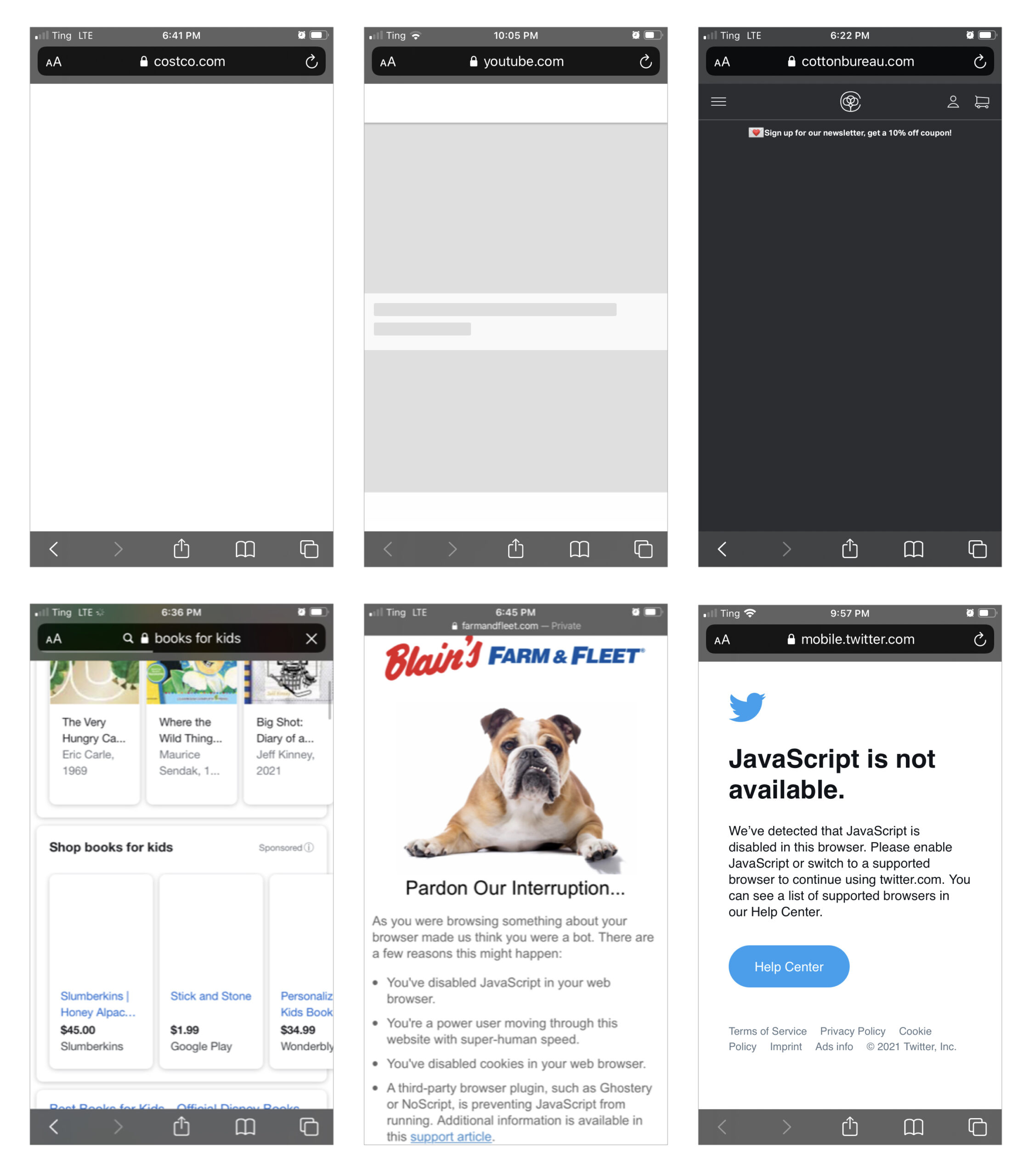
What's harder to accept is that sites requiring JavaScript just to be usable are now normal, with page weight averaging around 2MB per page. Disable JavaScript and you get what the author calls the blizzard: site after site showing only a white screen.
JavaScript is a legitimate third pillar of the web. The objection is to sites that cannot load at all without it. Loading HTML and CSS should not depend on JavaScript.
A move to a rural area on the edge of a major city brought the dial-up experience back on mobile: broadband indoors is fine, but outdoors or during an outage, browsing means relying on Reader Mode and disabling JavaScript and most images (many of which lazy-load via JavaScript). Many sites then refuse to load entirely. The white screen isn't a dead phone—it's lost connectivity, repeated across every site visited.
A concrete failure case: the outage page
Late in the summer, the power went out. With the whole house running on electricity, the next question was when service would return—answered, presumably, by the utility's site. That mobile site ships 3MB transferred and 8.6MB in resources, and it would not load even with JavaScript enabled. The outage was aired on Twitter instead:
https://twitter.com/_hmig/status/1432093685924179968
Responses pointed to sites that handle constraints well, such as traintimes.org.uk and the text-only version of NPR. Which raises the obvious question: why not offer a text-only outage page, so the page people need most urgently works under the worst conditions?
Unreliable access is not a one-off
The power-outage case is extreme but isolated. Plenty of people across the U.S. and worldwide live with unreliable Internet because no better option exists. NPR has reported on teaching during the pandemic in communities with no reliable broadband; that this remains the state of availability anywhere in the U.S. is hard to believe, but it does. The international speed data tells a similar story.
Sites built before broadband was widespread—the infamous Space Jam site from 1996 being the canonical example—load on any device, from anywhere, under almost any conditions, because those constraints shaped them. The hope is that developers adopt an adaptive loading strategy with solutions for users on slow networks or low-end devices.



