

Automation Is About More Than Time Saved
Every developer has a set of recurring workflows: launching apps and servers at the start of the day, running tests before committing, or scaffolding files for a new feature or post. Automating those steps seems like an obvious productivity win, but the math can look discouraging. Spending four hours to automate a task that takes a minute means you need to perform that task 240 times before you break even.
That framing, popularized by XKCD comics like 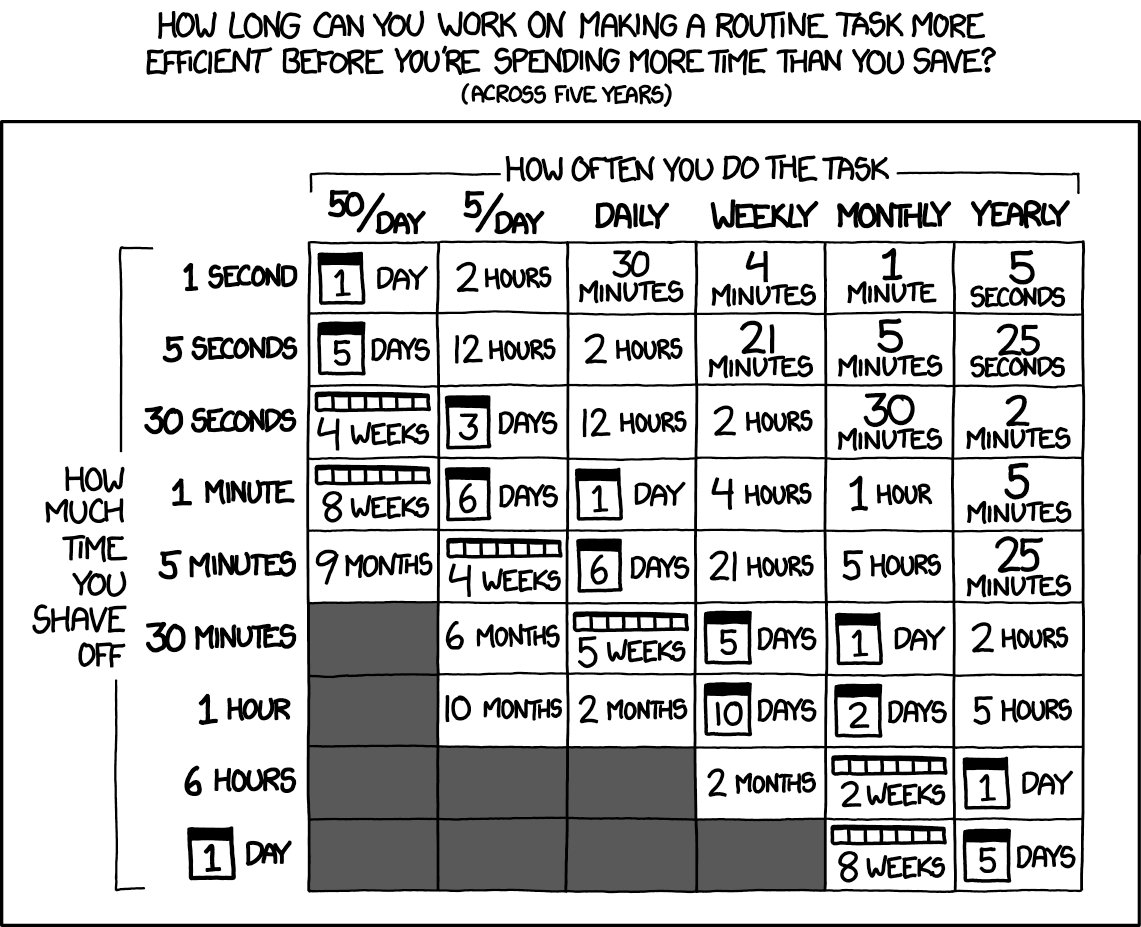 and
and 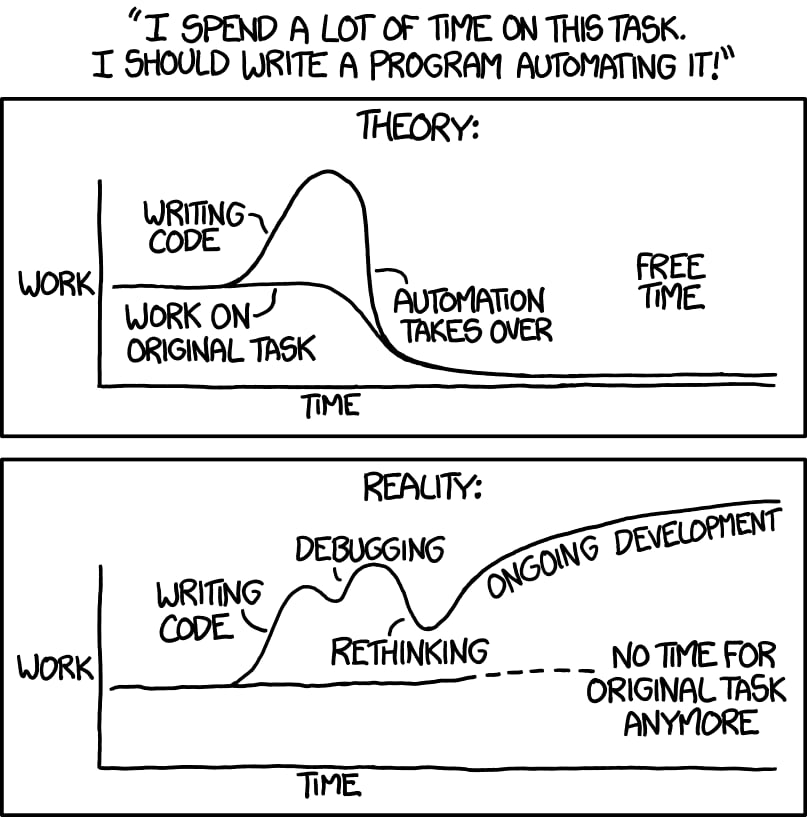 , misses what automation actually buys you. Time saved is only one benefit, and often not the most important one.
Reducing Context Switching
Consider the process of publishing a blog post on a modern static site. Content lives in mdx files with YAML frontmatter for metadata like title, date, description, and keywords. A banner image sits in an adjacent images directory. Creating a new post involves creating content/blog/<name-of-post>/index.mdx, searching for an image on Unsplash, downloading it and moving it to the right folder, filling in frontmatter fields including banner and bannerCredit, writing the post, and committing and pushing changes.
For a contributor who has done this hundreds of times, the actual file setup might take only a minute. But that minute is not the real cost. The real cost is the mental gear-shifting required to leave a creative task and handle boilerplate. Losing your train of thought mid-write to remember the exact YAML syntax or the directory path can cost far more than the mechanical steps themselves. Keeping your brain on the task at hand is often the strongest justification for automation.
Eliminating Human Error
Humans excel at creative problem solving but are notoriously bad at repeating the same task without mistakes. Computers are the opposite. Once a workflow is scripted, it runs the same way every time—no fatigue, no boredom, no typos. The risk of small errors multiplies with every manual step, and catching those errors gets harder the deeper you get into a process. Offloading the mundane parts to a script moves that risk to zero.
Doing More, More Often
Automation also lets you expand what happens as part of a routine process without extra effort. A blog post creation script, for instance, can accept command-line input and format it into YAML, open an Unsplash search with the post title, download and optimize the banner image from just an Unsplash ID, fetch the photographer credit automatically, prefill the banner path, and generate the slug and date fields.
When the mundane parts are handled, you have more attention for the parts that genuinely need human judgment—choosing a good title, selecting categories and the right image. You also tend to do the whole task more often. Release automation works the same way: when deployment is reliable and scripted, you ship more frequently.
Sharing Multiplies the Value
The efficiency math changes dramatically when an automation is shared. A script you use yourself saves time once per run. Put it in an open source tool and even a modest user base multiplies the time saved by hundreds. Stephan Bönnemann’s semantic-release is a good example—a tool that automates versioning and releases has saved countless hours for developers who never had to think about the underlying mechanics.
The same argument applies internally. If your automation standardizes how files are structured in a repository, every future contributor benefits from consistent layouts and less guesswork. And in the extreme case, automating something well enough that people will pay for it has created entire companies.
Automation as a Learning Tool
Building automation is also practice. A CLI tool teaches you about command-line design and libraries like inquirer. Using third-party APIs to fetch metadata or images shows you different API design approaches. Open sourcing your solution adds lessons in testing, continuous integration, and release management.
None of this argues for automating everything reflexively. You still need to ship actual work. But the break-even calculation for automation is more than just time saved. The ability to stay focused, eliminate errors, expand what gets done, share the gains, and learn from the process means automation is frequently worth the investment sooner than the simple math suggests.


