
The 2026 Mother's Day scrollytelling experiment is, per its author, only the most recent instance of a pattern: a way of using UI and code to bring someone back into the room. The tribute doubles as a look at how a card can be driven by scroll behavior rather than clicks.
The CodePen relies on scroll-snap events and scroll-state queries, and therefore only works in Chromium-based browsers at the moment.
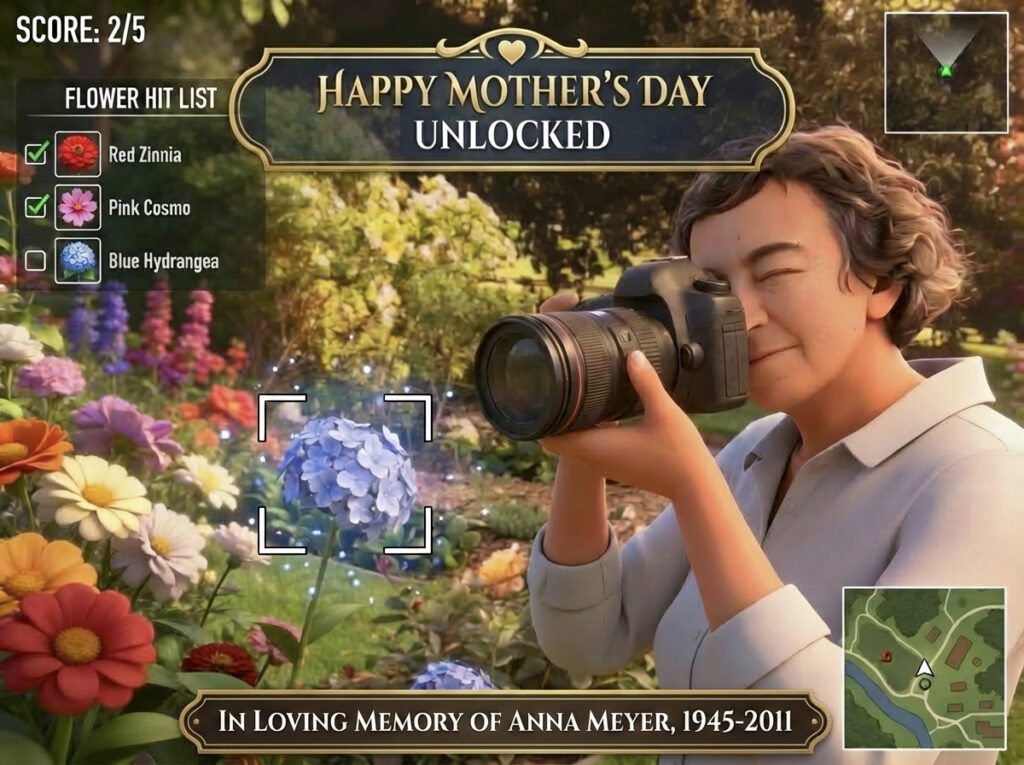
Surviving through pattern-finding
Behind the piece is a 1945 birth in a hospital in Kazakhstan — the year World War II ended — where civilian patients shared wards with discharged soldiers suffering PTSD. When the author's mother was born she wasn't breathing; staff immersed her in cold water, then hot, then cold again, a so-called remedy at the time based on no science. The pattern that followed defined her: surviving not because of the help received, but despite chaos disguised as help.
As an adult she found patterns and sense in the unfathomable through three passions:
- Photography, for framing the moments when surrounding chaos briefly harmonized into beauty.
- Teaching, for breaking that chaos into logical steps people could follow.
- Computer programming, for encapsulating those illustrated teachable moments in interactive experiences — where, unlike real life, a failed interaction can be traced and solved.
In other words, she educated the author with the toolkit now recognized as web development, before the web existed. She died of cancer in 2011.
What the card borrows from her
The scroll-triggered time-lapse of day into night, built from CSS shapes, is the central conceit: a single scroll gesture gives the gist of an entire day, like the way she could explain a big topic to a child as if it were play.
The page is built on scroll-snap events, a module the author describes as available only in Chrome and Opera at the time of writing, with randomness provided by UFOs. Snapping between the day and night scenes triggers behavior CSS alone can't express, such as randomized UFO flight paths and the Pretext-inspired effect of spacecraft repelling letters as they fly through the text. (Randomness in CSS is being worked on, the author notes, but currently only functions in Safari.) The UFOs' randomness symbolizes a camera capturing fleeting moments of sense in a chaotic world.
The transitions are context-aware: what happens as the user slides between day and night and back again depends on the game logic's state at that moment.
Design lineage and a pre-Pokémon Snap photography game
Scroll-snap-driven transitions between landscapes were explored earlier in Roland Franke's deconstructed radial slice transition, with a foreground figure watching each scene change — a patience in observation the author associates with his mother's habit of condensing what she saw into short interactive stories.
Before Pokémon Snap existed, she used QuickBASIC to build a photography game because she didn't want one that was about blowing things up. The author recalls an Armor Alley demo running in a shop window in the 90s; she dismissed it — "the helicopter started it" — and went home to make her own game instead. Violence in games, she taught, is a metaphor for life's uncertainty, but not the only way to cope with it.
The mechanism
Scroll snapping is enabled in CSS with:
/* The scroll container */
body {
  overflow-y: auto;
  scroll-snap-type: y mandatory;
}

/* Each snap target */
.snap-panel {
  scroll-snap-align: start;
  scroll-snap-stop: always;
}
and handled in JavaScript with:
// scrollsnapchanging fires while the user is scrolling —
// snapTargetBlock is the panel they are heading toward.
snapScroller.addEventListener('scrollsnapchanging', ({ snapTargetBlock }) => {
  markPanelStates({ active: selectedPanel, incoming: snapTargetBlock });
  if (snapTargetBlock === dayPanel)   onScrollingTowardDay();
  if (snapTargetBlock === nightPanel) onScrollingTowardNight();
});

// scrollsnapchange fires once a panel has snapped into place —
// snapTargetBlock is the panel now fully in view.
snapScroller.addEventListener('scrollsnapchange', ({ snapTargetBlock }) => {
  selectedPanel = snapTargetBlock;
  markPanelStates({ active: selectedPanel, incoming: null });
  if (snapTargetBlock === dayPanel)   onLandedOnDay();
  if (snapTargetBlock === nightPanel) onLandedOnNight();
});
The author's summary of this arrangement is a sentence about his mother: she would always give him another chance to get things right. For readers who arrived via a search for a conventional Mother's Day gift rather than an avant-garde homemade one, the parting advice is to buy a Kindle. The author bought one for his mother while she was alive; they read the same novel separately and compared notes by phone on days he couldn't visit.



