
Dropbox’s Sixth-Generation Hardware: Less Snowflake, More Sedan
Dropbox has run its own infrastructure for nearly a decade, operating one of the few exabyte-scale storage systems in the world. That scale demands deliberate hardware design. The company’s Hardware team recently shipped its sixth generation of server designs, covering the tiers that keep the service online: Storage, Database, Compute, and Edge.
The philosophy behind these builds is consistency. Rather than crafting custom servers for each of the more than 100 services that run on Dropbox’s infrastructure, the team focuses on a few general-purpose system designs. That avoids the "snowflake" problem, where one-of-a-kind configurations multiply maintenance burdens. A handful of utilitarian building blocks, serving as family sedans rather than high-performance sports cars, let the company stay agile across its workload footprint.

Inside the Sixth Generation
Scooby: Storage Density
Co-designed with the Magic Pocket team, the Scooby storage server hosts customer data on high-capacity 3.5” HDDs. It scales to more than 2 PB per server and 20 PB per rack, with each chassis containing over 100 drives, a compute enclosure running Magic Pocket software, and a 100 Gb NIC. Eight chassis fit in a rack, delivering greater performance density per rack than any previous generation.
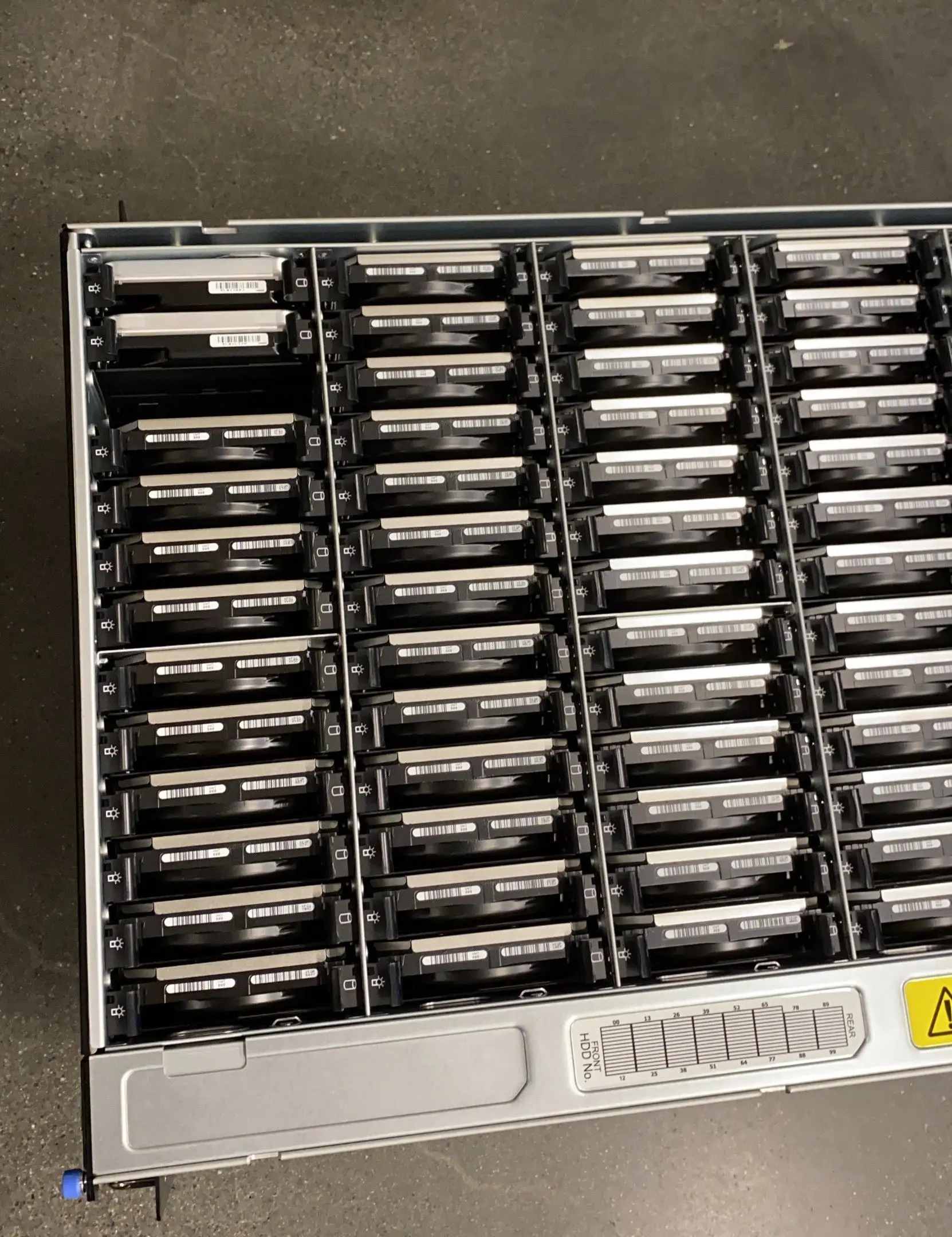
Drives on drives on drives! Photo by Jared Mednick
Diego: Database Doubling
Diego powers the persistent storage layer behind services like Edgestore, File Journal, and Magic Pocket. It effectively doubles rack density compared to its predecessor, adding 60% more CPU cores and 16 TB of NVMe SSDs—twice the flash storage of the prior generation. That flash capacity is critical for the low-latency, high I/O access that metadata workloads demand.
Cartman: General Compute Ramp
For general-purpose applications, each Cartman node is a low-end server in a 1U enclosure, stacked 46 per rack and interconnected with a top-of-rack switch. The tier achieves a 3x improvement in speed and power, driven by multi-tenancy and CPU industry trends that deliver more performance with fewer processors. Each box packs a 48-core CPU, 256 GB DDR4 RAM, a 1 TB boot SSD, and a 25 Gb NIC.
Coco: Closing the Edge Gap
The Coco servers handle encryption and decryption of traffic entering and leaving Dropbox data centers, making them the closest tier to end users. This refresh boosts POP rack density by 17%, increases core count by 50%, lifts network speeds by 25%, and triples total memory. The result is lower latency and faster connections to Dropbox’s distributed points of presence.
Looking Toward the Seventh Generation
With the sixth generation deployed, Dropbox’s software teams are monitoring real-world performance and feeding those insights back into future hardware decisions. That co-design loop has historically let the company bet early on new technology—it partnered with AMD on the Naples and Rome processors and was among the first to deploy Shingled Magnetic Recording (SMR) drives at petabyte scale.
The next targets are machine learning accelerators, which are new to the fleet. They are expected to deliver significant gains for inference and regression workloads, improving features the company has rolled out in recent years. On the storage side, heat-assisted magnetic recording (HAMR) drives are the next step for higher density, using a heated laser to write bits to the platter. Dropbox plans to work with suppliers to fold those drives into its fleet.
Work on the seventh generation is already underway, and it will coincide with the tenth anniversary of designing these configurations in-house. The priorities remain stable: scaling storage, optimizing for multi-tenancy, and unlocking new capabilities in the database tier.


