
When Leather Nearly Got the Boot
In 1979, San Francisco’s Gay Freedom Day Committee faced a familiar-sounding question: should the parade ban participants in leather, chains, and other bondage gear? The dispute began after some S&M entries in the 1978 parade had been immediately preceded by a group called Women Opposed to Violence and Pornography in the Media — an uncomfortable juxtaposition that set off a planning-cycle fight the following year.
Critics of the leather presence argued two things. First, that bondage symbolism played directly into the hands of the non-Gay media, providing precisely the kind of sensational imagery that fueled negative coverage. Second, and more substantively, that such displays undercut the stated theme of Gay Pride Week: freedom. On those grounds, they proposed a formal ban on leather and chains for the 1979 event, which was expected to draw the same kind of crowds as the prior two years, when attendance had run between 250,000 and 300,000 people and the festivities had received national publicity.
The full committee, however, voted the proposal down. Their reasoning turned the freedom argument on its head: the theme itself required allowing people to wear what they chose. Several subcommittee members drew a direct analogy to the long-running controversy over men in female attire, or drag. A 1976 guideline on sexism — subsequently adopted by each year’s committee — had already settled that question by declaring that dressing in drag is not sexist in itself; it only becomes offensive when it demeans women or degrades Gay men. The leather debate, they argued, fell under the same principle.
The 1979 Gay Freedom Day Committee will apparently take the advice of its March Subcommittee and not attempt to bar persons who appear in chains, leather and other bondage symbolism in the eighth annual parade on June 24.
Several of the core of 60 people who have participated in this year’s planning meetings had objected to a 1978 “parade” occurrence. Some “S&M” entries had immediately followed Women Opposed to Violence and Pornography in the Media.
Bondage symbolism, objectors this year contend, provides not only sensation for non-Gay media coverage, but also emits a message contrary to the freedom theme of Gay Pride Week. Thus, they proposed a ban on leather and chains for this year’s celebration. The 1977 and 1978 events in San Francisco attracted 250,000 to 300,000 people and received national publicity.
However, a majority of the GFDC had decided that the “freedom” theme itself requires that people be allowed the attire of their choice.
Many subcommittee members see a parallel between this latest controversy and another of several years’ standing involving men in female attire (“drag”). A 1976 guideline on sexism (adopted also by succeeding committees) resolved that “dressing in drag on the part of either sex is not sexist of itself” and is offensive only if it “demeans women or is degrading to Gay men.”
Bay Area Reporter, 1979
Leather and Pride: A History of Conflict and Contribution
The argument that kink has no place at Pride rests on a set of claims about harm and consent. Kink, critics say, is not inherently LGBTQ; it is practiced by straight people too. They argue that public displays of pup hoods, harnesses, floggers, and other gear expose children, asexual people, and trauma survivors to material they cannot consent to or process. Some go further, framing non-consensual exposure to such displays as a form of sexual assault, or worse. These positions are not uniformly held, and many are advanced by people who identify as queer or queer-friendly, often younger and with limited firsthand experience of Pride's history.
What is often missing from this debate is an understanding of how deeply leather communities are woven into the fabric of LGBTQ history. Leather people were present at the Compton's Cafeteria and Stonewall riots. They organized, marched, wrote, and fundraised from the earliest Prides onward. In New York City, Leather Pride Night was for years the single largest financial contributor to Pride, and leather contingents were among the biggest in New York and Los Angeles. During the AIDS crisis, leather organizations mobilized substantial financial and direct aid. Leather activists helped organize and marched in full gear at the 1987 and 1993 Marches on Washington, and led whip-cracking demonstrations at Prides in San Francisco, Dallas, and New York.
Yet the relationship between queer leather and the broader LGBTQ community has never been easy. Pride organizers did attempt to ban leather from the event. Leather groups were denied access to feminist and queer community centers, and their writing was excluded from bookstores and periodicals during the Lesbian Sex Wars. Calls to moderate leather, overt sexuality, and drag from Pride continued well into the 1990s. The struggle over leather's public visibility within the queer community has been ongoing for more than fifty years.
Why This History Matters
"Know your history" is a common refrain directed at young queers in the annual kink debate. But that history is difficult to learn. Queer history is poorly documented, and queer leather history even more so. The AIDS epidemic took a devastating toll: many leather people of that generation lost dozens or hundreds of friends in a few short years, and some are the only surviving members of their leather families. Stories went unwritten, or were deliberately omitted from publication. What was recorded was often not conserved, and the records that survive are frequently accessible only as physical copies in research institutions. Limited press runs and anti-obscenity laws further constrained the availability of queer leather texts.
There are histories of leather, of public sexuality, and of Pride, but none address their intersection directly. Assembling these disparate sources makes a contested and currently relevant history more accessible. Ellen Broidy, co-organizer of the first New York Pride, put it this way:
Know your history. Acknowledge the fact that you did not invent this struggle. You can move it forward in new and important ways, but you didn't invent it.
I say that with a great deal of self-criticism, given my own completely dismissive behavior towards the people who came before me, like the Mattachine Society and Daughters of Bilitis, the mainstream homophile organizations of that time. And really they were incredibly brave people. They didn't participate in the struggle in the way I thought they should have, but at 23 you think you know everything.
Scope and Method
This work focuses on the United States from 1965 to 1995, a period covering Pride's origin, the rise of gay liberation and organized leather, and leather's partial acceptance within the LGBTQ movement. Much of the account centers on New York and San Francisco — the city that originated Pride and the city that became a focal point for debates over public displays of variant sexuality. These are the cities with the most extensive available sources, though more remains to be told about other cities.
The author is a gay leatherman who has participated in Pride events since roughly 2008, from Duluth to San Francisco, as well as leather-oriented street fairs like Folsom and Dore. They describe their methods as amateur, relying heavily on secondary sources with primary sources biased by database availability. The work draws on roughly thirty books, academic theses and articles, contemporary and retrospective articles, several hundred periodical issues, archival photography and video, and personal conversations with fellow leather people. In the interest of copyright, photographs and videos are generally not reproduced; links to public archives are provided where possible.
A Note on Language
Terminology for LGBTQ people has shifted dramatically over the last fifty years. Terms like "transvestite" and "drag" have changed significantly since the 1960s. This work uses a mix of modern senses — "Pride," "LGBTQ," "queer," "trans," "BDSM," "kink," "leather" — and period senses like "gay liberation," "sadomasochism," and "S/M" when describing a particular person, movement, or event. In general, the aim is to describe people as they would like to be described, or in a way that includes people who were present but not acknowledged at the time, such as saying "LGBTQ activists" instead of "lesbian and gay activists." For individuals who have transitioned, their later names and genders are used, with changes noted when relevant. For unknown people in images, captions and perceived presentation guide the description.
This is not a polemic, though the author notes a desire to write one as a companion. It does not offer a complete argument for leather's presence at Pride. Instead, it provides historical context for engaging with questions of public sexuality at Pride. The account begins with background on leather as a culture and Pride as an event, moves through a thematic sketch introducing key people and threads, devotes the bulk of its coverage to a mostly-chronological account of activism and Pride, and concludes by connecting past debates to modern discourse through the lens of moral panic.
Defining the Terms of Debate
Leather as Subculture
Much of the confusion surrounding kink at Pride stems from ambiguity about what “kink” actually means. In its simplest reading, kink describes a sexual practice—enjoying spanking, for instance, or a lingerie fetish. But here, “leather” serves as a broader umbrella covering kink and BDSM with a specific connotation: that of a queer subculture. Leather is not merely a set of acts but a full cultural formation with its own ethics, territory, language, symbols, practices, and technologies.
The subculture’s ethics emphasize acceptance of variant sexuality, the centrality of consent, the transformation of pain into pleasure or catharsis, and respect for technical skill and experience. Its language includes a rich vocabulary of personal archetypes—top, bottom, Goddess, switch, Sir, brat, girl, and pup. Symbols abound: hankies, wallets, and keys positioned to indicate interest in giving or receiving; a practice called flagging where colors and patterns carry meanings (grey for bondage, green for Daddy/boy dynamics, houndstooth for biting, celery for “just going to brunch”); collars denoting relational status akin to wedding rings; hats signaling preferred positions in power dynamics; vests decorated with patches and pins declaring group membership; sashes identifying pageant titleholders. A knowledgeable observer can read volumes from a single outfit.
Leather also supports elaborate relationship structures—mentoring dynamics like Daddy/boy, total power exchange in Master/slave arrangements, and playful pack hierarchies. Relationships may be sexual or platonic, brief or decades-long, informal or organized into leather families. Institutionally, the culture maintains bars, clubs, and playspaces as physical territory, with street fairs, runs, conferences, and contests generating temporary sites of gathering. Pride’s creation of temporary queer space implicitly creates leather space as well.
The practices themselves span physical acts (fisting, whipping, rope bondage, suspension, piercing, play with electricity, heat, cold, and sensory deprivation) and psychological techniques that render experience both erotic and affirming. These are supported by a family of sexual technologies designed to make play fun, safe, and meaningful. Central among these is negotiation: discovering each party’s interests and limits before play. Check-ins during play allow ongoing reassessment of well-being and consent. A structured scene moves through warmup, rising action, climax, cooldown, and aftercare. Play parties have their own schedules, spaces, and etiquette; public play benefits from community oversight, and dedicated playspaces employ dungeon monitors. Safety technologies include safe calls at appointed times when visiting new partners and reference checks through reputational networks. Post-scene discussions process emotions and deepen bonds.
Not everyone participates fully. Some incorporate rough play into their sex lives without supporting culture; others engage solely through online exposure like Tumblr posts about pup play; many simply wear harnesses to circuit parties. But for a significant number, leather is not merely a kink—it is the language in which they are gay, structuring and enriching their queer lives.
Pride as Polyvocal Event
Pride resists simple definition. It is a celebration—marked by joy, belonging, and what McFarland (2012) terms “collective effervescence.” It is a commemoration of Stonewall and the broader LGBTQ movement, its annual rhythm and rituals connecting participants to history. It is a gathering of diverse peoples: trans and intersex individuals, cisgender queers, leather bears, PFLAG moms. Conflicts are common, and yet Pride routinely fosters cross-group affinity. McFarland (2012) reports that none of her interview participants mentioned negative interactions with other attendees—with the exception of some feeling transgender people were not fully included.
Pride is also political protest. Marchers carry signs advocating policy changes; politicians, NGOs, corporations, and cishet allies participate as political speech; media coverage amplifies messages. Beyond explicit politics, Pride functions as cultural protest by making queer people visible en masse. In a heteronormative culture where queerness ranges from invisible to illegal, Pride creates a counterpublic—a bubble of queer norms. This counterpublic is prefigurative: participants temporarily manifest the culture they wish existed.
This counterpublic provides what participants call a safe social space: a place to meet friends, celebrate, cruise for partners. Gilbert Baker recalled his first San Francisco Prides: “I’d go and meet someone right away; then we’d go home and fuck all day” (Hippler, 1985).
Pride also functions as what Califia (1991) might call a sex zone—a city space where sex is visible, sought, and sometimes performed. Overlaid on Pride’s public territory, this sex zone is one aspect of its polyvocal expression. McFarland (2012) found sexual displays at all six US Prides she surveyed in 2010, except Fargo, which had more reserved norms. Such displays are, for many, a form of self-expression:
I think that it has to do with self-expression. I think that it has to do with having the right in feeling comfortable expressing themselves in the way that they would like to in an open community, and a Pride Parade seems to be really open and welcoming to people that want to express themselves in that way. (McFarland, 2012)
McFarland frames these displays in terms of defiant and educational visibility. The defiant perspective challenges cultural codes precisely because such acts once brought ostracism, arrest, and sex offense charges. As leatherman Bronski (1991) wrote:
In a world that functions on sexual repression, the sight of two queens or dykes walking down the street is a vision of the gradual cracking of the social order.... “This is about power,” we are saying “and the power is ours to do with what we please."
The educational perspective, by contrast, emphasizes queer similarity to cishet society through normative displays, arguing that representing LGBTQ people as “normal” changes attitudes and earns civil rights. Bruce (2016) observes that this strategy requires conservative policing of expression—including asking trans, gender non-conforming people, drag queens, and leatherfolk to suppress identity elements for cishet comfort. These perspectives need not be mutually exclusive; a single contingent can blend confrontation with approachability.
Public sexual expression serves another function beyond cultural challenge. Sexuality is socially constructed—we learn it from cultural images and scripts. Warner (1999) argues that queer sex is learned through participation and example:
One learns both the elaborated codes of a subculture, with its rituals and typologies (top/bottom, butch/femme, and so on), but also simply the improvisational nature of unpredicted situations.... Restrictions on public sex extinguish sexual culture, Warner argues, enforcing hierarchies of acceptable sexuality that echo those Rubin catalogued in Thinking Sex.
The “no kink at Pride” argument, in demanding that marginalized sexualities remain private, maintains such hierarchies. These debates are as old as Pride itself. As Koskovich and Sueyoshi (2020) note:
Debates about respectability, commercialization, protesting versus partying, and the place of women, drag queens and people of color became inextricably entwined in the implementation of Pride during its first decade.
Pride’s endurance may derive precisely from these tensions. Griswold (1987) suggests cultural objects with multiple interpretations possess greater “cultural power.” Pride’s hybrid march/parade/fair format, adaptable to places, cultures, and political moments—running different floats each year, choosing to be more or less political, more or less sexual—keeps it institutionally robust (Armstrong & Crage, 2006).
Four Currents Behind a Half-Century of Leather at Pride
To understand how leather became part of Pride — and why it was ever contested there — it helps to trace four overlapping histories: the LGBTQ movement’s evolution, the presence of young people in marches, the shifting norms of public sexual display, and the growth of leather culture itself. Each fed into the others, and each was shaped by recurring cycles of cultural anxiety.
How Gay Liberation Became a Movement of Many Identities
The Black civil rights and women’s liberation movements pushed LGBTQ activists in the 1960s beyond the homophile movement’s cautious approach. The resulting gay liberation stance treated being gay not as a condition or deviant practice but as a positive identity under shared oppression (Weeks, 2016). Police raids on gay bars spurred violent and non-violent rebellions, most famously at the Stonewall Inn in 1969. Though not the first such protest, Stonewall became the symbolic catalyst: radical activists organized the first Pride in 1970, simultaneously in New York, Los Angeles, and Chicago, and other cities followed in later years.
Debates over Pride’s form mirrored the broader movement’s internal debates. The 1970s saw a single ethos of shared oppression fragment into identities based on distinct politics, classes, genders, races, and sexual practices, as trans people, bisexual people, women, and people of color demanded inclusion. Legal gains such as city-level nondiscrimination policies invited a conservative backlash: Anita Bryant’s “Save Our Children” campaign and the Briggs initiative in 1977 framed gays and lesbians as a threat to children. HIV arrived in 1981, giving conservatives a public-health rationale for closing bathhouses and policing gay sex, and prompting many mainstream gay voices to distance themselves from sexual radicals (Weeks, 2016; Endres, 2009; Rosky, 2021).
By the late 1980s, Black feminist theorists had developed intersectional frameworks emphasizing pluralism and diversity. The 1987 March on Washington and ACT UP’s direct action reflected this rising militancy (Brown, 2016). Queer Nation emerged from ACT UP’s legacy in 1990, but mainstream lesbian and gay activism became increasingly institutionalized and moderate, exemplified by the 1993 March on Washington — even as leather, bisexual, and trans contingents continued to press for inclusion (Warner, 1999).
Youth Were There From the Start
Each generation tends to assume it is the first to bring young people to Pride. But young people have participated since the 1970s. Many Stonewall Inn patrons were teenagers (M. Stein, 2019): the New York Times called the rebellion “a melee involving about 400 youths” (1969), and the Village Voice referred to some rioters as “kids” (Truscott IV, 1969). Teens were in the crowds of the first New York Christopher Street Liberation Day in 1970 (N. Tucker, 1970), and a 1971 Advocate spread shows a child holding a “Gay Power” sign at the LA parade (The Advocate, 1971a). By 1972, straight couples and children watched New York marchers from windows over the Stonewall Inn, and fathers hoisted children onto their shoulders (Wicker, 1972; Blumenthal, 1972).
San Francisco’s 1973 Pride featured workshops on gay youth, and a 16-year-old named Wendel marched in 1974 — later recalling he’d become “a black man on a black Harley wearing black leather” by 1988, adding “It hasn’t changed. It’s still great” (Hippler, 1988). In 1976, school-age children marched in front of the Eulenspiegel Society in New York, beside their banner for S/M liberation (Fink, 1976a). The following year in San Francisco, kids marched with “We Are Your Children,” and photographs show babies and toddlers (Crawford Barton, 1977a–c; Fink, 1977a). By 1978, the parade offered organized childcare. In 1979, the “Gays Under 21” contingent demanded their rights be taken seriously by straight and gay adults alike, whom they accused of “accepting straights’ position that young people have no sexuality” and “excluding us from the larger gay community” (Gays Under 21 Contingent, 1979).
Adrienne Maldonado was five when she marched with her gay dad in 1985 and returned in three of the next four years, calling it “colorful and nice” (Hippler, 1988). Chicago’s 1986 parade had a parents contingent; SF’s 1988 parade had gay and lesbian parents marching with children in baby carriages (Richards, 1988). The “Romper Room” contingent at SF Pride in 1991 had 30 gay and lesbian youths aged 15–23 (Greenbaum, 1991). Youth participation has been continuous, even if its character and density have shifted.
From Button-Downs to Bare Skin: the Shifting Display
The first Pride events were generally more restrained than modern ones. New York organizer Fred Sargeant recalled “no boys in briefs” at the first NYC march (2010), and video footage shows more button-downs than bare breasts (Vincenz, 1970). Yet open sexual expression was central to the event from the start (Bruce, 2016). Karla Jay of the Radicalesbians said marchers wore “Halloween costumes, our best drag, tie-dye T-shirts, or almost nothing” (Kaufman, 2020). Participants went naked in Central Park where a “gay-in” devolved into debate over an “orgy” (Lahusen, 1970; Grillo, 1970). Los Angeles had an infamous Vaseline float and topless women in a convertible; the next year, a 35-foot penis-caterpillar collided with a police car to applause (The Advocate, 1970, 1971b).
By 1973 San Francisco embraced “an abundance of male cheesecake” — a man wearing grapes, men in towels on the Barracks float (BAR, 1973a; Pennington, 1988). Public nudity arrived by 1975 (M. Owens, 1975). The bacchanal peaked in 1976, when paradegoers stood “stark naked at Castro and Market” and the post-parade gathering at Marx Meadows featured “rampant nudity” (Berlandt, 1982; Hardman, 1976). Anita Bryant’s campaign seized on this footage, calling San Francisco “a cesspool of sexual perversion gone rampant” (Pettit, 1977c). Organizers responded in 1977 by banning nudity and “negative imagery” (Pettit, 1977b), producing a notably more buttoned-down parade (Associated Press, 1977). But the ban was imperfect: in 1978, about ten bare-breasted women marched, along with a semi-naked man roller-skating in knee pads, a thong, and butterfly wings (Mendenhall, 1978; KPIX, 1978).
By 1980, a sense that Pride was too political and attendance had dropped led co-chair Bruce Goranson to reach out to drag, women, leather, and business communities. The nudity ban held for a few years (Berlandt, 1982; Gay Freedom Day Committee, 1980), but police began ignoring “partial nudity” in 1980 and 1983, including at least one “totally naked” man (Spunberg, 1983; Sun, 1980). Chicago’s 1986 parade had “drag, leather, and near-nudity” (Rist, 1986). By 1989, San Francisco’s “Sexuality was proudly and boldly represented” by scantily clad porn stars, bare-chested men, and completely naked Dykes on Bikes (McMillan, 1989; A. White, 1989). In 1991 in New York, lesbian marchers removed their blouses, and one man wore only a white jockstrap and ostrich feather headdress (UPI, 1991). By 1993, San Francisco’s Radical Faeries marched nude (Provenzano, 1994a), and New York had bare-breasted women with dildos. In Dallas’ 1993 video, floats featured masculine figures in bikinis and no shortage of shirtless men (Bucher, 1993).
The Growth of Leather Culture
Popular accounts trace gay leather culture to post-WWII discharged servicemen and the rebellious biker image of the 1950s (Addison, 2012). Gay men formed motorcycle clubs and S/M clubs in the 1950s and 1960s, largely in secret (Clark, 1996a). By 1969, New York’s leather men were out and about “in good and bad neighborhoods… they went to leather bars, and some belonged to leather, S/M, or motorcycle clubs” (Clark, 1995). Leather bars and baths faced police harassment, from the violent LAPD raid on the Black Cat in 1967 to the 1976 “slave auction” raid at the Mark IV baths involving about a hundred officers, two helicopters, and a dozen vehicles (LA Leather History, 2021; S. K. Stein, 2021; Rubin, 1982b).
A coherent leather community and political identity took shape about a decade after gay liberation. As Rubin (2015) put it, S/M was “far less institutionally developed than was homosexuality… it took longer for a significant number of sadomasochists… to start perceiving themselves as an oppressed minority rather than as people with a psychological condition. In the US, that transformation… occurred primarily in the 1970s.” That transformation required institutions and media. Pat Bond and Terry Kolb founded The Eulenspiegel Society (TES) in 1970 as a mixed-orientation BDSM education and advocacy group. San Francisco’s Society of Janus followed in 1974 (Rubin, 2015).
Increased visibility prompted some lesbian and gay leaders to exclude BDSM (S. K. Stein, 2021); in the early 70s, “gays asked leathermen and drag queens to wait” (Kantrowitz, 1989). S/M was especially suspect in feminist circles, where it was often read as patriarchal violence (Califia, 1987). San Francisco lesbians founded Samois in 1978 as a counter to anti-porn groups like WAVPM, igniting the Lesbian Sex Wars (Rubin, 2015). Media representations were equally hostile: the 1977 “Save Our Children” campaign and CBS’s 1980 Gay Power, Gay Politics equated homosexuality with sadomasochism (Bernstein, 2016).
In response, Brian O’Dell founded New York’s Gay Male S/M Activists (GMSMA) in 1980, and the Lesbian Sex Mafia (LSM) appeared in 1981. City-scale S/M organizations proliferated, converging on a message of consensual, non-exploitative, and safe play (S. K. Stein, 2021). Leather periodicals flourished and “title” contests grew increasingly political as fundraisers. During the AIDS crisis, blame often fell on leather people (Rofes, 1991); police raids and mass arrests continued — most notoriously in Britain’s Operation Spanner, which started in 1987 and ultimately convicted 16 men, imprisoning eight (S. K. Stein, 2021). Yet by the late 1980s leather activists had earned formal inclusion in the 1987 March on Washington, seats at NGLTF’s Creating Change conferences, and national networks such as the National Leather Association (Rubin, 2015). Chuck Renslow and Tony DeBlase founded the Leather Archives and Museum in 1991. Police harassment faded in the 90s — Boston arrests in 1991 and the LAPD raid on Dragonfly in 1993 were late outliers; no major group faced criminal charges after 1999 (S. K. Stein, 2021).
Kink’s Contributions to Queer Life
Leather folk also earned legitimacy through concrete support of the broader movement. Peter Fiske, at Stonewall and Compton’s Cafeteria, marched in San Francisco’s first 1970 Gay Freedom Day in vest and chaps (Teeman, 2020). Bisexual leatherwoman Brenda Howard — “the mother of Pride” to some — coordinated a Stonewall rally, served on the Christopher Street Liberation Day Committee, and marched in the 80s attached to a leather lead (Limoncelli, 2005; Nelson, 2005; Howard, 1980s – 1987). While GLF members contest her centrality in Pride’s origins (San Francisco Bay Times, 2021), there is documentation of her organizing work on the 1987 March on Washington and advocacy for “bisexual” in the title of the 1993 march.
Reverend Troy Perry helped organize Los Angeles’ first Pride, and founded the Metropolitan Community Church — still queer- and leather-friendly. Larry Townsend founded the Homophile Effort for Legal Protection (HELP), was arrested at its 1972 fundraiser in The Black Pipe, and also founded one of the earliest openly gay democratic clubs (Fritscher, 2009; LA Leather History, 2021). Morris Kight, another LA Pride co-organizer, volunteered to be auctioned as a leather “slave” for a day in 1976 (Humphries, 1976). Cookie Andrews-Hunt, National Leather Association co-founder, helped organize the 1987 and 1993 marches on Washington and Stonewall 25. Leather people joined ACT UP direct actions too — Jim Kelly was arrested in a 1989 sit-in for AIDS funding (GMSMA, 1989a).
Leather fundraising was vital to Pride’s survival. New York Pride hit a budget crisis in 1983; the leather community threw a fundraiser at a prominent leather bar, raising enough to keep the parade going (P. Douglas, 1995; EDGE, 2015). Leather Pride Night (LPN) contributed a sixth of NY Pride’s budget by 1985, raised over $350,000 in three decades for GLAAD, community centers, AIDS assistance, and queer youth. Jo Arnone, LSM co-founder and LPN auctioneer, later helped raise over a million dollars for charity (Arnone, 2020). GMSMA volunteered space and money to the Gay and Lesbian Community Services Center after being denied access (P. Douglas, 1995; Stein, 1985). In San Francisco, leather bars and bathes sponsored Pride, and Mr. S Leather’s Alan Selby ran fundraising for the AIDS Emergency Fund (AEF). SF leather folk began marching bare-assed in the early 1990s to raise money for AEF (Mr. Marcus, 1992a). Titleholders were regular AIDS fundraisers at bars like Chaps, where a single weekend could net $7,000 (Mr. Marcus, 1985a). Leather people served as Pride organizers and marshals as well: GMSMA put three members on NYC’s committee by 1984; Jo Arnone announced New York Pride in 1985; Shadow Morton, trans man and International Ms. Leather co-founder, co-chaired SF Pride in 1995 (Bradley, 1995).
Leather in the Parade: Contested and Celebrated
MC clubs and kinky individuals in gear participated from the earliest Prides. Cycle MC joined New York’s first 1970 Pride and leather-clad riders in LA “tended to shock straight spectators into silence” (Hardy, 2003b; Advocate, 1970). However, motorcycle clubs did not necessarily represent S/M. The first explicitly S/M-focused contingent appears to be TES, which carried a “Freedom for Sexual Minorities” banner in NY in 1972 (Fink, 1972a). Gold Coast brought a classic car, a giant leather boot, and over a dozen leathermen to Chicago the following year (Dunfee, 1973). By 1976, leathermen in New York marched with whips, and some were led cuffed and chained by leashes (Fink, 1976b). But the mere existence of such displays was contested from within the community. In 1975, a letter to the Bay Area Reporter objected to “slaves on chains, licking grime off their master’s boots, in full view of 50,000 people,” demanding a “responsible parade” of “real gays” (Joplin, 1976). Leather columnist Mr. Marcus asked participants to avoid “flaunting their sexuality” on Pride day, lest they shame the rest of the community (1977b).
1978’s San Francisco Pride marked the first entry of an explicitly SM-focused organization. The Society of Janus marched with a red Jeep and a chained woman; Patrick (then Pat) Califia of Samois recalled jeering, spitting, and shouts of “Nazis” from the crowd. Pride monitors tried to eject Janus for violating rules against “images that were sexist or depicted violence against women” (Califia, 1987). In 1979, the parade committee tried to ban the wearing of leather or S/M regalia outright, with police enforcement if needed. Samois responded by joining the March subcommittee, running a leaflet campaign, and finally passing a regulation supporting the freedom of all attendees to wear what they liked (Califia, 1979, 1987; BAR 1979). Attempts to ban SM contingents recurred for six more years (S. K. Stein, 2021). On the East Coast in 1979, NY Pride’s TES contingent received some of the loudest cheers from the crowd (NYT, 1979). Marquee marches could be stricter: despite Alan Young’s welcome message covering everyone from “those who bite and those who cuddle,” leather participation was banned from the 1979 March on Washington, and one organizer demanded a marcher remove handcuffs due to “local regulations” (S. K. Stein, 2021; Rofes, 1991).
Attitudes shifted in the 80s. GMSMA began marching in NYC in 1981 (Stein, 2021), and the Lesbian Sex Mafia joined them by 1984, in leather chaps, vests, and harnesses (GMSMA, 1984; GMSMA, 1984; Unknown, 1985). Some smaller parades boasted “contingents” as small as a single leather couple (Smitherum, 1992). San Francisco’s first Folsom Street Fair in 1984 — a public BDSM event — helped persuade Pride organizers that leather participation was safe (S. K. Stein, 2021). By 1986, Janus, the Outcasts (lesbian S/M), and the 15 Association formed an official S/M community contingent fielding over a hundred marchers (Rubin, 2015; Bay Area SM Community, 1986–87). At the massive 1987 March on Washington, roughly 700 explicitly S/M-Leather marchers enjoyed “raucous applause,” with Brenda Howard on a leash in their midst (Douglas, 1987; Hardy, 2003a; Unknown, 1987). SF Pride the same year featured a “Precision Drill Whip Team,” a tradition still alive today, as well as a Powerhouse float “covered with writhing, dancing men partially dressed in” leather chaps and armbands (Linebarger, 1987). Seattle leatherfolk marched with nipple clamps, and leather dykes whipped and cracked bullwhips in London (G. Nelson, circa 1987–88; Disgrace, 1988).
But exclusionary impulses remained. In 1988, a letter complained that leather and drag were “freaky people waving wands and wearing funny clothes” — and predicted straight acceptance would come easier without them. BAR columnist McMillan answered: “it was a group of ‘freaky people wearing funny clothes’ back then who made it possible for you and me today to sit undisturbed…. We are most emphatically not, for love and life, going back.” Over time, other skeptics converted, such as McPherson (1988), who initially denied leather, S/M, and drag had a place at Pride before coming to see those displays as valuable self-expression. Leather contingents also marched at Pride in LA — NLA’s 1990 contingent was that city’s largest at 400 people over two city blocks (LA Leather History, 2021) — and Dallas, whose leather men drew wild applause (Bucher 1992, 1993; NLA: Houston, 1993). When S. Carlin Long marched in GMSMA’s contingent in 1992, he was fired by co-workers the next morning (Long, 1992).
The movement’s tensions between normative and radical impulses came to a point in 1994’s Stonewall 25 in New York. Organizers banned Dykes on Bikes, denied trans inclusion in the title, removed drag queen floats, and barred S/M play at the march — a policy not widely known. That policy only grew contentious when marchers in the 3,000-person leather contingent demanded whip displays. Over objections from some leather titleholders worried about a public-relations catastrophe, leatherwoman Tala Brandeis cracked a bullwhip, setting off a “wave” of applause down the march route. The incident triggered a debate in queer and leather circles about assimilation vs. radicalism, about trans dyke identity vs. a predominantly cis gay male leadership, and about the very nature of consent: the crowd demanded it, but bystanders and children had not given it.
Such displays fed right-wing attacks. In 1993, The Gay Agenda used similarly decontextualized footage of Pride to oppose military service laws and support anti-gay ballot measures. Certain queer normativists, like Bruce Bawer, regarded drag, bondage, and sexual expression as obstacles to acceptance (Bawer, 1993; Kustin, 1993). The Lambda Report produced a video urging conservatives to frame all queers as S/M practitioners (S. K. Stein 2021). Yet the push to sever leather from queer public life ultimately failed. Leather continued to march everywhere from New York to Columbus, Ohio, where a small lesbian group called Briar Rose was often seen at its local Pride. The New York Times editorial board in 1995 even argued that a just society protects “men in leather and chains” as it does those in Brooks Brothers suits.
Moral Panic: A Framework
Understanding the periodic attempts to bar leather from Pride — past and present — is difficult without grasping the concept of the moral panic. Typically, such panics displace real anxieties and fears onto a convenient scapegoat. As Weeks (1981) argued, sexuality has had “a peculiar centrality” in these dynamics, making sexual “deviants” omnipresent scapegoats. The history of American moral panics is instructive: the obsession with “white slavery” in the early 1900s was brought to bear on consenting adults (and Black people in interracial relationships) through the Mann Act; the 1950s panic over “sex offenders” justified purges of homosexuals from government jobs (Rubin, 1982a).
As Rubin (1982a) argued in Thinking Sex, Western society stratifies sex. Privileged forms — heterosexual, private, married, reproductive, paired, same-age — enjoy social sanction and legal protection, while others are subject to stigma and state control. Moral panics draw their rhetorical structure from that stratification:
Because sexuality in Western societies is so mystified, the wars over it are often fought at oblique angles, aimed at phony targets, conducted with misplaced passions, and are highly, intensely symbolic. Sexual activities often function as signifiers for personal and social apprehensions to which they have no intrinsic connection. During a moral panic, such fears attach to some unfortunate sexual activity or population. The media become ablaze with indignation, the public behaves like a rabid mob, the police are activated, and the state enacts new laws and regulations.
Moral panics have recurred with regularity. In the 1880s through early 1900s, urbanization and greater mobility for young women fueled false fears of trafficking by immigrant men. The 1950s and 60s produced purges of homosexuals and suspected lesbians even from feminist groups like NOW. Then in the 1970s through 1990s, new panics emerged around homosexuality, child pornography, and BDSM (Vance, 1992b; Rubin, 2015).
These panics leave lasting harm. Even when the activity at issue is harmless, banning it is often justified because it allegedly leads “to something ostensibly worse” (Rubin, 1982a). That logic drove the feminist anti-porn movement — where some barred self-described sadomasochists from writing, publishing, conferencing, and even marching — until it dovetailed in the mid-1980s with religious right campaigns and the Meese commission’s agenda (Rubin, 2015). In the early 1990s, BDSM was used to censor leather and general LGBTQ media and to defund queer art via the NEA. These are the older echoes of many modern arguments against kink at Pride.
The Pre-Stonewall Climate
The common shorthand that “the first Pride was a riot” obscures a more complex history. The first Pride was actually a peaceful commemorative march for the 1969 Stonewall riots, and it drew on an existing—and more conservative—tradition of queer political demonstration. More importantly, neither Stonewall nor Pride emerged from a vacuum. The shape of queer life and activism in the years before 1969 directly shaped the Pride we know today.
The 1950s homophile movement, operating under the threat of McCarthyite purges, pursued a strategy of assimilationist caution. Activists denounced “swish” mannerisms and promiscuity, with one Mattachine president writing in 1956, “We must blame ourselves for much of our plight. When will the homosexual ever realize that social reform, to be effective, must be preceded by personal reform?” These activists built important networks and publications, but the broader climate remained hostile: Hollywood was bound by the Hays Code, anti-sodomy laws were on the books in every state but Illinois, and cross-dressing was illegal in many states. Police raids and entrapment were routine, and visible mass gatherings of queer people were essentially unheard of.
Within this climate, leather and S/M imagery were growing more popular. Early fetish magazines provided space to discuss theory and practice, including an emerging ethics of consent. In 1964, Life magazine introduced middle America to the concept of a leather bar, framing it as part of “a sad and often sordid world,” while noting that homosexuals were “discarding their furtive ways.”
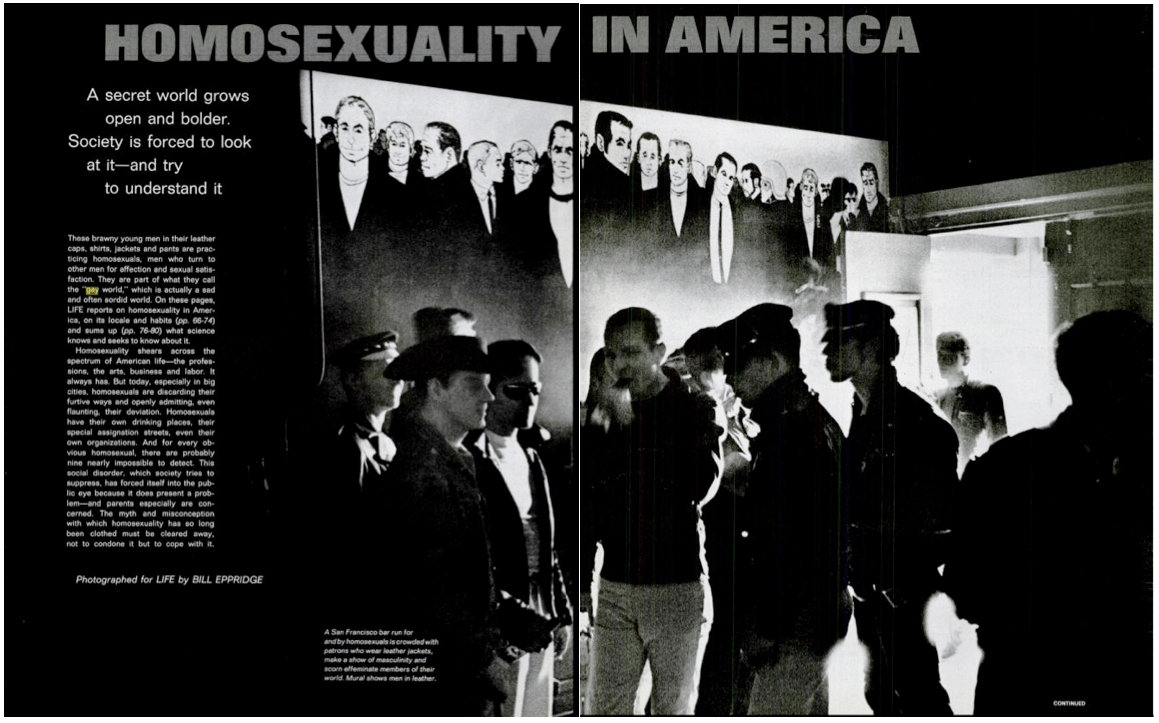
The medicalized framing of homosexuality as a “social disorder” reflected the moral panic of the era. Yet by 1969, as leatherman W. Charles Clark recalled, there was “casual sex for the gay man, into leather or not, just about anywhere in New York.” Leather men belonged to clubs, frequented dedicated bars, and were a discernible—if semi-pariah—presence in the city's queer scene.
Raids and the Road to Stonewall
Police raids on gay establishments were so routine that patrons knew the script: police entered, made arrests, and the threat of public exposure loomed. But the 1960s saw resistance. In May 1959, patrons of a Los Angeles donut shop threw donuts, coffee, and dishes at LAPD officers attempting arrests, sparking a street action. On January 1, 1965, San Francisco police raided a homophile dance at California Hall; instead of acquiescing, lawyers demanded a search warrant, and ministers called a press conference that successfully curtailed police harassment. The raid became a triumph, though it did not generate a commemorative event.
The following year, a raid at Compton’s Cafeteria—a hangout for trans people, hustlers, and street kids—provoked a full-scale riot. Rioters threw cups and saucers, broke windows, and set a newspaper stand on fire. Among the rioters was leatherman Peter Fiske. But the event left almost no record, produced no legal challenge, and was only documented later in scholarship.
In Los Angeles on January 1, 1967, plainclothes officers brutally beat patrons of the Black Cat, a leather bar, for exchanging New Year’s kisses. The beating of a bartender ruptured his spleen, and 14 men were arrested. The community response was unprecedented: somewhere between two and six hundred people protested outside the bar, including leatherman Alexei Romanoff, who would co-found the Avatar Club. The protests fueled growing anger and helped activist Dick Michaels expand The Advocate, which by September 1969 had a national circulation of 23,000. But with no clear victory—the courts declined to hear the cases, and both bars closed—there was no culture of commemoration to build on.
By contrast, the Annual Reminder, begun in 1965, was explicitly designed as an annual event. Organized by East Coast Homophile Organizations, it was a strict, disciplined picket at Philadelphia’s Independence Hall on July 4th, with a rigid dress code: jackets and ties for men, dresses for women. Trans people were excluded. The Reminder’s aim was to look “employable and presentable,” but its very existence established the technology of an organized, visible, recurring queer march—a key predecessor to Pride.
The Rebellion and Its Framing
The Stonewall Inn in 1969 served a profoundly mixed clientele: poor and wealthy, Black, Brown, and white, drag queens, hustlers, street kids, and leather men. W. Charles Clark remembered it as serving “a cross-section of gay lifestyles.” Peter Fiske, a leatherman and regular, recalled three police raids in 1968 and 1969: “The first evidence was the music being turned off, and the lights turned on.” Those arrested included people not wearing what police deemed three items of gender-appropriate clothing.
Accounts of the rebellion are contradictory, but the outline is familiar: around 1:20 AM on June 28, police raided the bar, and a crowd gathered and fought back. The following night saw hundreds in the street, including, for the first time, a large leather contingent. Dick Leitsch of the Mattachine Society contrasted the scene with the Annual Reminder, noting this was a spontaneous protest, not a “carefully planned, super-straight picketing demonstration.”
Clark remembered the second night as a “lighthearted party atmosphere tinged with danger” and noted that few leather men were present. “A leather man I knew who was an executive with a large national retail firm said liberation was not the leather man’s fight.” Nevertheless, the uprising laid the foundation for a new kind of politics.
What made Stonewall different from earlier resistance was not simply the riot itself, but the infrastructure available to immediately frame it as historically pivotal. Organizers distributed flyers on Sunday morning; Craig Rodwell contacted New York’s daily papers. New York lacked a developed local gay press, but The Advocate and mainstream coverage transmitted news nationally. Crucially, the rioters were partly successful, creating a nascent narrative worth commemorating—one that LA’s protests, the claimed space of the uprising, and the template of the Annual Reminder could all feed into.
The First Christopher Street Liberation Day
One week after Stonewall, the 1969 Annual Reminder was held, but not without friction. When some participants held hands, organizer Frank Kameny broke them apart, declaring there would be “none of that.” In frustration, activists Craig Rodwell, Fred Sargeant, Ellen Broidy, and Linda Rhodes proposed moving the Reminder to New York City on the anniversary of Stonewall, explicitly barring any dress or age regulations. The resolution passed at the Eastern Regional Conference of Homophile Organizations, and the Christopher Street Liberation Day Committee was formed. Almost immediately, a “collective forgetting” took hold: despite knowledge of earlier resistance, queer publications adopted the myth of Stonewall as the singular spark.
With the source of the myth cemented, the first Christopher Street Liberation Day events took place in 1970 in New York, Los Angeles, and Chicago, with an informal action in San Francisco. Leather people helped organize and marched in New York, LA, and San Francisco.
New York: A Political March
New York organizers demanded a march, not a parade. Marcher Martha Shelley remembered, “The most important thing was to be out in public, to say that we were not going to take it any more.” Marcher Stephen F. Dansky recalled, “I saw that my identity as a gay man was worthy of political formulation.” The march drew roughly 3,000 participants and was, by modern standards, clothed. Activist Fred Sargeant looked back and noted, “There were no floats, no music, no boys in briefs.”
But the absence of a dress code was itself a radical departure. Marchers wore flamboyant costumes, drag, and “almost nothing,” as co-organizer Karla Jay remembered. Cycle MC, a leather motorcycle club, marched. So did Sylvia Rivera and Marsha P. Johnson’s Street Transvestite Action Revolutionaries. The presence of teens was unremarkable, as the event was explicitly all-ages. After the march, a “gay-in” in Central Park saw participants cuddle shirtless or completely naked, with one couple attempting to set the world record for the longest kiss.
Los Angeles: Confrontation and Celebration
Los Angeles’ Christopher Street West was chiefly organized by leatherman and MCC founder Reverend Troy Perry, Morris Kight, and Rev. Bob Humphries. Obtaining a permit was a battle; the police chief famously declared that permitting a gay parade was the equivalent of permitting one for “thieves and robbers.” Roughly 1,200 people marched. LA framed the event as more of a parade, and the displays were deliberately provocative: a convertible of topless contestants, a drag queen “Grand Duchess,” and an infamous LA Gay Liberation Front float topped with an enormous jar of Vaseline.
Marcher Ruth Weiss explained that for many, the attitude was “in your face” celebration. Marcher Perry Brass recalled marching with “a contact high, just touching each other, being with each other.” But open sexuality drew immediate criticism. An anonymous August 1970 letter to The Advocate lamented that the parade had done “more harm than good” by showing off “silly freaks.” Others defended the display, noting that drag queens, not “closet queens,” had fought back at Stonewall.
San Francisco’s Reluctant Entry
San Francisco’s activist establishment objected to commemorating a riot, fearing police backlash. But a small group coalesced for a “Gay Freedom Day” march and gay-in at Golden Gate Park, among them leatherman Peter Fiske. This began a period in which the city’s Pride events established an ethos of universal inclusion, explicitly welcoming drag, leather, and “every other segment of the gay community.”
The Annual Reminder’s Legacy: Debates Over Respectability
The 1970 march’s visible sexuality marked a turning point. At the Central Park gay-in, a filmed debate between participants captured the friction. When one man objected to “all of this orgy stuff,” his companion shot back: “If straight people can do all of this carrying on and holding hands and kissing in the park, why can’t I do it?”
The debate soon structured entire organizations. In 1970, New York’s Gay Activist Alliance (GAA) argued over whether to include drag and trans people in their actions. Before the preamble to its constitution established a policy of radical inclusiveness, the GAA’s Street Theatre Subcommittee argued for carrying a transvestite on a litter down Lexington Avenue to challenge stereotypes. Cultural reformers resisted, seeking to present a more mainstream image. Both positions were on display: the GAA later became a leading voice for inclusive queer identity, while its early debates echoed for decades.
The debates in the late 1960s and early 1970s were not simply about the parades, however. They concerned the fundamental architecture of queer public identity itself. As one historian put it—by coming out, people could show the world they existed, and construct new narratives about who they were. “A very large number of these new stories were about sex,” Jeff Weeks notes. “Sex was pleasure, but it was also political.” Pride became a vehicle for expressing that sexual liberation, fueling increasingly bold expressions of sexuality at the annual marches.
Building Steam: Explosion of Expression, 1971–1974
By the early 1970s, calls to curb Pride’s sexuality were already failing. In 1971, Los Angeles spectators saw a “surrealistic cock”: activists powered a 35-foot blue-and-white caterpillar phallus down the street, which accidentally collided with a police car. The “cockapillar” drew threats of obscenity charges and infuriated “respectable” liberals. The following year, conservative organizations like the Homophile Effort for Legal Protection withdrew support, and Pride shrank to less than a quarter of its prior attendance.
San Francisco’s 1972 event formalized its non-exclusionary policy. Visuals at the 1973 and 1974 parades brought leather contingency after leather contingency, motorcycle clubs, and S/M imagery into mainstream view. The Eulenspiegel Society marched, displaying banners reading “Freedom for Sexual Minorities.” New York’s parades brought leather in vest and harnesses, straight spectators—often with children on their shoulders—watching the procession. In Chicago, the Gold Coast leather bar contributed a float with a huge black leather boot carrying over a dozen leather men.
By 1974, The New York Times' coverage was matter-of-fact. Leather bars marched. Transvestite groups marched. Parents of Gays marched. The sheer variety of queer life had become the point.
Bacchanalia, 1975–1976
The mid-1970s marked a zenith of public queer revelry, perhaps especially in San Francisco. Earlier prohibitions on nudity were dropped or ignored. Participants described “rampant nudity” in Golden Gate Park after the parade. A 1976 Bay Area Reporter story cheerfully described lesbians baring their chests and marchers of all sorts displaying their bodies.
Gilbert Baker, creator of the rainbow flag, recalled his first parades fondly. “I don’t remember much about my first parades, because I’d go and meet someone right away; then we’d go home and fuck all day.” The 1976 parade—the one he remembered best—was a “complete orgy.” He continued, “People remember it as a great shame, but it was fabulous. It was so liberating, taking power into our own hands like that.” In 1976, one Bay Area Reporter reporter noted the full arc of the event: “The parade and the concert following in Golden Gate Park turned into a ‘complete orgy.’ People ran naked and fucked all over the city.” At the 1976 New York Pride, the Eulenspiegel contingent marched for S/M liberation, bounding past school-age children.
Not everyone was thrilled. The 1976 Southern decadence drew its critics: a letter-writer to the Bay Area Reporter asked whether spectators were “uplifted at the sight of slaves on chains, licking grime off their master’s boots, in full view of 50,000 people,” and urged a “responsible parade” instead. In 1976, Los Angeles’s Pride board voted to ban a marcher from dressing as a giant phallus.
That same year, a “slave auction” fundraiser at the Mark IV baths in Los Angeles provoked a massive LAPD raid, with officers arriving by helicopter to arrest dozens of men on charges that included violating slavery laws.
Bryant, Briggs, and the Battle over Image
The unfettered celebration was short-lived. In 1977, Anita Bryant’s “Save Our Children” coalition in Dade County, Florida, argued that gay civil rights ordinances violated religious freedom and—more importantly—synthesized public anxieties about gay threats to children. Her campaign used footage of San Francisco Pride to broadcast its message:
The Orange Bowl Parade: Miami’s gift to the nation. Wholesome entertainment!
But in San Francisco, when they take to the streets, it’s a parade of homosexuals. Men hugging other men. Cavorting with little boys. Wearing dresses and makeup.
The Bryant campaign’s images drew directly from the previous decade of Pride bacchanalia: footage of men in leather, snap-the-whip demonstrations, and naked revelers at Marx Meadows were contrasted with wholesome mainstream parades. The strategy succeeded; the ordinance was repealed.
In California, state senator John Briggs launched a copycat campaign. The “California Defend Our Children” initiative sought to make not just public homosexual conduct, but even marching in a parade or supporting a gay teacher grounds for firing. One Los Angeles city vice squad even used a similar approach for censorship.
Bryant’s tactic deeply shaped the queer community’s internal debates. The idea that Pride’s excesses were fuel for enemies led to organizing around curbing that public face in 1977. “Nudity has been banned,” one San Francisco Pride co-chair announced, adding that violators who refused to dress would be cited. Harvey Milk urged participants not to give the right wing “any more ammunition.” Drag queens were encouraged to stay home—one San Francisco columnist insisted the key to success was “an exhibition of DIGNITY.” This provoked widespread, often comical opposition: an “Anarchist Flashers” collective pointed out that the rebels who set off Stonewall hadn’t debated whether they offended the Church. A widely circulated satirical flyer urged marchers to buy “GRAY BUSINESS SUITS” as “the only costume which will endear us to the silent majority.”
Yet by the time of the parade, the tone had narrowed. Organizers prepared for nationwide press, and the actual events bore the mark of self-discipline. San Francisco police estimated that the parade drew record numbers, but a notable change was toward a younger, less camp, and more deliberately political marcher. Mr. Marcus, a leather columnist for the Bay Area Reporter, saw benefit in the restraint, suggesting that queer people failed to realize how much the public disliked them, and that “flaunting” had consequences. But he also celebrated the one South of Market leather contingent that remained in the procession, which he described as “an exhilarating experience.” The spectacle of leather, chaps, and bikers was now somewhat more circumscribed, but present.
The Lesbian Sex Wars
While Bryant and Briggs defined the external pressure, an internal conflict over S/M and pornography defined queer feminism in the late 1970s. In 1976, the women’s movement was almost uniformly hostile to S/M. “For feminists to play with these forms and make games of them is as stupid as it is dangerous,” one article in Big Mama Rag asserted. Women Against Violence in Pornography and Media (WAVPM) coalesced around the idea that sadomasochistic pornography was violence against women. In 1977, WAVPM began marching in San Francisco’s Pride against this imagery.
In June 1978, a group of women largely from the Society of Janus founded Samois, the first organization devoted to lesbian S/M. Their identity blended lesbian feminism with the Society of Janus creed, insisting that BDSM was consonant with—not opposed to—lesbian ethics. This created an unavoidable collision at San Francisco’s 1978 Gay Freedom Day Parade.
When the Society of Janus fielded a contingent, monitors challenged its presence on the grounds that the parade had policies against sexist imagery that depicted violence against women. Patrick Califia, a Janus co-coordinator, recalled that monitors tried to expel the group and demanded that a chained woman be “released.” The crowd largely hissed, booed, and spat. The San Francisco Chronicle ran a large picture of their contingent.
A year later, the San Francisco Pride organizers tried to ban leather and S/M from the parade entirely. Pushing back against the anti-pornography logic, Samois members joined the parade subcommittee. Gay S/M groups, leather bars, baths, and clubs collectively raised voices for inclusion. The media saw the tension: The Bay Area Reporter noted in April 1979 that the Gay Freedom Day Committee would allow people in chains, leather, and bondage gear, precisely because “freedom” required it. The result was a striking success that year: Samois distributed the first lesbian hanky code, a copy of What Color Is Your Handkerchief?. Police liaison reports described crowds as friendly, with leather receiving “resounding roars.”
Rise of the Leather Clubs and Infrastructure
Throughout the 1970s, gay and lesbian S/M groups moved from shadow to structure. Clubs like the Chicago Hellfire Club, the New York Eulenspiegel Society, California’s Society of Janus, and the Catacombs in San Francisco all coalesced. Many of these organizations were home to men and women who were also active in broader civil rights organizations, though they hadn’t yet found the unified voice of the national scene they would build later.
By the early 1980s, national organizations like the Gay Male S/M Activists (GMSMA) and the Lesbian Sex Mafia were active in New York. In Los Angeles, HELP organizer and leather author Larry Townsend won a campaign against police harassment at a bar named the Black Pipe. In San Francisco, the efforts of the Radical Faeries and others pushed the SFDA beyond the federal district.
Lending Support: 1983–1985
Leather communities in the early 1980s frequently functioned as an unofficial funding source and activist wing of the broader queer movement. In New York, when the newly-created Lesbian and Gay Community Center balked at hosting the explicitly S/M-oriented GMSMA, the group’s leadership used direct confrontation and a “gift” of 150 folding chairs to force inclusion.
When the Christopher Street Liberation Day Committee (New York Pride) underfunded the 1983 march, GMSMA, the Lesbian Sex Mafia, and others organized a fundraiser at the leather bar The Spike. “Pride Night at the Spike” raised enough to fund the march. The event grew into an annual Leather Pride Night. By 1985, a single annual event provided one-sixth of New York Pride’s funding.
In San Francisco, the title system (Mr. Leather, International Mr. Leather, etc.) swung decisively toward activist fundraising. Leather titleholders raised money for the AIDS Emergency Fund, gay health clinics, and anti-violence projects. The Eagle raised over $37,000 over a handful of months in 1985 for AIDS efforts. Leather contests like Mr. Leather/New York raised $11,000 for Gay Men’s Health Crisis in its first year. In 1984, leather communities simply created their own public event in the Folsom Street Fair—which, by celebration of constraint, arguably moved many San Franciscans toward accepting BDSM in parade spaces.
In 1986–87, this pulse accelerated. The first US-wide BDSM advocacy organization, the National Leather Association, formed. The Leather Journal launched from Los Angeles as a national news clearinghouse. GMSMA, meanwhile, had begun pushing for an organized national representation to be included in no less than the upcoming 1987 March on Washington to articulate its members’ stakes.
Whose March? Whose Face? The Debates of 1987
The 1987 March on Washington was the culmination of a process GMSMA began in 1986. “We created a national network,” recalled organizer Barry Douglas, reaching activists in every US region through a series of coordinator nodes. The S/M-Leather contingent organized under the rallying cry of “Safe, Sane, and Consensual,” a principle decades in development that crystallized into a watchword. The contingent deliberately embraced everyone—“if you thought you belonged in the community, you did,” Douglas said.
The radical inclusivity of the march did not extend to all who sought to be on its planning, or its stage. In a deliberate bid to include queer people of every stripe, the S/M-Leather contingent was added to the steering committee—the first time a national LGBTQ coalition had so named the leather community as a core constituent—after activists fought off opposition within. Brenda Howard and Barry Douglas co-chaired its efforts. The national rally’s political platform, when it emerged, pushed for the repeal of anti-sodomy laws and an end to censorship of gay and lesbian imagery.
The march itself drew thousands of leatherfolk to Washington—estimates top out at more than a thousand—marching in boots, vests, and yellow-fringed chaps that seemed less threatening than their actual diversity. Video footage shows several marchers leading others on leashes with collars around their necks. Leigh Vogel, in her social snapshot, sums up S.F.’s mid-decade leather panoply: “At Tiffany’s Restaurant… A leatherman’s jeans and chaps at a 7 a.m. breakfast—after a night at the Mineshaft.
At the 1987 march, when a controversy broke out, the assembled crowd cheered, snapping photos. “There is nothing quite so annoying as a bigot who has a sense of humor,” began a Bay Area Reporter correspondent from that day.
Obscenity and the Culture Wars of the Late 1980s
The institutional acceptance of the late 1980s stood against the resurgence of organized moral panic. The Reagan administration’s Meese Commission on Pornography used the same images and slide-shows the anti-porn feminists had circulated years earlier to argue for stricter controls on “degrading” images—images that included those depicting consensual BDSM. The LGBT groups struggling for civil rights watched as anti-obscenity codes frequently used against queer publishers. The effects were material: England’s Operation Spanner against BDSM practitioners ran from 1987 to 1989, producing raids, mass arrests, and convictions of gay men; in Los Angeles the LAPD raided the leather bar the Dragonfly in 1993.
A scandal erupted in 1989 over the NEA’s funding of the queer BDSM imagery of photographer Robert Mapplethorpe, and organized right-wing pressure generated loyalty oaths requiring that grantees not produce art that might be considered “obscene.” NGLTF activists—some wearing leather gear—negotiated with some success to carve out spaces for queer erotica. Vance noted a sleight of hand within the culture wars: even occasional nudity or “mere reference to homosexuality were called ‘sexually explicit’” when the agenda required it, while conservative forces used these battles to overturn feminist gains. “Between 1982 and 1992, a series of moves brought the subject of pornography from inside feminism… into mainstream politics,” she noted.
Leather Contingents In Mainstream Pride
With the floodgates of local organizing open, leather’s footing within Pride progressed throughout the late 1980s. In Los Angeles, the Avatar Club—founded by veterans of gay-liberation action—marched and produced for Pride a contingent that was the largest in the parade: over 400 members, extending for two blocks. San Francisco’s 1987 parade included the “all 400” women of Dykes on Bikes, “most garbed in sensible black leather,” as one reporter sniped. The Bay Area SM Contingent began adding structure to its marches, creating a whip drill team as a kind of kinky color guard. In 1988, GMSMA, marching in New York, drew over 100 leatherfolk, joined by leatherdykes from Boston who “literally cracked her bullwhip as she rode” alongside them.
Literature in mainstream communities greeted some of these displays with fresh panic. In Manhattan, for example, Deputy Inspector Mayronne told a reporter in 1987 that the parade was “less offensive” because there were fewer visible transvestites and leather-clad motorcyclists. “They’ve cleaned it up,” he said. Yet conservative, normalizing gay thinkers pushed back from the other side. Jesse Helms used Mapplethorpe’s BDSM imagery to argue that the NEA’s grants implicitly endorsed sexual abuse. Activist Scott Tucker responded that the argument—that if gays rejected leather, the Supreme Court would grant them rights—was “an illusion,” an ethcial cop-out. “Our right to privacy will never be secure until the public world is truly free,” he wrote. The alternative, when homophobic judges disallowed privacy in the public square, was an endless search for someone even more different to blame.
At the March on Washington in 1987 and 1993, leather activists fought for and won visible representation. Accompanying conferences—the first of which GMSMA put together from scratch—created national, ongoing networks in BDSM communities, intended to consolidate and stabilize representation for all scales of interaction—from the largest meeting halls to local neighborhoods.
Stonewall 25’s Visibility Crisis
Debates over visibility reached fever pitch at the 25th-anniversary Stonewall Christopher Street event in 1994. Ahead of the march, organizers muzzled Dykes on Bikes, banned NAMBLA, and forbade floats carrying drag queens. When trans men asked for inclusion in the official event title, they were denied. In the wake of these restrictions, and of the still-fresh tensions over the 1993 March’s displays, an ominous silence descended on the organizers’ program: an official policy banning public S/M “play” was articulated in writing—and then not enforced, and rarely mentioned.
Strains among leatherfolk were visible. Activists Barry Douglas, Guy Baldwin, and Bruce Marcus—three men who led the negotiations for participation—confronted beloved leatherwoman Tala Brandeis. Brandeis, who had been cracking her 12-foot bullwhip in the air at the head of the contingent—no contact with any person—refused to cease when they asked. She agreed to pause only for a few minutes of silence outside the United Nations.
Many in the community framed the incident as a conflict over values. Could an 1,800-strong leather contingent be reasonably represented by a flagrant whip display in a public streetscape, and did such display sabotage organizing that sought to decouple leather from shock value? Anne “Spencer” Bergstedt was one of the marchers who dropped out that day, citing what she called assimilationist politics and a failure to understand that the Right saw all queer practice as a menace. Bergstedt wrote later: “Why are we doing this? What crumbs are we waiting to have drop down to us from the table… when we are willing to cover ourselves and our sexuality for the sake of media control?” She called the reaction a simple case of internalizing homophobia and leather hatred.
For Tala Brandeis’s defenders, the gesture was the point. Barry Douglas had explicitly complained that whip-cracking itself was not the image he wished to project. “I know that we were not visible in the March on Washington,” he said a year later—that a camera-shy mainstream both demanded and then resented, or excised, Mapplethorpe-style evidence.
Pat Califia, the writer and activist who had pushed for Janus’ inclusion, used the controversy to catalogue wider disagreements over the viability and meaning of LGBTQ public spaces. Leather peoples’ styles—whether buttoned-up East Coast activists who sought to confine BDSM to private, permitted locations, or West Coast “radicals in rubber” who promoted public filth and fierceness—spoke to divergent ideas of what Pride itself was for. In “Screw” fashion, they thrived on such confrontation, Califia argues.
Drewery defended the notion that public pride events obliged witnesses to respecters of consent. “To all of the voyeurs that enjoyed the whippings at Pride—it was not done for you,” one Drewery shot back. And, pushing past the culture of display, worried that children then aged into frightened adults.
All of these arguments were old. They had haunted debates in the Movement from the earliest attempts at radical visibility—from the efforts of the Lesbian Sex Mafia, to Janus at San Francisco Pride, to the first calls to normalize the LA parade. “It’s not that we have not yet overcome difficult barriers—we are the road,” wrote Andrew Calder for Pat Califia, generalizing to the broader, halting dance of social change.
The 25th anniversary proudly wore both masks—the future of queer public activism was fully seen only when leather joined. Yet few within the broader cohort saw the real show at all; far from cheering, the mainstream press had explicitly looked away.
As Shadow Morton—a trans man serving as assistant coordinator for the 1994 parade committee—told the Bay Area Reporter, describing state approval for such public outpouring, “They granted permission because [the gay community] is of the new fabric of the city. Permissions are seldom denied; the more politically active, militant straight-edge groups feel excluded from this privilege.”
New configurations of leather belonging made the notion of queer progress more complicated even than the desire for reform itself. A young correspondent named Mark Curtius noted for the Los Angeles Times in 1991 that no formal district existed in San Francisco’s vibrant, plural streets that neatly matched the sprawling mapping of an “inner city” of the mind.
In the March 1995 edition of The Leather Journal, R. Sydney Meadows tried to frame a passage for it. “The focus of Gay Liberation—for people, for sex and gender,” he wrote, “has moved with tectonic force, from a goal of assimilation to plurality—from the literal identity of what we are to the more fluid, subjective identity of what we ourselves can be.” The means have necessarily been as varied. The Life magazine exposé had doubled as assimilation’s call: “Society is forced to look at it and try to understand it.” Four decades later, the most direct response had emerged not from institutions, but from the people who took Stonewall’s lesson personally. Scott Tucker put it plainly in 1991:
Our right to privacy will never be secure until the public world is truly free. That’s why our annual parades are both celebration and protest. The right to privacy is well worth fighting for, but it will be a sad victory if it means nothing but the continued enforcement of sexual secrecy. We have an equal right to the public world, to be indistinguishably similar to straight people, or to be distinctly different.
How Leather Was Policed at Pride—and What Changed
Arguments about what belongs at Pride have been with us since the first marches. Debates over leather visibility are as old as the movement itself, part of a longer history in which what counts as acceptable queer expression has continuously shifted. Throughout that history, the question of who gets to define acceptable displays has been one of power, not principle.
A Known Quantity
Leather, nudity, and drag have coexisted with families and children at Pride for five decades. That’s not to say it’s always easy—but it is documented, generation after generation. Plenty of parents report their kids are fine seeing kink at Pride; in my own experience marching, families often cheer leather contingents. If seeing kink at Pride were genuinely traumatizing children in any widespread way, we’d likely know by now: the first kids to witness Pride are now baby boomers, and each generation afterward has only participated more. Nobody has tracked these people down in any statistically meaningful way, but it would be worth someone trying.
That doesn’t mean Pride is a universal good: participants feel everything from mild discomfort to physical assault. Seeing things we don’t want to see is inherent to public life, and reckoning with discomfort is intrinsic to every queer person’s journey toward self-acceptance. But code-setting exercises must balance the value of variant sexual displays—with their capacity for joy, creativity, eroticism, and education—against the potential for harm.
Context Is Everything
Assumptions about what constitutes outrageous sexuality are highly contextual. Calls to ban drag queens from Pride were common well into the 1990s. Simply wearing leather issued sufficient grounds for San Francisco parade monitors to threaten police enforcement against the Society of Janus’s contingent. Today’s arguments involve a similarly broad range of incompatible expectations: some believe that public piss play is normal, others hold that a pup hood is too sexual. A single unitary public standard would have to account for the ace whip top delighting crowds, the spectator with trauma who feels safe only in rope, and the kids who want to howl along with pups on floats—a tall order.
The system of sexual hierarchy functions smoothly only if sexual nonconformity is kept invisible, hence the interpersonal tension when sexual difference surfaces. For dominant sexual groups, the appearance of the sexual lower orders produces anxiety, discomfort, the threat of pollution, and a challenge to their hegemony…
Our relative ignorance about the actual range of sexual behavior and fantasy makes us into latter-day sexual ethnocentrists; the observer is convinced that her own sex life is normal, understandable, and tasteful, while the observed’s preferences may be frightening, strange, and disgusting. The external system of sexual hierarchy is replicated within each of us, and here in lies its power. Internalized cultural norms enforce the status quo. As each of us hesitates to admit deviations from the system of sexual hierarchy, nonconformity remains hidden, invisible, and apparently rare. The prevailing system retains hegemony and power, appearing to be descriptive as well as prescriptive, a statement of what is as well as what should be. (Vance, 1992a)
There’s a complicated story here—one that evokes Foucault’s History of Sexuality— about how even those who police variant culture scrutinize and reproduce selected images of it. When leather people are visible, they resist that dynamic. That visibility both educates and critiques: leather contingents serve as protestors, yes, but also as ambassadors for how BDSM is actually practiced—with humor and play, from chaste to scandalous, as complex forms of social and sexual expression.
The Road to Acceptance
Drag was historically regarded by more conservative lesbians and gay men with a hostility equal to that aimed at BDSM: critiques and defenses of both practices frequently went hand-in-hand. Today, drag is widely accepted and seen as “safe” for kids. The people who did drag in public deserve credit, alongside the International Court System and the Sisters of Perpetual Indulgence. But my leather peers point to Drag Race: following RuPaul, drag became accessible in family living rooms, not just 21+ bars. Drag’s language and archetypes became legible to a mass audience; nineties films added further nuance. It’s plausible that shows like Pose and Legendary are doing the same for ballroom culture now.
Would a Leather Drag Race work? Leather is only partly about appearance and performance. Its center is play—the exchange of sensation, trust, power, and intimacy that binds players together. Bondage and impact play might translate to a mass audience; street demonstrations often attract curious, supportive onlookers. Fisting might be more of a stretch. Even if the format worked, a flattened mainstream version might give outsiders the illusion of understanding without real fluency. It could still beat watching online teens insist that wearing a pup hood in public equals pedophilia every June.
Folk Devils and Real Harms
The model of moral panic is useful here: when anxiety drives a community, it can be displaced onto a marginalized “folk devil” and resolved through exclusion. Kink-at-Pride discourse currently targets leather people. But if leatherfolk were genuinely responsible for sexual harassment at Pride—molesting children or assaulting bystanders—banning them would be a legitimate response. No group in Pride advocates for harassment. NAMBLA, which advocated for adult-child relationships, was different: real power differentials mean children cannot meaningfully consent, and these relationships are widely understood to be unethical. Bullyingly small, long controversial, NAMBLA was ejected and largely vanished from public queer life by the mid-1990s.
Leather culture has no interest in children. Its ethics center on consent between adults. Leatherfolk are not running through Pride paddling random strangers—the purported harm is symbolic, the visibility of BDSM itself. That focus may redirect attention from where abuse mostly occurs: not in public kink spaces, but in private, often among acquaintances, relatives and families. Public harassment certainly happens, but the social pressure of crowds often moderates it. My own experience of harassment—comments, groping, slapping, attempted penetration—came overwhelmingly from vanilla contexts, not leather ones. Harassment is broadly distributed; an adequate response must be equally broad.
Reading Symbols Without the Code
Moral panics are intensely symbolic. Clothing, equipment, and references stand in for whole people; objects are read as acts. Since leather plays with and subverts existing structures of gender and power, casual misinterpretation is easy and sometimes deliberate. San Francisco queers once called S/M folk “Nazis”; merely appearing in leather got Janus and Samois ejected from Pride in 1978–79; leather garments were policed at the Michigan Womyns’ Music Festival. The mere symbolism of chains or whips was itself construed as violence against women—even a demonstration whip crack, hitting no one, was labeled by leatherfolk as a serious problem, as Tala Brandeis’s show at the 1994 March on Washington revealed.
Both CBS’ Gay Power, Gay Politics and anti-porn activism relied on decontextualized BDSM images to recast queer people as perverse threats—as does today’s Operation Pridefall, which pairs images of harness-wearers or pup hoods kneeling near children to suggest a sexual threat. Friendly photo opportunities can be reframed as sexual dangers by those unfamiliar with leather culture and parade norms.
BDSM people at Pride aren’t abducting bystanders into cages—the harm attributed to them is understood entirely as a moral pollutant: the visibility of some acts, or even a reference to them, sickening society and harming individuals. Symbolic harm can be real; seeing something may create genuine distress. But seeing a flogging on a float is not meeting one. The two need distinct analyses.
The Slippery-Slope Trap
If unfamiliarity rounds an anonymous act into a fearful fantasy, that broad categorization can be groomed into a slippery slope. An image of WAVPM: fisting, bondage, or leather without context → disgust in viewers → fear generalized to all leatherfolk (or all queer people) → all kinds of deviant and nonmoral acts placed on one continuum ending in patriarchal domination or social decay. In the 1970s, this justified the removal of everything from transvestites and drag queens to public sex and BDSM from the respectable gay mainstream.64
How do you stabilize “good” sexuality? By recoding certain acts as non-sexual (Dykes on Bikes, say) or by detaching gay identity from sexuality entirely. Today’s modern equivalent categorically labels any public sexuality seen by children as pedophilia, and any expression in the presence of asexual people as assault. Because public spaces contain various degrees of sexuality practically at all times, some mental contortion remains status quo: carrying the Offended Gen does require dropping logic at the door.
Feminists learned… that an attack on lesbians was an attack on all women, whether lesbians or heterosexual. Successful attacks diminished all women’s options and posed a powerful threat… At that time, feminists discovered that the only suitable response in the face of a sex panic was to stop denying the presence of devalued persons and acts, an endless and defensive task, and to insist, “Yes, we are everywhere.” We would do well to remember this lesson now. (Vance, 1992a)
Rowello’s single article lauding kids seeing pups led to an online harassment campaign of being called “pedophile” and “child abuser.” Anita Bryant’s “Save Our Children” would be proud: sizable cadre of queer people have internalized the narrative that simply seeing adult queer sexuality harms children. The same articles linked being trans to fetishism—a ploy to follow leather and drag out the Pride door.65
Consent Isn’t Everything
“Safe, sane, consensual” is community bedrock since the 1980s. “Consent” has since the early 1990s been extended to onlookers; by mid-decade, bystander consent was applied even to a bullwhip display in which the impact landed in the air, not on a bottom. But that logic flattens everything into one category: ballet audiences are not accused of dancing a pas de deux.
Unquestioned consent cannot settle public norms. Universal consent almost never exists, given variegated human preferences. Some degree of everyone compromising their comfort is simply part of living together in a democracy. Otherwise, we might need a new law requiring the entire public to sign off in advance, before anyone leaves the house in a leather vest. No.
By most norms, commonplace hetero displays—kissing, thongs on the beach, underwear ads—don’t require bystander consent. Everyone applies implicit filters. Queer lifestyles continue navigating unwritten bans. Gay marriage didn’t have anyone’s universal sign-off either. Pride itself asserts that visibility, community, and sexual expression can trump heteronormative comfort.
Grounding Norms in Contingent Realities
Of course not all Pride norms should be tossed out—some good sense must still hold the line. We rightly banned NAMBLA. But adult leatherfolk are poorly grouped with those dangers. Allowing fewer protests rarely requires much real sacrifice. This points to standards being anchored in real harms rather than feared hypotheticals. Grounding rules in “the concrete” means not letting abstract worry override the messy individual reality: many asexual people and families flock to see leather contingents, who in turn demystify kink and open pathways for people to explore their own desires, perhaps discovering unexpected facets of themselves. With caution and curiosity, there’s room to make room.
Suggested Reading: Queer History, Leather Culture, and Sexuality Studies
For a broad orientation to the LGBTQ rights movement, the Ashgate Research Companion to Lesbian and Gay Activism (Paternotte & Tremblay, 2016) is a solid starting point, with useful summaries and citations from queer historians and theorists including Julian Jackson, Jeffrey Weeks, Mary Bernstein, Gavin Brown, and Gayle Rubin. For Pride specifically, Katherine McFarland Bruce's thesis (2012) and book Pride Parades: How a Parade Changed the World (2016) offer strong ethnographic grounding. Complement these with Elizabeth Armstrong and Suzanna Crage's Movements and Memory: The Making of the Stonewall Myth (2006), a compact but insightful paper on earlier resistance and how Stonewall became a central origin story. For primary-source material on the riots themselves, Marc Stein's The Stonewall Riots: A Documentary History (2019) collects numerous contemporary accounts.
On the intersections of gender, sexuality, and state power, Gayle Rubin's Thinking Sex and its retrospective postscripts in her anthology Deviations (1982a) provide a framework that continues to shape how LGBTQ people understand their own political and sexual identities. Pair this with The Leather Menace (1982b), which examines cultural hostility toward S/M. Michael Warner's The Trouble with Normal: Sex, Politics, and the Ethics of Queer Life (1999) extends this line of thought with a critique of stigmaphobia and the disidentification of sexuality from LGBTQ identity.
Patrick Califia — leather activist, trans man, erotic author, and historian — is essential reading. Two anthologies are especially valuable: Public Sex (1994a) and Speaking Sex to Power (2002). They address moral panic, the Lesbian Sex Wars, censorship, and the politics of queer, leather, and variant sexualities, as well as trans and disabled perspectives. Readers should note that Califia later changed some positions, and his early essays defending cross-generational sex remain troubling; even so, his analyses of adult sexuality are cogent and uncompromising.
Both Califia and Rubin engage with the Lesbian Sex Wars and right-wing campaigns to suppress queer sexual expression and art. Carol Vance's contemporary and retrospective essays in Pleasure and Danger: Exploring Female Sexuality (1992b) offer a complementary feminist perspective from the early 1980s.
For ethnographic and political perspectives on leather culture, the anthology Leatherfolk: Radical Sex, People, Politics, and Practice (Thompson, 1991) comes first, followed by Geoff Mains' Urban Aboriginals (1984). Both are products of their era: Mains frames leather as a "tribe" with parallels to indigenous cultures that modern readers may find appropriative. Even so, Urban Aboriginals remains a striking attempt to make a misunderstood subculture comprehensible to outsiders, weaving together biochemical, cultural, and spiritual threads.
Joseph W. Bean's Leathersex (1994) and Flogging (2000) are partly technical manuals (which readers may skip), but the real value lies in their nuanced, radical treatment of consent, scene structure, energy exchange, and the trust inherent in S/M. Anton Fulmen's The Heart of Dominance (2016) provides a modern, consent-focused complement on dominance and submission.
For academic history, Rubin's chapter SM Politics, SM Communities in the United States (in the Ashgate Companion, 2015) is a sound foundation. Stephen K. Stein's recent Sadomasochism and the BDSM Community in the United States (2021) offers the most comprehensive survey to date, though readers should cross-reference claims, as any history of this contested and poorly documented subculture is bound to contain discrepancies. Samois' Coming to Power (Califia, 1987) is worth hunting down for a firsthand history of SM activism in San Francisco.
Acknowledgments
This work depends on scholars both retrospective and contemporary, especially Patrick Califia and Gayle Rubin, the latter of whom shared hard-to-find articles by email. Queer periodicals — from the Bay Area Reporter and the Advocate to leather publications such as Venus Infers, GMSMA Newslink, and the Sandmutopia Guardian — each contributed unexpected stories and questions. Archivist Mel Leverich at the Leather Archives & Museum in Chicago suggested sources and event leads during a productive visit and via correspondence. Thanks also to Lea Shull and public librarians in Cincinnati for tracking down books and database access.
Conversations with friends and colleagues — Hans & Mark, Alex & Ginger, Rhys, Jeff, boy cage, Daddy Jay, pup Red of Chicago, Brian "Bolt" Donner, Nitro of Atlanta, and my Sir, Dan Mess — shaped the thinking here. Several reviewed drafts and shared their knowledge. To support preservation of leather culture, consider donating to the Leather Archives & Museum, one of the few institutions devoted to this history; if in Chicago, visit in person.
Sources and Further Reading
The historical record on leather at Pride draws on a scattered set of archives: community newspapers like the Bay Area Reporter and Dallas Voice, organizational newsletters from groups such as GMSMA and the Society of Janus, photographs held by the GLBT Historical Society and the Leather Archives & Museum, and mainstream press coverage in the New York Times and Chicago Tribune. Digitized collections at the California Digital Newspaper Collection, the Lesbian Herstory Archives, and the University of Washington make much of this material accessible.
The following citations correspond to the primary and secondary sources referenced in this history. A significant body of evidence comes from contemporaneous reporting, flyers, and photographs rather than retrospective accounts, so several sources are single archival items that document a specific contingent or incident in a particular year.
For contemporary commentary on the continuing debate over kink's place at Pride, see Baker-Jordan (2021), Bartosch (2020), and Chingy L. (2019) for opposing views, alongside the historical analyses in Peterson, Wahlström, and Wennerhag (2018) and Stein (2021).
Addison, B. (2012). Long beach's leather roots. Long Beach Post News. https://lbpost.com/news/lgbtq/long-beach-s-leather-roots
Altman, J. (1979). The society of janus contingent. Joe Altman photographs of the San Francisco Gay Freedom Day Parades, PC-040; Box 01, Folder 03; California Historical Society. https://digitallibrary.californiahistoricalsociety.org/islandora/object/chs:10375
Armstrong, E. A., & Crage, S. M. (2006). Movements and memory: The making of the stonewall myth. American Sociological Review, 71, 724–751. https://web.ics.purdue.edu/~hoganr/Soc%20525/Armstrong_and_Crage_2006_Stonewall.pdf
Associated Press. (1977). Thousands march for gay rights. Santa Cruz Sentinel, 121(150), 6. https://cdnc.ucr.edu/?a=d&d=SCS19770627.1.6
Barnes, J. (1994). Covering the castro. Bay Area Reporter, 24(41), 8. https://cdnc.ucr.edu/?a=d&d=BAR19941013.1.8
Bay Area Reporter. (1973a). A fabulous gay freedom celebration in sunny san francisco. Bay Area Reporter, 3(13). https://cdnc.ucr.edu/?a=d&d=BAR19730627.1.1
Bay Area Reporter. (1977a). A super parade: From frivolity to pride. Bay Area Reporter, 7(13), 4. https://cdnc.ucr.edu/?a=d&d=BAR19770623.1.4
Bay Area Reporter. (1977b). Unauthorized flyers. Bay Area Reporter, 7(13), 22. https://cdnc.ucr.edu/?a=d&d=BAR19770623.1.22
Bay Area Reporter. (1978). 138 parade entries. Bay Area Reporter, 8(13), 11. https://cdnc.ucr.edu/?a=d&d=BAR19780622.1.11
Bay Area Reporter. (1979). Leather OK. Bay Area Reporter, 9(8), 4. https://cdnc.ucr.edu/?a=d&d=BAR19790412.1.4
Bay Area Reporter. (1991). Streicher, long are 1990 parade marshals. Bay Area Reporter, 21(26), 42. https://cdnc.ucr.edu/?a=d&d=BAR19910627.1.42
Bay Area SM Community. (1986). Join us in the parade! Flyer. https://leatherarchives.org/ca/index.php/Detail/objects/98398
Berlandt, K. (1980). Gay parade in turmoil. Bay Area Reporter, 10(11), 1. https://cdnc.ucr.edu/?a=d&d=BAR19800522.1.1
Berlandt, K. (1982). '82 parade program ad nudity sparks debate. Bay Area Reporter, 12(20), 10. https://cdnc.ucr.edu/?a=d&d=BAR19820520.1.10
Bronski, M. (1991). Leatherfolk (M. Thompson, Ed.; pp. 56–64). Daedalus.
Bruce, K. M. (2016). Pride parades: How a parade changed the world. NYU Press.
Bucher, T. (1992). 1992 alan ross texas freedom parade footage. Videodisc. https://texashistory.unt.edu/ark:/67531/metadc805070/
Califia, P. (1979). A secret side of lesbian sexuality. The Advocate.
Califia, P. (1980). Feminism and sadomasochism. Heresies, Sex Issue, 12.
Califia, P. (1987). Coming to power (pp. 245–284). Samois. https://archive.org/details/comingtopowerwri00samo
Califia, P. (1994a). Public sex: The culture of radical sex. Cleis Press.
Califia, P., & Sweeney, R. (1996a). The second coming: A leatherdyke reader (pp. 322–329). Alyson Publications.
Chaparro, N. (1992). Leather men on parade in new york. Bay Area Reporter, 22(27), 14. https://cdnc.ucr.edu/?a=d&d=BAR19920702.1.14
Clay, R. (1978). Arena black and blue banner carried in the gay pride parade in san francisco, in june 1978. https://www.alamy.com/arena-black-and-blue-banner-carried-in-the-gay-pride-parade-in-san-francisco-in-june-1978-image227094329.html
Conover, S. W. (1977). United we stand: Divided–chaos. Bay Area Reporter, 7(13), 25. https://cdnc.ucr.edu/?a=d&d=BAR19770623.1.25
Darnton, J. (1973). Homosexuals march down 7th avenue. The New York Times. https://www.nytimes.com/1973/06/25/archives/homosexuals-march-down-7th-avenue-bars-represented-to-each-his-own.html?searchResultPosition=23
Disgrace, D. (1988a). And the march stops - those troublesome SM dykes. http://dcmny.org/islandora/object/lesbianherstory%3A802
Douglas, B. (1987). For love and for life: The march on washington. Newslink.
Douglas, B. (1995a). Cookie andrews hunt: A remembrance. Newslink, 32, 18–19.
Douglas, B. (1995b). The political pillar of GMSMA. Newslink, 33, 13–17.
Fink, L. (1973a). Christopher street liberation day march, new york, 1973. https://artsandculture.google.com/asset/christopher-street-liberation-day-march-new-york-1973-leonard-fink/xwHBxFIGNCBoIQ
Fink, L. (1975b). Christopher street liberation day march, new york, 1975. https://artsandculture.google.com/asset/christopher-street-liberation-day-march-new-york-1975-leonard-fink/0wEKiWBcpdObXw
Fink, L. (1978d). Christopher street liberation day march, new york, 1978. https://artsandculture.google.com/asset/christopher-street-liberation-day-march-new-york-1978-leonard-fink/KQGPZ5YJLHXmOA
Gay Freedom Day Committee. (1973b). Dear gaypeoples of the west. Letter. https://www.glbthistory.org/labor-of-love
GMSMA. (1983). March with pride! GMSMA News, 1(5).
GMSMA. (1989d). Pride parade triumphs. Newslink, 15.
Goldberg, B. (1984). The gay outcasts? Bay Area Reporter, 14(27), 7. https://cdnc.ucr.edu/?a=d&d=BAR19840705.1.7
Greenbaum, V. (1991). Gay romper room on the march. Bay Area Reporter, 21(27), 4. https://cdnc.ucr.edu/?a=d&d=BAR19910704.1.4
Hardman, P. D. (1976). Gay pride week: Gay power startles san francisco. Bay Area Reporter, 6(14). https://cdnc.ucr.edu/?a=d&d=BAR19760708.1.22
Hippler, M. (1988). There's nothing like it in fresno. Bay Area Reporter, 18(26), 12. https://cdnc.ucr.edu/?a=d&d=BAR19880630.1.12
Kantrowitz, A. (1989). Taking our place: S/m and the gay community. Newslink, 13.
Karr, J. F. (1981). Our amazing diversity: What is permissible? Bay Area Reporter, 11(14).
Karr, J. F. (1994). Het arrogance on parade. Bay Area Reporter, 24(27), 31. https://cdnc.ucr.edu/?a=d&d=BAR19940707.1.31
Leitsch, D. (1969a). Gay riots. Mattachine Society of New York Newsletter, 24–25.
Linebarger, C. (1987). 1987 parade: A mixed bag. Bay Area Reporter, 17(27). https://cdnc.ucr.edu/?a=d&d=BAR19870702.1.14
Mains, G. (1984). Urban aboriginals. Daedalus Publishing Company.
Mangels, A. (1994). Leading the leather s/m contingent in the NY stonewall '94 pride parade. Bay Area Reporter, 24(27), 46. https://cdnc.ucr.edu/?a=d&d=BAR19940707.1.46
Marcus, Mr. (1990b). Leathermen: 'Hey, it's our parade too'. Bay Area Reporter, 20(25), 105. https://cdnc.ucr.edu/?a=d&d=BAR19900621.1.105
Marcus, Mr. (1992b). Leather pride on parade. Bay Area Reporter, 22(27), 50. https://cdnc.ucr.edu/?a=d&d=BAR19920702.1.50
McMillan, D. (1988). In defense of costumes. Bay Area Reporter, 18(16), 16. https://cdnc.ucr.edu/?a=d&d=BAR19880421.1.16
Mendenhall, G. (1977). Out of the closets; into the streets. Bay Area Reporter, 7(13), 16. https://cdnc.ucr.edu/?a=d&d=BAR19770623.1.16
Murphy, M. J. (1989). Gay parade covered the spectrum. Bay Area Reporter, 19(26), 44. https://cdnc.ucr.edu/?a=d&d=BAR19890629.1.44
Nash, T. (1989). Breaking the leather barrier. Dallas Voice, 5(39), 7. https://texashistory.unt.edu/ark:/67531/metapth615827/m1/4/
Pennington, G. L. (1988). Mirror of our community: A history of the gay parades in san francisco. Bay Area Reporter, 18(25), 1, 24–25. https://cdnc.ucr.edu/?a=d&d=BAR19880623.1.2
Pettit, B. (1977a). Gay parade takes shape: No nudity for '77. Bay Area Reporter, 7(10), 7. https://cdnc.ucr.edu/?a=d&d=BAR19770512.1.7
Pettit, B. (1977b). A parade of parades. Bay Area Reporter, 7(14), 21. https://cdnc.ucr.edu/?a=d&d=BAR19770707.1.21
Provenzano, J. (1994b). Pride and protest. Bay Area Reporter, 24(24), 41. https://cdnc.ucr.edu/?a=d&d=BAR19940616.1.41
Pruzan, R. (1987). The combined eagle and powerhouse float graced by leather luminaries in the parade. Bay Area Reporter, 17(27), 30. https://cdnc.ucr.edu/?a=d&d=BAR19870702.1.30
Rubin, G. (1982a). Deviations: A gayle rubin reader (pp. 137–193). Duke University Press. http://sites.middlebury.edu/sexandsociety/files/2015/01/Rubin-Thinking-Sex.pdf
Rubin, G. (1991). Leatherfolk: Radical sex, people, politics, and practice (M. Thompson, Ed.; pp. 119–141). Alyson Publications.
Schiefelbein, J. (1989). Pride parade triumphs. Newslink, 15.
Society of Janus. (1978a). July newsletter.
Stein, D. (1991a). How GMSMA changed the world: A personal view. A Decade of s/m Pride.
Stein, S. K. (2021). Sadomasochism and the BDSM community in the united states. Routledge.
The Leather Journal. (1994a). Stonewall 25 weekend. The Leather Journal, 61.
Truscott IV, L. (1969). Gay power comes to sheridan square. Village Voice, 1(18).
Vercher, D. (1989). Breaking the leather barrier. Dallas Voice, 5(39), 4–15. https://texashistory.unt.edu/ark:/67531/metapth615827/m1/4/
Warner, M. (1999). The trouble with normal. Harvard University Press.
Weeks, J. (1981). Sex, politics, and society: The regulation of sexuality since 1800. London Longman.
White, A. (1982). Gay freedom day. Bay Area Reporter, 12(26), 12. https://cdnc.ucr.edu/?a=d&d=BAR19820701.1.12
White, A. (1984). We love a parade. Bay Area Reporter, 14(26), 14. https://cdnc.ucr.edu/?a=d&d=BAR19840628.1.14
Notes on the Text
The following notes accompany the main article. They clarify terminology, flag uncertainties in the historical record, and identify places where the author's interpretation of events departs from a purely factual account.
- Throughout this history, references to public debates about "kink at Pride" use the contemporary framing. The historical record shows that these debates are not new: similar arguments about respectability, public sexuality, and children's presence appear in coverage of Pride events from the late 1970s onward.
- The term "leather" is used broadly to describe a community and aesthetic that includes but is not limited to BDSM practice. Some leatherfolk do not engage in S/M at all, and some S/M practitioners do not identify with leather culture.
- The term "kink" is anachronistic for most of the period covered here; contemporary sources use "S/M," "sadomasochism," and "leather" with shifting and contested meanings.
- Accounts of the Stonewall Rebellion vary in their perspectives. This article uses both "riot" and "uprising," following the terminology of activists who participated in the events.
- The Society of Janus, founded in San Francisco in 1974, was among the first pansexual S/M organizations. Their participation in Pride parades is documented from the late 1970s.
- Samois, a lesbian-feminist S/M organization active in San Francisco from 1978 to 1983, was the first lesbian S/M group to march in Pride.
- The feminist "Sex Wars" of the early 1980s placed lesbian S/M groups like Samois in conflict with anti-pornography feminists, a dynamic that played out within Pride planning committees as well as in the broader feminist movement.


