Both of us joined Dropbox in 2021 as Virtual First employees, working remotely for most of our time with physical studios reserved for in-person collaboration. Dropbox adopted Virtual First in October 2020, which meant the onboarding process had to be reimagined so new hires still got the experience they would have had in person. As two recent engineering hires, we want to describe how that onboarding actually works.
I'm Adam, an engineer on the Business Space Experience team, which works on improving the workflows of teams that use Dropbox. I first encountered the company during my college days in 2015, when Dropbox recruited heavily on campus. Years later, in Spring 2021, I was looking for ways to grow my career and came across Dropbox again; early on I had integrated zxcvbn, Dropbox's open source password strength estimator, into a login page I was developing. The interview questions were unlike any I'd seen before, and the interviewers' answers to my own tough questions convinced me they believed in the company and were excited about Virtual First.
I'm Brian, an engineer on the Organized Experience team, whose mission is to give users tools to keep files tidy—"a place for everything and everything in its place." I was moving on from healthcare software and made a profile on Hired.com; Dropbox was one of the first companies to reach out. The interview questions felt challenging rather than copied from LeetCode, and I was impressed by every engineer and recruiter I spoke with. Once I matched with a team and learned about its projects, accepting the offer was easy.
We had both experienced in-person onboarding elsewhere, at opposite extremes: Adam had essentially none, while Brian had plenty of classes but little practical experience early on. Dropbox occupies a middle ground. New hires, called Droplets, get 90 days to absorb the culture, learn teams' processes, and ship a first small project—with the resources to succeed but without overwhelming information or immediate pressure to deliver.

First days and initial setup
Day one was held over Zoom and led by our onboarding lead, Alinane. As a group we covered the Dropbox mission, values, and business strategy, and set up our laptops and signed up for benefits. A full day on Zoom was tiring at times, but the session balanced being useful and informative without overwhelming us.
Among the most useful materials was an onboarding checklist of important tasks with a timeline for when to complete them, whether in the first week or the first month. It let us learn about the company—from senior leadership to users' workflows—at our own pace. The next day we met our onboarding buddies: Adam was paired with Bozhen and Brian with Jiayi. They helped us get settled but initially sent a flood of information, including dozens of links to useful resources and the names and roles of people on our teams and the teams we'd work with most closely. Having a fellow engineer to answer whatever questions came up, over Slack or in Zoom walkthroughs of team strategy, was invaluable, and our buddies were always generous with their time.
Because we work primarily remotely, setting up our workspaces was a top priority.
Adam: Worried about adjusting to the Touch Bar on my new Mac, I wanted a keyboard first. Dropbox made it easy to order gear through an internal site called Dropgear, and I later added a standalone trackpad and a monitor.
Brian: I also used Dropgear in my first week for a monitor and a mouse. Supplier issues delayed the mouse by several weeks, but a 34-inch ultrawide monitor arrived in under a week at no cost. Dropbox also offers a Perks Allowance for almost anything, with a few exceptions; I joined a week before the quarter ended but could still use the full amount for an adjustable standing desk and a Steelcase chair.
How the material is delivered
Onboarding for new engineering, product, and design hires combines interactive video calls with documentation for asynchronous review. The first couple of weeks included around five calls of one to two hours each; the rest of the material lived in Dropbox Paper to read whenever we had time. This mix was our introduction to "async by default," a key Virtual First tenet: Dropboxers share information async via Slack or email as much as possible and reserve meetings for discussion, debate, and big decisions.
Each call covered how Dropbox works technically, as a product and as a company—how we use open-source software and best practices for committing and reviewing code. Especially enjoyable was a talk on the architecture behind Dropbox, which gave us a mental model of the pieces, including the hybrid approach between a monolithic and service-oriented architecture (Atlas), the async task framework (ATF), and the block storage solution (Magic Pocket). Sessions were recorded so we could rewatch them if we didn't retain everything.
The remaining sessions were written in Paper for self-guided study, including a deep dive into how file syncing and sharing work and a guide to preparing for twice-yearly performance reviews. The async material gave us flexibility in when and what we learned: if we felt Zoom fatigue or needed time to digest a complex morning session, there was no need to jump into another call. We could also fit lessons around our schedules and our managers', which let us start on real projects earlier—some of us shipped code in the first week.
Onboarding also introduced Core Collaboration Hours, another Virtual First pillar: four-hour blocks when all meetings are supposed to be held—12 pm to 4 pm ET in North America, for example. The other four hours are meant for uninterrupted deep work, and because Dropbox is async by default, everyone can work those hours when they're most productive. The goal is fewer unnecessary meetings and more time for what matters most, from deep work and team building to family and friends.
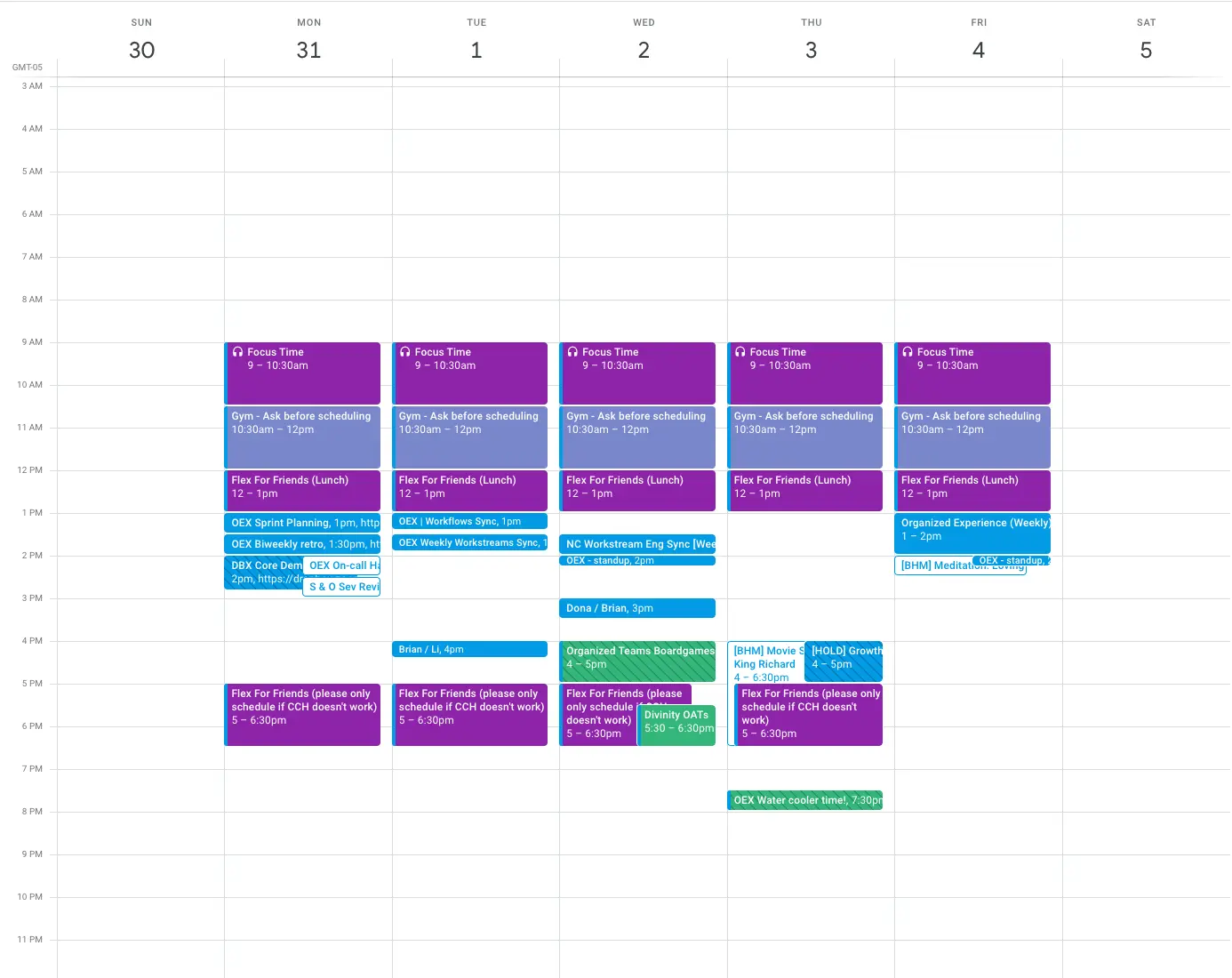
Brian’s calendar. Note that my team agreed to shift our Core Collaboration Hours to 1 pm to 5 pm ET.
Building connections remotely
We were worried about forming connections in a virtual first environment. At previous companies we could walk up to a desk or grab coffee, which isn't possible here. With some gentle nudging from our managers, we realized we had to be more purposeful about building those connections.
In our first couple of weeks we held quick 15–20 minute one-on-ones with teammates, sharing how we ended up at Dropbox and hearing each coworker's path. We were impressed by the diversity of experience on our teams and attended virtual social events to get to know people better; Brian's team, for instance, has a weekly online board game event. Meeting people remotely was new to us, but our colleagues made us feel welcome from the start.
Projects and shipping
We received our onboarding projects on our second day, from our buddies. Adam worked with Bozhen on updating modals in the Dropbox web client to improve the file upload flow, while Brian added new naming convention rules to help users keep their file systems organized. Bozhen and Jiayi broke the projects into well-defined, manageable tasks and introduced us to sprint planning, roughly estimating time and assigning due dates. With our buddies handling project planning, we could focus on learning the codebase—including the commit and review process—without vague or overcomplicated goals.
Codelabs were among the most useful resources: targeted tutorials showing how to accomplish tasks within the Dropbox ecosystem, such as creating a new API endpoint or creating a feature gate. They served as both tutorials and reference material during our first projects, helping us avoid missed steps. Brian, for example, shipped code in his first week and used the feature gate codelab to keep people outside Dropbox from accessing the work while it was still under development.
Onboarding projects lasted 6–8 weeks. Brian shipped the new naming convention rules to users in his seventh week. Adam helped Bozhen complete the new file upload flow a couple of weeks ahead of schedule, letting the team start user testing sooner. By then we were comfortable with the Dropbox development ecosystem and had started working with the rest of our teams on other projects. Though technically still onboarding and occasionally reading an onboarding doc, we felt fully integrated.
Where the ramp-up lands
Both engineers describe the process as async by default: because so much was written down, they could work at their own pace, which produced a smooth ramp-up. They credit Bozhen and Jiayi for support through their first few months. Overall, they rate it the best onboarding either of them has had.
Closing the loop
Once established in their roles, both began interviewing prospective engineers and passed on their experience. Brian took on advocacy for the Virtual First team, which exists to help new employees transition from in-person to virtual work. Adam, as his team grew, became an onboarding buddy for new hires. The guidance they give new hires is consistent: the three month ramp-up is for learning, with no expectation of immediate results, so that engineers are more effective by the end of it.
Lessons from dropping the bootcamp
In-person bootcamps let engineers build connections quickly with coworkers and fellow Droplets, but they also required absorbing large amounts of information in real time — not the best learning format for everyone. In the authors' view, the Virtual First shift hit the right balance between individual learning and community building: new hires set their own pace for learning and contributing while still forming strong human connections with their teams. Engineers interested in the experience can find open roles on the Dropbox engineering jobs page.