Config 2024 has wrapped, and Figma credits the event's success to its community: attendees from around the world, speakers, and the staff and volunteers behind the scenes. Sessions are available to rewatch on the conference's YouTube playlist, and Figma has published a launch recap on its blog. For the Asia-Pacific region, Figma is hosting its first Config APAC virtually on July 2, with registration open.
Day 2: Designing for Everything
The second day opened with the Designing for Everything keynote from The Browser Company's Karla Mickens Cole and Nashilu "Nash" Mouen, who work on the Arc browser. They framed the central challenge as breaking and reshaping expectations "in a world that loves straight lines," and their answer is to leave fingerprints—traces of authentic selves and experiences—on the products they build. "You can't build something new if you're only looking internally," Nash said. "Sometimes the best products, brands, and stories pull from outside technology."
Figma Director of DesignOps Meredith Black then sat down with artist and designer Refik Anadol. He described how his life changed after MoMA acquired Unsupervised, a digital piece that uses AI to manipulate the museum's archives: "We computed the possible dreams of the machine." Asked about critics who say he simplifies data, Refik replied, "Digital art was a blind spot for the art world. When it comes to critics, I wonder: 'Who is saying it, and why?'"
Simone Giertz on play and invention
Inventor and YouTuber Simone Giertz (pronounced "Yetch") shared inventions that earned her internet fame—a helmet that brushes your teeth, an alarm clock that slaps you awake, and a soup-feeding robot that mostly dumps soup on your shirt. The ideas came after she quit her own startup and let herself play again. "I needed to change my tactic because pushing myself to be excellent wasn't working out," she said. "I realized that 'difficult' does not equal 'important.'" As her skills evolved, she recognized that her self-deprecation was undermining her, and in 2019 she launched a product design company, Yetch, to refine and sell her best inventions, such as the Coat Hinger. She closed with a two-minute exercise: list as many uses as possible for a single brick, then share your last three—the weirdest—with a neighbor. "My favorite invention, by far, is my job," she said.
Physical craft, from the Eameses to teamLab
The afternoon brought Eames & teamLab: Crafting for the Physical Space. Llisa Demetrios of the Eames Institute joined Figma Story Studio Director Amber Bravo, describing how she looks at things "as Charles and Ray Eames' granddaughter, but also as a curator." She recalled a childhood dinner with Charles: asked on the walk home whether she'd liked the borscht, she said she hadn't, and he responded, "How would you have done things differently?"—a moment she describes as empowering and heard. The Eameses loved toys, she said, "because toys are preludes to serious ideas," citing their 1957 Solar Do-Nothing Machine, which served no practical purpose but showcased solar energy's power. To friends afraid to try and fail, Charles and Ray would say, "Well, that's one less misconception."
teamLab Co-founder Daisuke Sakai, who met Co-founder Toshiyuki Inoko at the Japanese folk dancing festival Awa Odori, outlined a guiding principle: No big ideas. "People think one big idea changes everything, but it's not about the idea itself," he said. "Ideas can be interpreted or misinterpreted many ways. What truly matters is the ability to realize the idea and the quality of its execution." He pointed to The Infinite Crystal Universe—"Anyone can have the idea to fill a room with LEDs." He also warned against dividing teams too much: every member brings expertise, but gaps appear between them, especially when people play into their roles. "We make sure information isn't diluted during execution," he said. "Pay attention to empty spaces between elements. See what can be dissolved or reshaped." His parting advice: "Never stop dancing."
On the floor and on stage
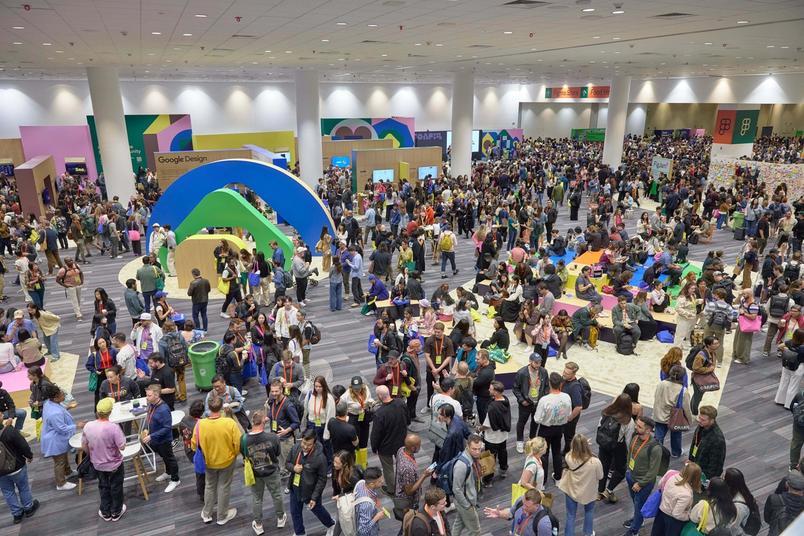
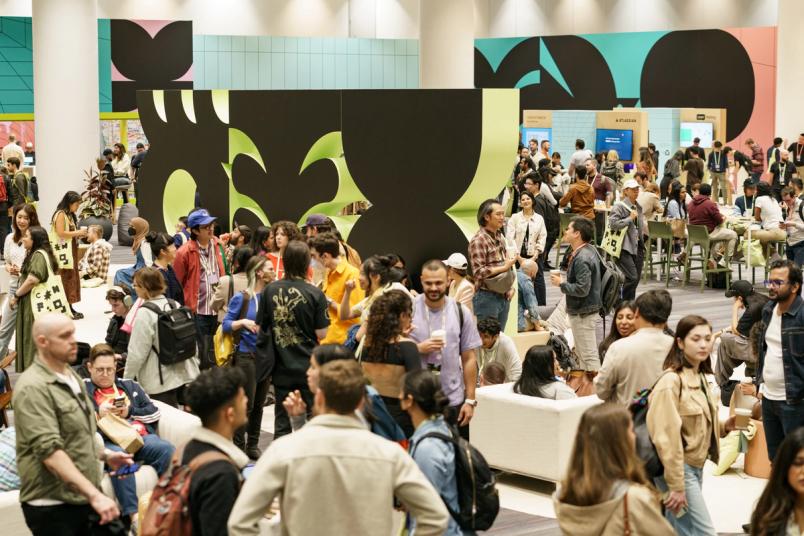
Attendees cited the mix of disciplines as a highlight; Mrinal Bhatia, a Design Strategist at Institute of Design with a background in architecture, said, "I love the mix of disciplines coming together at Config." In the Maker Space, Ryan Scott, UX Designer at United Wholesale Mortgage, decorated a Config tote bag with patches at the Customization Station while Emily Bramlitt, UX Designer at Carboncopies, had her aura portrait taken. The Figma Store drew a long line; Kurt Bettencourt, Brand Designer at Exxact Corporation, showed off his hoodie: "The swag is fun and reminds me a lot of the brand studios I follow. Everything's quirky and just odd enough to be cool."
Figma Design Director Marcin Wichary's talk, In Defense of an Old Pixel, drew raves and invited attendees to make their own pixel fonts. Wichary also wrote Shift Happens, a book covering 150 years of keyboard design.
Figma staff also met CROP Ready 4 Life fellows at Config through a mentorship program. The Oakland-based nonprofit, CROP Organization, prepares formerly incarcerated people for careers in tech and design; Figma's blog profiles its founders and first cohort. Fellow Eric Hudson said, "This has been a mind-blowing experience. This is definitely a first for me—to be at any convention. It's been really educational. I kind of wish I could do this all the time."
Closing keynote: Jason Ballard
My favorite invention, by far, is my job.“My favorite invention, by far, is my job.”
Icon Co-founder and CEO Jason Ballard closed the day by stressing beauty and good design. "Beauty is the difference between dystopia and utopia," he said to applause. "Design is the emergent property that expresses our values." With technologies like Icon's 3D-printing robots, he argued, "dignified housing is going to be abundant in this world. Even though we're using AI and robots, if we can keep our values in design at the table, this world will be more human and not less." He urged the audience to keep fighting for their values and signed off: "Zoom zoom! We ride."
Keynote: UI3, Dev Mode and AI take the stage
Dylan Field opened the product keynote with demos of UI3, moving from the redesign into Dev Mode. Emil Sjölander, Software Engineering Manager, covered the Dev Mode changes, including Code Connect exiting beta and a new Ready for Dev View. "Yeah, I like it too," he said in response to the audience's cheers.
Figma's AI features came next, with Field wearing a T-shirt reading Now with AI. To show off Make Designs, he entered the prompt A personal portfolio website for a sustainable Middle Earth architect, which produced a design for an elven architect named Elrond Perendhel.
Rename Layers drew a huge reaction. "I'm not gonna lie, that's one of my favorite features I'm showing today," Field said. After recapping the announcements, he paused: "Wait, can someone pull up my speaker notes?" The entire keynote had been built in Figma Slides, which brought resounding cheers.
Product Manager Mihika Kapoor then cursor-chatted with Field ("Should I come on stage?") and demoed Figma Slides. Kapoor had started the project during an internal hackathon called Maker Week, originally pitching it as Flides.
Off the main stage, software engineer Hanbin Cho described the mood: "It felt like a rock concert. Just seeing the sheer number of people and how they were moved was really cool. As a humble developer, I hope to work on something that makes people cheer like that."
On the floor and in the sessions
Ariana Kim of Figma's Marketing Operations team gave a tour of the San Francisco office to Giovanni Gonzales, a fellow in the CROP program for formerly incarcerated people. "Config is so incredible and huge!" Gonzales said. "I thought the AI for websites and app development was so cool, and I'm excited to create my own app with it."
In Hall F, The Human Algorithm session opened with Henry Modisett, Head of Design at Perplexity: "Technology is not useful on its own but in how it's applied." Among the possibilities he raised were AI powering a video game with endless possibilities and audiobooks voiced differently for each character. Sam Whitmore and Jason Yuan, Co-founders of New Computer, then introduced Dot, an AI that grows as you talk to it, and discussed the human-computer relationship, with Yuan explaining the role social boundaries play.
Over lunch, Lakshh Gontla, Senior Multidisciplinary Desig"nerd" at Inizio Evoke, showed off a custom outfit honoring type variables, designed by a friend. His next day's outfit would use Figma's colors to celebrate diversity: "I mean that in all senses, including different roles in product building and how it's important for everyone to collaborate. Everything I do comes with empathy. Why leave out fashion?"
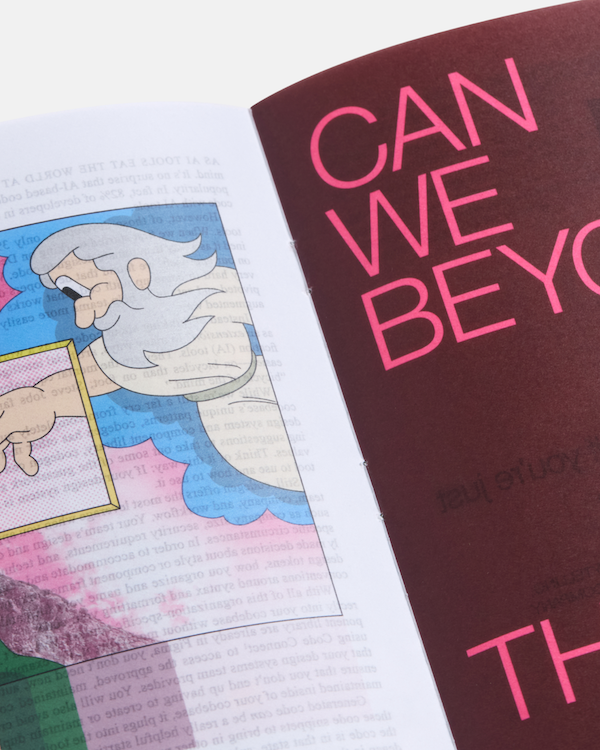
The FigJam wall filled with messages on Figma-inspired stickies. In the lunch line, Lékan Mabayoje, Principal Experience Designer at Capital One, praised The Prompt, the Figma magazine designed by Chloe Scheffe that attendees received in their swag bags and that will soon reach the Figma Store. "It's so tactile," he said. "You can touch and smell the paper. The translucency adds a lot of dimension. I'm going to go home and read all the articles."
Closing keynote: spatial intelligence and small steps
In conversation with Field, Teenage Engineering Founder and CEO Jesper Kouthoofd offered a modest mandate: "You don't have to revolutionize design. Just move the dot a little bit forward. We do it together."
AI innovator Dr. Fei Fei Li argued that spatial intelligence will carry AI beyond its current limits: "Simply seeing is not enough. Seeing is for doing and learning." At the Stanford Human-Centered AI Institute, she and her students trained a robotic arm to make a sandwich and place a napkin for someone. "Spatial intelligence will augment humanity," she said.
Day 0: Config Commons kickoff
Product builders arriving from around the world gathered at Yerba Buena Gardens for Config Commons, the first-ever kickoff event, with DJ Nina Sol playing the '90s track "Show Me Love." Jou An Chen, a freelance product designer visiting from New York City, said, "It feels like a university campus! Everyone in New York is so busy doing their own thing, so I'm here to connect with people."
Rodrigo Zapata, Senior Product Designer at Realtor.com, was meeting his remote team in person for the first time: "I feel like I'm at Coachella." Anushri Gupta, Product Designer at Mercury, had a more local comparison: "It's like Outside Lands for designers."
Designer Advocate Miggi Cardona warmed up the crowd before Taki performed tracks about annotations and auto layout, declaring, "Auto layout yourself!" Food options included Korean rice bowls, naan sandwiches and empanadas. Over dinner, Avni Nijhawan, Founder and Designer at Fundae, and Brian Hinton, Accessibility Lead at Grammarly and a local Friends of Figma coordinator, met in person for the first time after connecting online over accessibility design.
Freelance UX and product designer Julia Young traded Config tote bags so the team could have the pink colorway. Attending in person for the first time after joining virtually last year, she said, "Everyone's been so approachable, the music's been great, and I love getting to try all the different foods." DJ Noodles closed out the night on the decks.
Getting into sessions
Agenda planning now happens before arrival. Figma is asking attendees to build their schedules in advance via the conference agenda, and QR codes will be scanned at the door—anyone without a pre-booked spot will not be admitted to that session. Several sessions are already full and others are close to capacity.
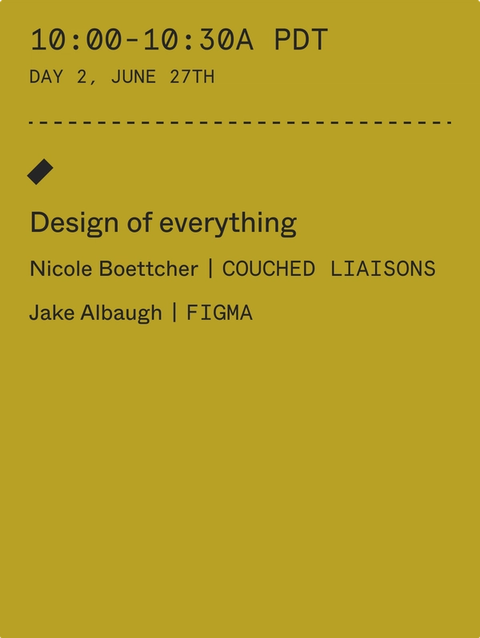
For attendees weighing the lineup, Figma highlights a few day-one options: "Staying human in the age of distraction" with speakers from Humane and Reginé Gilbert of New York University; "Should developers design?" with speakers from Not a Designer and Vercel; and the closing keynote featuring Figma co-founder and CEO Dylan Field, Teenage Engineering's Jesper Kouthoofd, and Dr. Fei Fei Li of the Stanford Human-Centered AI Institute. Day two picks include "Designing for everything" and "Eames & teamLab: Crafting for the physical space." Designer Advocates Mallory Dean and Miggi Cardona also published agenda builder tutorials with their own recommendations.
Capacity is not a dead end: breakout rooms will screen talks on large displays, and attendees with laptops can stream sessions from inside Moscone.
Before the doors open
Config Commons, the opening mixer, runs on June 25 from 12 p.m. to 9:30 p.m. at Yerba Buena Gardens—a day ahead of the June 26–27 main event. Activities include typewriter poetry, live screen printing and DIY buttons. A badge is required for entry; badges can be collected at Moscone South starting at 11:30 a.m. that day.
Remote attendance
Talks will be live-streamed, along with what Figma describes as web-exclusive surprises, for those who register for the virtual stage. Alternatively, Friends of Figma is hosting more than 40 watch parties worldwide.
Figma says it will publish live updates and daily recaps once the conference begins. Until then, the advice is to reserve session spots, prepare for #confits2024 and get some sleep.